จำนวน Repository ( 1852 )
Improvement of Durable Press Finish Process on Cotton Fabric with 1,2,3,4-Butantetracarboxylic Acid and Chitosan
The aim of this research was to improve the durable press finish process on cotton fabric with non-formaldehyde finishing agents. The mercerization of cotton fabric was carried out by 30 Be’ NoOH at 20 C before finishing. The mercerized fabric was finished by padding in the mixture of 4% (w/v) BTCA 0.4% (w/v) chitosam and 6% (w/v) sodium hypophosphite then dried at 85 C for 5 min. The treated fabric was cured at 180 C for 3 min. The finished fabric showed wrinkle recovery angle at 262 tensile strength at 281 N and elongation at break at 34.8 mm. The result showed that the combination of mercerization process and chitosan supported the crosslinking of BTCA on cotton fabric and reduced the loss of tensile strength of finished fabric.
The Demand of the Vocational and High Vocational Graduates with Commercial Major by the Entrepreneurs Under the Industrial Estate Authority of Thailand During 2008-2010
This research aims to study the demand of vocational and high vocational graduates with commercial major by the entrepreneurs under the Industrial Estate Authority of Thailand (IEAT) during 2008-2010. The samples are the 340 entrepreneurs under the IEAT. The data are collected by questionnaire during June-August 2007 and analyzed by frequency and percentage; and it is found that: (1) the entrepreneurs’ demand with high vocational certificates is 61.17% whereas the demand for graduates with vocational certificates is 38.83%. (2) The top 3 fields of studies in vocational education which are in high demand by the entrepreneurs are sale accounting and business computer. High vocational education which are in high demand by the entrepreneurs are marketing accounting and business computer.
Development of Value Added Food Product from Freshwater Fish
Development of value added food product from freshwater fish aimed to develop processed food product from 5 types of freshwater fish. Because freshwater fish is found locally and cheap processed and value-added product from freshwater fish would enable a producer to have a wide range of market distribution. The findings of this study demonstrated that the most suitable products were fish sausage with Tom Yam flavour added developed by using seven-stripped carp fish partially substituted with spotted featherback fish at level 50% and 7.5% instant Tom Yum flavour. Pla-Yar produt with herbs product was developed by using Nile tilapia and 3.5% curry paste. Pla-Jor product was developed by using minced lard and thawing 2-week frozen Pla-Jor by microwave at heat level 70% for 1 minute. Fish flake from silver barb fish was developed by crushing to roll and sliding to sheet. Sauce of grilled silver barb fish paste and chill was developed by using silver barb fish partially substituted with shrimp at level 70% and the appropriate drying method was using tray dryer at 73 ◦C for 1 hour.
The Preparation of Silver Fibers with Electrospinning Process
The preparation of silver fiber with electrospinning process was a principle to impulse the iron within the polymer solution. The polymer solution jetted onto the ground collector in nonwoven form when the electric charge was higher than the polymer surface tension. This research had 3 key factors consideration that were electric power supply polymer concentration and length between needle tip and aluminum ground collector. The electric voltage was 6 9 12 15 and 18 kilovolt the ratio of Ag : polymer solution (%wt) was 1:10 1:20 and 1:30 and the length between needle tip and aluminum foil collector was 6 7 8 9 and 10 centimeter respectively. The fibers obtained were investigated and compared to the fiber morphology by Scanning Electron Microscope and the anti-bacteria test via AATCC test method 100-1999 (Quantitative) and 147-1998 (Quality). The optimal electrospinning condition was 18 kilovolt the ratio of Ag : PVA (%wt) was 1:20 at length 7 centimeter. The fibers were continuous average diameter as 183.3 nanometer and available to against bacteria.
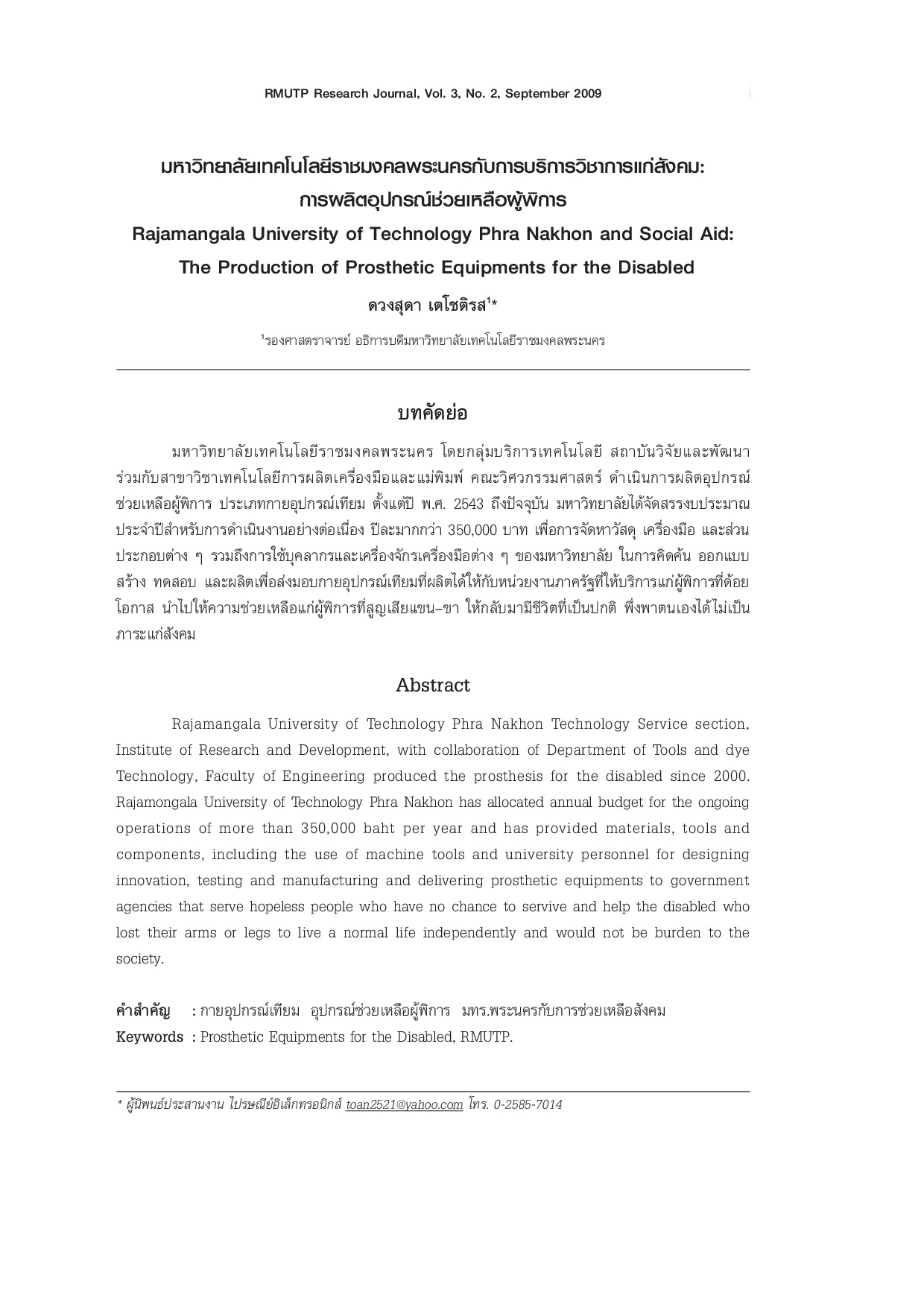
Rajamangala University of Technology Phra Nakhon and Social Aid: The Production of Prosthetic Equipments for the Disabled
Rajamangala University of Technology Phra Nakhon Technology Service section Institute of Research and Development with collaboration of Department of Tools and dye Technology Faculty of Engineering produced the prosthesis for the disabled since 2000. Rajamangala University of Technology Phra Nakhon has allocated annual budget for the ongoing operations of more than 350000 baht per year and has provided materials tools and components including the use of machine tools and university personnel for designing innovation. testing and manufacturing and delivering prosthetic equipments to government agencies that serve hopeless people who have no chance to servive and help the disabled who lost their arms or legs to live a normal life independently and would not be burden to the society.