จำนวน Repository ( 1852 )
Low Calorie Soy Milk Product Fortified with Beta-Carotene
The purposes of the study on low calorie soy milk product fortified with beta-carotene were 1) to study the suitable content of carrot which was one source of beta-carotene and sugar 2) to study the physical and chemical quality of the product 3) to study shelf- life of the product and 4) to investigate the product acceptance. Standard soy milk formula was studied and fortified with 3 levels of carrot and reduced 4 levels of sugar content. The 3x4 factorial Design was used to experiment and 9-points hedonic scale was used for sensory evaluation from 30 panelists. The results were found as follows: 1. For the content of carrot and sugar the panelists had the acceptance of carrot with 2000 gram and 65% of sugar reduction. The use of carrot and sugar had significant (p<0.05) effects on over all liking and milk’s taste. 2. For the physical quality it was found that L* value was 6.50 a* value was 20.13 b* value was 10.44 viscosity was 27.80 centipoint total soluble solid was 11.33 + 0.01 degree Brix and ph was 6.55. For the chemical quality 100 gram of soy milk fortified with beta-carotene contained 37.45 kcal energy 2.48 g protein 0.01 g fat 6.86 g carbohydrate and 3.18 ml beta- carotene. 3. For shelf-life study it was found that the product did not change when kept in the temperature of 7 degree Celsius for 0-10 days except for 11-14 days. Total bacteria count was 4.8x10 CFU/cm3 when compared to Thai Community Product Standard (529/2547) it should be found lower than 1x10⁴ colony/ 1 cm3 . It was evidently found that low calorie soy milk fortified with beta-carotene was safety for consumer when kept for 14 days. 4. For the product acceptance it was found that 93% of the consumer satisfied the product price of 10 baht per 200 ml consumption.
Phosphonic Acid Functionalization of Hyperbranched Polyamidoamine Grafted Ultrafine Silica to Prepare the Flame Retardant for Cotton Fabric
Grafting of hyperbranched polyamidoamine (PAMAM) dendrimer onto ultrafine silica followed by the introduction of phosphonic acid groups onto branch ends was carried out. First an initiating site was incorporated into silica surface by reacting the silica silanol group with 3-aminopropyltriethoxysilane producing amino-functionalized silica. The free amine group content was controlled by varying ratios of methanol to water in the hydrolysis step of sol-gel reaction. Then grafting of PAMAM was performed by repetitive reactions between Michael addition of silica amino groups to methyl acrylate and amidation of the resulting terminal methyl ester groups with ethylenediamine. Amino group content in each generation was determined. This was found to be significantly lower than theoretical value due to unavoidable side reactions. After the G3.0 hyperbranched PAMAM grafted onto silica was synthesized phosphonic acids functionalization of the terminal amino groups by the Mannich type reaction was carried out. The phosphorylated hyperbranched PAMAM grafted silica was achieved and its application on cotton fabric to produce phosphonated cellulose was studied.
Preparation of Ceria Fibers Via Electrospinning Process
Electrospinning is an interesting technique with various potential applications. CeO2 fibers production was achieved via this technique. In this work the prepared condition and the fiber morphology were investigated and described. The optimum condition was 15 kV 7 cm in distance between needle tip and ground collector 50 wt% of i-propanol in the co-solvent. The obtained fibers were continuous with a diameter of 900 nm. The smooth electrospun fibers produced were dried for one hour and then calcined at 450 OC for 3 hours. The calcined fibers were reduced to 600 nm and cracked on the fibers. They were ceria fibers what verified by EDX and XRD pattern. They had high specific surface area to volume ratio and monolith fibers which is applied for catalytic applications.
The Study of Instant Pad Thai Powder Processing
This paper aimed to study the process of making instant Pad Thai powder by Spray Drying method. The appropriate temperature of hot gas and the quantity of Maltodextrin in processing instant Pad Thai powder by Spray Drying method were studied. Factorial in Completely Randomized Design (CRD) was used. The study found that the appropriate quantity of Maltodextrin was 20% and the appropriate temperature for in and out hot gas was 150/90 ºC. The color variation of the finishing instant Pad Thai powder was as follow: Bright colors L* 88.32 Red a* 0.99 Yellow b* 8.26. The color variation after cooking the product was: Bright colors L* 30.73 Red a* 3.08 Yellow b* 8.25. aw 0.22. The moisture of the powder was 1.24. Then the consumer satisfaction was studied by using 3 types of Pad Thai Noodles; Pad Thai Noodles with Instant pad Thai Powder Pad Thai Noodles with regular Pad Thai sauce and Pad Thai Noodles sold in general market. Randomized Complete Block Design RCBD was used. The study of the consumer satisfaction revealed that there was no difference between pad Thai Noodles made with Instant Pad Thai Powder and Pad Thai Noodles made with regular Pad Thai sauce at the statistical significance (p>0.05). The testers rated the overall taste of Pad Thai Noodles at 7.57. Next the researcher studied the expiration period of Instant Pad Thai Powder by packing the product in double vacuum foil and storage the product at 4 different temperatures 30 35 45 and 55 degree Celsius. Then the product was studied to evaluate the physical chemical microorganism and sensory property. The product kept at 55 ºC was the most different of the four storage products at p ≤ 0.05 with the highest level of consumer satisfaction at color = 7.33 smell = 7.30 taste = 7.90 texture = 7.57 and total = 7.40. The amount of microorganism yeast and fungus were at the safe level to comsume.
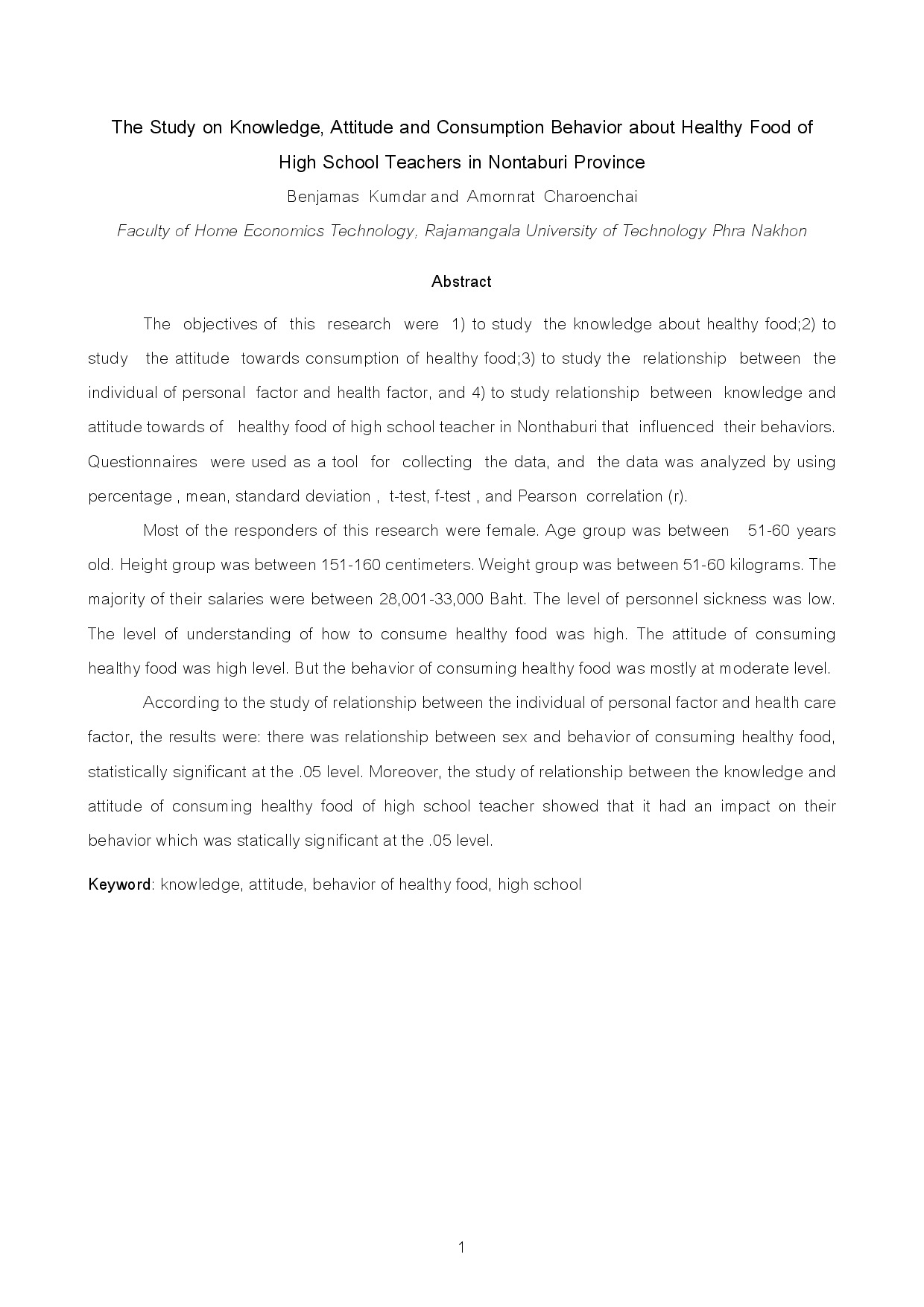
The Study on Knowledge, Attitude and Consumption Behavior about Healthy Food of High School Teachers in Nontaburi Province
The objectives of this research were 1) to study the knowledge about healthy food;2) to study the attitude towards consumption of healthy food;3) to study the relationship between the individual of personal factor and health factor and 4) to study relationship between knowledge and attitude towards of healthy food of high school teacher in Nonthaburi that influenced their behaviors. Questionnaires were used as a tool for collecting the data and the data was analyzed by using percentage mean standard deviation t-test f-test and Pearson correlation (r). Most of the responders of this research were female. Age group was between 51-60 years old. Height group was between 151-160 centimeters. Weight group was between 51-60 kilograms. The majority of their salaries were between 28001-33000 Baht. The level of personnel sickness was low. The level of understanding of how to consume healthy food was high. The attitude of consuming healthy food was high level. But the behavior of consuming healthy food was mostly at moderate level. According to the study of relationship between the individual of personal factor and health care factor the results were: there was relationship between sex and behavior of consuming healthy food statistically significant at the .05 level. Moreover the study of relationship between the knowledge and attitude of consuming healthy food of high school teacher showed that it had an impact on their behavior which was statically significant at the .05 level.