จำนวน Repository ( 1574 )
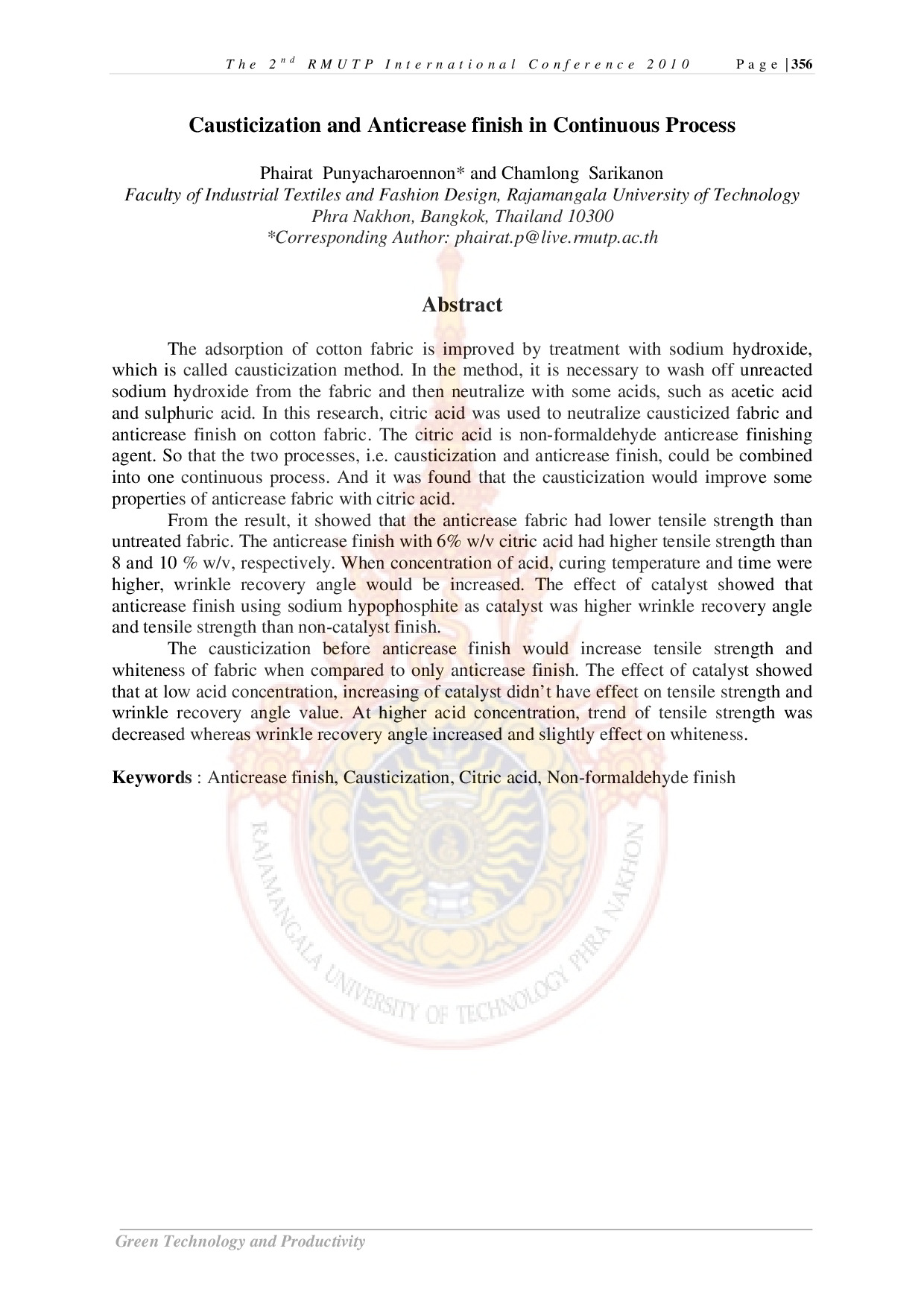
Causticization and Anticrease finish in Continuous Process
The adsorption of cotton fabric is improved by treatment with sodium hydroxide which is called causticization method. In the method it is necessary to wash off unreacted sodium hydroxide from the fabric and then neutralize with some acids such as acetic acid and sulphuric acid. In this research citric acid was used to neutralize causticized fabric and anticrease finish on cotton fabric. The citric acid is non-formaldehyde anticrease finishing agent. So that the two processes i.e. causticization and anticrease finish could be combined into one continuous process. And it was found that the causticization would improve some properties of anticrease fabric with citric acid. From the result it showed that the anticrease fabric had lower tensile strength than untreated fabric. The anticrease finish with 6% w/v citric acid had higher tensile strength than 8 and 10 % w/v respectively. When concentration of acid curing temperature and time were higher wrinkle recovery angle would be increased. The effect of catalyst showed that anticrease finish using sodium hypophosphite as catalyst was higher wrinkle recovery angle and tensile strength than non-catalyst finish. The causticization before anticrease finish would increase tensile strength and whiteness of fabric when compared to only anticrease finish. The effect of catalyst showed that at low acid concentration increasing of catalyst didn’t have effect on tensile strength and wrinkle recovery angle value. At higher acid concentration trend of tensile strength was decreased whereas wrinkle recovery angle increased and slightly effect on whiteness.

Effect of grinding on chemical and physical properties of rice husk ash
The effect of grinding on the chemical and physical properties of rice husk ash was studied. Four rice husk ashes with different finenesses i.e. coarse original rice husk ash (RHA0) RHA1 RHA2 and RHA3 were used for the study. Ordinary Portland cement (OPC) was partially replaced with rice husk ash at 20% by weight of binder. The water to binder ratio (W/B) of the mortar was maintained at 110%±5% with flow table test. Specific gravity fineness chemical properties compressive strength and porosity test of mortars were determined. The differences in chemical composition of the rice husk ashes with different finenesses from the same batch are small. The use of RHA3 produces the mortars with good strength and low porosity. The strength of the mortar improves with partial replacement of RHA3 in comparison with normal coarse rice husk ash. The use of RHA3 results in a strong and dense mortar which is due to the better dispersion and filling effect as well as an increase in the pozzolanic reaction.
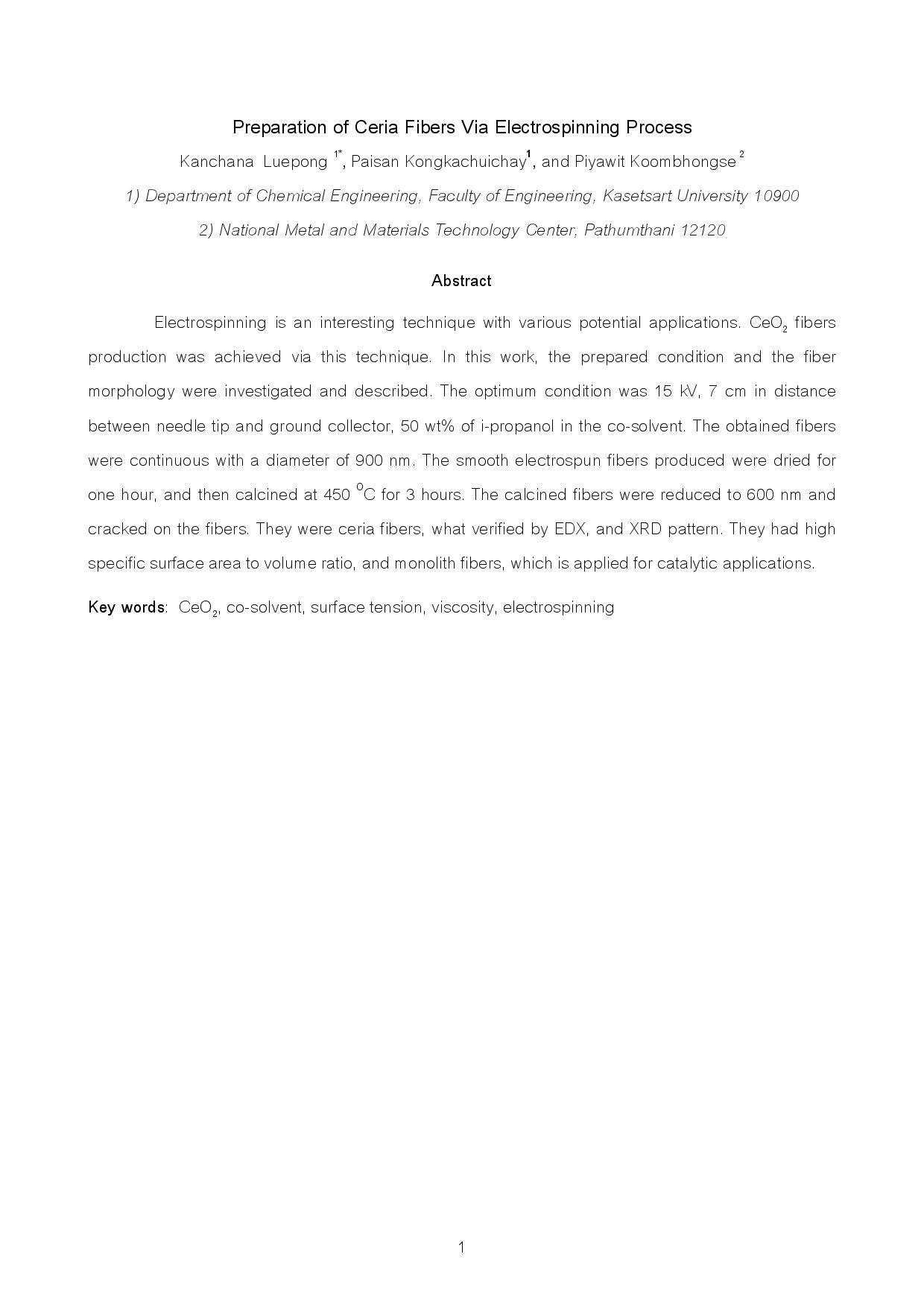
Preparation of Ceria Fibers Via Electrospinning Process
Electrospinning is an interesting technique with various potential applications. CeO2 fibers production was achieved via this technique. In this work the prepared condition and the fiber morphology were investigated and described. The optimum condition was 15 kV 7 cm in distance between needle tip and ground collector 50 wt% of i-propanol in the co-solvent. The obtained fibers were continuous with a diameter of 900 nm. The smooth electrospun fibers produced were dried for one hour and then calcined at 450 OC for 3 hours. The calcined fibers were reduced to 600 nm and cracked on the fibers. They were ceria fibers what verified by EDX and XRD pattern. They had high specific surface area to volume ratio and monolith fibers which is applied for catalytic applications.
Regional Flow Duration Curves for Wang River Basins
In this studies the regional flow duration curves were prepared for Wang River Basins. More than 10-year daily flow records of 10 selected gauging stations in these river basins (catchment areas ranging from 95.7 to 10442 square kilometers) were used in the analysis. The flow duration curves and dimensionless flow duration curves were construced at the gauging stations. In the regional analysis river basins were devided into 3 subregions of similar hydrological condition. The regional flow duration curves models were constructed for each subregion in which an equations for predicting the mean dischage and the maximum percent of time from physical parameters of the catchment were proposed for each subregion .The curves and equations obtained from this study could be used to estimate the design flow duration curve of any specified percent of time at any location gauged or unguaged within these river basins.
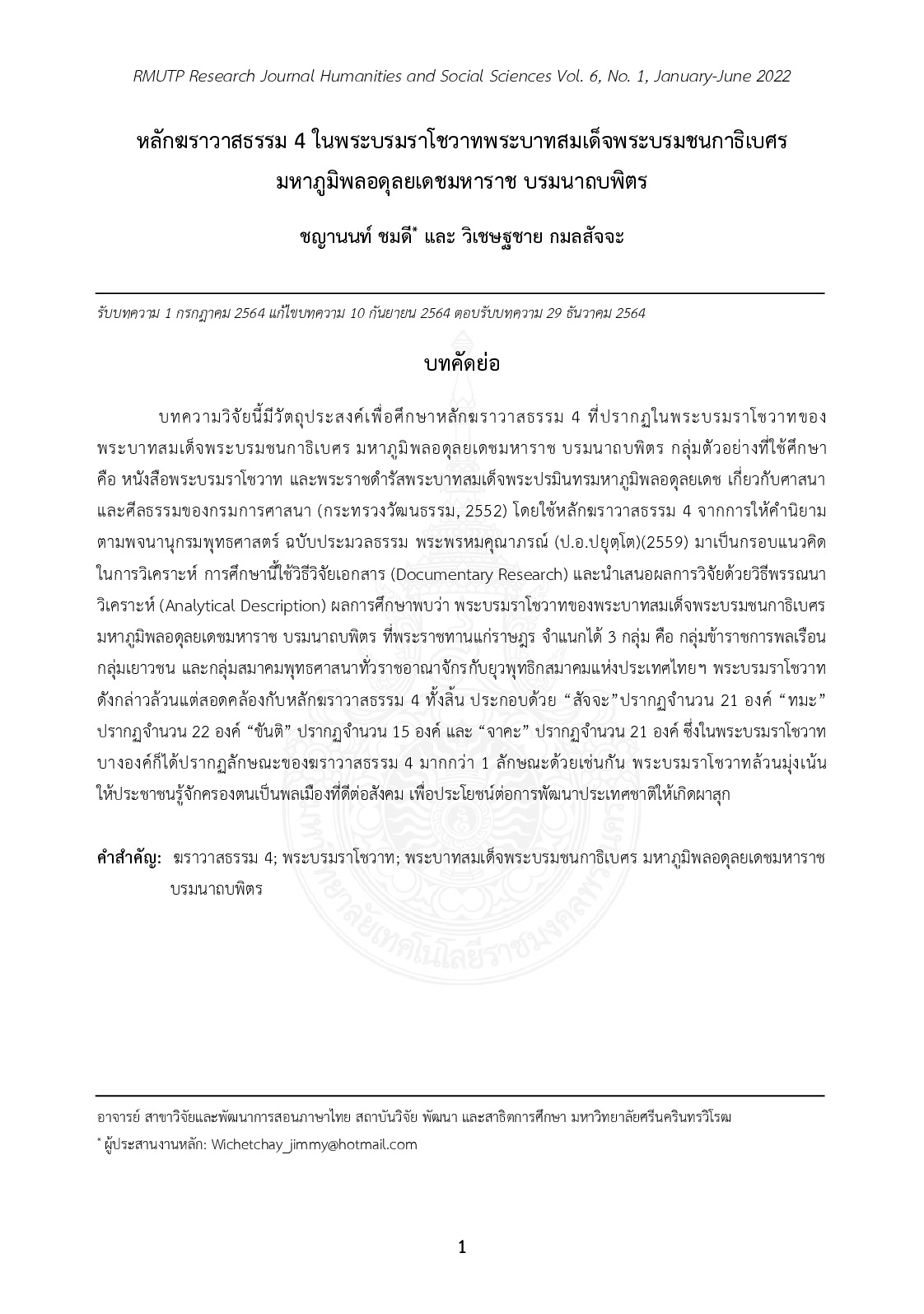
หลักฆราวาสธรรม 4 ในพระบรมราโชวาทพระบาทสมเด็จพระบรมชนกาธิเบศรมหาภูมิพลอดุลยเดชมหาราช บรมนาถบพิตร
This research article aimed to investigate the Gharavasa-dhamma IV which appeared in the royal guidance of His Majesty King Bhumibol Adulyadej the Great. The sample was The Royal Guidance of His Majesty King Bhumibol Adulyadej the Great about religion and morality book of the Department of Religious Affairs (Ministry of Culture 2009). Gharavasa-dhamma IV principle in Buddhism which was defined in Dictionary of Buddhism by Phra Bhramagunabhorn (P.A. Payutto) (2015) was the conceptual analysis framework. The study is based on the documentary research and presented through analytical description. The study found that the royal guidance of His Majesty King Bhumibol Adulyadej the Great can be classified into 3 groups: civil servant youth and Buddhist association with the young Buddhists association. according to the royal guidance literally conformed Gharavasa-dhamma IV was found a total of 21 words of Sacca [truth and honest] 22 words of Dama [taming and training oneself] 15 words of Khanti [tolerance ; forbearance] and 21 words of Caga [generosity]. However in some Royal Guidance there were more than one characteristic as well of Gharavasa-dhamma IV. The royal Guidance therefore has aimed on people to know how to be a good citizen in society for the benefit of People in nation and for their happiness.