จำนวน Repository ( 156 )

The optimization of formulation and cost on homemade dairy yogurt
The objective of this study was investigate the optimal formulation of Homemade dairy yogurt that 100 percent of dairy milk ratio of dairy milk to skim milk powder and milk powder was 90:10 85:15 and 80:20 respectively as compared to the control (commercial-yogurt Dutch mill). The Yogurt mixeds were heated to 85 C and held for 5 min incubated at 43 C until the pH reached 4.3. The mixes were then stored at 4 C. Yogurt were prepared from higher ratio of dairy milk : skim milk powder and milk powder led to the more time of incubation. The 31 participated sensory evaluation of the sample. From the result choosed first three formulas to analysed in chemical characteristic and bacterial chariacteristic. Total solid of yogurt were prepare from 90:10 and 85:15 of dairy milk : milk powder ratio were not different with control (p>0.05). Total cell count was found to range between 8.08 – 8.50 LogCFU/g and Lactic acid bacteria was found to range between 6.71 – 8.88 LogCFU/g. The optimum formula of homemade dairy yogurt that ratio of dairy milk to milk powder was 90 : 10 and cost per unit (140 g.) was 10.51 Baht compare with control was 14 Baht.
Feasibility study of investment in rice seed of rice community center at muang district phitsanulok province
This research aims to collect and analyze financial data as well as assess financial feasibility and analyze business environment for investment in rice seed production of rice community center in Muang district Phitsanulok. Primary data in financial information used in the study were collected from rice seed center and rice community center. Secondary data were collected from documents and information of both government and private agencies. The research found that rice community center in Muang district Phitsanulok gained rice seed support from the Rice Department for seed production. However there were problems in production management that were not in accordance with rice seed production standard. Therefore the center had to change it operation from manufacturer to be buyers of rice seeds for its members. Financial analysis revealed that in terms of rice seed production cost the total cost per rai was 3800 to 7500 baht depending on the method of rice growing. Income from sale could be classified as sale price per sack (25 kg) at 575 baht per sack and sales price per ton from 11000 to 15000 baht. Analysis of business environment of the community center showed that the existing condition did not support business performance. Thus the possibility of investing in rice seed production was low.
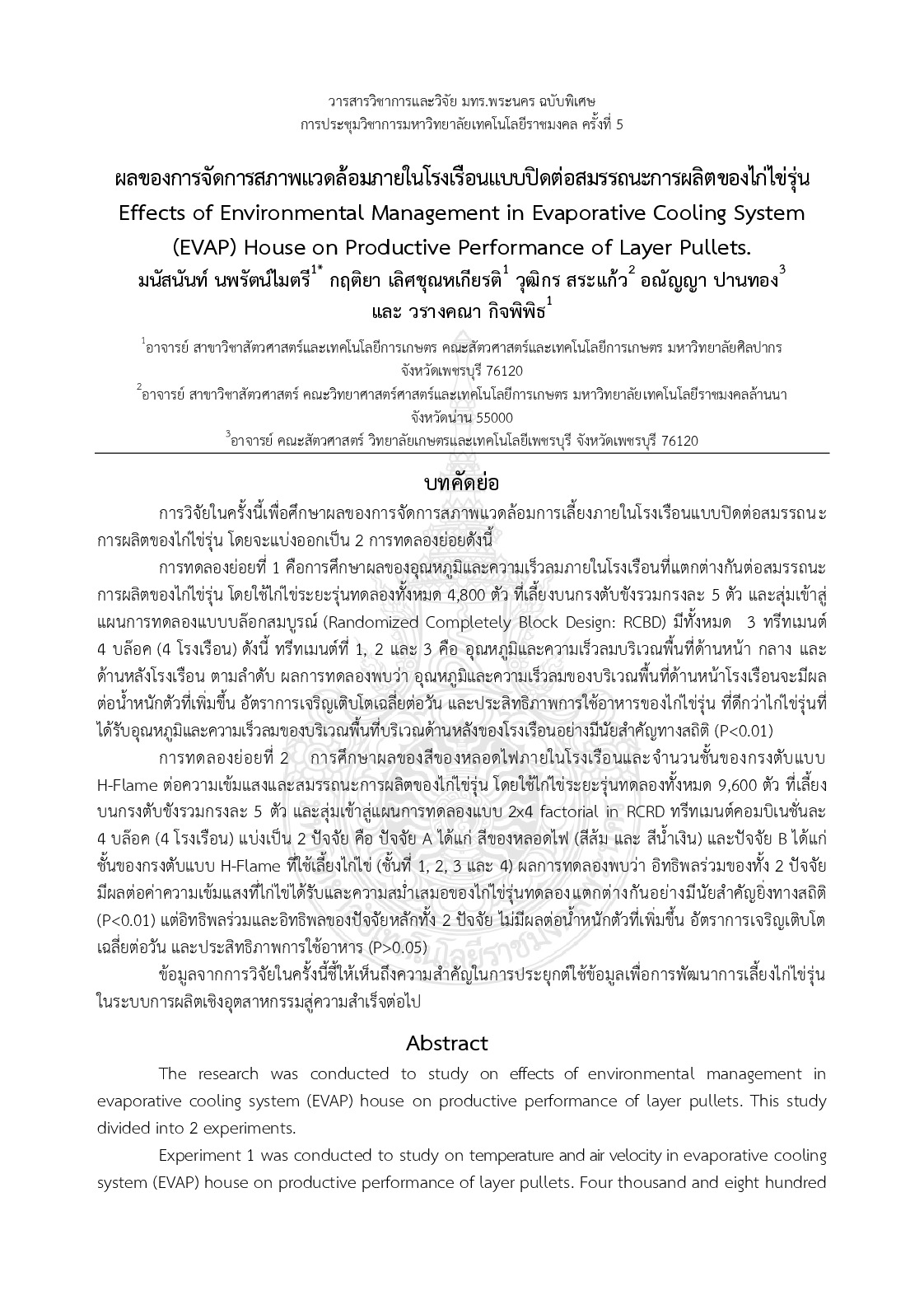
Effects of environmental management in evaporative cooling system (EVAP) house on productive performance of layer pullets
The research was conducted to study on effects of environmental management in evaporative cooling system (EVAP) house on productive performance of layer pullets. This study divided into 2 experiments. Experiment 1 was conducted to study on temperature and air velocity in evaporative cooling system (EVAP) house on productive performance of layer pullets. Four thousand and eight hundred layer pullets were raised on battery cage with 5 birds per cage and assigned in a Randomized Completely Block Design (RCBD) experiment with three treatments. Each treatment consisted of four blocks (four houses) and followed different temperature and air velocity in raising area of evaporative cooling system (EVAP) house as front area central area and back area. Results showed that temperature and air velocity in front area was grater body weight gain (BWG) average daily gain (ADG) and feed conversion ratio (FCR) of layer pullets than layer pullets were raised in back area of evaporative cooling system (EVAP) house (P<0.01) Experiment 2 was conducted to study on light color and number of H-Flame battery cage row in evaporative cooling system (EVAP) house on light intensity and productive performance of layer pullets. Nine thousand and six hundred layer pullets were raised on H-Flame battery cage with 5 birds per cage and assigned in a 2x4 factorial in Randomized Completely Block Design (RCBD) experiment with two factors. Factor A was light color comprised of range and blue). While Factor B was number of battery cage row comprised (first row second row third row and fourth row). Each treatment consisted of four blocks (four houses). Results showed that interaction between factor A and B on light intensity and uniformity of layer pullets with highly significantly different (P<0.01). However interaction between factor A and B and main effect (factor A and B) were investigated on body weight gain (BWG) average daily gain (ADG) and feed conversion ratio (FCR) (P>0.05). The data from this research was suggests the important for implicate to improve the egg production industry in further success.
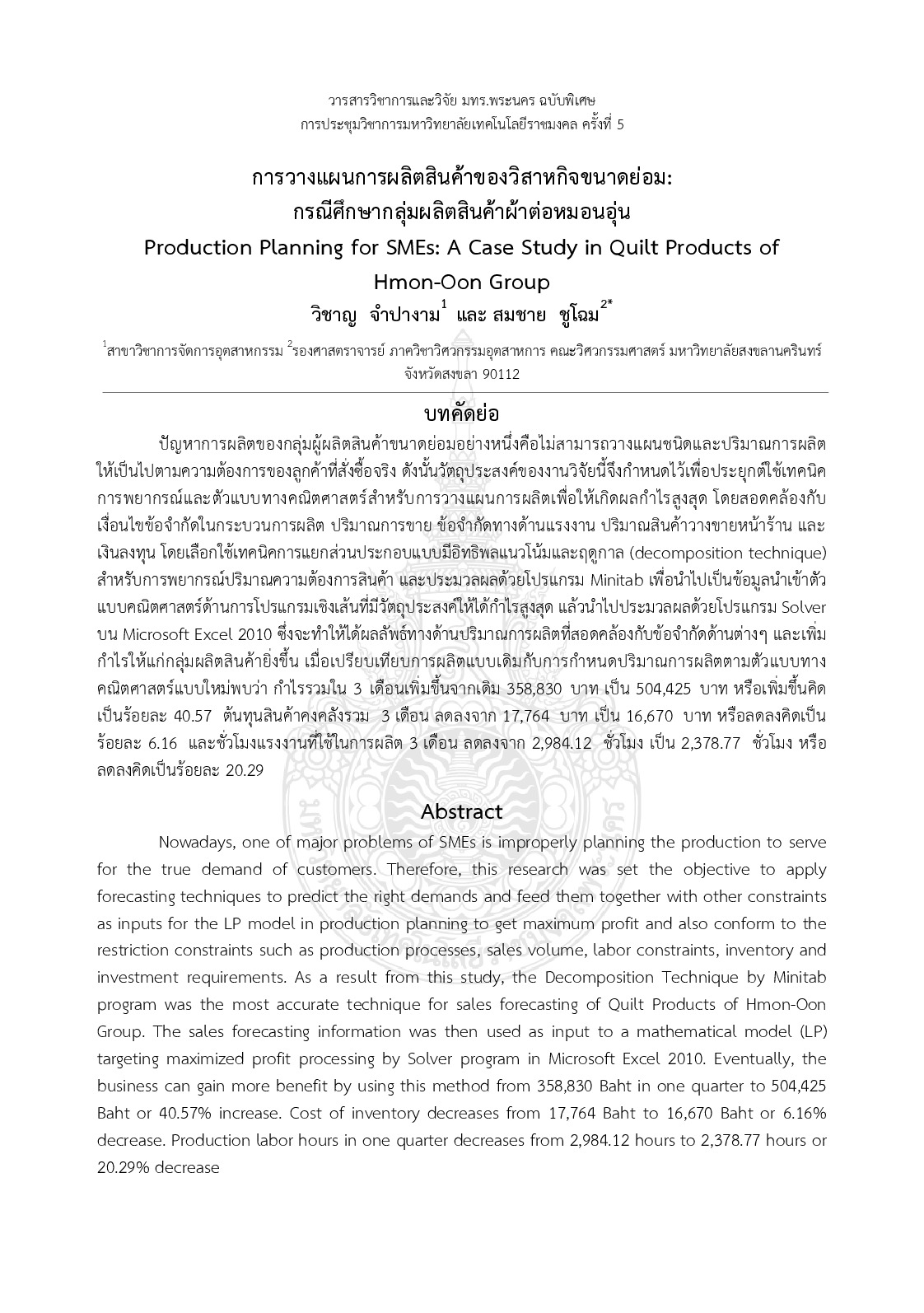
Production planning for SMEs: a case study in quilt products of hmon-oon group
Nowadays one of major problems of SMEs is improperly planning the production to serve for the true demand of customers. Therefore this research was set the objective to apply forecasting techniques to predict the right demands and feed them together with other constraints as inputs for the LP model in production planning to get maximum profit and also conform to the restriction constraints such as production processes sales volume labor constraints inventory and investment requirements. As a result from this study the Decomposition Technique by Minitab program was the most accurate technique for sales forecasting of Quilt Products of Hmon-Oon Group. The sales forecasting information was then used as input to a mathematical model (LP) targeting maximized profit processing by Solver program in Microsoft Excel 2010. Eventually the business can gain more benefit by using this method from 358830 Baht in one quarter to 504425 Baht or 40.57% increase. Cost of inventory decreases from 17764 Baht to 16670 Baht or 6.16% decrease. Production labor hours in one quarter decreases from 2984.12 hours to 2378.77 hours or 20.29% decrease
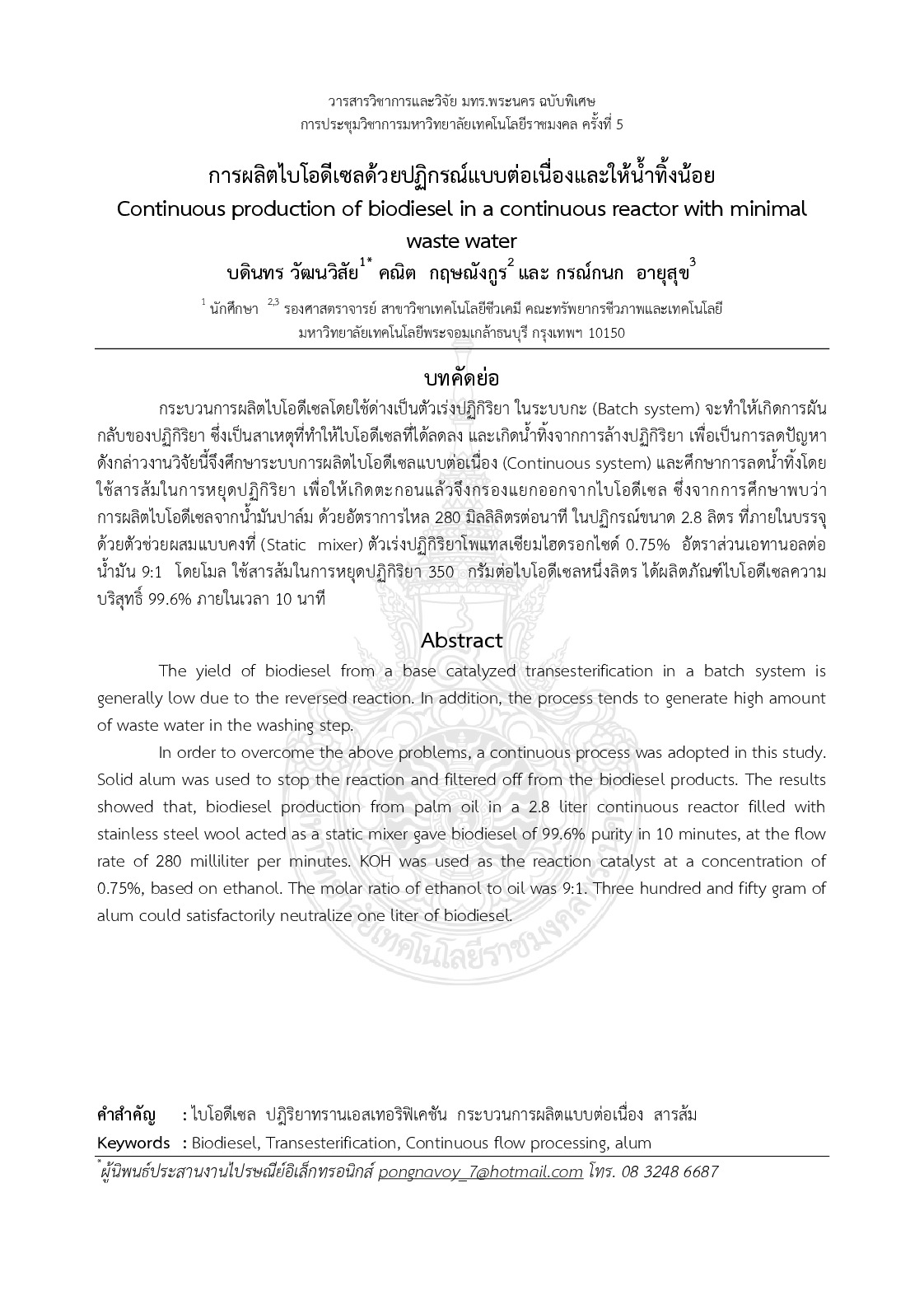
Continuous production of biodiesel in a continuous reactor with minimal
The yield of biodiesel from a base catalyzed transesterification in a batch system is generally low due to the reversed reaction. In addition the process tends to generate high amount of waste water in the washing step. In order to overcome the above problems a continuous process was adopted in this study. Solid alum was used to stop the reaction and filtered off from the biodiesel products. The results showed that biodiesel production from palm oil in a 2.8 liter continuous reactor filled with stainless steel wool acted as a static mixer gave biodiesel of 99.6% purity in 10 minutes at the flow rate of 280 milliliter per minutes. KOH was used as the reaction catalyst at a concentration of 0.75% based on ethanol. The molar ratio of ethanol to oil was 9:1. Three hundred and fifty gram of alum could satisfactorily neutralize one liter of biodiesel.