จำนวน Repository ( 266 )

การใช้ประโยชน์จากเศษไม้ในอุตสาหกรรมเฟอร์นิเจอร์เพื่อการออกแบบเฟอร์นิเจอร์สนามสำหรับบ้านพักอาศัยขนาดกลาง
This research study design and furniture from wood waste material in the furniture industry for residential medium. Study materials made from wood chips in the industry to create commercial benefits. And study furniture styles for residential medium which has a lot of current. Including testing standard furniture from wood chips in the industry standard for the structure of the furniture design. The model home furnishing materials wood waste material from interviews with experts in the design. Conclusions regarding the manufacture and design of a study to determine specialists as appropriate. Researchers have taken a home furnishing is correct. Then residents of the residential-sized survey about home furnishing 30 who works as follows. Front of the house. The average was 4.6 most of the comforts average was 4.6 most security average is 4.75 most of the design value is 4.7 the overall satisfaction is at its greatest. The test standard furniture. The testing of materials furniture grass. Static force acting on the basis of a test ride. The static force exerted on the backrest. In the test criteria. The static pressure test on the arm to the side and the force acting on the wing surface at the head. In the test criteria. The static pressure test on the press arm. In the test criteria. Criteria to test the force exerted on the seat and the backrest against the switch. In the test criteria. Force acting on the basis of the test. In passing the test. The impact tests and shock at the surface of the bracket. In the test criteria. Criteria for testing for the one side then drop free In the test criteria.
การออกแบบเครื่องทอพรมไร้รอยต่อที่บังคับกระสวยด้วยรีโมทเพื่อพัฒนาผลิตภัณฑ์ ชุมชนเชิงพาณิชย์
The purposes of this research were to study a seamless carpet weaving by shuttle remote to develop communities of commercial products. Including studied the needed problems to use the seamless carpet weaving loom to be effective for responding the most demand of weavers and brought the data to analyze for prototype of a seamless carpet weaving loom by shuttle remote to develop communities of commercial products. As well as bring the knowledge transfer of technology to workshop. The research was experiment research by the field survey. There were 25 specific samples selected of hand carpet weavers in the lower northern district that were the carpet weavers group of Ban Huay Bong Tambon Ban Sao Muang district in Uttaradit province. The application developed into commercial products such as floor carpets and decorating carpet for various rooms. The results of this study found that the experiment to find the effective satisfaction of carpets weavers by hand weaving loom were as follows: The production can be woven carpets with maximum 3 meters width and 90 centimeters. It was the seamless carpet to satisfy quickly for customer demands in time. It was depending on the structure and complexity of the carpet design. The basic design can be woven faster than original for three times and seamless. In working can reduce the process to use workers to tend the traditional shuttle up to two times. In production costs were lower than industrial because it was produced in each time a lot to breakeven to open the loom. In treatments were easy to use and were not complicated in installation equipments with the shuttles remote control which using the shuttle tended to convert to chart in 220-volt and 12-volt battery etc. The power wheel drives in the channel on weft yarn back and forth for a time to charge the battery for an hour. This seamless carpet weaving loom forced by shuttle remote to develop communities of commercial products brought the basic of knowledge to develop the loom equipments patterns design and develop communities of commercial products in the future.
โครงการออกแบบและพัฒนาผลิตภัณฑ์เซรามิกส์ที่ใช้ในการก่อผนักเพื่อการอนุรักษ์การใช้พลังงานภายในอาคาร
This research aims to study and test a ceramic product in using to constructs a wall. This research is based on a previous studying to develop a ceramic product that saves the energy in the building. The early test shows the product has out door heat resisting capability and it is very user-friendly. However the test was only an early stage. The research still lack of a real life situation test and has very little feedback from the consumers. All of which are very importance to farther develop this product into a production stage. The research has 2 steps. First step to testing the heat and humidity resisting quality of the product the researcher is building four testing blocks (dimension 1x1x1 meter). Each block has different material on one of its side block 1 has brick block 2 has concrete masonry unit block 3 has autoclaved aerated concrete and block 4 has ceramic block. The other three side of each block have a heated and humidity resisting form. The researches test the following; heat energy the temperature inside the blocks and humidity inside the block. After comparing the difference between the airs inside and out-side of the blocks the block 2 with concrete masonry unit has the best humidity resisting quality and is the most user-friendly product. In the term of heat resisting block 3 with autoclaved aerated concrete perform the best. Second step to test the user-friendliness of the product the researcher found 2 groups of consumers. First group are the wall constructing expert. This group has a hard time using this product and can’t get use d to the product so they find this product to be too thin and too weak. Second group the home owner feel the product has a thinner wall and believe it’s weaker than a typical construction brick. There for they still don’t know how to use this product.
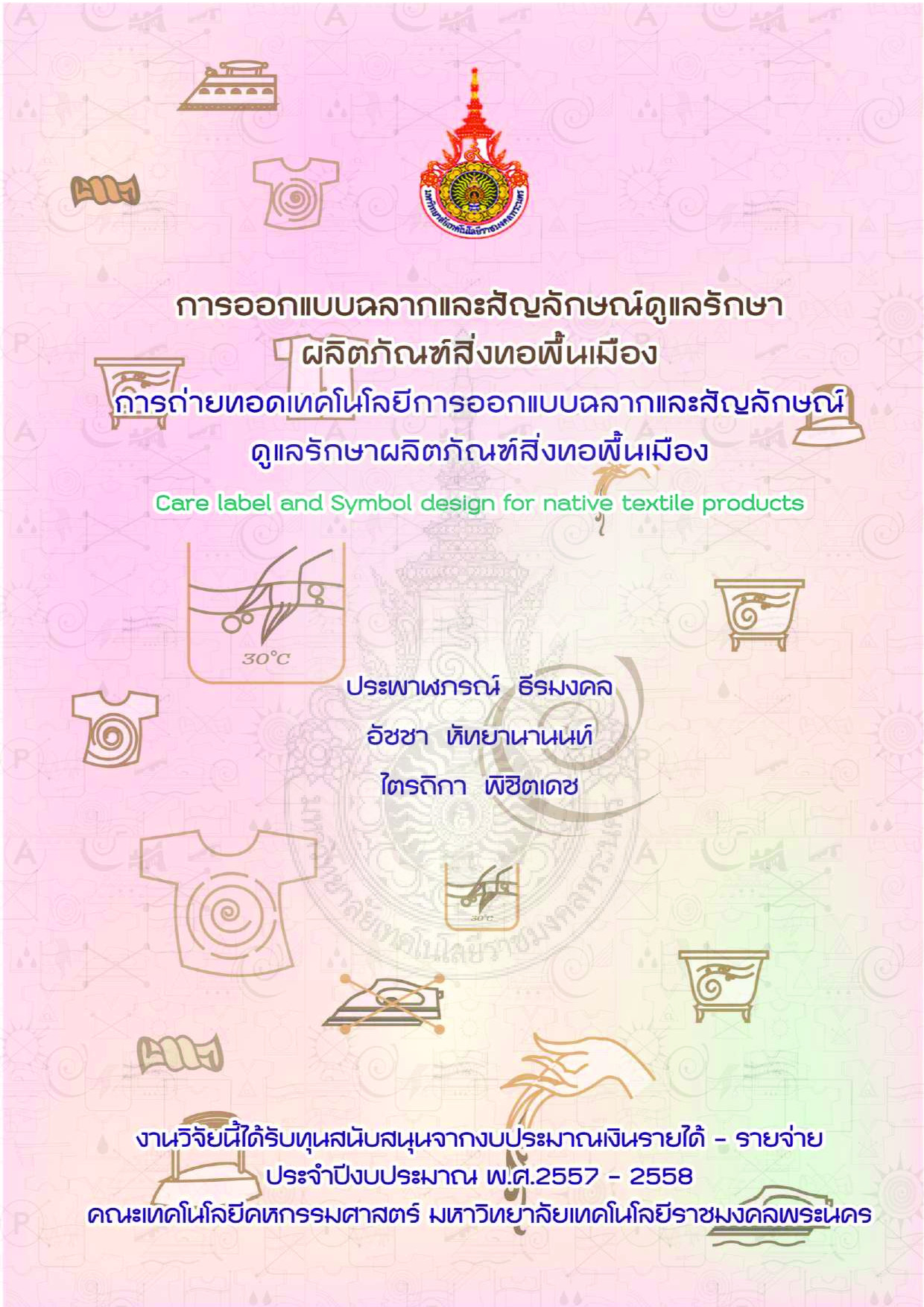
การออกแบบฉลากและสัญลักษณ์ดูแลรักษาผลิตภัณฑ์สิ่งทอพื้นเมือง
This research is Care label and Symbol design for native textile products. The purpose of this research were 1) to study and design the care label and symbol design of native textile products. 2) to design the care label and symbol design of native textile products and 3) to assessment the consumers satisfaction towards the care label and symbol design for native textile products. 4) to transfer knowledge towards the SMEs production communities about the care label and symbol design for native textile products. 5) to assessment the consumers satisfaction towards the care label and symbol design for native textile products. The research instruments used to collect data: 1) a draft care label and symbol design of native textile products of 6 types (10 prototypes) as 60 prototypes of washing bleaching spinning twisting and drying ironing and colour dropping. 2) Questionnaire of expert opinion and selective drafts for 3 models as 18 prototypes. 3) Questionnaire of consumers satisfaction towards the care label and symbol design for native textile product of 100 people: buyers sellers manufacturers and those interested in native textiles. The evaluation data was analyzed by using SPSS program in frequency mean and percentage. All in conclusion as table and descriptive. In the second research year the process are focus group people for transfer knowledge as SMEs community Enterprise OTOP production communities and other that it is interesting in this research : MEA-LA small enterprise in Singburi province PAMONT Hand-woven Communities in Ratchaburi province and Thai SONG-DUM Woven Ban-Sa-Kee-Rai in Nakhompathum province. To plan the schedule and set the date place amount of participate and lectures 102 people on 12 22 and 28 July 2015 and asking for consumer satisfaction of the curriculum and lecture for “transfer knowledge the care label and symbol design for native textile product” by Questionnaire of participate satisfaction. Last the evaluation data was analyzed by using SPSS program in mean and percentage. The First year’s research showed that mostly respondents were male at 59 percent aged 46 years at 52 percent and also being the entrepreneurs / business owners at 45 percent. 48 percent as bachelors degree and their income were an average of 20001 - 25000 baht at 46 percent. The analysis of consumers satisfaction can be concluded that the first types of care label and symbol design for native textile product at highest levels satisfaction is Colour dropping at 4.46. The next types is bleaching at 4.44 Washing at 4.42 Ironing at 4.38 Twisting and Drying at 4.32 and the last types is at least levels satisfaction is Spinning at 4.28 but all have been satisfied at maximum average and highest level of satisfaction. The research in the second year found that mostly participates were female aged 51 – 60 years old finished the secondary school and also there are farmer. The participates are their income under 5000 baht and They are moderately understanding symbol and care label but they are not make for their products. In relation to technology transfer of “the care label and symbol design for native textile product” divided into 3 parts it is also the curriculum and lecture for this research. The analysis of participate satisfaction It have been satisfied at maximum average and highest level of satisfaction in facilities. The participants are mainly used to provide benefits to themselves for one month to apply the gained after the training. The participants used care and symbol label for their products. Moreover a focus will be capped by the other communities to teach another one for working out. Satisfaction with the benefits of technology transfer and utilization. Satisfaction at the highest level. The comments and suggestions of the participants found that they need for re-training again. They would like to have a longer period of training in order to gain more knowledge. All lecturer can transfer knowledge during the training as well.
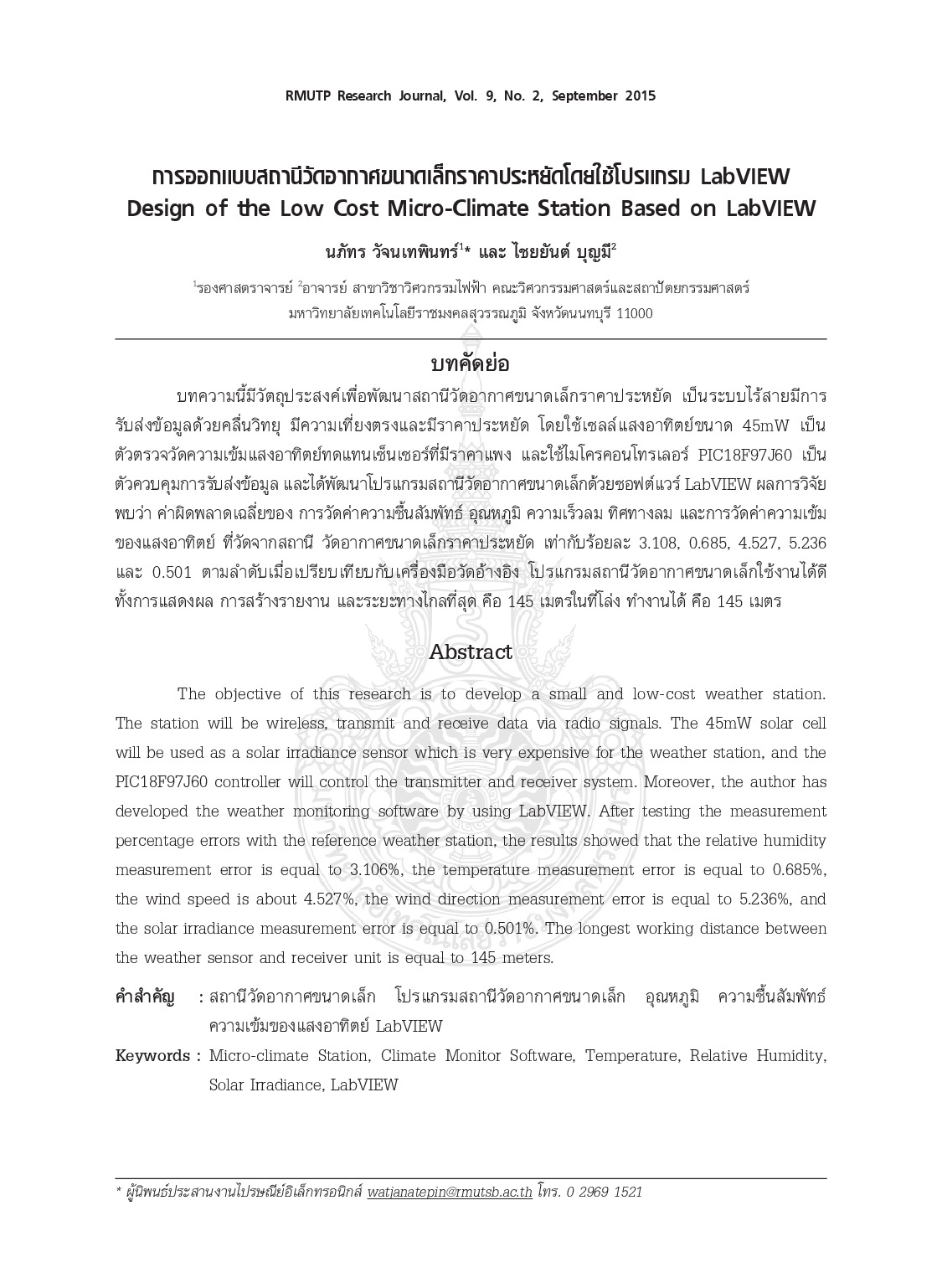
การออกแบบสถานีวัดอากาศขนาดเล็กราคาประหยัดโดยใช้โปรแกรม LabVIEW
The objective of this research is to develop a small and low-cost weather station. The station will be wireless transmit and receive data via radio signals. The 45mW solar cell will be used as a solar irradiance sensor which is very expensive for the weather station and the PIC18F97J60 controller will control the transmitter and receiver system. Moreover the author has developed the weather monitoring software by using LabVIEW. After testing the measurement percentage errors with the reference weather station the results showed that the relative humidity measurement error is equal to 3.106% the temperature measurement error is equal to 0.685% the wind speed is about 4.527% the wind direction measurement error is equal to 5.236% and the solar irradiance measurement error is equal to 0.501%. The longest working distance between the weather sensor and receiver unit is equal to 145 meters.