จำนวน Repository ( 167 )

การพัฒนาน้ำหมี่กรอบสำเร็จรูป
The study objective was to the basic recipe of Ready Made Mee-Krob (Crispy Rice Noodle) sauce were evaluated the sensory property appearance color flavor taste texture and overall acceptability by 7-Points Hedonic Scale. The first basic recipe including sugar tamarind juice lime juice fish sauce shallots bean paste and tomato sauce had the highest scores in overall acceptability. Mee-Krob sauces were packed in retort pouch and stored at room temperature for 90 days. The color-values (L* a* and b*) of the product were decreased while the viscosity and pH of the product were increased during storage. The microbiological shelf life of Mee-Krob sauce were assessed. The microbial population remained under 10 CFU/g for 90 days. Consumer acceptance testing was a passive measure to indicate the acceptance of the product by Home Use Test. The consumers gaving a high degree of product acceptance indicated that the product was well accepted.
The innovation construction for the toughness measurement of rice kernel with the inner pressure method
During the rice processing the possible situations of rice kernel cracking and breakage are commonly occurred and these consequences cause a low marketing price. According to this issue the real-time observation and together with the knowledge base of mechanical properties should be essentially helpful in detection of these defect observations. The objective of this work was established to study the mechanical stress-strain properties of rice kernels via our in-house pneumatic system design. We found that stress-strain of RD6 RD15 Phitsanulok 2 and Khao Dawk Mali 105 were greater than KhaoYipun DOAI with moisture content of 20% w.b. These results tentatively indicated the mechanical stress-strains occurred were from the difference of rice shapes. Moreover we could recognize that the characteristics of these various shapes significantly followed the scaling law of the relation between strain and time. We also found that the breaking force was different value for rice varieties. This parameter obtained can be such a high potential approach that can be used for further developing in the quantitative classification of rice varieties.
การพัฒนาวัสดุจีโอโพลีเมอร์จากเถ้าแกลบและเถ้าชานอ้อย
This research studies the potential for using waste ash from industrial and agricultural by–products as a geopolymer material. This paper presents a study of the resistance to chloride penetration and resistance to sulfuric acid of geopolymer mortar containing ground rice husk ash (RA) and ground bagasse ash (BA). Geopolymer mortars with constant liquid to ash ratio and similar flow were used for the tests. Compressive strength porosity chloride penetration test Rapid migration test of chloride depth chloride ion diffusion coefficient immersion test of chloride depth and weight loss with impressed sulfuric acid were investigated. Test results show that the workable flow of geopolymer mortar was in the range of 110–115% and was dependent on the ratio by mass of sodium silicate to NaOH and the concentration of NaOH. Extra water was used to improve the workabililty. In case of rice husk ash geopolymer mortar the geopolymer mortars with high strengths were obtained with concentration of NaOH of 15M with the sodium silicate to NaOH ratio by weight of 2.5. However the bagasee ash geopolymer mortars with high strengths were obtained with concentration of NaOH of 10M with the sodium silicate to NaOH ratio by weight of 2.5. The use of rice husk ash and bagasse ash produces geopolymer mixes with good strength and resistance to acid and chloride penetration. The resistance to acid and chloride penetration is higher with an increase in the sodium silicate to NaOH ratio by weight of 2.5.
Uniqueness and Form of the Rice - and - Curry Fast Food Type of Thai Restaurant Business in Southern Part of Thailand
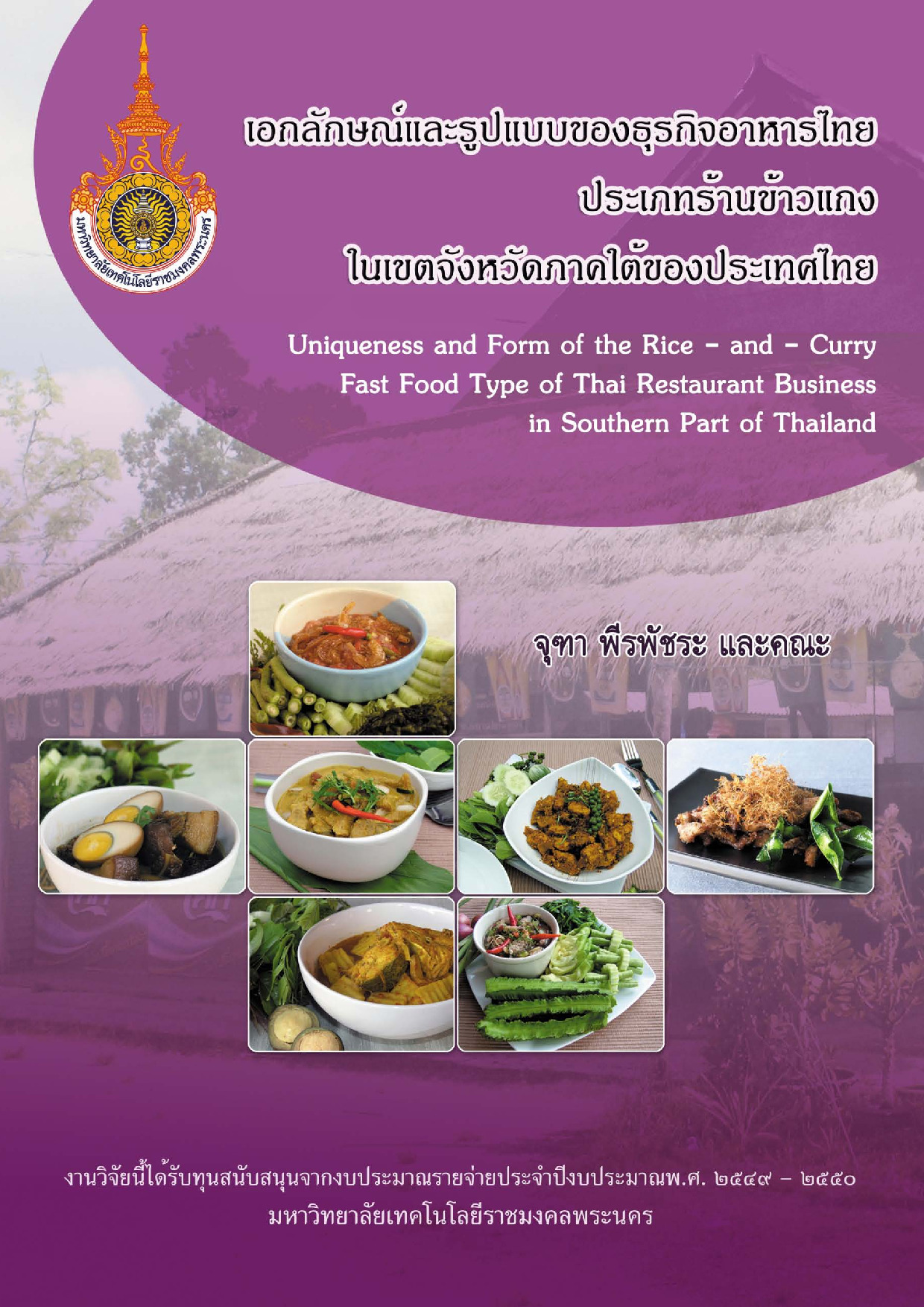
The research on uniqueness and form of the rice-and-curry fast-food type of Thai restaurant business in southern part of Thailand is a combined quantitative and qualitative research which aims to study the uniqueness of the rice-and-curry fast-food type of Thai restaurant business in terms of raw materials and cooking method. It has three main purposes: to study the form of the rice-and-curry fast-food type of Thai restaurant business in terms of administration decoration and sale in order to compare the uniqueness of Thai rice-and-curry fast-food in each province; to compare the form of rice-and-curry fast-food type of Thai restaurant business in each province; and to organize standard recipes for Thai rice-and-curry fast-food in southern provinces of Thailand. The sample used in this research were rice-and-curry fast-food shops from Nakhon Sri Thammarat Krabi Phang-nga Songkhla and Satun provinces - 5 shops each - with a total of 25 shops. The tool used in this study consisted of survey questionnaire food test questionnaire and record form for food recipe raw materials and equipment. Data were collected bymeans of survey and interview and were statistically analyzed for frequency and percentage together with a qualitative analysis.