จำนวน Repository ( 1852 )
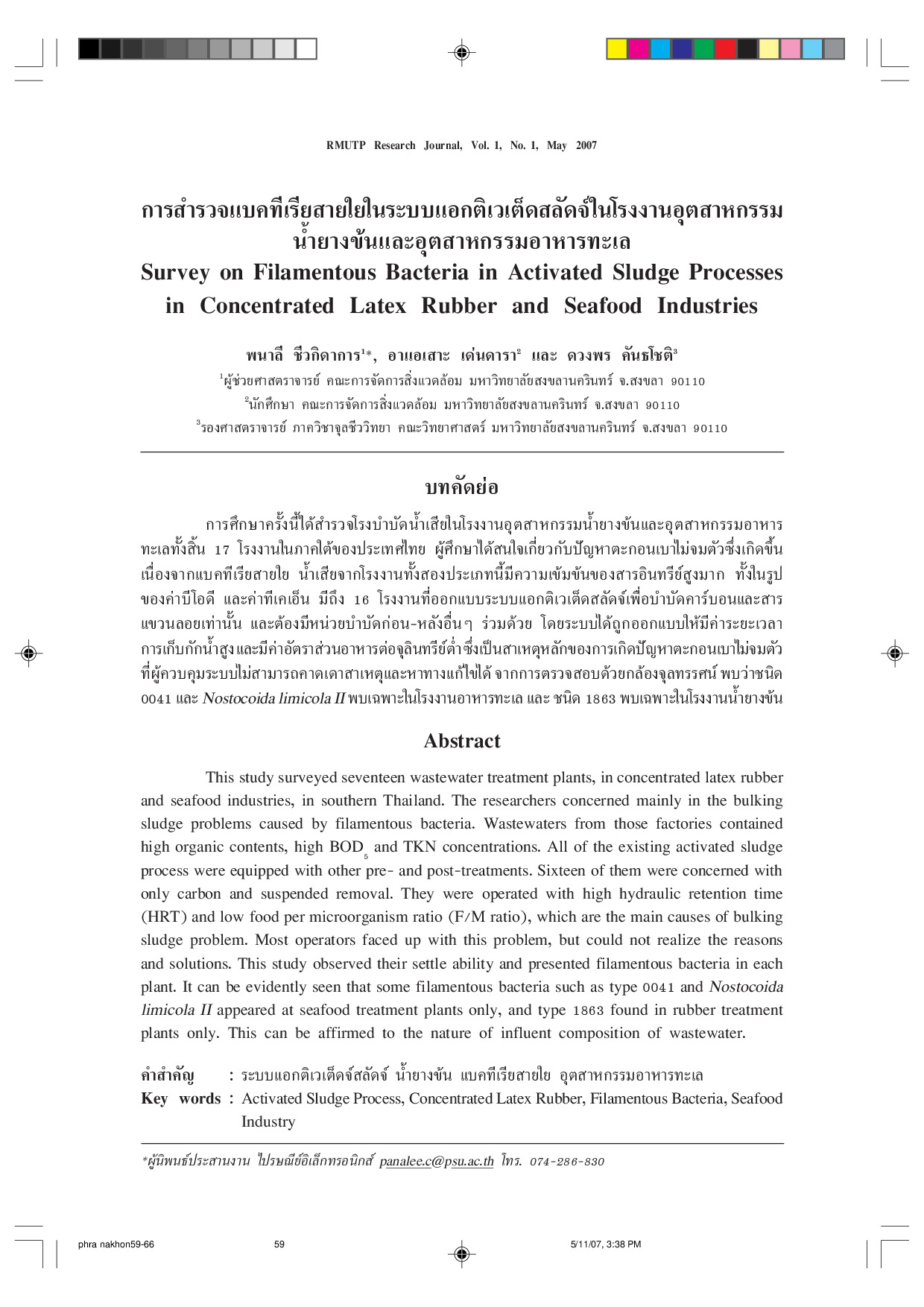
Survey on Filamentous Bacteria in Activated Sludge Processes in Concentrated Latex Rubber and Seafood Industries
This study surveyed seventeen wastewater treatment plants in concentrated latex rubber and seafood industries in southern Thailand. The researchers concerned mainly in the bulking sludge problems caused by filamentous bacteria. Wastewaters from those factories contained high organic contents high BOD5 and TKN concentrations. All of the existing activated sludge process were equipped with other pre- and post-treatments. Sixteen of them were concerned with only carbon and suspended removal. They were operated with high hydraulic retention time (HRT) and low food per microorganism ratio (F/M ratio) which are the main causes of bulking sludge problem. Most operators faced up with this problem but could not realize the reasons and solutions. This study observed their settle ability and presented filamentous bacteria in each plant. It can be evidently seen that some filamentous bacteria such as type 0041 and Nostocoida limicola II appeared at seafood treatment plants only and type 1863 found in rubber treatment plants only. This can be affirmed to the nature of influent composition of wastewater.
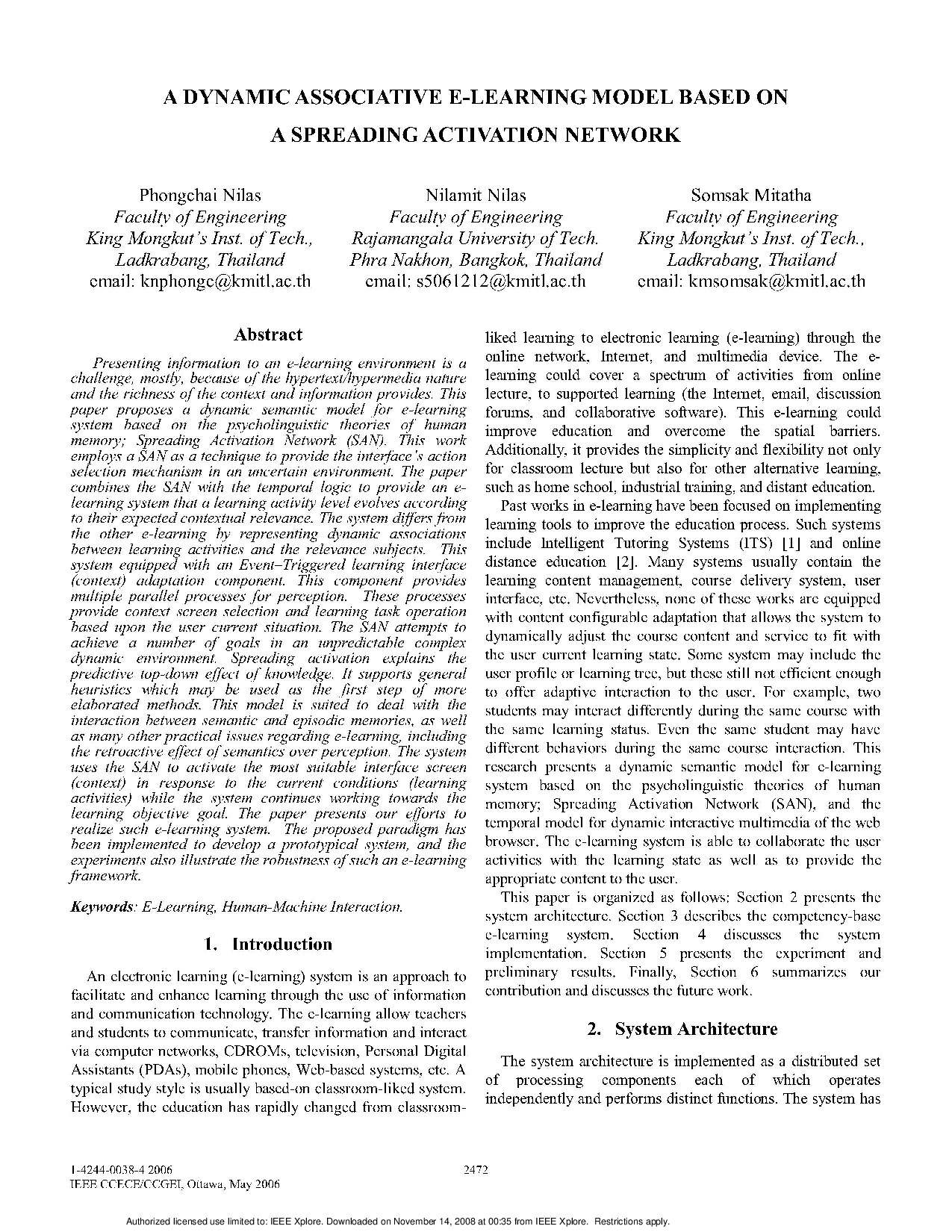
A Dynamic Associative e-learning model based on a spreading activation network
Presenting information to an e-learning environment is a challenge mostly because of the hypertext/hypermedia nature and the richness of the context and information provides. This paper proposes a dynamic semantic model for e-learning system based on the psycholinguistic theories of human memory Spreading Activation Network (SAN). This work employs a SAN as a technique to provide the interfaces action selection mechanism in an uncertain environment. The paper combines the SAN with the temporal logic to provide an e-learning system that a learning activity level evolves according to their expected contextual relevance. The system differs from the other e-learning by representing dynamic associations between learning activities and the relevance subjects. This system equipped with an Event-Triggered learning interface (context) adaptation component. This component provides multiple parallel processes for perception. These processes provide context screen selection and learning task operation based upon the user current situation. The SAN attempts to achieve a number of goals in an unpredictable complex dynamic environment. Spreading activation explains the predictive top-down effect of knowledge. It supports general heuristics which may be used as the first step of more elaborated methods. This model is suited to deal with the interaction between semantic and episodic memories as well as many other practical issues regarding e-learning including the retroactive effect of semantics over perception. The system uses the SAN to activate the most suitable interface screen (context) in response to the current conditions (learning activities) while the system continues working towards the learning objective goal. The paper presents our efforts to realize such e-learning system. The proposed paradigm has been implemented to develop a prototypical system and the experiments also illustrate the robustness of such an e-learning framework.

การพัฒนาผลิตภัณฑ์อาหารจากกล้วยเพื่อธุรกิจอาหารเจ
This research aims to 1) develop pork roll product from cultivated banana flesh and banana flour for vegetarian food business; 2) develop suitable and unique packaging for food product using cultivated banana flesh and banana flour instead of meat; and 3) transfer technology in developing food product using cultivated banana flesh and banana flour instead of meat for vegetarian food business. Regarding suitable amount of banana flour used in place of isolated soy protein in pre-emulsion preparation from 4 levels of banana flour used at 0 10 15 and 20 percent it was found that increasing amount of banana flour used in place of isolated soy protein caused significant increase of L* value in the product (p<0.05). Moreover hardness and flexibility in texture profile of the product were not significantly different from the control product (p>0.05). In terms of sensory evaluation tasters gave the highest score for meat-emulated reducedemulsion product that used banana flour in place of isolated soy protein at 15 percent. For packaging of pork roll product it was found that Model-A package was the most suitable with recommendations to add tight-closed material to prevent contamination from outside and to print expiry date as well as food safety certified sign. Furthermore consumers’ overall satisfactory in packaging model was found to be highest at the mean of 4.31. Finally transferring of technology in a form of training workshop in developing food product from banana flour for vegetarian food business for Ban Lak Khon Bakery Housewife Community Enterprise and entrepreneurs in Nonthaburi province showed that post-training test scores were significantly higher than pre-training scores at .05 level. This indicated that technological transfer in a form of real-practice workshop provided increasing knowledge in developing food product from banana flour for vegetarian food business. Moreover it was also found that trainees were highly satisfied in both overall service (mean of 4.85) and by-aspect: servicing staff (4.93) procedure/steps (4.87) trainers (4.83) and usefulness of service (4.75) respectively.

อัลกอริทึม T-fuzzy ดีไอดีล
In this research we will study an algebraic structure d-algebras. Then we establish an algorithm to check any sets in d-algebras if they are ideals or T-fuzzy d-ideals. Moreover we investigate some related properties in d-algebras.
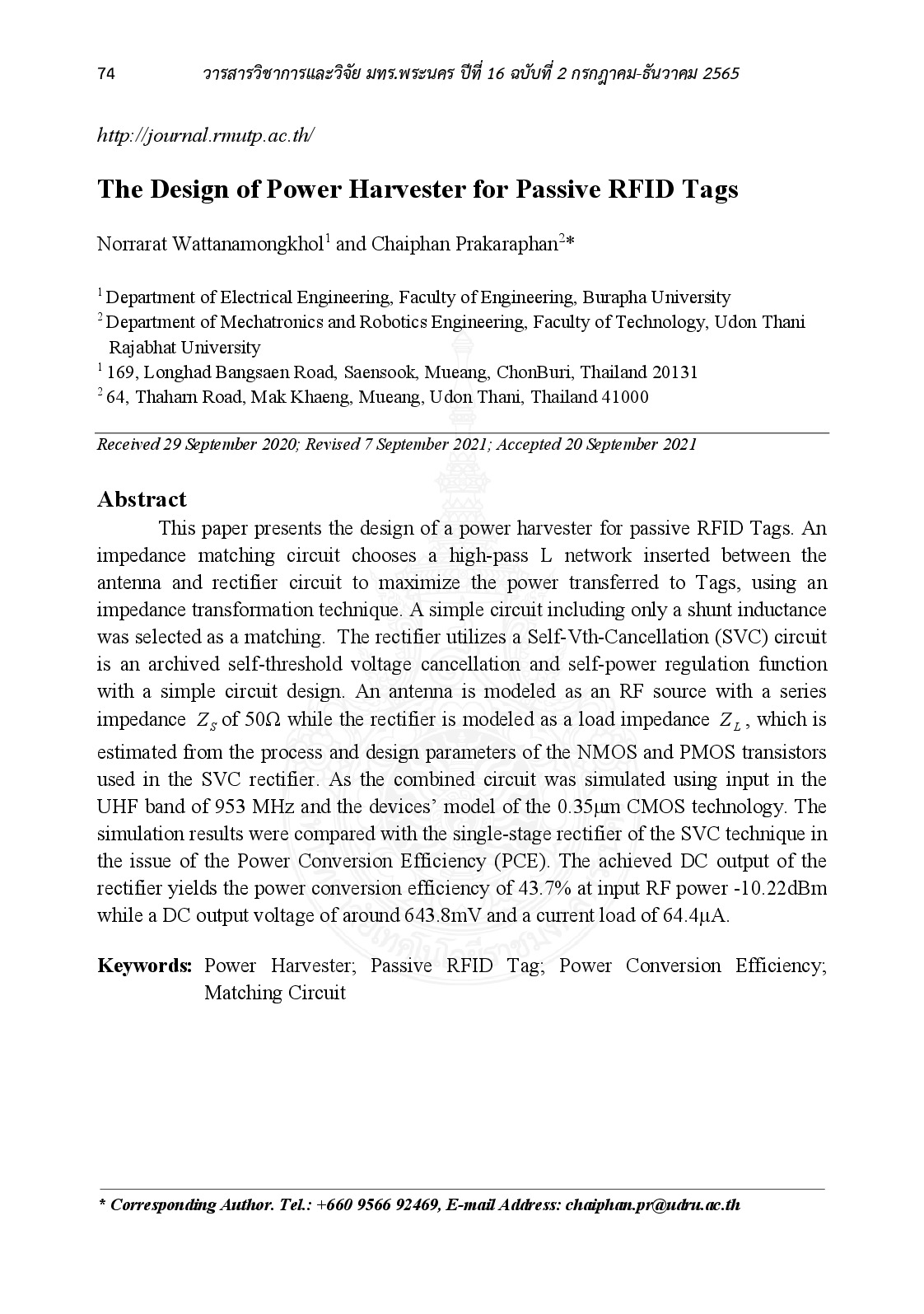
The Design of power harvester for passive RFID Tags
This paper presents the design of a power harvester for passive RFID Tags. An impedance matching circuit chooses a high-pass L network inserted between the antenna and rectifier circuit to maximize the power transferred to Tags using an impedance transformation technique. A simple circuit including only a shunt inductance was selected as a matching. The rectifier utilizes a Self-Vth-Cancellation (SVC) circuit is an archived self-threshold voltage cancellation and self-power regulation function with a simple circuit design. An antenna is modeled as an RF source with a series impedance Zs of 50Ω while the rectifier is modeled as a load impedance ZL which is estimated from the process and design parameters of the NMOS and PMOS transistors used in the SVC rectifier. As the combined circuit was simulated using input in the UHF band of 953 MHz and the devices’ model of the 0.35μm CMOS technology. The simulation results were compared with the single-stage rectifier of the SVC technique in the issue of the Power Conversion Efficiency (PCE). The achieved DC output of the rectifier yields the power conversion efficiency of 43.7% at input RF power -10.22dBm while a DC output voltage of around 643.8mV and a current load of 64.4μA.