จำนวน Repository ( 19 )
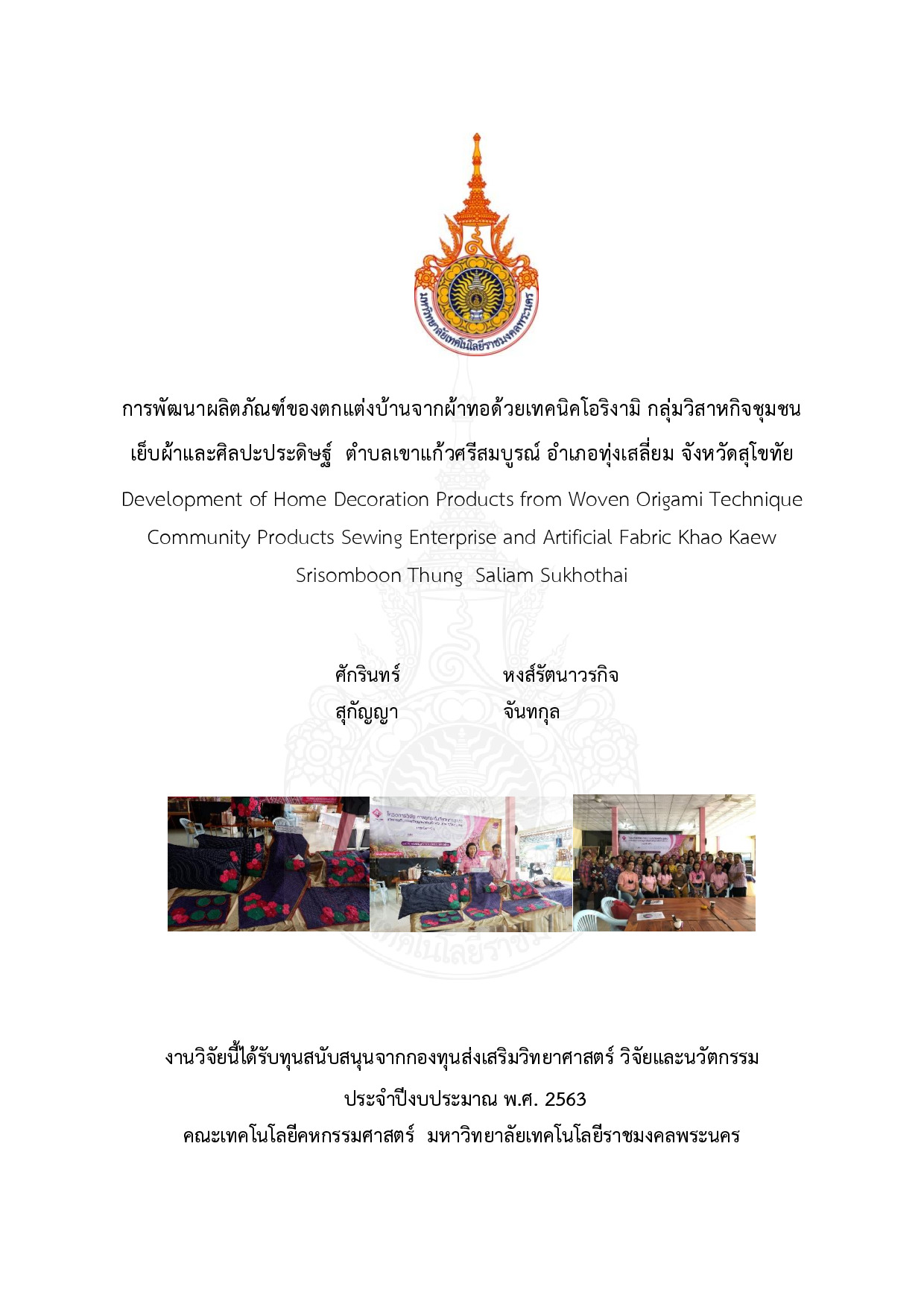
การพัฒนาผลิตภัณฑ์ของตกแต่งบ้านจากผ้าทอด้วยเทคนิคโอริงามิ กลุ่มวิสาหกิจชุมชน เย็บผ้าและศิลปะประดิษฐ์ ตำบลเขาแก้วศรีสมบูรณ์ อำเภอทุ่งเสลี่ยม จังหวัดสุโขทัย
Research on the development of home decoration products from woven fabric with origami technique. Sewing and Craft Community Enterprise Group Khao Kaew Srisomboon District Thung Saliam Sukhothai Province. The objectivity of this project is to study the pattern design and the Development of home decoration products from woven fabric with the origami technique also to propagate product development technology in various forms for interested persons or trader of the textile type in Sukhothai Province Then we did a satisfaction survey for the satisfaction level from 30 persons of the target group The collected data were analyzed using frequency percentage and mean with the following analysis results. Satisfaction towards the propagating product development technology to the development of home decoration products from woven fabric with origami technique. Sewing and Craft Community Enterprise Group Khao Kaew Srisomboon District Thung Saliam Sukhothai Province. The average score of 4.80 which is at the highest level In terms of content most respondents were satisfied with the appropriateness of the training time. The average score of 4.86 which is at the highest level For the lecturer the majority of respondents were satisfied with their ability to impart of knowledge. The average score of 4.89 which is at the highest level For facilities was found that most of the respondents were satisfied with media/training materials are up to date and ready for use
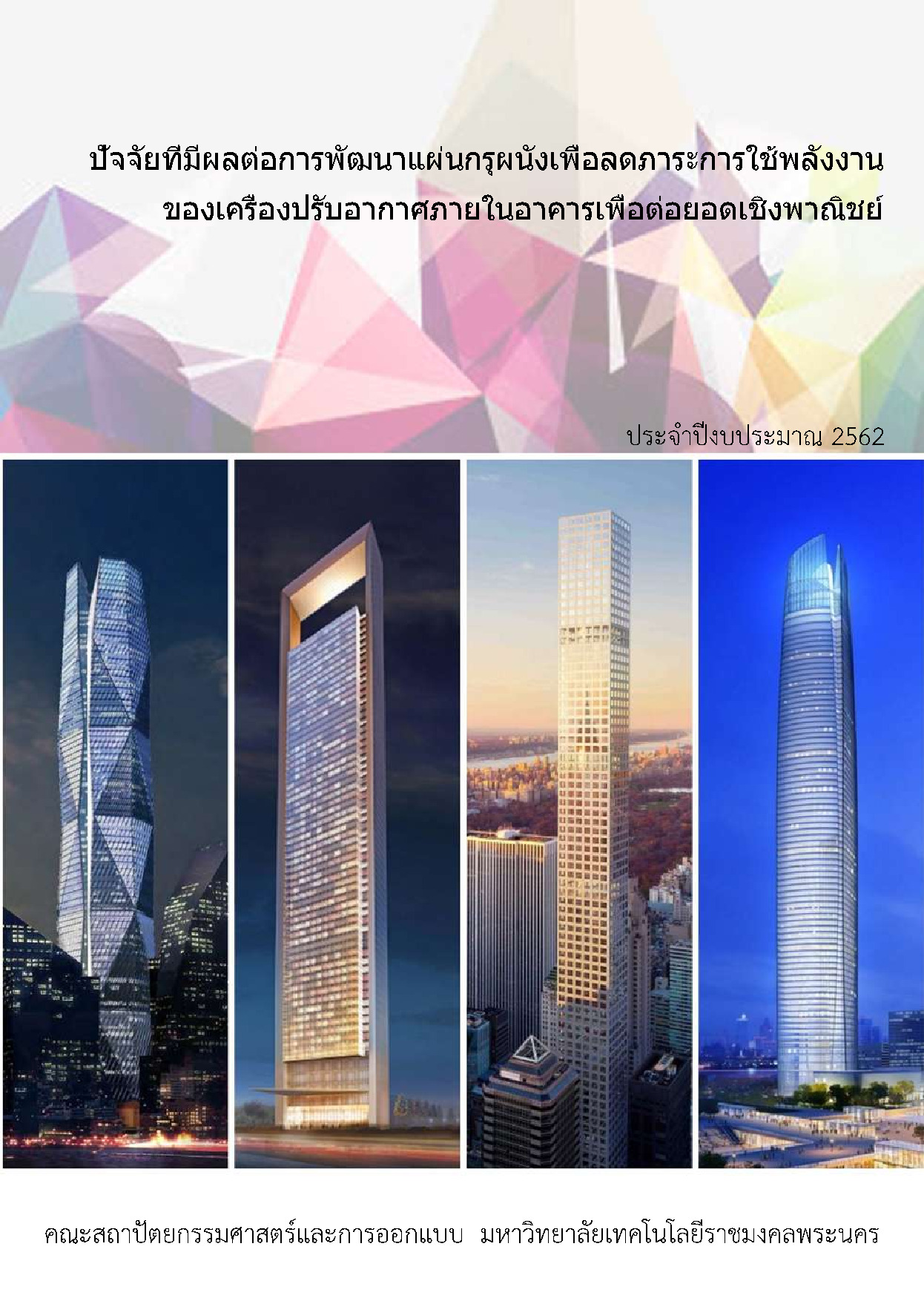
ปัจจัยที่มีผลต่อการพัฒนาแผ่นกรุผนังเพื่อลดภาระการใช้พลังงานของเครื่องปรับอากาศภายในอาคารเพื่อต่อยอดเชิงพาณิชย์
This research approach to study the development of interior wall for reduce energy consumption by air conditioning in the building. In order to be a prototype in the development of an industrial system for the export of green architecture in order to generate income for the community or entrepreneurs to bring money into the country to upgrade the industrial economy to be sustainable It is an architectural material that is compatible with the weather in Thailand. It can be used as a guideline for people interested in applying it to their own home building or disseminating through various media to reduce energy costs for a comfortable living. The objective is to study the factors that affect the development of wall paneling in order to reduce the energy burden of the air conditioner in the building in order to further the commercial production. The researcher collected data for the past 6 months not including other thermal energy. Used to calculate the energy consumption index for 2 building groups it was found that the electricity consumption of green buildings were 531100 kilowatt hours. And an average of 5.31 kilowatt hours per square meter While the non-green building has an average of 653360 kilowatt hours. And an average of 6.53 kilowatt hours per square meter As for the results of the data analysis the damage level is mostly at level 1 which is the wall surface and no obvious damage. Especially the 4th and 5th height is 1.55 meters and 1.85 meters from the floor level in the building. Damage level 3 is found at the height level 3 at a height of 1.00 meters from the floor level in the building. Assessment of damage caused to the interior wall of the building that occurred in 3 levels. The results of the data analysis showed that most damage levels were at level 1 namely the wall surface without obvious damage. Especially the 4th and 5th height is 1.55 meters and 1.85 meters from the floor level in the building. Damage level 3 is found at the height level 3 at a height of 1.00 meters and from the results of collecting moisture content in the exterior wall materials And analyzed to find the average for each of the 5 levels of height which are 0.55 meters 0.75 meters 0.95 meters 1.55 meters and 1.85 meters found that the buildings have different moisture content in each wall level (p <0.05). In conclusion this green building index equation can be applied to other buildings to reduce energy consumption and meet the standards of the green building. From the equation the electricity consumption can be predicted using the electricity usage index and systematically designed energy management in buildings. The area with the most damage will find the humidity in the range of 47% -98% the highest damage level 3 at an elevation of 0.80 meters from the floor level in the building

การตรวจหามัลติพีคและการปรับเท่าฮีสโตแกรมเพื่อรักษาค่าเฉลี่ย ความสว่างต่ำสุด
The sharpness of the image the current demand is increasingly high. Since many types of screens has developed a definition and high definition media support for secondary NICs modern electronica. But if we have information that is incomplete. Monitor is not working efficiently. There are various ways to improve the clarity of digital images. For example HE BBHE DSIHE and MMBEBHE have been developed to improve the image sharper and brighter. By improving the techniques for Histogram Equalization independently of each other. In this paper will present the Digital Image Enhancement via Multi-Peak Histogram Equalization (DIEMPHE) by histogram equalization into n sections as the turning point arch top and bottom of the Histogram. By each section is independent. Image results are the average brightness error is lower and the higher the intensity of the image.
งานดอกไม้เครื่องสดในพระราชพิธีพระบรมศพและพระศพเจ้านายสมัยกรุงรัตนโกสินทร์
This thesis aims to explore the history of fresh flower decoration in the royal funeral rites of Kings and aristocrats in Rattanakosin Era as well as analyze pattern and development of fresh flower decoration in Royal Palace. This is a qualitative study conducted by means of researching and collecting historical evidences of artistic works documents chronicles and photographs stored at the National Archives. Researchers interviewed relevant people and specialists and summarized the results by inquiring seven specialists in flower decoration using Snowball Sampling technique to choose from then analyzed the data using Analytical Description procedure. The result shows that the traditions of flower decoration in royal palace have been passed by the hands of Mr. Tani a renowned artisan in Ayutthaya Era down to children and grandchildren in Rattanakosin Era. From lords to servants the tradition prevails and prospers during the reign of King Rama V (1868 – 1910). It was not commonly recorded in documents but instead conserved through the system of nobility rank passing down from generations. Currently civil service department and ceremony department are in charge of the fresh flower decoration duty. The main two sources where fresh flowers are supplied are from royal garden and external sources such as major cities. Style of conventional fresh flower decoration took after those of traditional which were highly regarded. The architectural pattern of thrones top of crown and castles are adopted into the decoration for instance the throne of Indra royal picture frames or catafalque. Also as the influence of Chinese and European spread through Siam the culture of flower decoration merged evolved and contributed to current beauty of flower decoration in Royal Palace namely interlacing of different color in garlands improvement of exquisite and big mobile decoration adaptation of fabric paper and wax into artificial flowers This is a beauty model in the royal court that is inherited to the present.
ผลิตภาพแรงงานของงานฉาบปูนผนังภายในอาคาร
The purpose of this research was to study productivity rate in concrete plastering of interior brick wall by studying 2 construction projects in Bangkok. The researcher divided the methods of labor productivity into two categories: (1) direct labor production technique and (2) field rating technique. The direct labor productivity technique of project A is about 1.38 m2/person/hr. and project B is about 1.19 m2/person/hr. by field rating technique project A had 77.75 % of workers in work status project B had 73.75% of workers in work status. The error rate was 4.08 % and 4.31 % respectively at the 95% confidence level. Project A has higher productivity rate than project B because project manager A chooses ready-mixed plaster for plastering. Project B selects cement mix (silica cement) mixed with fine sand cement mixer and water which take longer to prepare than Project A resulted cost of materials increase for 28.21 %.Meanwhile the working time for wall plastering could take longer for 13.77 %. It can be concluded that the selection of material for work is another factor affecting labor productivity