จำนวน Repository ( 19 )
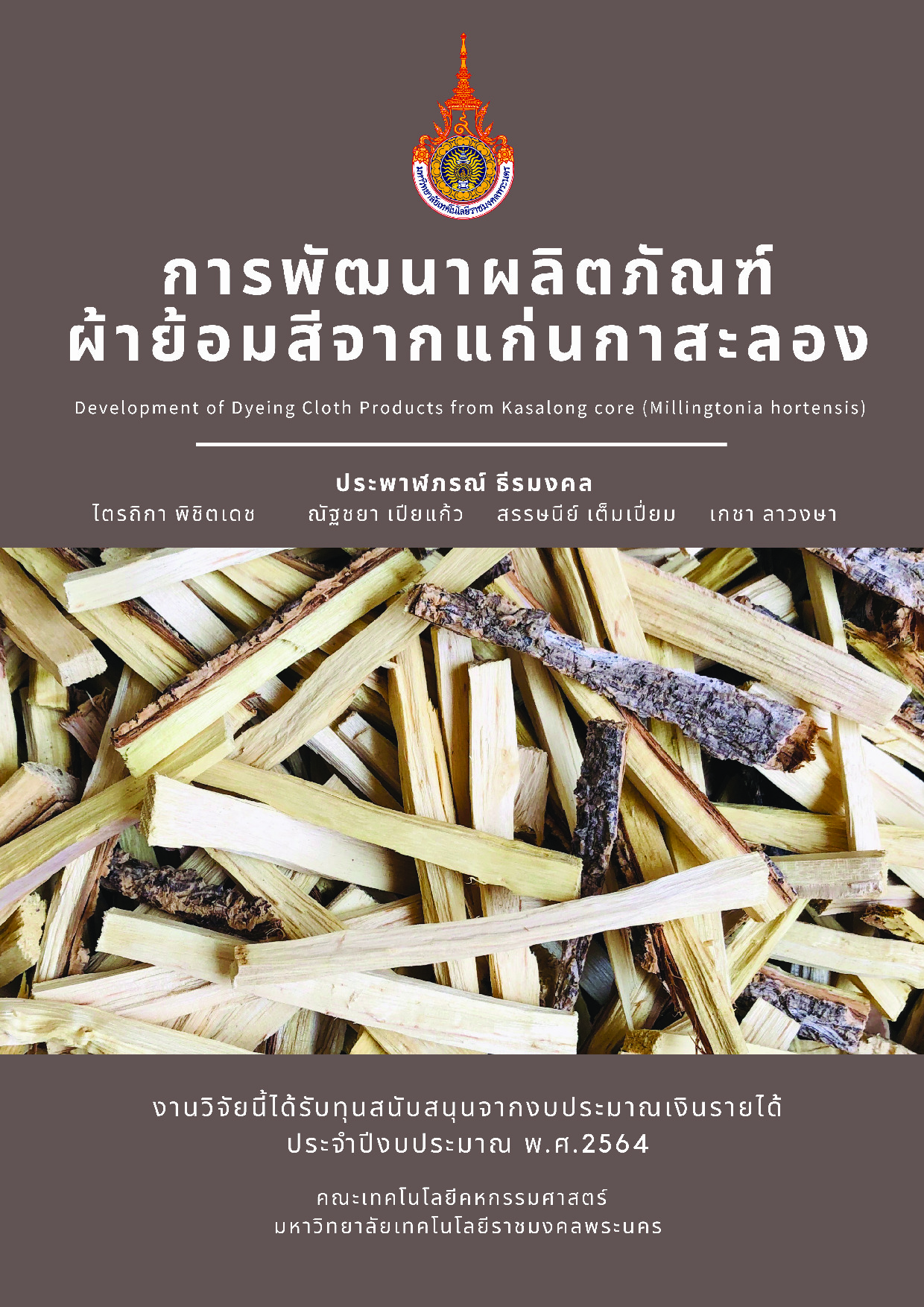
การพัฒนาผลิตภัณฑ์ผ้าย้อมสีจากแก่นกาสะลอง
Promotion of handicrafts in the field of natural dyes in the country. Increase the potential of the community and use the strengths of the cultural community. way of life and wisdom by finding ways to develop textile products by using creative textile innovations based on local wisdom in sustainable community areas To add added value to products in the ECO PRODUCT and ZERO WASTE product groups from the aforementioned concept To conserve plant genetics that exist throughout the country. The researcher therefore studied the process of dyeing fabrics by natural methods. By taking natural ingredients that are locally available and transforming them into environmentally friendly home products. This research is to study the natural dyeing of cotton fabric from Kasalong core. have a purpose Study on the effect of dyeing and the use of adjunctive agents in natural dyeing from Kasalong kernels. To develop dyed fabric products from Kasalong core and to pass on the knowledge and technology of developing dyed fabric products from Kasalong core for the general public. The result of dyeing cotton with natural dyes from Kasalong core. Four types of adhesives were used at a concentration of 20 percent as tamarind juice lime juice lime juice ash water and to test the washing fastness and sunlight resistance with the AATCC standard. The results can be summarized as follows. 1. The results of the study found that from the extraction of color from Kasalong kernels and then filtered with cloth. The color water extracted from Kasalong essence is brown. and when left for 24 hours the water color is dark brown and in this research using hot dyeing methods. 2. The result of dyeing cotton with natural dyes from Kasalong core without mordant using was found to yellow-brown but after washing the color intensity on the fabric fades slightly. 3. The result of dyeing cotton with natural color from Kasalong core. It was found that after washing the color intensity on the fabric was moderately fading. 4. The color measurement L* a* b* found that when the dye was measured in the CIELab system L* = 26.81 a* = 33.33 b* = 45.69 dL = 0.36 and dE*ab = 0.85 water. The resulting color from Kasalong will be reddish yellow. 5. Make the research prototypes as 10 of bag products. 6. Conducting technology transfer by organizing workshops dyeing course and sewing durating of the workshop for students and the general public was 1 day. Most of the participants had the highest level of satisfaction in all questions.
การศึกษาการบำบัดน้ำเสียจากการย้อมผ้าแบบเคลื่อนที่โดยใช้ถ่านกัมมันต์จากกะลามะพร้าว
The dyeing industry both of business size and household size where the remaining water from the dyeing process is dumped into pipes and flows into natural water sources causing sewage problems. Therefore a column type wastewater treatment system has been developed by using a filtration system along with an adsorption system. The materials used to treat the wastewater from dyeing are gravel sand charcoal from wood and activated carbon from coconut shell. The study was conducted on the synthesis activated carbon from coconut shell using for color and molecules adsorption. The amount of activated carbon from coconut shell was varied at 200 400 600 and 800 g applying with filter media and other adsorption materials taking 1 hour to treat the wastewater from dyeing. The parameter using to measure water quality consisted of color value pH suspended solids conductivity turbidity value COD and TKN to indicate the water quality before and after treatment evaluating the efficiency of the wastewater treatment system. The best ratio that can treat the color is the formula containing 800 g of coconut shell activated carbon. It was able to treat the color equal to 5.94 SU or 99.43 percent compared to the wastewater before treatment.
การกำจัดสีย้อมผ้าด้วยถ่านกัมมันต์จากเมล็ดสละพันธุ์สุมาลีที่กระตุ้น ด้วยสารละลายโพแทสเซียมไฮดรอกไซด์
Dyes contaminated in wastewater that negatively affecting the environment and human health. The objectives of this study to prepare activated carbon from Salacca zalacca (Sumalee) seeds activated by 36 mmol/g KOH dye solution and activated carbon ratio 20:32 ml/g for dye removal. The influents of dye removal from wastewater by Salacca zalacca (Sumalee) seeds activated carbon were investigated as initial dye concentration activated carbon and dye solution ratio and contraction time. The moisture content the iodine number the methylene blue index and the functional groups by FTIR technique of the Salacca zalacca (Sumalee) activated carbon were characterized and the kinetics adsorption were also analyzed. The results showed that the activated carbon was the microporous material the highest dye removal from wastewater was 7.50 ± 0.25 mg/g the equilibrium time was 150 min with the activated carbon to dye solution ratio of 1:500 g/ml for 200 mg/l initial concentration. The kinetics of the adsorption process can be described by a pseudo-second order model (R2 = 0.9999). When increasing the initial concentration of dyes the adsorption efficiency was increased. The amount of activated carbon increased resulting in lower adsorption efficiency and the equilibrium time was longer

การพิมพ์สีครั่งบนผ้าฝ้ายและผ้าพอลิเอสเตอร์โดยไม่ใช้การมอร์แดนท์สำหรับผู้ประกอบการรายย่อย
This research had an aim for studying the printing process of LACCIFER LACCA KERR. (LAC) on cotton and polyester fabric. The Lac dye was extracted by using Sodium hypochlorite solution Sodium hydroxide Hydrogen peroxide and diethyl ether then Acetic acid was used for dye sedimentation. Thenthe printing condition and color fastness to washing crocking and light were examined. The efficiency of solution for extraction process were found Diethyl ether > Sodium hypochlorite solution > Sodium hydroxide > Hydrogen peroxide respectively. The hot air was suitable fixation process for cotton and polyester printing. The cotton fixation was 150oC for 5 minutes it is 11.87 in color strength. And the polyester fabric was fixed at 220oC for 3 minutes the 8.27 color strength was shown. The both of cotton and polyester were printed with Lac dye had the good color fastness to crocking and light and moderate in washing fastness. This study can apply the Lac dye on cotton and polyester fabric by a printing technique without mordanting. Then it can reduce some chemicals in the textile printing industry. This process can applied and transfer for small enterprise for Lac value added appication.
การเลือกซื้อผลิตภัณฑ์ผ้าหม้อห้อมย้อมสีธรรมชาติของนักท่องเที่ยวจังหวัดแพร่
The purposes of this research are : 1) to study the personal factors at tourist in Phrae Province 2) to study is the factors of marketing mix use to purchasing of products Morhom Fabric Dyed in natural color of tourists in Phrae Province 3) to study is purchasing of products Morhom Fabric Dyed in natural color of tourists in Phrae Province 4) the relationship between personal factors with an option to is purchasing of the products Morhom Fabric Dyed in natural color of tourists in Phrae Province and 5) the relationship between marketing mix to purchasing of products Morhom Fabric Dyed in natural color of tourists in Phrae Province. The samples are tourists traveling in Phrae Province and buy products Morhom Fabric Dyed in natural color 405. The instruments are using in research questionnaires and interviews. The statistics are using for data analysis frequency percentage mean standard deviation and Chi-square. The research were found that as follows: 1) Tourists in Phrae Province Most were female aged 31-40 years with a bachelors degree. A career was as a private company employees .The averaged income per month 20001-30000 baht and domiciled in Phra Province. 2) Visitors were to the factors critical to the overall marketing mix at a high level. The first two items in order from most to least found that the side with the highest mean score. The product was the lower cost and minimal personnel.3) Most tourists were purchasing of products Morhom Fabric Dyed in natural color of tourists in Phrae Province for themself or them family. The choice of piece of fabric was dyed the clothing and apparel or garments were buying a shirt at the time of used and decoration shop the cushions as well as sorts of travelers choose and bought a bag with the purchase of products Morhom Fabric Dyed in natural color factors on choosing found that sex education estimate salary and the domicile of tourists was associating with the purchase of purchasing of products Morhom Fabric Dyed in natural color of tourists in Phrae Province .There were no significant correlation. And 5) the relationship between marketing mix to purchase of purchasing of products Morhom Fabric Dyed in natural color of tourists in Phrae Province found not correlation. The statistical significance level. 05.