จำนวน Repository ( 17 )
การออกแบบและพัฒนาผลิตภัณฑ์ถ่านอัดแท่งจากวัสดุเหลือใช้ เพื่อทดแทนถ่านจากไม้
งานวิจัยนี้ มีวัตถุประสงค์เพื่อพัฒนาผลิตภัณฑ์ถ่านอัดแท่ง และศึกษาเปรียบเทียบการผลิตถ่านเชื้อเพลิงจากวัสดุเหลือใช้ ประเภทซังข้าวโพดและใบไม้แห้งและวัสดุอื่น โดยผสมวัสดุเหลือใช้กับแป้งและน้ำในสัดส่วนต่างกัน ได้แก่ 93 : 4 : 3 94 : 3 : 3 95 : 3 : 2 96 : 2 : 2 ตามลำดับ โดยผ่านกระบวนการทำให้วัสดุกลายเป็นคาร์บอน เริ่มจากการเผา การบด การผสม การอบ และการผลิตให้เป็นผลิตภัณฑ์แท่งถ่าน และการถ่ายทอดผลงานวิจัยสู่ชุมชน เป็นการต่อยอดผลงานวิจัยให้สามารถใช้ประโยชนน์ได้จริง ผลิตภัณฑ์ถ่านอัดแท่งที่ผลิตได้นำไปอบให้แห้งที่อุณหภูมิ 100 – 120°C ภายใต้ระยะเวลาต่างกันที่ 6 ชม. 10 ชม. 15 ชม. และ 48 ชม. จากนั้นนำไปทดสอบเพื่อหาระยะเวลาการเผาไหม้ทดสอบเวลาน้ำเดือด และทดสอบคุณสมบัติต่าง ๆ จากผลการทดลองพบว่าถ่านอัดแท่งมีส่วนผสมต่าง ๆ กัน ได้ระยะเวลาในการให้ความร้อนถึงจุดเดือดของน้ำมีค่าใกล้เคียงกันอยู่ในช่วงระหว่าง 43.75 – 44.25 นาที ส่วนระยะเวลาการเผาไหม้อยู่ในช่วง 3.06 – 3.08 ชั่วโมง และผลการวิเคราะห์ความแปรปรวน (ANOVA) ปรากฎว่าระยะเวลาถึงจุดเดือด และระยะเวลาการเผาไหม้แต่ละส่วนผสมไม่แตกต่างกันที่ระดับนัยสำคัญ 0.01 ฉะนั้นหากมีผู้ที่สนใจในการผลิตถ่านอัดแท่งขอแนะนำให้ใช้สัดส่วนการผสม 95 : 3 : 2 เพราะว่าให้ค่าความร้อนสูงที่สุด ส่วนคุณสมบัติด้านอื่นปรากฎว่ามีถ่านคงตัวสูงถึง 45.8 เปอร์เซ็นต์ สารระเหย 32.1 เปอร์เซ็นต์ ความหนาแน่น 0.58 กรัมต่อลูกบาศก์เซนติเมตร ดังนั้น จึงสามารถนำวัสดุดังกล่าวมาผลิตเป็นถ่านเชื้อเพลิงเพื่อเป็นพลังงานทดแทนได้เป็นอย่างดี ผลการต่อยอดงานวิจัยสู่ชุมชนปรากฎว่า ชุมชนสามารถผลิตถ่านพลังงานทดแทนจากวัสดุเหลือใช้เกิดการสร้างานในชุมชนมากขึ้น มีการจัดตั้งกลุ่มเพื่อส่งเสริมอาชีพการเกษตรในชุมชน หมู่บ้านสุขสมบูรณ์ ต.ไทยสามัคคี อ.วังน้ำเขียว จ.นครราชสีมา ในนาม กลุ่มส่งเสริมอาชีพผู้ผลิตถ่านอัดแท่ง อย่างเป็นทางการโดยหน่วยงายราชการ รายอำเภอ เกษตรอำเภอให้การรับรองและเป็นการสร้างงาน ลดการตัดไม้ในพื้นที่และในชุมชนต่อไป
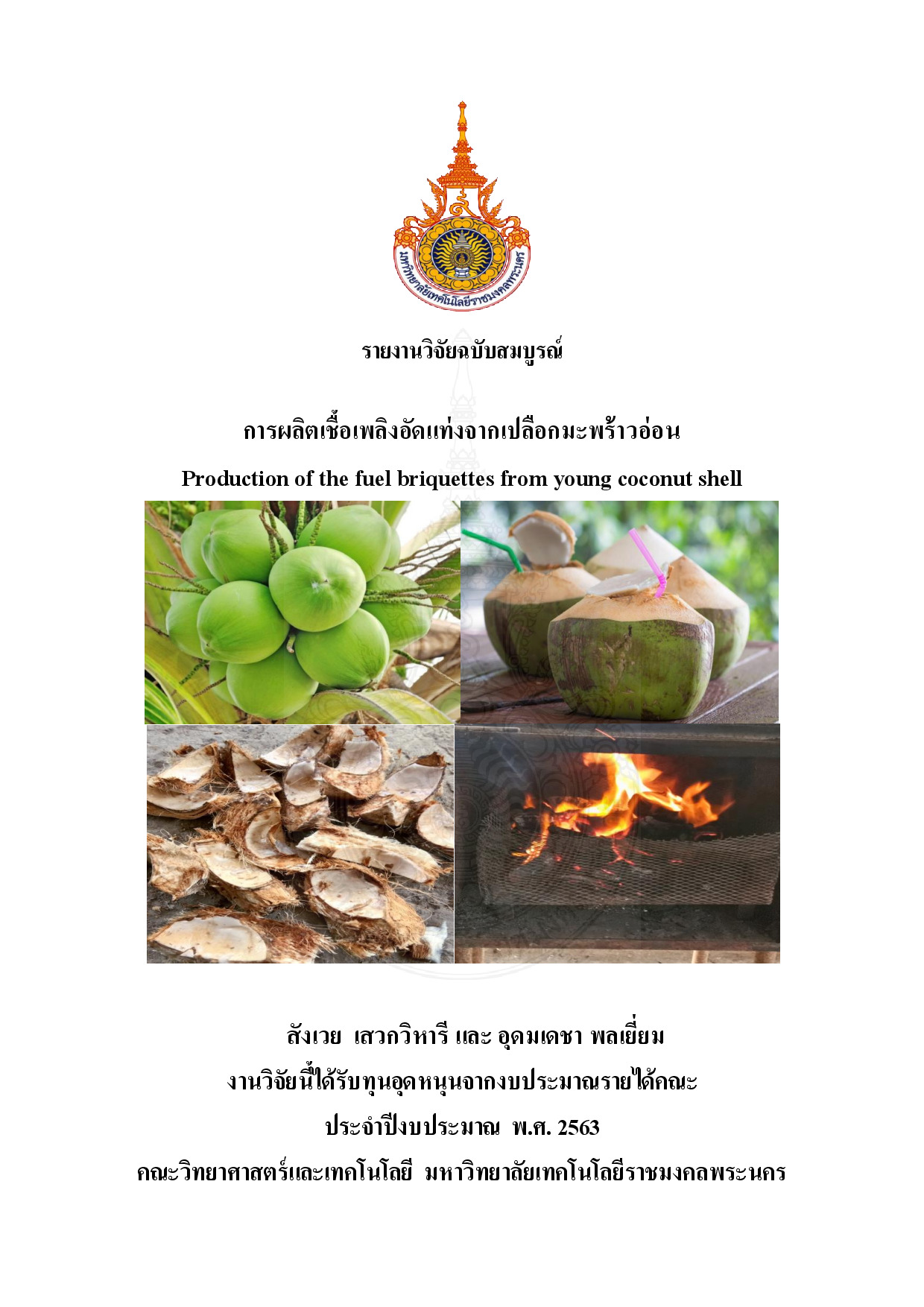
การผลิตเชื้อเพลิงอัดแท่งจากเปลือกมะพร้าวอ่อน
Young coconut shells are a byproduct after processing coconut juice which can be used to produce a solid-fuel. This fuel from the coconut shell is an alternative source instead of using firewood or charcoal made of timber in the natural forest. The solid-fuel from young coconut shells was prepared by using a wet glue powder as a binder then was compressed by using a briquette machine. The black coconut briquette was stable after exposure to the sun. The average of the briquette combustion rate was at 11.24 g /min. There is no eruption smut smoke and odor by using the young coconut shell briquette yo start a fire. To sum up a young coconut shell has a high potential as an alternative biomass material for producing a briquette especially for commercial. This solution can increase the reduction of haze weather in the sight of solid waste incineration and also global warming.
การพัฒนารถไฟฟ้าพลังงานแสงอาทิตย์ต้นแบบสำหรับการแข่งขัน
The objective of this paper is to construct the solar car prototype. The car uses flexible solar panels with the battery as a power source. Thereafter the performance of the solar car is tested in the actual condition. This solar car’s body was developed by fiberglass and the internal structure was made from the steel. This car uses the 2 kW brushless DC motor to be the prime mover and the motor is driven by the regenerative dc converter. The power sources are 480 watts of the flexible solar panel with a charger to charge power to four of 12V 33Ah battery. The total weight of the solar car is 173 kg. The solar car’s weight including driver is about 233.4 kg. The solar car test drive is on 10 km distance. The result found that the car has: (1) the average speed is equal to 45.98km/h by using only battery (2) the average speed is equal to 51 km/h when the battery is combined with solar panels. This knowledge should be applied to develop the next version of the solar racing car.
นวัตกรรมคอนกรีตมวลเบาแบบเซลลูล่าด้วยการใช้วัสดุเหลือทิ้ง
This research presents a study of the compressive strength tensile strength flexural strength and water absorption of Cellular Lightweight Concrete containing fine fly ash and ground bagasse ash. Portland cement (CT) is partially replaced with pozzolans 20 30 and 40% by weight of the cementitious materials. The results show that the compressive strength tensile strength flexural strength and low water absorption of Cellular Lightweight Concrete improves substantially with partial replacement of Portland cement with fly ash and bagasse ash. Cellular Lightweight Concrete mix cement containing 20 and 30% of pozzolans can be used to make cementitious materials. In addition the use of fly ash and ground bagasse ash produces Cellular Lightweight Concrete mix with good compressive strength tensile strength flexural strength and water absorption.

Preparation of titanium dioxide supported on activated carbon
The purpose of this research work was to synthesize titanium dioxide supported on activated carbon and used it as a catalyst for dye decolorisation. The effect of preparing factors on titanium dioxide supported on activated carbon such as calcinations temperature and the amount of carbon supports were investigated at 300 400 and 500OC and in range of 5-30 percent by weight respectively. The X-ray diffraction (XRD) technique was used to detect the crystal structure of prepared catalysts. It was found that all peaks were anatase phase. The morphology of these catalysts was analyzed by scanning electron microscope (SEM) and transmission electron microscope (TEM) techniques. The results showed regularly distribution of titanium dioxide supported on activated carbon. The particle size of obtained catalysts was 5-10 nm. The Brunauer-Emmett-Teller (BET) technique was analyzed physical characteristic of catalysts. The specific surface area average pore diameter and pore volume of catalysts was 151.02-784.13 m2/g 26.94-64.35 and 0.24-0.55 cm3/g respectively. Furthermore the activity of obtained catalyst was carried out by using these catalysts to decolourise dye aqueous solution. The titanium dioxide supported on activated carbon 20 percent by weight can obtain 99.78% decolourisation at dye concentration 75 mg/L catalyst concentration 0.5 g/L within 90 minute. Comparison with titanium dioxide P25 (commercial grade) titanium dioxide supported on activated carbon has higher ability. This is because it was not only photocatalytic reaction but it was also absorption