จำนวน Repository ( 25 )

ผลิตภัณฑ์ผลไม้แปรรูปจากมะม่วงหาวมะนาวโห่ : ชุมชนตำบลบางนกแขวก อำเภอบางคนที จังหวัดสมุทรสงคราม
The purpose of the study of processed fruit products from Karonda : Bang Nok Kwaek parish communities Bang Khonthi Samut Songkhram Province is to study the proper quantity of the Koranda fruit in the product the quality in the product’s process and the consumers’ acceptance (Consumer Test) in the product. The processed products are Karonda fruit jelly instant pasteurized Karonda fruit juice with extra fiber Karonda fruit sorbet Karonda fruit yoghurt ice-cream and concentrated juice (sauce) for drink mixing. The product has been tested by Randomized Complete Block Design (RCBD) method. The process was consisted with offering a tasting and evaluated in color scent taste matter and overall satisfaction by giving 9 point Hedonic scale from 70 consumers. And has been compared the difference of average means at 95% trustiness by Duncan’s New Multiple Range Test (DMRT) by an instant statistical analysis software. The result information is as the followings; The physical properties indicates of Karonda fruit the total acidity of 2.30 with the pH and the color was found that the brightness (L *) of 16.52 fee (a *) equal to 8.95 and (b. *) equals 5.37. The study of the chemical quality of Karonda fruit amount of energy in calories carbohydrates 73.2 percent 18.3 percent protein 1.57 percent 1.32 percent humidity fats fiber 83.7 percent ash 4.26 percent and 0.75 Vitamin C is found. The duration of ripening fruit yawning lemon booed affect the vitamin C in the fruit of the mango yawning lemon booed the oil will have more vitamin C than ripe to t 2 so I scratched the reduction of vitamin C may. Is due to be deployed as a compound to breathe. And led to the synthesis of new carbon structures during ripening. Karonda fruit jelly. The most acceptances level for Karonda fruit juice in the product is at 1:6 for its best flexibility. Since the juice concentration affects the jelly as it lowers the matter (flexibility). Too much of acid in Karonda fruit juice is able to unstabilize jelly matter. From the study of Pectin quantity the consumer has the most acceptance at the level of 10 grams which is the best recipe that keeps the good jelly matter (flexibility) stabilized. The physical properties indicates that there are the level of color hue at 5R color brightness at Value 4 Chroma at 14 sweetness at 35 Brix and pH at 3.05. The study of the chemical quality of Karonda fruit jelly in each 100 grams provides 120 kilocalories of energy 69.60 grams of humidity 0.11 gram of fat 29.80 grams of carbohydrate 0.41 gram of fiber 0.50 gram of ash and 0.45 gram of acidity. The consumer satisfaction is at 97.30 percent. Instant pasteurized Karonda fruit juice with extra fiber. The acceptance is at 100 percent of replacing Okra fruit juice by Karonda fruit juice. The acceptance study shows that the most proper fiber quantity adding to Karonda fruit juice is at 15 percent. The acceptance study shows that the most proper Pectin quantity affecting coconut jelly spreading is at 3 percent. The analysis results of the physical properties indicate that instant pasteurized Karonda fruit juice with extra fiber has color hue level at 5R value at 4 and Chroma at 12 which rendered the product to dark red. Also the pH level is at 3.29 sweetness is at 17 Brix firness g force 1 is at 11.29 g Viscosityag.sec AREA F-T 1:2 is at 339.507 ag.sec. The study of the chemical quality of Karonda fruit juice in each 100 grams provides 63.3 kilocalories of energy 83.9 grams of humidity 0.01 gram of fat 0.10 gram of protein 15.8 grams of carbohydrate 0.41 gram of fiber 0.24 gram of ash and 0.18 gram of pH balance. The consumer satisfaction to instant pasteurized Karonda fruit juice with extra fiber is at 98.66 percent. Karonda fruit sorbet. The most proper quantity of Karonda fruit juice is at 30 percent. The physical properties of Karonda fruit sorbet contain the brightness level at L*34.32 red color level at a*41.26 yellow color level at b*21.18 meltable solid quantity at 30*Brix and pH balance at 2.40. The study of the chemical quality of Karonda fruit sorbet in each 100 grams provides 91.8 kilocalories of energy 77.1 grams of humidity 0.15 gram of fat <0.20 gram of protein 22.6 grams of carbohydrate 0.11 gram of fiber and 0.12 gram of ash. The consumer satisfaction to Karonda fruit sorbet is at 100 percent. Karonda fruit yoghurt ice-cream. The most proper quantity of Karonda fruit added in the yoghurt ice-cream is at 10 percent of the whole ingredient. The consumers’ acceptance has been given the most for its scent taste matter (smoothness) and overall satisfaction which has the average mean at 7.24 7.77 7.17 and 7.67 consequently. The physical properties of Karonda fruit yoghurt ice-cream contain the viscosity level at 364.798 cps. color hue at 10P Value at 8/6 Chroma at N9/.5 overrun statistics at 4.55 and Karonda fruit yoghurt ice-cream melting rate at 89.90. The chemical quality of Karonda fruit yoghurt ice-cream in each 100 grams provides 214 kilocalories of energy 64.0 grams of humidity 14.6 gram of fat 3.14 gram of protein 17.5 grams of carbohydrate 0.76 gram of fiber 0.74 gram of ash and 5.67 pH balance. The consumer satisfaction to Karonda fruit yoghurt ice-cream is at 100 percent. Concentrated juice (sauce) for drink mixing. The most acceptance recipe is the strawberry sauce recipe number 1 with the replacement of Karonda fruit at 80 percent. The physical properties contain the viscosity level at 9.28 cps sweetness at 21 Brix color hue at 5R Value at 2 and Chroma at 4. The chemical quality of concentrated juice (sauce) for drink mixing in each 100 grams provides 91.1 kilocalories of energy 77.2 grams of humidity 0.30 gram of fat 0.1 gram of protein 22.3 grams of carbohydrate 0.76 gram of fiber 0.4 gram of vitamin C and 0.56 of pH balance. The consumer satisfaction concentrated juice (sauce) for drink mixing is at the maximum satisfaction at 92.0 percent as the concentrated juice (sauce) emphasizes the better taste of smoothie drink mixing and easy to consume. Keyword: jelly Karonda fruit instant fruit juice fiber sorbet ice-cream yoghurt concentrated sauce mixed drink
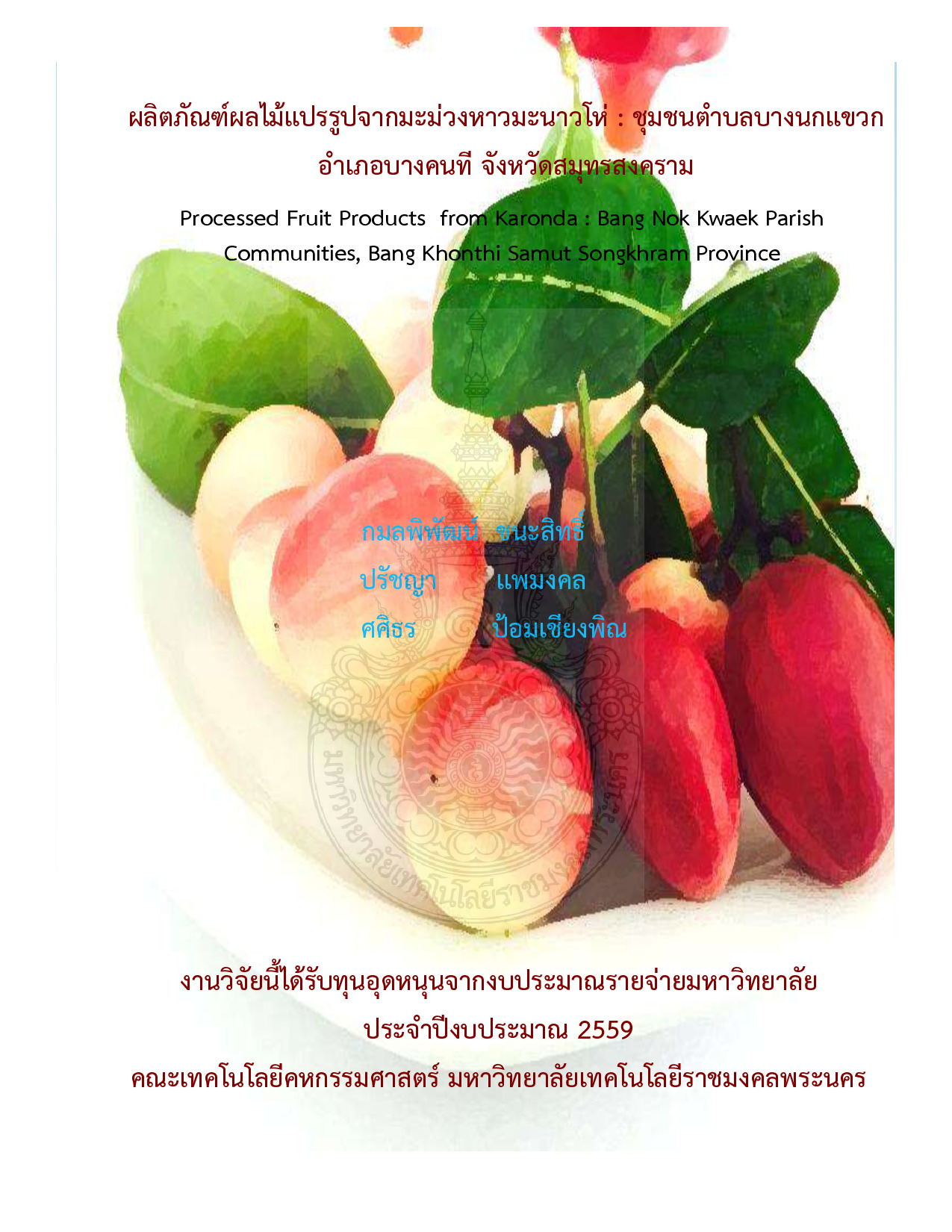
ผลิตภัณฑ์ผลไม้แปรรูปจากมะม่วงหาวมะนาวโห่ : ชุมชนตำบลบางนกแขวก อำเภอบางคนที จังหวัดสมุทรสงคราม
The purpose of the study of processed fruit products from Karonda : Bang Nok Kwaek parish communities Bang Khonthi Samut Songkhram Province is to study the proper quantity of the Koranda fruit in the product the quality in the product’s process and the consumers’ acceptance (Consumer Test) in the product. The processed products are Karonda fruit jelly instant pasteurized Karonda fruit juice with extra fiber Karonda fruit sorbet Karonda fruit yoghurt ice-cream and concentrated juice (sauce) for drink mixing. The product has been tested by Randomized Complete Block Design (RCBD) method. The process was consisted with offering a tasting and evaluated in color scent taste matter and overall satisfaction by giving 9 point Hedonic scale from 70 consumers. And has been compared the difference of average means at 95% trustiness by Duncan’s New Multiple Range Test (DMRT) by an instant statistical analysis software. The result information is as the followings; The physical properties indicates of Karonda fruit the total acidity of 2.30 with the pH and the color was found that the brightness (L *) of 16.52 fee (a *) equal to 8.95 and (b. *) equals 5.37. The study of the chemical quality of Karonda fruit amount of energy in calories carbohydrates 73.2 percent 18.3 percent protein 1.57 percent 1.32 percent humidity fats fiber 83.7 percent ash 4.26 percent and 0.75 Vitamin C is found. The duration of ripening fruit yawning lemon booed affect the vitamin C in the fruit of the mango yawning lemon booed the oil will have more vitamin C than ripe to t 2 so I scratched the reduction of vitamin C may. Is due to be deployed as a compound to breathe. And led to the synthesis of new carbon structures during ripening. Karonda fruit jelly. The most acceptances level for Karonda fruit juice in the product is at 1:6 for its best flexibility. Since the juice concentration affects the jelly as it lowers the matter (flexibility). Too much of acid in Karonda fruit juice is able to unstabilize jelly matter. From the study of Pectin quantity the consumer has the most acceptance at the level of 10 grams which is the best recipe that keeps the good jelly matter (flexibility) stabilized. The physical properties indicates that there are the level of color hue at 5R color brightness at Value 4 Chroma at 14 sweetness at 35 Brix and pH at 3.05. The study of the chemical quality of Karonda fruit jelly in each 100 grams provides 120 kilocalories of energy 69.60 grams of humidity 0.11 gram of fat 29.80 grams of carbohydrate 0.41 gram of fiber 0.50 gram of ash and 0.45 gram of acidity. The consumer satisfaction is at 97.30 percent. Instant pasteurized Karonda fruit juice with extra fiber. The acceptance is at 100 percent of replacing Okra fruit juice by Karonda fruit juice. The acceptance study shows that the most proper fiber quantity adding to Karonda fruit juice is at 15 percent. The acceptance study shows that the most proper Pectin quantity affecting coconut jelly spreading is at 3 percent. The analysis results of the physical properties indicate that instant pasteurized Karonda fruit juice with extra fiber has color hue level at 5R value at 4 and Chroma at 12 which rendered the product to dark red. Also the pH level is at 3.29 sweetness is at 17 Brix firness g force 1 is at 11.29 g Viscosityag.sec AREA F-T 1:2 is at 339.507 ag.sec. The study of the chemical quality of Karonda fruit juice in each 100 grams provides 63.3 kilocalories of energy 83.9 grams of humidity 0.01 gram of fat 0.10 gram of protein 15.8 grams of carbohydrate 0.41 gram of fiber 0.24 gram of ash and 0.18 gram of pH balance. The consumer satisfaction to instant pasteurized Karonda fruit juice with extra fiber is at 98.66 percent. Karonda fruit sorbet. The most proper quantity of Karonda fruit juice is at 30 percent. The physical properties of Karonda fruit sorbet contain the brightness level at L*34.32 red color level at a*41.26 yellow color level at b*21.18 meltable solid quantity at 30*Brix and pH balance at 2.40. The study of the chemical quality of Karonda fruit sorbet in each 100 grams provides 91.8 kilocalories of energy 77.1 grams of humidity 0.15 gram of fat <0.20 gram of protein 22.6 grams of carbohydrate 0.11 gram of fiber and 0.12 gram of ash. The consumer satisfaction to Karonda fruit sorbet is at 100 percent. Karonda fruit yoghurt ice-cream. The most proper quantity of Karonda fruit added in the yoghurt ice-cream is at 10 percent of the whole ingredient. The consumers’ acceptance has been given the most for its scent taste matter (smoothness) and overall satisfaction which has the average mean at 7.24 7.77 7.17 and 7.67 consequently. The physical properties of Karonda fruit yoghurt ice-cream contain the viscosity level at 364.798 cps. color hue at 10P Value at 8/6 Chroma at N9/.5 overrun statistics at 4.55 and Karonda fruit yoghurt ice-cream melting rate at 89.90. The chemical quality of Karonda fruit yoghurt ice-cream in each 100 grams provides 214 kilocalories of energy 64.0 grams of humidity 14.6 gram of fat 3.14 gram of protein 17.5 grams of carbohydrate 0.76 gram of fiber 0.74 gram of ash and 5.67 pH balance. The consumer satisfaction to Karonda fruit yoghurt ice-cream is at 100 percent. Concentrated juice (sauce) for drink mixing. The most acceptance recipe is the strawberry sauce recipe number 1 with the replacement of Karonda fruit at 80 percent. The physical properties contain the viscosity level at 9.28 cps sweetness at 21 Brix color hue at 5R Value at 2 and Chroma at 4. The chemical quality of concentrated juice (sauce) for drink mixing in each 100 grams provides 91.1 kilocalories of energy 77.2 grams of humidity 0.30 gram of fat 0.1 gram of protein 22.3 grams of carbohydrate 0.76 gram of fiber 0.4 gram of vitamin C and 0.56 of pH balance. The consumer satisfaction concentrated juice (sauce) for drink mixing is at the maximum satisfaction at 92.0 percent as the concentrated juice (sauce) emphasizes the better taste of smoothie drink mixing and easy to consume.
การพัฒนาขนมลืมกลืนจากผักผลไม้ 5 สี
The Development of KhanomLeumKleun byusing 5 different colors of fruits and vegetables is aimed to study the consumption of fruits and vegetables 5 colors including mall berry beetroot spinach. Pumpkin and millet in different KhanomLeumKleun3 levels.Planning of randomized complete block (Randomized Complete Block Design RCBD) applied to the evaluation of sensory quality in appearance. Color smell taste texture and overall by means of taste was rated as 9 level (9 - Point Hedonic Scale) analyzed the average. Analysis of variance Analysis of Variance ANOVA and compared the difference of the average by statistical software. The study of the mulberry supplementinKhanomLeumKleun at the level of 10% weight of pastry. Recognized in the appearance color smell taste and preference by the overall average score 7.80 7.70 and 7.58 7.56 7.56 respectively. The texture the taste the level of 5% by the score 7.36 when analyzing variance. Comparison and contrast it was found that the appearance of color smell taste texture overallno statistically significant difference at the 0.05 The study of usingbeetroot supplement in KhanomLeumKleunat the level of 15% residuary bequest weight of pastry. Recognized in the appearance color smell taste texture and overall by the score 8.24 7.89 7.90 and 8.00 8.00 8.24 respectively. When analyzing the differences found in the appearance color smell taste texture and overall liking. The difference is statistically significant at 0.05. The study of usingspinach supplement in KhanomLeumKleunat the level of 10% residuary bequest weight of pastry.Recognized in the manner of appearance texture smell The taste and preference for overall scores 7.41 7.05 preference and 7.51 7.55 7.58 Respectively and the panelists accepted in color at the level of 15% average 7.21 preference when used to analyze the variance and compared the difference in statistics. It was found that the texture taste and preference overall. There were significant differences at the level of 0.05.

การพัฒนาสบู่สำหรับใช้งานแกะสลักแทนผักและผลไม้เพื่อสร้างมูลค่าเพิ่มให้งานหัตถกรรมไทย
The objective of this research was to determine the formulation of soap for carving operations and study the satisfaction of developed carved-soap by carving person. There were 3 basic formulas of the soap e.g. olive oil formula (formula 1; 500 ml olive oil 60 g sodium hydroxide and 140 ml water) coconut oil formula (formula 2; 200 ml coconut oil 34 g sodium hydroxide and 80 ml water) and glycerin formula (formula 3; 200 g glycerin and 5 g sodium hydroxide). The basic formula 3 showed the highest satisfaction scores from carving person when compared with other formulas. The next experiment was to find the optimal temperature for heating the mixtures in the range of 40-60oC. The results showed that the temperature of 45oC was the best treatment for heating three types of soap mixtures. Moreover the formula 3 soap received the highest satisfaction scores ( X = 4.21-4.53) from carving person which had the good appearance exquisite styles shape and proportion right. There was no crack no visible of mold growth and soap powder on the product after caving operations. The satisfaction of 52 carving persons between the general soap and developed carved-soap for carving operations was studied using 5-point rating scales. The satisfaction scores of softness stickiness and aroma were significant different (p<0.05) between two types of soap. However the dryness/hardness silkiness color painting property and overall quality scores were not different. The suitable shape of soap for carving operations was a round shape followed by square shape oval shape and heart shape respectively.
การปรับปรุงคุณภาพและการยืออายุการเก็บรักษาผักและผลไม้แกะสลัก
The objective of this research was to find the suitable types of carving style for five fruits and vegetables e.g. pumpkin carrot radish cantaloupe and Japanese cucumber. Physiological changes and methods to improve quality and extend shelf-life were also studied. The results showed that the leave-carved operations stimulated the respiration rate ethylene production and the electrolyte leakage more than flower-carved operations. These responses depended on the size of wound and surface area that contacted with atmospheric oxygen. Two concentrations of peroxyacetic acid (60 and 80 mg/L) solutions showed the efficacy in reducing microorganism populations better than sodium hypochlorite (50 and 75 mg/L). The three firming agents of calcium chloride (0.5-1.5%) calcium lactate (0.5-2%) and calcium propionate (0.5-2%) could improve texture at different concentrations. The combination effects of peroxyacetic acid (80 mg/L) and firming agents (0.5% calcium chloride 1.5% calcium lactate and 2% calcium propionate) and/or 0.25 and 0.5% of chitosan coating were applied on rose and lotus-carved fruits and vegetables. All off flower-carved fruits and vegetables were stored at 5?1oC in clamshell container. Then they were placed in a control temperature chamber at 25?1oC every day for 3 hours until the end of shelf-life. The results showed that 0.25 and 0.5% chitosan coating had the best coating solutions for extended shelf-life of carved pumpkin carrot and cantaloupe. The control treatment dipped in tap distilled water showed the suitable treatment for rose-carved radish and lotus-carved Japanese cucumber. The best chemical treatment for each fruit and vegetable was repeated in the storage experiment and then they were stored at 5?1oC in clamshell containers to determine the shelf-life of three carved fruits and vegetables (rose carnation and lotus). The shelf-life of two styles of flower from carved pumpkin did not exceed 6 days. Carved carrot in rose and carnation flowers had shelf-life for 12 days while radish was not more than 9 days. The shelf-life of rose and carnation carved cantaloupe did not exceed 9 and 6 days respectively. Lotus-carved Japanese cucumber had shelf-life for 6 days. Carved radish and Japanese cucumber were dipped in tap distilled water which had high initial microbial population that caused the short shelf-life. Thus the application of 2% calcium propionate and 80 mg/L peroxyacetic acid was the suitable treatment for reducing microbial population and improving the appearance quality and extended shelf-life.