จำนวน Repository ( 12 )
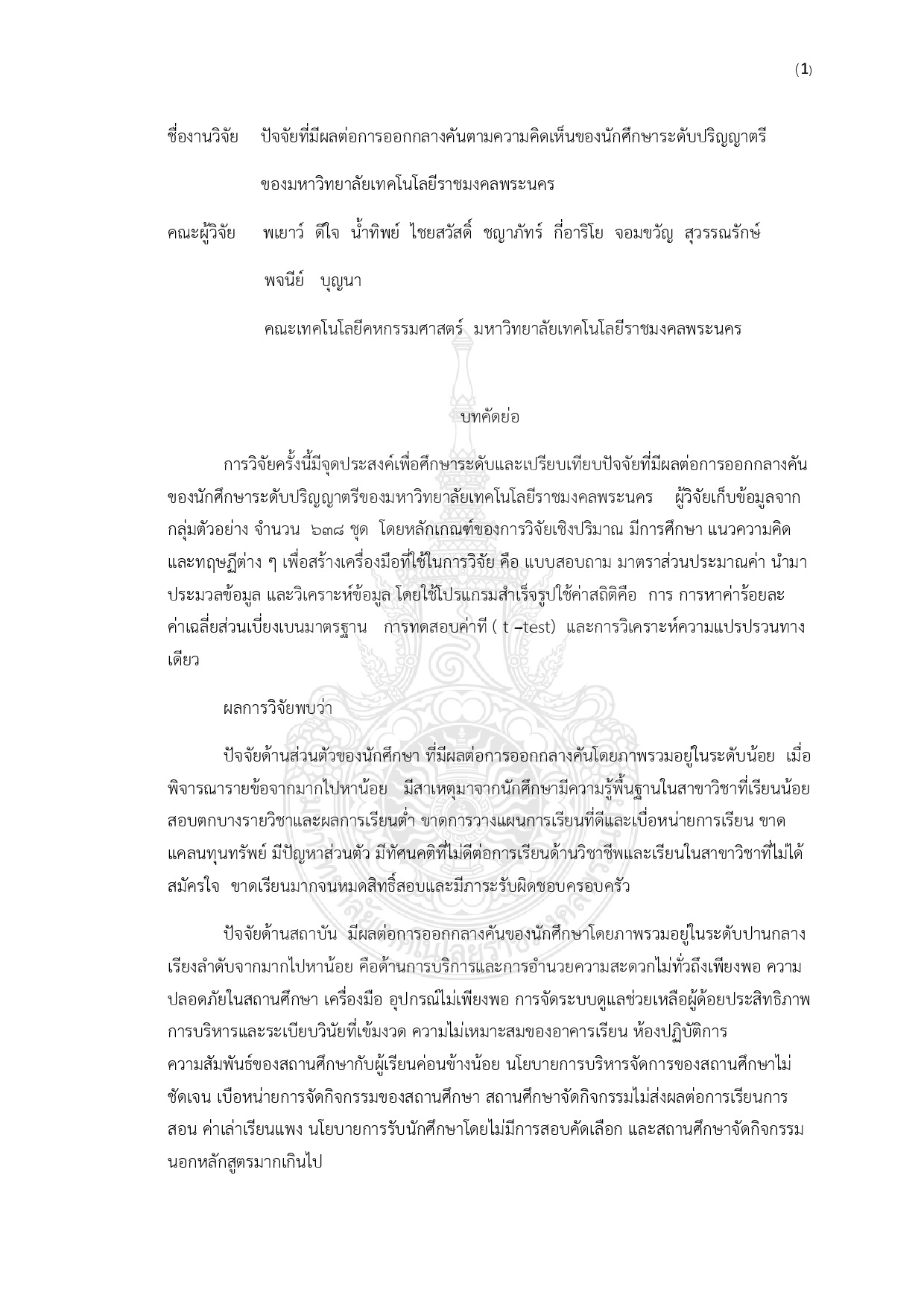
ปัจจัยที่มีผลต่อการออกกลางคันตามความคิดเห็นของนักศึกษาระดับปริญญาตรีของมหาวิทยาลัยเทคโนโลยีราชมงคลพระนคร
The objectives of this research were to study and compare factors affecting dropping out of undergraduates in Rajamangala University of Technology Phra Nakhon. The finding on four types of factors were launched : personal educational institute family and social factor. Survey research methodology was exploited by distributing questionnaires to sample group of 638 RMUTP undergraduates in 2012 academic year. And the data was analyzed by the percentage the standard deviation the t-test and one way analysis of variance (ANOVA). The results were as followed : the personal factor as a whole was at low level they were : insufficient background knowledge in their fields capability in passing the examination getting low grade point average learning without planning boring of learning facing financial problem negative attitude in vocational field learning in dislike branch absence in class and having problems on family responsibility. On the institute factors as a whole it was at moderate level the causes were: inadequate facilities and services of the institute personal safety learning without instruments lack of helpfulness for the handicapped institute’s strict discipline inappropriate laboratory and buildings the executive management’s transparency institute’s relations with students unsuitable activities for learning expensive fee the students’ entrance without admission system overloaded extracurricular activities. On the family factor it was at low level as a whole they were : economics problems the family’s poverty parents’ attitude towards the institute single-mom’s burdens stability of parents career. Finally the social factor as a whole it was at low level they were : distance from students’ home the freshmen’s traditions self( 4) adjustment among peer group improperly learning environment quarrels and conflicts with others and freshmen’s assimilation in new surroundings. By comparing personal factors to family factors the study found that all factors were nonsignificantly different at the level of 0.05. While the institute factors and the social factors were significant different at the level 0.05

วิถีชีวิตและความมั่นคงของอาหารภาคใต้
The purpose of this project is to study way of life and food security of people in the southern part of Thailand in terms of ability to use existing local resources for food food processing cooking types of food local cuisine and food consumption culture. This research is both quantitative and qualitative. Research tools consisted of questionnaires in-depth interviews focus group and participative observation. Quantitative data were statistically analyzed for frequency and percentage and qualitative data were analyzed with content analysis method. Results of the research show that firstly most of the local Southern people purchased food from market. Regarding consumption pattern most local people usually eat 3 times a day. Food preservation and processing methods included drying salt curing pickling fermentation and smoking. In terms of problems and solutions in food management southern people solved the problems by growing their own food plants or finding alternative food. Secondly a variety of foods are available and these various types of food resources are regarded as culinary treasures which guarantee food security. Thirdly food and food resources of local southern people could be accessed in 4 ways: planting collecting from nature purchasing and sharing. Finally for food utilization local southern people managed their food and food resources by making use of their knowledge talents and skills in food resources management for use in their daily life for producing and acquiring food and for use as raw materials in making various utensils. Concerning attitude towards self-dependence most southern people thought that they could depend on themselves for food.