จำนวน Repository ( 17 )

การพัฒนาผลิตภัณฑ์น้ำพริกปลาทูกึ่งสำเร็จรูปแบบผง
This study aimed to investigate 1. the process of development of semi readymade mackerel chili paste. 2. to study consumer acceptance of semi readymade mackerel chili paste product. 2 groups of population were used in the study: 10 experts and 100 students of Rajamangala University of Technology Krungthep. In selecting the basic formula for standard mackerel chili paste Randomize Complete Block Design (RCBD) was used to evaluate the overall sensory quality color flavor texture and appearance. A 9-point Hedonic Scale rating found that formula 1 had the highest score. The semi readymade mackerel chili paste was made by baking mackerel by hot air at 90 80 and 70 degrees Celsius for 3 4 and 5 hours respectively. Other ingredients were baked in hot air at 65 degrees Celsius for 3 hours then mixed with dried mackerel. It was found that drying mackerel in hot air oven using to degrees Celsius for 5 hours received highest score. When the semi readymade mackerel chili paste was reconstituted the product was mixed mixed with water in proportions of 1:1 1:2 and 1:3 respectively. The 1:2 proportion resembled most standard mackerel chili paste. The semi-finished mackerel was measured in color. Chemical analysis showed protein was ash were 63.42% fat was 5.59% moisture content 4.31% moisture content 6.02% fiber content and 11.30% ash content.
การใช้แป้งข้าวเจ้าทดแทนแป้งดัดแปรในซอสมะเขือเทศปรุงรสพริกไทยดำในผลิตภัณฑ์ปลาแมคเคอเรลกระป๋อง
The purposes of this study were to study amount modified starch substitution by rice canned mackerel in tomato sauce seasoned with black pepper ratio at 15:85 20:80 and 25:75 percentage. The results showed that the best formulation of product was rice flour (percentage) 20:80 because sauce in can were red orange pH of sauce was = 6. The result of the study showed that the physical and chemical attributes of product canned mackerel in tomato sauce seasoned with black pepper compared with control. Found that canned mackerel in tomato sauce seasoned with black pepper of dark orange more than control. pH = 6.05 – 6.15 were similar moisture protein fat and carbohydrate content but the differences in ash content. The consumer acceptability indicated of target consumer accepted the product consumer need to buy this product 79% like moderately this product 72% and suitable price about 15 bath/can. The product of storage 6 mouths and not detects mesophilic aerobic bacteria and thermophilic aerobic bacteria.
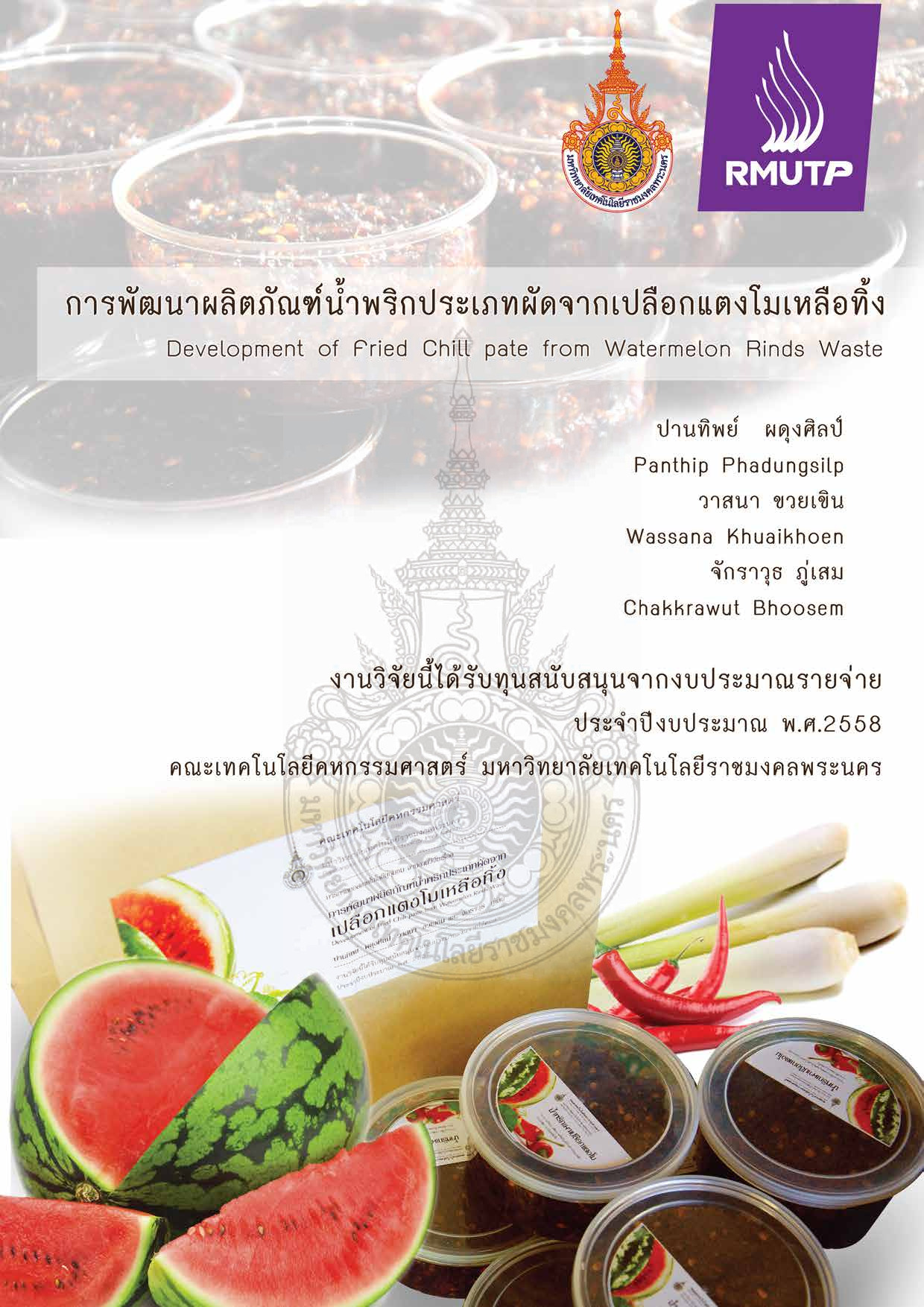
การพัฒนาผลิตภัณฑ์น้ำพริกประเภทผัดจากเปลือกแตงโมเหลือทิ้ง
The research products of chili fried watermelon rind remains were found. The decent amount enhancing of the watermelon rind in fried chili pastes are 25% 50% and 75% of total weight. The results show the 50% enhancing of the watermelon rind in fried chili pastes all of sample such as roast chili paste fermented fish chili paste Tadand chili paste and Oong chili paste were recognized in the like moderately-like very much. Increase of watermelon rind at 75% of total weight the acceptance is decrease. The texture of samples of fried chili pastes enhancing of the watermelon rind show that 1035.74-1901.16gram of the consistency -132.16- -98.07 gram: milligram of the cohesiveness and 2.15-5.67 gram of the viscosity. The chemical composition of fried chili pastes enhancing of the watermelon rind show that the 50% of watermelon rind in roasted chili pastes were 233 Kcals of total energy 7.20 of protein 9.56 of fat 4.83 of ash 29.60 of carbohydrate and 7.09 of crude fiber. The 50% of watermelon rind in fermented fish chili paste were 152 Kcals of total energy 5.93 of protein 5.60of fat 4.21of ash 19.4of carbohydrate and 5.41of crude fiber. The 50% of watermelon rind in Tadand chili paste were 183 Kcals of total energy 6.68 of protein 3.26 of fat 7.34 of ash 31.80 of carbohydrate and 11.10 of crude fiber. The 50% of watermelon rind in Oong chili paste were 182 Kcals of total energy 6.77 of protein 12.80 of fat 2.61 of ash 9.92 of carbohydrate and 3.21 of crude fiber For the technology transfer of Fried Chili paste from Watermelon Rinds Waste to Center Concert career womens groups Don Kang. The participants were satisfied with the course of 92.67
การพัฒนาผลิตภัณฑ์พริกแกงสำเร็จรูปเพื่ออุตสาหกรรมการส่งออก
Development Project of instant Thai curry products for export industry aimed to conduct the process of making curry to have shelf-life extension and transfer this knowledge and technology to community entrepreneur and private organizations for industrial productivity with quality ready-to cook and tasty delicacy curry paste. It also helps adding value for the market and the export which is correspond with the policy of promoting Thailand as Kitchen ofthe World Since 2006 the research on curry paste process and developed recipe included 5 types of curry; red curry green curry Pha-naeng curry Tai PIa curry (Fish innards curry) and Thai Tom Yum curry. The result of the study was found that the overall satisfaction level of the consumer was accepted for curry powder because it lasted and was ready to cook. As for the research in 2007 it focused on the shelf-life extension of Thai instant curry and was developed by testing for its quality by physical chemical microbial and sensory evaluation. It was found that Thai instant curry lasted for more than 8 months. When developed to use in the factory the quality of curry was not different from the one produced in the laboratory except currys weight after drying which was less; however the result was accepted. In this case the quality of raw material temperature and drying period should be controlled constantly. The researcher transferred this knowledge and technology to the community and target private organization twice. The first time held on Instant Curry Course at the Faculty of Home Economics Technology between 30 June -1 July 2007. The second time was the training course for Organic community in Khon Kaen province between 21-22 July 2007. The result of the technology transfer was found that 94.6 % of the participants satisfaction was accepted and after the course was finished the target groups applied this knowledge and technology for their careers to increase communitys income. It is regarded that this project was accomplished according to its success in the goal and objectives.
Development of germinated brown rice with vegetable juice ready-to-drink beverage
The purposes of this research were to study the ratio of germinated brown rice and plant juice and sweetener types for mixed drink process. The ratio of germinated brown rice and plant juice were varied at 7:3 8:2 and 9:1 in 1 littre of water and sweetener types were changed to sugar sorbitol and honey for adjusted the total soluble solids at 11Brix. Results showed that L* a* and b* values of the mixed drink prepared by germinated brown rice and plant juice at a ratio of 8:2 were 36.17 1.80 and 12.10 respectively. The mixed drink obtained 14.85% DPPH free radical (DPPH 22-diphynyl-1-picrylthydrazyl). Furthermore the fortified honey mixed drink provided highest overall preference score. The score was 7.60 in the 9-point hedonic scale from sensory evaluation.