จำนวน Repository ( 13 )

แผ่นใยอัดจากเส้นใยต้นมันสำปะหลัง
This research aims to study the application of cassava fiber. The fibers are taken from cassava and pineapple Head that 3 ratios are used to all of fiber mixing. The fiberboard production use 130°C of temperature with 20 – 50 kg/sq.cm of compressive pressure with 10 minutes per piece of rate. Their fiberboards have 681 – 724 kg/cu.m of density and 7.1 – 7.6 % of moisture. Resulting the CF 05 ratio (cassava: urea is equal to 0.95:0.13) is suitable ratio which has good physical and mechanical properties.
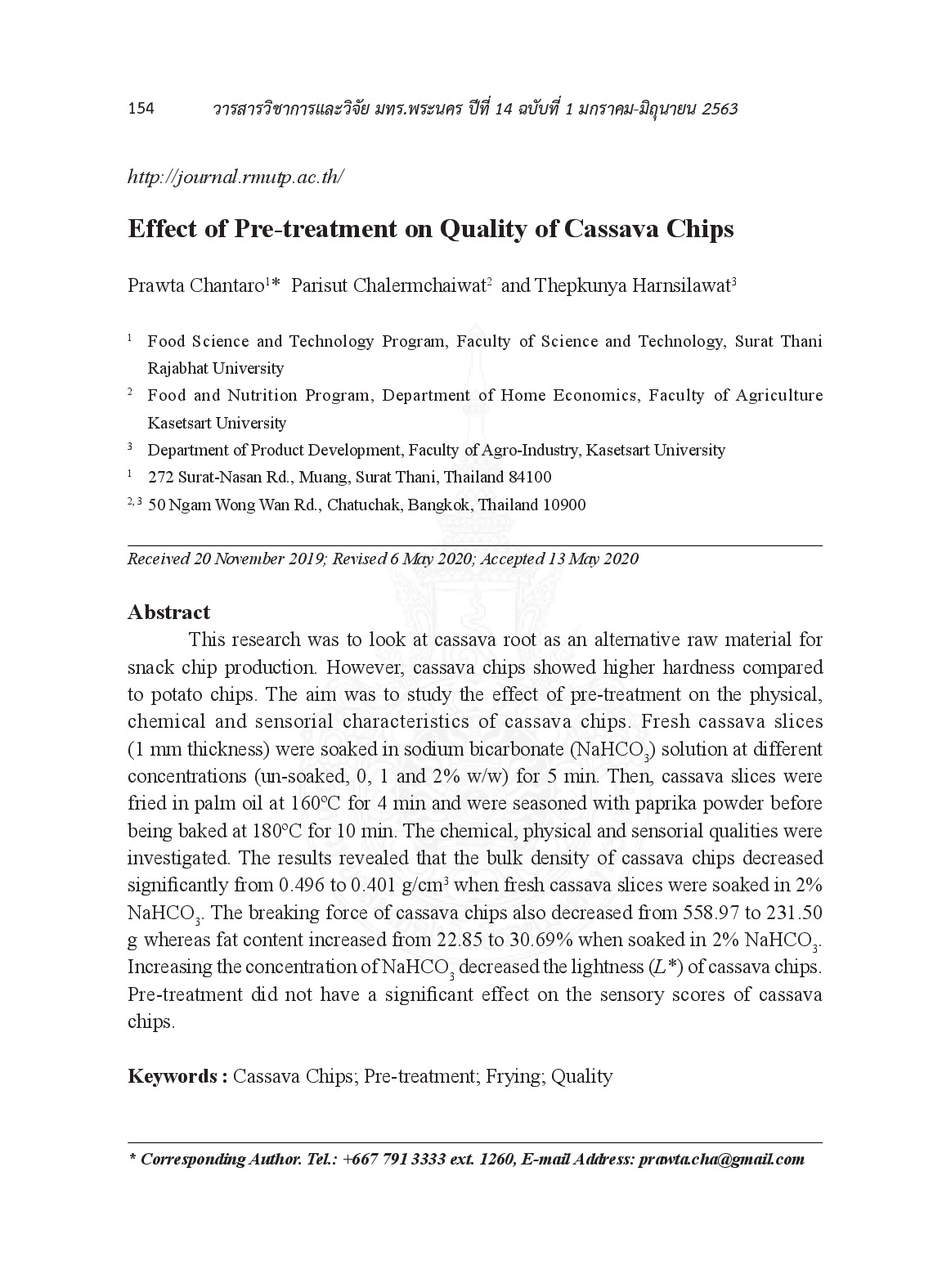
Effect of pre-treatment on quality of cassava chips
This research was to look at cassava root as an alternative raw material for snack chip production. However cassava chips showed higher hardness compared to potato chips. The aim was to study the effect of pre-treatment on the physical chemical and sensorial characteristics of cassava chips. Fresh cassava slices (1 mm thickness) were soaked in sodium bicarbonate (NaHCO3) solution at different concentrations (un-soaked 0 1 and 2% w/w) for 5 min. Then cassava slices were fried in palm oil at 160ºC for 4 min and were seasoned with paprika powder before being baked at 180ºC for 10 min. The chemical physical and sensorial qualities were investigated. The results revealed that the bulk density of cassava chips decreased significantly from 0.496 to 0.401 g/cm3 when fresh cassava slices were soaked in 2% NaHCO3. The breaking force of cassava chips also decreased from 558.97 to 231.50 g whereas fat content increased from 22.85 to 30.69% when soaked in 2% NaHCO3. Increasing the concentration of NaHCO3 decreased the lightness (L*) of cassava chips. Pre-treatment did not have a significant effect on the sensory scores of cassava chips.
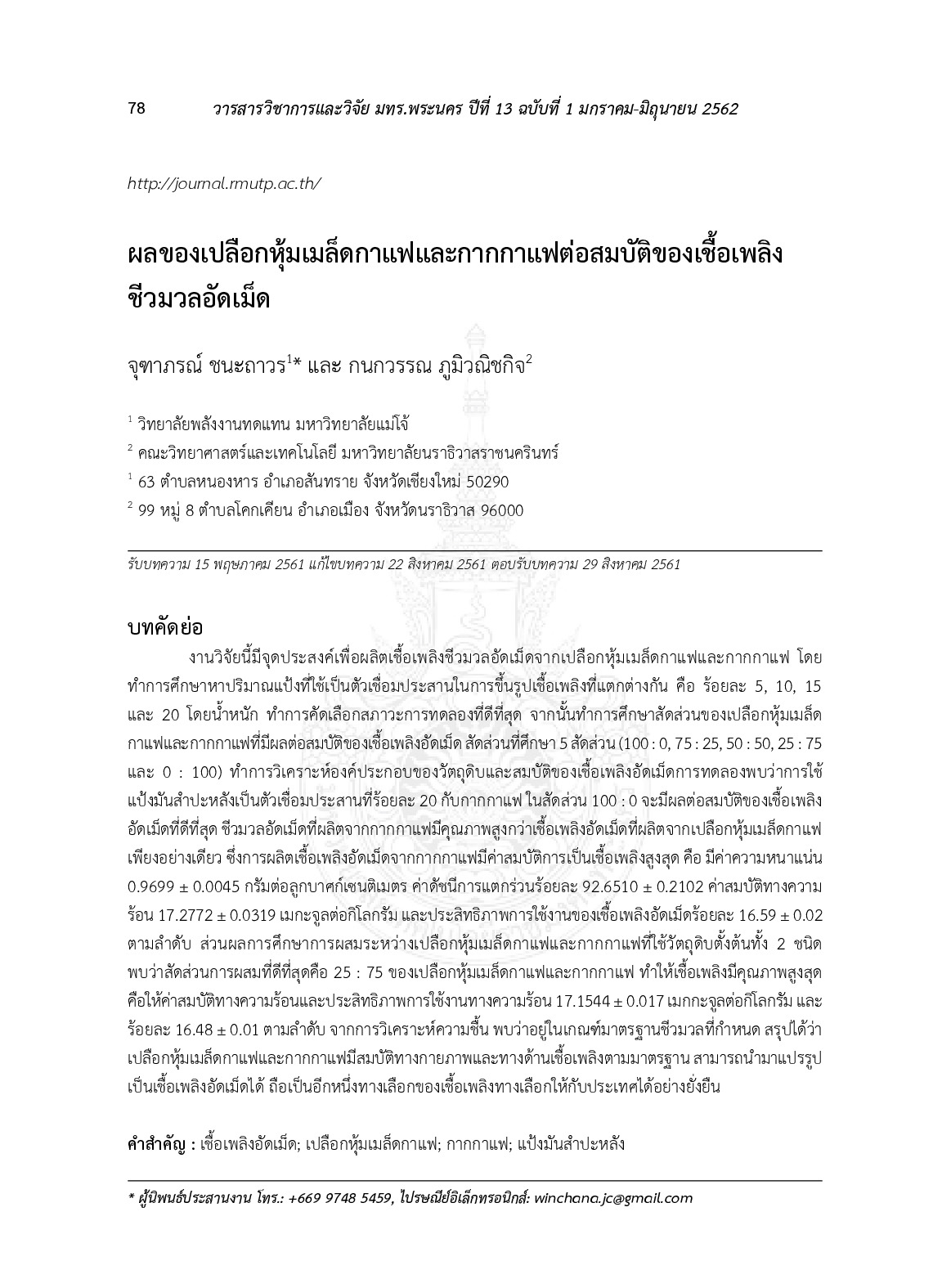
ผลของเปลือกหุ้มเมล็ดกาแฟและกากกาแฟต่อสมบัติของเชื้อเพลิงชีวมวลอัดเม็ด
The objective is to produce the biomass pellet fuel from coffee silverskin and spent of coffee grounds. To study the percentage of cassava powder as binder was mixed at 5 10 15 and 20% by weight and the best condition was chosen. Then to study the ratio of coffee silverskin and spent of coffee grounds was 5 ratios (100 : 0 75 : 25 50 : 50 25 : 75 and 0 : 100) on propertied of biomass pellet fuel. Characteristics and properties of raw materials and biomass pellet fuel were analyzed. The results found that the highest property of the biomass pellet fuel was 20% of cassava powder as binder. The biomass pellet from spent coffee grounds as main component was higher quality than coffee silverskin. The biomass pellet from spent coffee grounds was the maximum fuel property. The bulk density was 0.9699 0.0045 g/ cubic cm shatter index was 92.6510 ± 0.2102% heating value was 17.2772 ± 0.0319 MJ/kg and heat utilization efficiency was 16.59 ± 0.02%. The results from the part of coffee silverskin and spent of coffee grounds ratio showed that the best ratio from 2 raw materials was 25 : 75 that gave the highest quality. The heating value was 17.1544 ± 0.017 MJ/kg and heat utilization efficiency was 16.48 ± 0.01%. In addition the study also discovered that the biomass pellet had moisture contents in the levels acceptable under biomass standards. Thus in summary the coffee silverskin and spent coffee grounds had physical property and fuel property according to the standardization to be made into biomass pellet fuel. It considered to be one of alternative fuels in country permanently.