จำนวน Repository ( 123 )
ศึกษาสมบัติทางกายภาพของวัสดุเหลือใช้ทางการเกษตรเพื่องานหัตถอุตสาหกรรม ชุมชนบ้านถ้ำเสือ จังหวัดเพชรบุรี
This research 1) to study and analyze the relationship between the context of industrial handicraftsproperties of agricultural waste in community areas and 2) to agricultural waste to find physical properties and the industrial handicrafts for Bantumsua community Phetchaburi province. From primary data it was found the relationship of the community with the context of industrial crafts is a culture of agricultural wisdom from the collection of participatory research data. Found method and test the properties of paper pulp from agricultural waste where banana leaves = A bamboo leaves = B and pineapple leaves = C.Use the formula for quantifying the triangular grid the Trixie Blend Diagram to uses caustic sodium hydroxide 10-15% of dry weight. There are 7 test items 1 formula thin and thickness (a) according to the experimental standard referring to the community product standards plant fiber paper. For testing as follows: 1) standard average weight from the test of paper size 45x85 cm operation number list of the experimental formula test section 1.1) standard weight the overall average is equal to 220 grams/sqm. 1.2) part 2 tear strength which is strong = 3(10a) at 1962 mN the second strength = 1(8a) at 1907 mN and third = 6(13a) at 1467 mN. 1.3) Part 3 the overall moisture content of the paper the experiment found the humidity level is within the normal level at ± 10% which is complete and can be developed into a products or package. 2) Summary of physical properties the color characteristics of the paper according to provide color tones gray-brown and different beautiful suitable for the screen-printing and using large size rubber stamp. Process forming can produce use by semi-automatic heat setting at 140°C at time of 70 seconds per piece is suitable for further expansion to create industrial handicrafts for the community.
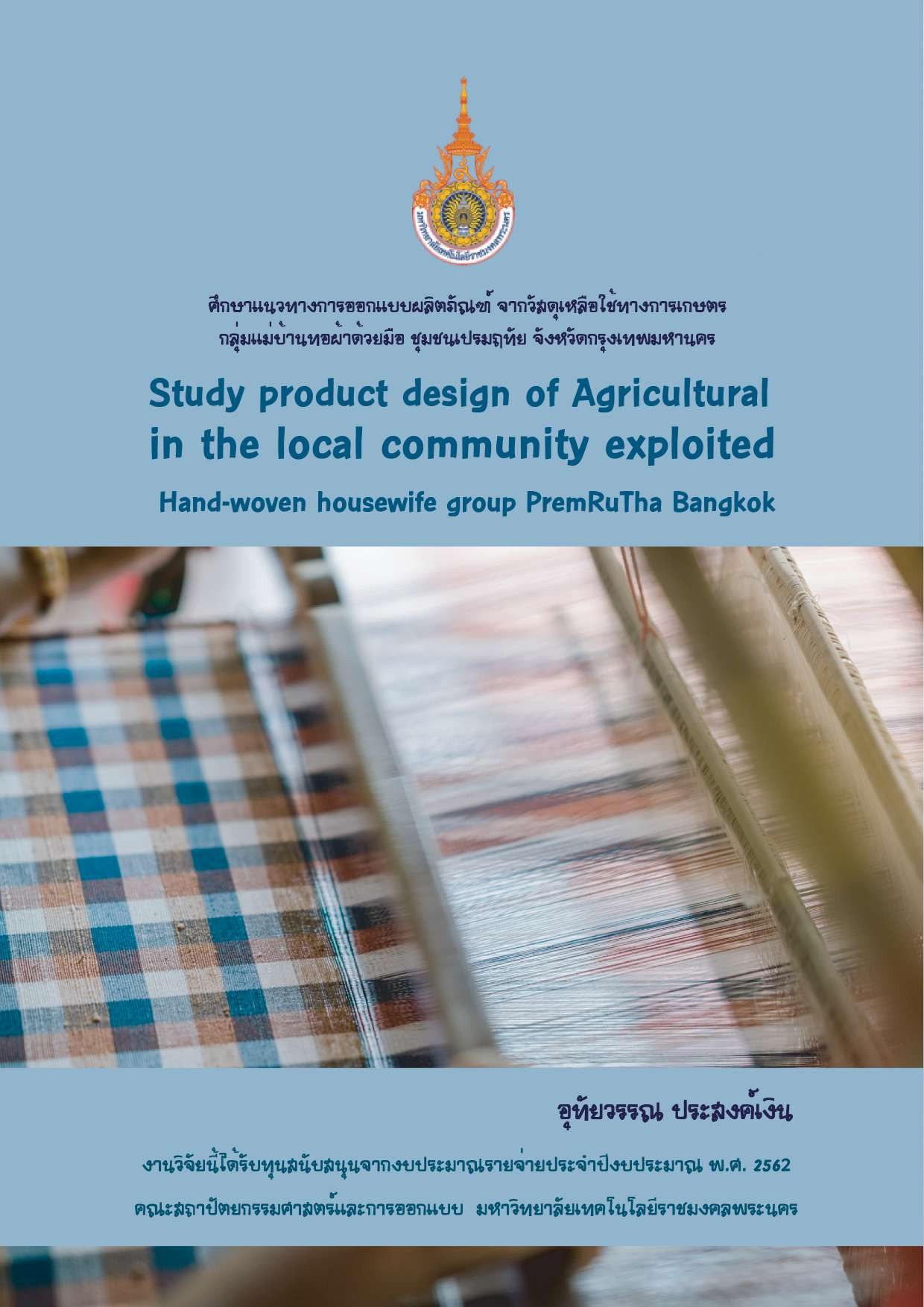
ศึกษาแนวทางการออกแบบผลิตภัณฑ์ จากวัสดุเหลือใช้ทางการเกษตร กลุ่มแม่บ้านทอผ้าด้วยมือชุมชนเปรมฤทัย จังหวัดกรุงเทพมหานคร
This research is Study the product design guidelines from agricultural waste materials. Weaving Housewife Group Premruethai Community Bangkok And in order to use waste materials to develop to add value With the following steps. (1) Surveying types amount of agricultural waste materials. (2) Study the physical structure and chemical properties of plant fibers. (3) Study the methods of preparing suitable fibers for textile materials. (4) Develop and study the suitable mixture ratio of blended fiber yarn. (5) Manufacture of hand-woven fabrics from agricultural waste materials. (6) Design and prototype of products from hand-woven fabrics from fibers agricultural waste And study from testing methods comparing the opinions of users / users and evaluators Assessed in the test Bring the results to analyze find conclusions analyze and suggest the research results to study. And analyze find conclusions study product design guidelines from agricultural waste materials Weaving Housewife Group Premruethai Community Bangkok Expect It was found that different methods of fiber content were obtained. And found that the amount of fiber varies according to the size of the material Analysis results of all chemical composition of fibers Found that the moisture content of 1.82% Water content 1.00% ashes 0.7 % and the fiber has the same amount of 0.97 mg kg at a normal level that can be found in general plants And meet the standard criteria Physical property test results of fibers The shape according to the cross-section of the fiber Looks like an oval almost round shape with a noticeable lumen. For the strength it was found that the fibers had an average elongation at break of 7.54% the toughness equal to 57.32% the fiber size was 16.45 deniers and the strength was 26.85 grams. Yarn production results The most suitable hand-woven (plant fiber and cotton) is 60% plant fiber mixed with 40% cotton. The yarn has an average toughness or strength of 4.86 newtons and the yarn is equal to 2.8 Ne and the result of Testing fabric peach mixed fiber fabric with handicraft pattern Found that the weaving of the fabric on the surface of the fabric and / or some grain on the fabric. And there is no hair and grain on the fabric medium Woven fabric has a lack of testing value from the number of abrasion cycles in the range of 1780 - 2100 and the color fastness to washing is in the level of 4-5 (the color has slightly changed And there is no color leakage) By the test streaking of yarn streaks (Plant fiber yarn) has the strength to withstand the pulling force in the range 577.30 - 610.22 newton the tear strength is in the range 37.26 - 53.89 newton and the size change after washing is in the range - 3.77 to - 6.59 should be developed into various home decoration products such as tableware sets curtains shoes bags etc. The assessor has the opinion that the use The beauty of various products Satisfied (1) Beauty pattern (2) color (3) Durability (4) Suitable proportion (5) Career promotion to local communities The assessors have the highest level of satisfaction respectively.
การพัฒนาผลิตภัณฑ์ของตกแต่งบ้านจากวัสดุรากเตยปาหนัน แรงบันดาลใจจากลวดลายผ้าทอเกาะยอ
The purposes of this research were to study the properties of Tei Panan Root suitable for the development of home decor products inspired by Koh Yo woven fabric patterns to conduct the development of home decor from Tei Panan material and to study the satisfaction of experts with home decoration products from Tei Panan root material inspired by the Koh Yo woven fabric patterns. The research began by studying the properties of Tei Panan root material and developing Tei Panan root materials. The most suitable formula was selected. The properties of Tei Panan root material were evaluated to select the most suitable pattern. The researcher designed the home decoration from Tei Panan material inspired by Koh Yo woven fabric pattern dividing to 3 types of lamps including hanging lamps wall lamps and table lamps (3 forms for each type). Five experts were appointed to select the most suitable form for each type. Then home decoration products were created from Tei Panan root material inspired by Koh Yo woven fabric pattern by assigning 10 experts consisting of 5 textile experts and 5 design experts and the product satisfaction was inquired about. The results showed that in the development of properties of Tei Panan root material the most suitable formula was formula 3 and the most suitable pattern was Su Ban Ni Ka pattern (n= 3 60%). The result of the development of home decoration from Panan material inspired by Koh Yo woven fabric pattern classifying hanging lamp form 3 (n=4 80%) wall lamp form 2 (n= 3 60%)and table lamp form 3 (n=3 60%). All 10 experts were satisfied with the home decoration products from Tei Panan root material inspired by Koh Yo woven fabric pattern with highest level in all aspects of satisfaction such as materials design product usability and overall satisfaction with a mean score of 4.56.
พัฒนาวัสดุคอมโพสิตพรุนจากดินลูกรังและทรายผสมพลาสติกเป็นวัสดุกรอง
จากการทดลองวิจัยพบว่าดินเป็นชั้นคุณภาพ A4 ประเภทของดินทรายแป้ง (Silty Soils) ผลการขึ้นรูปตามอัตราส่วนของ ดินลูกรัง – พลาสติก-ทราย ดินลูกรังและทรายที่ไมมีเรซินเป็นตัวประสานไมสามารถขึ้นรูปได้ และ ดินลูกรังและทรายที่มีเรซิน น้อยกว่า 20 % ไม่สามารถขึ้นรูปได้เนื่องจากปริมาณตัวประสานไมสามารถยึดเกาะกันระหว่างมวลกับพลาสติก กำลังอัดของ คอมโพสิตพรุน ขนาด 1 CM. สามารรับกำลังอัดตำสุดที่สามารขึ้นรูปและทดสอบได้อยู่ที 0.67 Ksc. และสูงสุดอยู่ที 6.37 Ksc. กำลังอัด คอมโพสิตพรุน ขนาด 2 CM. สามารรับกำลังอัดตำสุดที่สามารขึ้นรูปและทดสอบได้อยู่ที 2.1 Ksc. และสูงสุดอยู่ที 79.1Ksc.คอมโพสิตพรุน ขนาด 3 CM. สามารรับกำลังอัดตำสุดที่สามารขึ้นรูปและทดสอบได้อยู่ที 6.77 Ksc. และสูงสุดอยู่ที 132.03Ksc.คอมโพสิตพรุนขนาด 4 CM. สามารรับกำลังอัดตำสุดที่สามารขึ้นรูปและทดสอบได้อยู่ที 4.6 Ksc. และสูงสุดอยู่ที 138.17Ksc. คอมโพสิตพรุน 5 CM. สามารรับกำลังอัดตำสุดที่สามารขึ้นรูปและทดสอบได้อยู่ที 22.3 Ksc. และสูงสุดอยู่ที 143.20 Ksc.ความสามารถในการดูน้ำความชื่นลดลงตามปริมาณเรซิ่นที่เพิ่มขึ้นตำสุดที่สามารขึ้นรูปและทดสอบได้อยู่ที 0.0%. และสูงสุดอยู่ที 20.02% อ๊อกซีเจนในน้ำ (Dissolved) ของดินคอมโพสิตพรุน ทุกขนาก มีค่ามากกว่า 3 ปลอดภัย นำไปใช้เป็นวัสดุเพิ่มค่า อ๊อกซีเจนในน้ำเลียงสัตว์น้ำได้ อัลคาไลนิตี้ (Total alkalinity) kH ค่าทีน้อยทีสุดได้สูงสุดอยู่ที่ 238 มิลิกรัมต่อลิตร สูงสุดอยู่ที 549 มิลิกรัมต่อลิตร ทุกอัตราส่วนไม่สามารถ ลดค่าแอมโมเนีย (Ammonium) ให้ได้ตามมาตราฐาน ค่า ไนไตรท์ (Nitrite) ทุกอัตราส่วนสามารถ ลด ได้ตามมาตราฐาน ค่า PH กรด-ด่าง (PH indicator strips) เป็นตามมาตราฐาน 6.50-8.50 ค่าอยู่ที่ 7 – 9 ดังนั้นการเลื่อกใช้งานให้เหมาะกับคุณสมบัตของวัสดุแต่ละขนาดและอัตราส่วนผสม
การผลิตและพัฒนาบรรจุภัณฑ์ที่ย่อยสลายได้จากวัสดุเชิงประกอบพลาสติก ชีวภาพและเส้นใยธรรมชาติที่ผ่านการปรับปรุงด้วยสารไซเลน
This work aimed to study the improvement of mechanical properties and cost reduction of biodegradable packaging made from polylactic acid (PLA) by using sisal fiber. Because sisal fiber as natural fiber is good mechanical properties biodegradable material and low cost. The variables studied were the addition of sisal fiber surface treatment with epoxy silane and fiber direction. Their effects were investigated by tensile flexural and impact testings and morphology analysis. The results suggested that the addition of sisal fiber increased Young’s modulus Flexural modulus and ultimate tensile stress whereas elongation at break and impact strength tended to decrease. For the effect of surface treatment it was found that tensile and flexural moduli increased with epoxy silane treatment but tensile flexural and impact strengths slightly changed. Surface treatment by epoxy silane led to good interfacial bonding by hydrogen bonding between oxirane ring of epoxy silane and hydroxyl group of PLA. The effect of fiber direction revealed that tensile properties of composite in fiber direction of 0o were higher than those of composite in fiber direction of 45o. Fiber direction did not affect flexural and impact properties.