จำนวน Repository ( 19 )
ปัจจัยที่มีผลต่อพฤติกรรมการเลือกซื้อสินค้าด้านหัตถกรรมของนักท่องเที่ยวในตลาดน้ำ จังหวัดสมุทรสงคราม
The purpose of this research are to : 1) Study personal factors of tourists 2) study purchasing behavior on handcraft products of tourist 3) Study the marketing mix factors used to make a purchase decision 4) Find the relationship between personal factors and purchasing behavior 5) Comparison of the importance of marketing mixfactors used in decision making to buy handicraft products in Samut Songkhram Floating Market. The samples were 400 Thai tourists who came to visit and purchase handicraft products in Samut Songkhram Floating Market. The instruments used included: Statistical questionnaire used in data analysis viz frequency percentage mean standard deviation Pearson Chisquare t-test and ANOVA. Statistical analysis by used computer program. The finding reveal that 1) Most of the tourists are females aged 21 to 25 years old. They have a bachelors degree and most of them are students with monthly average income less than 10000 baht 2) The tourists have behavior of purchasing for handicrafts first is a metal product. The purpose or the reason to decide to buy the product is to use it yourself to purchase a product once a month. Most tourists decide to purchase immediately when they see the product. The average price is approximately 51 - 100 Baht. Tourists decide to purchase by themselves. 3) Tourists focus on the marketing mix factors used to make a purchase at the highest level and when considering each side found that there are 3levels at the highest level. Sort by descending from the average is product marketing and pricing. Tourists focus on distribution at a high level. 4) Relationship between personal factors and purchasing behavior on handicraft products of tourist Samut Songkhram Floating Market found that gender age education level occupation and monthly income were correlated with the purchas in g behavior of tourists in Samut Songkhram Floating Market at the level of 0.5. and 5) Comparison of the importance of marketing m ix factors used in decision making to buy handicraft products in Samut Songkhram Floating Market found thatgender educational levels and occupations of the tourists are important to the marketing mix used in the decision to buy handicraft products in Floating Market Samut Songkhram Province is different. The age and average income per month of different tourists are important to the marketing mix used in the decision to buy handicraft products in Floating Market Samut Songkhram Province is not different at the level of 0.05.

ศักยภาพภูมิปัญญาท้องถิ่นด้านอาหารพื้นบ้านเพื่อเพิ่มมูลค่าพืชท้องถิ่น ของชุมชนแพรกหนามแดง อาเภออัมพวา จังหวัดสมุทรสงคราม
The purposes of this research were to investigate the types of local foods of Praknamdaeng Community and the potential of local wisdom of the community’s traditional foods in the aspect of raw material resources production process commercial production wisdom transfer to collect the knowledge of food ingredients and cooking methods and to study nutritive values of 15 recipes (using INMUCAL-Nutrients program) in Praknamdaeng Community Amphawa Samutsongkhram. This research was conducted by in-depth interviews with 12 local food experts who have lived in six villages of Praknamdaeng Community. Two people per village were purposively selected. The research tools were interview forms a tape recorder and a camera. The data were analyzed by mean percentage and rating scales. The study revealed that 132 types of local foods were found and classified into three groups namely main dish (75%) dessert (15.15%) as well as preserved and processed foods (9.85%). As for the potential in raw material resources all types of traditional foods were at a high level (100%) and in the aspect of the potential in production process all kinds of the foods were also at a high level namely main dish (93.94%) preserved and processed foods (84.62%) and dessert (80%). Furthermore the potential in preserved and processed food’s commercial production was at a high level (53.85%) whereas the potential in dessert’s commercial production was at a moderate level (40%) and the potential in main dish was at a low level (52.53%). From the result of wisdom transfer all types of the foods were at a moderate level including dessert (100%) preserved and processed foods (100%) and main dish (67.67%). As a result of the collection of the knowledge of food ingredients and cooking methods the commonly used meat to cook main dishes were found in the local areas and consisted of cuttle fish tilapia long-whiskered catfish mullet sea catfish sea bass rock cod mackerel bream white bait nile tilapia shakehead fish giant tiger prawn banana shrimp jinga shrimp sea crab and salt mardi crab. Moreover the vegetable ingredients were phak plang (Bacella alba Linn.) cha-kram (seablite) luk sam sip (Asparagus race mosus willd) phak bia (rose moss) nam pung do (Azima sarmentosa Benth) and phak kom hin (Trianthema portulacastrum). Most dessert ingredients were coconut milk palm sugar and granulated sugar whereas the ingredients of preserved and processed foods were fishes shrimps and salt which were used to preserve foods; for example drying salting etc. In addition the findings showed that the main dishes’ cooking methods of six villages were curries with local vegetables including hot and sour soup with phak kom hin (Trianthema portulacastrum) hot and sour soup with cha-kram (seablite) hot and sour soup with phak plang (Bacella alba Linn.) hot and sour soup with tua tob tab (Derris trifoliate Lour.) hot and sour soup with yod prong thalee (queen sago leaf) hot and sour soup with sano (Sesbania javanica Mig.) flower kaeng liang (spicy herb soup) with phak kom hin (Trianthema portulacastrum) kaeng oom (dill soup) with nam pung do leaf and red curry with Nipa palm’s fruit. Nowadays the ready-made curry paste which is available in the market is normally used. If any vegetables used were bitter salty or astringent they would be boiled before cooking. Most of the desserts were boiled ones such as khanom tom (Thai coconut munchkins) khuay buat chi (banana in sweet coconut milk) buat fak thong (pumpkin in sweet coconut milk) green beans in light syrup soft sweet sticky rice pudding with young coconut meat and tapioca pearl pudding with young coconut meat. Due to lots of fishes all year-round most of the favorite preserved and processed foods in the community were sun-dried fish and deep-fried marinated fish. Due to study the nutritive values of 15 recipes of local foods of Praknamdaeng Community it was found that cha-kram red curry with cockle provided highest energy (2578.59 kcal) highest fat (196.29 g) highest iron (74.35 mg.) highest Vitamin B1 (0.70 mg) and highest Vitamin B2 (2.76 mg) respectively. Cha-kram Jam provided highest carbohydrate (347.76 g). Steamed tilapia curry in banana leaves with cha-kram provided highest protein (135.15 g) highest Vitamin C (65.65 mg) and highest Niacin (24.73 mg) respectively. Nam Pung Do scrambled egg provided highest Vitamin A (736 µg RE). According to sensory evaluation test on appearance color odor taste texture and preference of 15 recipes of Praknamdaeng’s local foods the result of taster acceptability test indicated that they highly liked every aspect of 13 recipes while steamed tilapia curry in banana leaves with cha-kram and Cha-kram Jam were accepted between a moderate level and a high level.
การพัฒนารูปแบบการสร้างชุมชนเข้มแข็งด้านการตลาดของ วิสาหกิจชุมชน จังหวัดสมุทรสงคราม
The study of Research and Development of Model for Building Strong Community on Marketing of Samutsongkram Community Enterprises. It was aimed to investigate factors affecting effectiveness of running this enterprise for further improvement and to figure out possible path for enhance productivity of small community enterprises. The subject of this study consisted producers Community Enterprises entrepreneurs who participating seminar in improving management and product designs. The participants included 149 community enterprises group 200 participants in total. The result stated that 1) Producing management ranked high level while each aspect yielded different results. Finance and accounting ranked the highest producing and cooperatingranked respectively lower. The administrative was estimated as following; 2) Considering factors affecting effectiveness of Community on Marketing of Samutsongkram Community Enterprises ranked the high level in overall. Looking at each aspect budgets and learning improvement ranked the highest while participants ‘knowledge and gathering budgets and resources ranked the lowest. 3) Factors influencing effectiveness of community enterprise included planning controlling cooperating marketing producing administrating accounting organization managing affected the overall efficiency of Samutsongkram Community Enterprises predicted at 97.60%. 4) Focus group analysis was done by SWOT Analysis presented strength weakness opportunity and threat of community enterprise planning from preparation implementation and application as following;Preparation step: Arranging seminar in designing and product design. Having financial support field trip for figuring out uniqueness of Samutsongkram Community Enterprises Implementation step: Supporting distribution channels enhancing production by increase machine capacity setting up standard guarantee center and encouraging new group of small and minor community enterprise Application step: Promoting products of Samutsongkram Community Enterprises by different channels of advertisement improving brand of the group and also information technology to support Samutsongkram Community Enterprises.
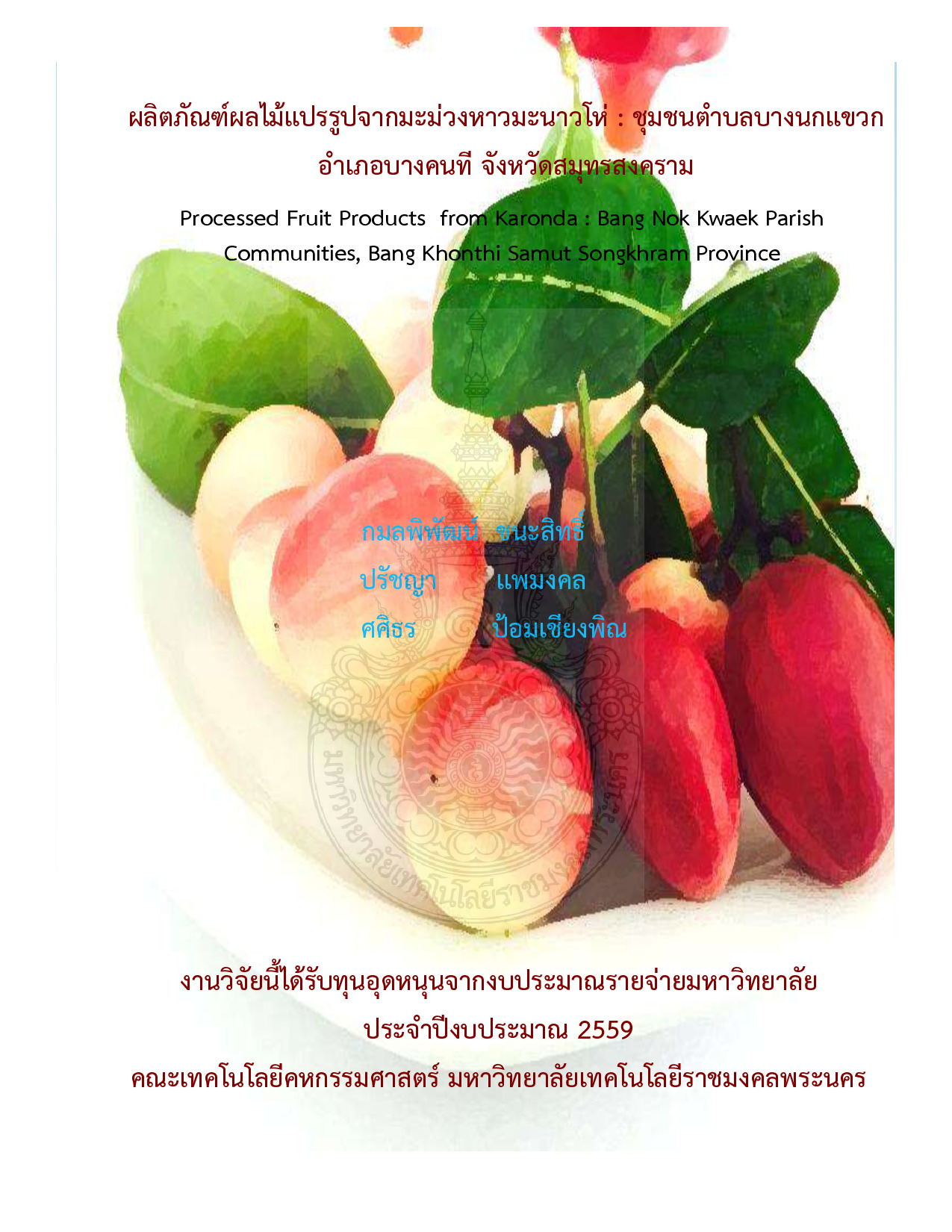
ผลิตภัณฑ์ผลไม้แปรรูปจากมะม่วงหาวมะนาวโห่ : ชุมชนตำบลบางนกแขวก อำเภอบางคนที จังหวัดสมุทรสงคราม
The purpose of the study of processed fruit products from Karonda : Bang Nok Kwaek parish communities Bang Khonthi Samut Songkhram Province is to study the proper quantity of the Koranda fruit in the product the quality in the product’s process and the consumers’ acceptance (Consumer Test) in the product. The processed products are Karonda fruit jelly instant pasteurized Karonda fruit juice with extra fiber Karonda fruit sorbet Karonda fruit yoghurt ice-cream and concentrated juice (sauce) for drink mixing. The product has been tested by Randomized Complete Block Design (RCBD) method. The process was consisted with offering a tasting and evaluated in color scent taste matter and overall satisfaction by giving 9 point Hedonic scale from 70 consumers. And has been compared the difference of average means at 95% trustiness by Duncan’s New Multiple Range Test (DMRT) by an instant statistical analysis software. The result information is as the followings; The physical properties indicates of Karonda fruit the total acidity of 2.30 with the pH and the color was found that the brightness (L *) of 16.52 fee (a *) equal to 8.95 and (b. *) equals 5.37. The study of the chemical quality of Karonda fruit amount of energy in calories carbohydrates 73.2 percent 18.3 percent protein 1.57 percent 1.32 percent humidity fats fiber 83.7 percent ash 4.26 percent and 0.75 Vitamin C is found. The duration of ripening fruit yawning lemon booed affect the vitamin C in the fruit of the mango yawning lemon booed the oil will have more vitamin C than ripe to t 2 so I scratched the reduction of vitamin C may. Is due to be deployed as a compound to breathe. And led to the synthesis of new carbon structures during ripening. Karonda fruit jelly. The most acceptances level for Karonda fruit juice in the product is at 1:6 for its best flexibility. Since the juice concentration affects the jelly as it lowers the matter (flexibility). Too much of acid in Karonda fruit juice is able to unstabilize jelly matter. From the study of Pectin quantity the consumer has the most acceptance at the level of 10 grams which is the best recipe that keeps the good jelly matter (flexibility) stabilized. The physical properties indicates that there are the level of color hue at 5R color brightness at Value 4 Chroma at 14 sweetness at 35 Brix and pH at 3.05. The study of the chemical quality of Karonda fruit jelly in each 100 grams provides 120 kilocalories of energy 69.60 grams of humidity 0.11 gram of fat 29.80 grams of carbohydrate 0.41 gram of fiber 0.50 gram of ash and 0.45 gram of acidity. The consumer satisfaction is at 97.30 percent. Instant pasteurized Karonda fruit juice with extra fiber. The acceptance is at 100 percent of replacing Okra fruit juice by Karonda fruit juice. The acceptance study shows that the most proper fiber quantity adding to Karonda fruit juice is at 15 percent. The acceptance study shows that the most proper Pectin quantity affecting coconut jelly spreading is at 3 percent. The analysis results of the physical properties indicate that instant pasteurized Karonda fruit juice with extra fiber has color hue level at 5R value at 4 and Chroma at 12 which rendered the product to dark red. Also the pH level is at 3.29 sweetness is at 17 Brix firness g force 1 is at 11.29 g Viscosityag.sec AREA F-T 1:2 is at 339.507 ag.sec. The study of the chemical quality of Karonda fruit juice in each 100 grams provides 63.3 kilocalories of energy 83.9 grams of humidity 0.01 gram of fat 0.10 gram of protein 15.8 grams of carbohydrate 0.41 gram of fiber 0.24 gram of ash and 0.18 gram of pH balance. The consumer satisfaction to instant pasteurized Karonda fruit juice with extra fiber is at 98.66 percent. Karonda fruit sorbet. The most proper quantity of Karonda fruit juice is at 30 percent. The physical properties of Karonda fruit sorbet contain the brightness level at L*34.32 red color level at a*41.26 yellow color level at b*21.18 meltable solid quantity at 30*Brix and pH balance at 2.40. The study of the chemical quality of Karonda fruit sorbet in each 100 grams provides 91.8 kilocalories of energy 77.1 grams of humidity 0.15 gram of fat <0.20 gram of protein 22.6 grams of carbohydrate 0.11 gram of fiber and 0.12 gram of ash. The consumer satisfaction to Karonda fruit sorbet is at 100 percent. Karonda fruit yoghurt ice-cream. The most proper quantity of Karonda fruit added in the yoghurt ice-cream is at 10 percent of the whole ingredient. The consumers’ acceptance has been given the most for its scent taste matter (smoothness) and overall satisfaction which has the average mean at 7.24 7.77 7.17 and 7.67 consequently. The physical properties of Karonda fruit yoghurt ice-cream contain the viscosity level at 364.798 cps. color hue at 10P Value at 8/6 Chroma at N9/.5 overrun statistics at 4.55 and Karonda fruit yoghurt ice-cream melting rate at 89.90. The chemical quality of Karonda fruit yoghurt ice-cream in each 100 grams provides 214 kilocalories of energy 64.0 grams of humidity 14.6 gram of fat 3.14 gram of protein 17.5 grams of carbohydrate 0.76 gram of fiber 0.74 gram of ash and 5.67 pH balance. The consumer satisfaction to Karonda fruit yoghurt ice-cream is at 100 percent. Concentrated juice (sauce) for drink mixing. The most acceptance recipe is the strawberry sauce recipe number 1 with the replacement of Karonda fruit at 80 percent. The physical properties contain the viscosity level at 9.28 cps sweetness at 21 Brix color hue at 5R Value at 2 and Chroma at 4. The chemical quality of concentrated juice (sauce) for drink mixing in each 100 grams provides 91.1 kilocalories of energy 77.2 grams of humidity 0.30 gram of fat 0.1 gram of protein 22.3 grams of carbohydrate 0.76 gram of fiber 0.4 gram of vitamin C and 0.56 of pH balance. The consumer satisfaction concentrated juice (sauce) for drink mixing is at the maximum satisfaction at 92.0 percent as the concentrated juice (sauce) emphasizes the better taste of smoothie drink mixing and easy to consume.
ศักยภาพภูมิปัญญาท้องถิ่นด้านอาหารพื้นบ้านเพื่อเพิ่มมูลค่าพืชท้องถิ่น ของชุมชนแพรกหนามแดง อำเภออัมพวา จังหวัดสมุทรสงคราม
The purposes of this research were to investigate the types of local foods of Praknamdaeng Community and the potential of local wisdom of the community’s traditional foods in the aspect of raw material resources production process commercial production wisdom transfer as well as to collect the knowledge of food ingredients and cooking methods in Praknamdaeng Community Amphawa Samutsongkhram. This research was conducted by in-depth interviews with 12 local food experts who have lived in six villages of Praknamdaeng Community. Two people per village were purposively selected. The research tools were interview forms a tape recorder and a camera. The data were analyzed by mean percentage and rating scales. The study revealed that 132 types of local foods were found and classified into three groups namely main dish (75%) dessert (15.15%) as well as preserved and processed foods (9.85%). As for the potential in raw material resources two types of traditional foods were at a high level (100%) and in the aspect of the potential in production process all kinds of the foods were also at a high level preserved and processed foods (84.62%) and dessert (80%) and main dish was at a moderate level (54.55%) Furthermore the potential in preserved and processed food’s commercial production was at a high level (53.85%) whereas the potential in dessert’s commercial production was at a moderate level (45%) and the potential in main dish was at a low level (59.60%). From the result of wisdom transfer all types of the foods were at a moderate level including dessert (100%) preserved and processed foods (100%) and main dish (67.67%). As a result of the collection of the knowledge of food ingredients and cooking methods the commonly used meat to cook main dishes were found in the local areas and consisted of cuttle fish tilapia long-whiskered catfish mullet sea catfish sea bass rock cod mackerel bream white bait nile tilapia shakehead fish giant tiger prawn banana shrimp jinga shrimp sea crab and salt mardi crab. Moreover the vegetable ingredients were phak plang (Bacella alba Linn.) cha-kram (seablite) luk sam sip (Asparagus race mosus willd) phak bia (rose moss) nam pung do (Azima sarmentosa Benth) and phak kom hin (Trianthema portulacastrum). Most dessert ingredients were coconut milk palm sugar and granulated sugar whereas the ingredients of preserved and processed foods were fishes shrimps and salt which were used to preserve foods; for example drying salting etc. In addition the findings showed that the main dishes’ cooking methods of six villages were curries with local vegetables including hot and sour soup with phak kom hin (Trianthema portulacastrum) hot and sour soup with cha-kram (seablite) hot and sour soup with phak plang (Bacella alba Linn.) hot and sour soup with tua tob tab (Derris trifoliate Lour.) hot and sour soup with yod prong thalee (queen sago leaf) hot and sour soup with sano (Sesbania javanica Mig.) flower kaeng liang (spicy herb soup) with phak kom hin (Trianthema portulacastrum) kaeng oom (dill soup) with nam pung do leaf and red curry with Nipa palm’s fruit. Nowadays the ready-made curry paste which is available in the market is normally used. If any vegetables used were bitter salty or astringent they would be boiled before cooking. Most of the desserts were boiled ones such as khanom tom (Thai coconut munchkins) khuay buat chi (banana in sweet coconut milk) buat fak thong (pumpkin in sweet coconut milk) green beans in light syrup soft sweet sticky rice pudding with young coconut meat and tapioca pearl pudding with young coconut meat. Due to lots of fishes all year-round most of the favorite preserved and processed foods in the community were sun-dried fish and deep-fried marinated fish.