จำนวน Repository ( 13 )
การพัฒนารูปแบบเสื้อผ้าสตรีจากผ้าลินินย้อมด้วยดอกดาวเรือง
Developing women’s clothing design from marigold-dyed linen. The objectives of the project were : 1) to study about linen dying technique with marigold with various kinds of mordant 2) to design and develop women’s clothing from marigold-dyed linen 3) to study the satisfaction of representative samples for the women’s clothing design from marigold-dyed linen. Using simple random sampling method analyzing the data with statistics percentage mean and deviation standard. The sample groups are selected from working women in Dusit District Suan Chitlada Subdistrict and students from Rajamangala University of Technology Phra Nakhon in total 100 participants. Research instruments are questionnaire and 2 women’s clothing prototypes one was dyed with natural mordant and the other chemical mordant. The results indicated that most of the samples aged from 25 and above single graduated with bachelor degree are general office workers and students and earn less than 15000 baht. The result also revealed the satisfaction for the women’s clothing design from marigold-dyed linen a design which was dyed with both natural and chemical mordant. The participants are satisfied with the modern design suited for working age and very useful at a high level with means of 4.07 and 4.05 natural and chemical mordant respectively. Considering the overall result the participant tended to be satisfied with natural mordant dyed dress more with a mean of 4.07
การพิมพ์ผ้าฝ้ายโดยใช้สารให้สีจากเปลือกมังคุด
This research was concerned a printing on cotton fabrics with dye powder from mangosteen rind. In this study the dye powder was composed of dye’ s solution extracted from mangosteen rind and maltodextrin 15 % . The dye powder was applied to a cotton fabric by screen printing technique and a pigment based print paste was used as a print paste in the printing process. Aluminium potassium sulphate (AlK(SO4)2·12H2O )and Iron (II) sulphate (FeSO4·7 H2O) were used as mordants in post-mordanting process. The influences of mordanting on colour appearance and fastness properties of printed fabrics were investigated. The colour fastness to washing and rubbing of printed fabrics was performed according to the present ISO standard. The results show that the post- mordanting can improve the colour fastness properties of printed fabrics. The ratings of colour fastness to washing and rubbing of the printed fabrics with the mordant were good. The appropriate amount of the mordant is 5 grams per liter and duration in the range of 5 minutes to 15 minutes seem to be a suitable time for the post- mordnating process. The type of mordant produced an effect on the colour appearance of the printed fabrics after mordanting.
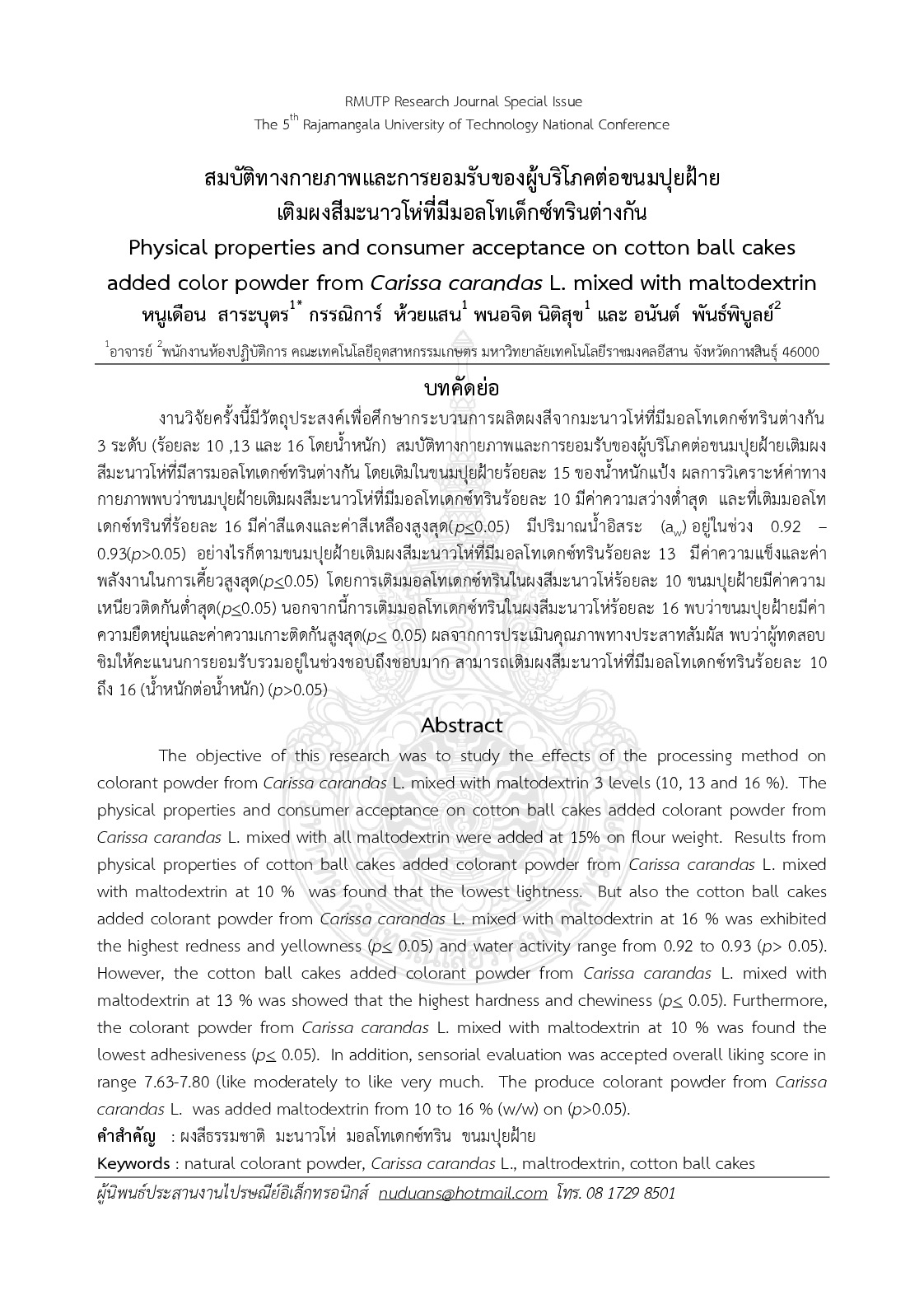
Physical properties and consumer acceptance on cotton ball cakes added color powder from carissa carandas l. mixed with maltodextrin
The objective of this research was to study the effects of the processing method on colorant powder from Carissa carandas L. mixed with maltodextrin 3 levels (10 13 and 16 %). The physical properties and consumer acceptance on cotton ball cakes added colorant powder from Carissa carandas L. mixed with all maltodextrin were added at 15% on flour weight. Results from physical properties of cotton ball cakes added colorant powder from Carissa carandas L. mixed with maltodextrin at 10 % was found that the lowest lightness. But also the cotton ball cakes added colorant powder from Carissa carandas L. mixed with maltodextrin at 16 % was exhibited the highest redness and yellowness (p< 0.05) and water activity range from 0.92 to 0.93 (p> 0.05). However the cotton ball cakes added colorant powder from Carissa carandas L. mixed with maltodextrin at 13 % was showed that the highest hardness and chewiness (p< 0.05). Furthermore the colorant powder from Carissa carandas L. mixed with maltodextrin at 10 % was found the lowest adhesiveness (p< 0.05). In addition sensorial evaluation was accepted overall liking score in range 7.63-7.80 (like moderately to like very much. The produce colorant powder from Carissa carandas L. was added maltodextrin from 10 to 16 % (w/w) on (p>0.05).