จำนวน Repository ( 20 )
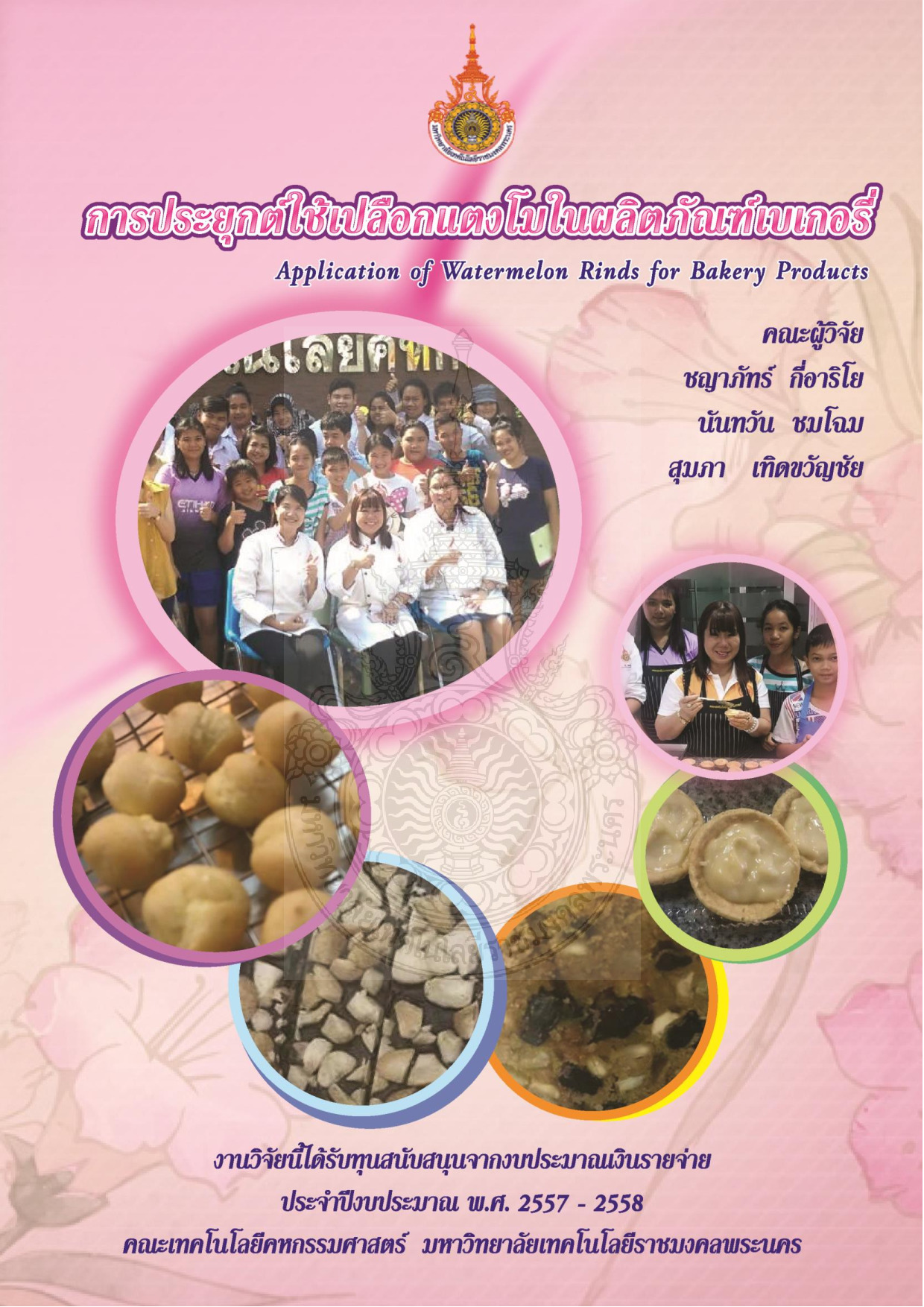
การประยุกต์ใช้เปลือกแตงโมในผลิตภัณฑ์เบเกอรี
The purpose of the application of watermelon rinds for bakery products is to study an appropriate amount of used watermelon rinds in four of bakery products such as cookie bar fruit cake Eclair with vanilla cream and coconut tarte. The research was planned in accordance with “Randomized Complete Block Design RCBD”. Sense test by tasting method by giving favorite scores of 9 levels (9 – Point Hedonic Scale) quality test of chemical composition and physical composition including acceptance test of 100 people towards the products were performed. The use of watermelon rinds in syrup added in cookie bar at 10% 15% and 20% of all total ingredients weight was found that the testing persons favored the cookie bar added watermelon rinds in syrup at 15% of all total ingredients weight. There are of favorite score in appearance color smell taste food texture and overall at 7.70 7.90 7.85 7.90 7.80 and 7.80 respectively. When analyzed with Oneway ANOVA compared the average of favorite scorn found that color smell taste food texture and overall the difference in statistical significant at (p 0.05). The approximate chemical compositions of cookie bar added watermelon rinds in syrup at 100g. were consisting of energy 436 Kcal carbohydrate 57.10g. protein 6.10g. fat 20.40g. moisture 15.20g. and ash 1.24g. physical quality of water activity (AW) as 0.80. The use of watermelon rinds in syrup substitute cherry in fruit cake at 50% 75% and 100% the testing persons favored the watermelon rinds in syrup substitute cherry in fruit cake at 100%. There are of favorite score in appearance color smell taste food texture and overall at 7.40 7.90 7.95 8.00 7.90 and 7.75 respectively. When analyzed with One-way ANOVA compared the average of favorite scorn found that color smell taste food texture and overall the difference in statistical significant at (p 0.05). The approximate chemical compositions of watermelon rinds in syrup substitute cherry in fruit cake at 100g. were consisting of energy 330 Kcal carbohydrate 63g. protein 6.08g. fat 5.93g. moisture 23.70g. and ash 1.31g. physical quality of water activity (AW) as 0.78. The use of watermelon rinds added in Eclair with vanilla cream at 20% 40% and 60% of vanilla cream weight was found that the testing persons favored the Eclair with vanilla cream added watermelon rinds at 20% of vanilla cream weight. There are of favorite score in color smell taste food texture and overall at 8.50 8.40 8.40 8.00 and 8.10 respectively. When analyzed with Oneway ANOVA compared the average of favorite scorn found that color smell taste food texture and overall the difference in statistical significant at (p 0.05). The approximate chemical compositions of Eclair with vanilla cream added watermelon rinds at 100g. were consisting of energy 190 Kcal carbohydrate 28.80g. protein 4.24g. fat 6.40g. moisture 59.70g. and ash 0.82g. physical quality of water activity (AW) as 0.97. The use of watermelon rinds substitute coconut in coconut tarte at 50% 75% and 100% the testing persons favored the watermelon rinds substitute coconut in coconut tarte at 75%. There are of favorite score in appearance color smell taste food texture and overall at 8.05 7.85 7.70 7.65 7.70 and 7.60 respectively. When analyzed with One-way ANOVA compared the average of favorite scorn found that appearance color taste food texture and overall the difference in statistical significant at (p 0.05). The approximate chemical compositions of watermelon rinds substitute coconut in coconut tarte at 100g. were consisting of energy 167 Kcal carbohydrate 27.80g. protein 1.78g. fat 5.38g. moisture 64.30g. and ash 0.69g. physical quality of water activity (AW) as 0.78. This research was found that the appected consumers in four of bakery products because of this products is add-value and using local ingredient from agriculture in this country. From the technology transfer of bakery products from watermelon rinds to community the results showed that the majority of participants were female with an average age ranging from 21 to 30 years old. Overall satisfaction level towards this project was high and respondent opinions towards trainers were high.

การศึกษาปัจจัยที่มีผลต่อการเปิดร้านเบเกอรี่ บริเวณมหาวิทยาลัยมหิดล อำเภอพุทธมณฑล จังหวัดนครปฐม
towards the bakery and the decisive factors affecting the selection of its products around the area of Mahidol University Phutthamonthon District Nakhon Pathom Province. The sample are 400 people and the research instrument was the rating-scale questionnaire administered to investigate the expectation factors and consumer demand towards the bakery and the decisive factors affecting the selection of its products. The statistical devices used to analyze all of the data from the questionnaire were the percentage mean and standard deviation. The results from the expectation factors and consumer demand towards the bakery showed thatthe sample like to have the bakery decorated in a vintage style. The customer service include having some relaxing and eating areas and takeaway. The bakery hours are 09.00 am – 09.00 pm. and it should close on Wednesdays. The price of the products are between 101 - 200 baht. Furthermore tea coffee chocolate cocoa fresh milk should be included in the bakery. From the decisive factors affecting the purchase of the bakery products it revealed that the sample prefers eating or buying cake most. Theconsuming frequency is once a week and the products are bought for only the consumption during 3 pm. – 6 pm. About the product the quality of the bakery must be fresh. The price is fair for the value of the product. The location of the bakery should be accessible and in the community. About the service the waiters or waitresses must greet and welcome customers politely and happily. Moreover the sale promotion is having the members get a discount
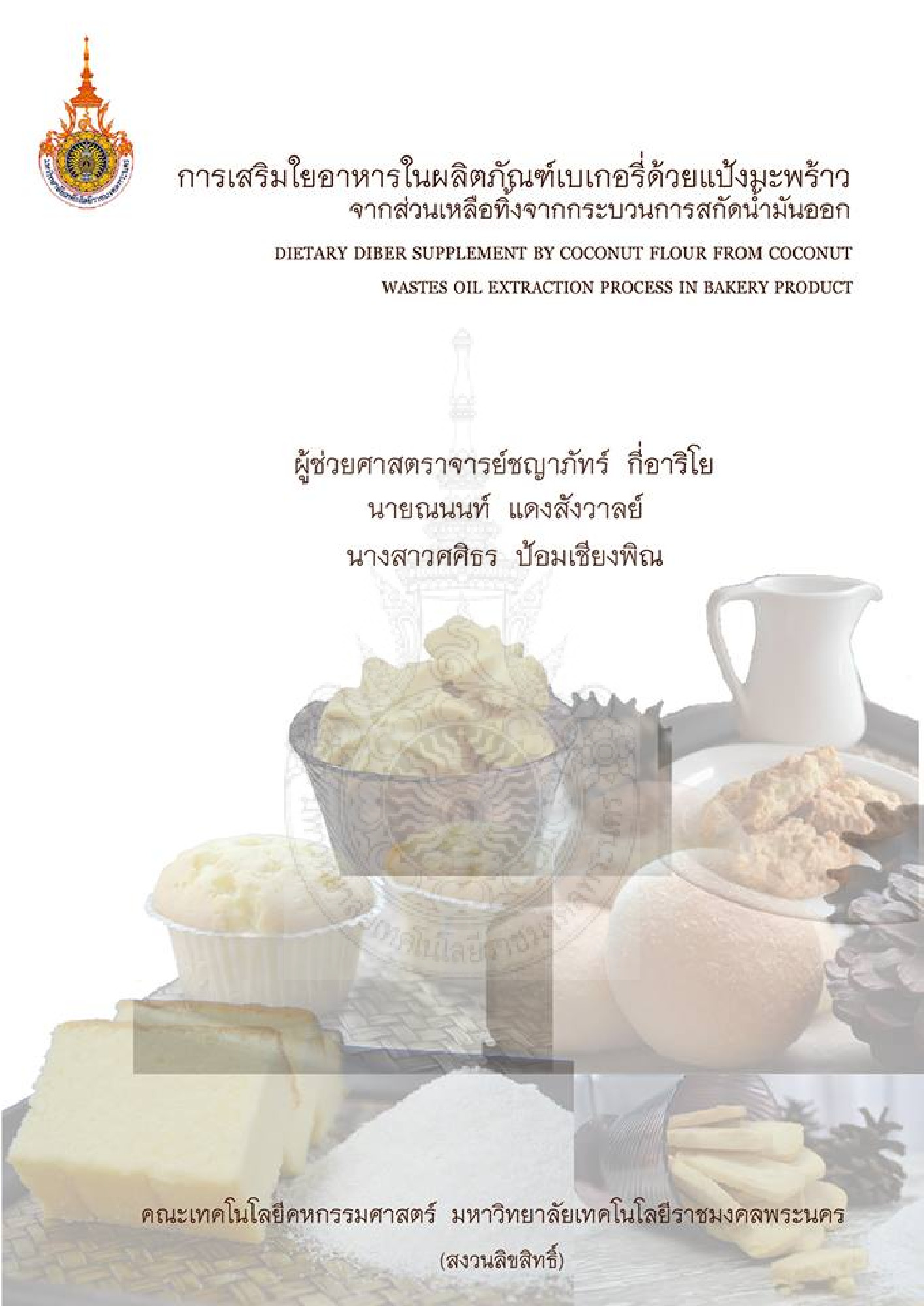
การเสริมใยอาหารในผลิตภัณฑ์เบเกอรี่ด้วยแป้งมะพร้าวจากส่วนเหลือทิ้งจากกระบวนการสกัดน้ำมันออก
The studies of Dietary Fiber Supplement by coconut flour from coconut Wastes Oil Extraction process in Bakery Product was investigated Production of coconut flour from coconut wastes oil extraction drying at 55 ° C for 12 hours and then grinding to powder gave the off-white fine powder. The chemical compositions of coconut flour were 57.70 % carbohydrate 29.4 % fat 6.23 % moisture 5.20 % protein and 1.48 % ash by dye weigh. Butter cake making experiment by substitution of wheat flour with coconut flour at 5 % of wheat flour weigh which has the highest sensory scores comparing butter cake with the control found that increase dietary fiber 1.34 g. /100 g. The majority of the tested consumers (92%) accepted butter cake with 5 % of coconut flour substitution. Muffin making experiment by substitution of wheat flour with coconut flour at 15 % of wheat flour weigh which has the highest sensory scores comparing muffin with the control found that increase dietary fiber 2.34 g /100 g. The majority of the tested consumers (81%) accepted muffin with 15 % of coconut flour substitution. Cornflake cookie making experiment by substitution of wheat flour with coconut flour at 20 % of wheat flour weigh which has the highest sensory scores comparing cornflake cookie with the control found that increase dietary fiber 3.54 g. /100 g. The majority of the tested consumers (94 %) accepted cornflake cookie with 20 % of coconut flour substitution. Butter cookie making experiment by substitution of wheat flour with coconut flour at 10 % of wheat flour weigh which has the highest sensory scorescomparing butter cookie with the control found that increase dietary fiber 3.04 g. /100 g. The majority of the tested consumers (94 %) accepted Butter cookie with 10 % of coconut flour substitution. Frozen cookie making experiment by substitution of wheat flour with coconut flour at 20 % of wheat flour weigh which has the highest sensory scores comparing cookie with the control found that increase dietary fiber 4.02g. /100 g. The majority of the tested consumers (93 %) accepted 20 % of coconut flour substitution. Butter bread making experiment by substitution of wheat flour with coconut flour at 15 % of wheat flour weigh which has the highest sensory scores comparing butter bread with the control found that increase dietary fiber 2.22 g. /100 g. The majority of the tested consumers (75 %) accepted 15% of coconut flour substitution. Whole wheat bread making experiment by substitution of wheat flour with coconut flour at 15 % of wheat flour weigh which has the highest sensory scores comparing whole wheat bread with the control found that increase dietary fiber 2.09 g. /100 g. The majority of the tested consumers (79 %) accepted 15 % of coconut flour substitution. Pie crust making experiment by substitution of wheat flour with coconut flour at 15 % of wheat flour weigh which has the highest sensory scores comparing pie crust with the control found that increase dietary fiber 2.91 g. /100 g. The majority of the tested consumers (82 %) accepted 15 % of coconut flour substitution.
การศึกษาอายุวันของไข่ไก่ที่มีผลต่อผลิตภัณฑ์ปันจ์เค้ก
The objectives of the research on the different egg age affecting the sponge cake were to study the appropriate different egg age to bake the sponge cake and examine the physical and chemical qualities of the sponge cake. The density of the different age cake was measures using the randomized complete block design (RCBD) method at 95% reliability. The quality of senses sight color smell taste and texture and the overall preference were evaluated. The difference of mean was compared with by Duncan New Multiple Rang Test (DMRT) using a computer program to find the appropriate different egg age to bake the sponge cake. 30 testers applied the 5- point hedonic scale to test the product. Research results showed that the testers preferred the egg age at 9 days the most. Ln terms of taste texture and overall preference the mean was 3.70 3.67 and 4.00 respectively. The physical quality test results indicated that the texture of the one-day egg age had the best adhesion and flexibility 0.54 and 0.94 respectively. The egg age at 12 days had the highest lightness (L*) yellowness (b*) and redness (a*) 50.61 4.71 and 23.99 respectively with the statistical significance (p).≤ 0.05
การศึกษาแป้งถั่วขาวทดแทนแป้งสาลีในทาร์ตสับปะรดไต้หวัน
Study on white bean flour in place of wheat flour in Taiwan pineapple tart The objective is to study the basic recipe of Taiwanese pineapple tart. And study the amount of white bean flour in place of wheat flour in Taiwan pineapple tart. By studying the 3 basic recipes of Taiwanese pineapple tart flour. To get the recipe that the tastemakers accept the most And to study the amount of white bean flour instead of wheat flour in 5 levels of Taiwanese pineapple which are 0 percent (control formula) white bean flour instead of wheat flour in 25 percent Taiwanese pineapple tart 50 percent 75 percent and 100 percent. of all wheat flour. The randomized complete block design (RCBD) was used to plan the sensory qualities of appearance color smell taste texture and overall liking. With a 9-point Hedonic Scale tasting method using 40 tasting participants 2 repeated. Who is a teacher and students in the food and nutrition program Faculty of Home Economics Technology Rajamangala University of Technology Phra Nakhon Take the result to find the mean 𝑥̅ Analysis of Variance (ANOVA) and compare the difference of the mean by the method (Least Significant Difference (LSD). The results of white bean flour instead of wheat flour in Taiwan pineapple tart. The tasters accept 25 percent of the taste texture and overall liking. With an average 7.50 7.40 and 7.43 respectively At a moderate level. Regarding appearance and color tasters accepted 0 percent with an average of 7.30 and 7.35 respectively. At a moderate level. As for the smell The tasters accepted 50% with an average of 7.45. Ata moderate level. When used to analyze the variance compare the differences. Found that the appearance color smell taste texture and overall liking. There is a statistically significant difference at the level of 0.05.