จำนวน Repository ( 110 )

การวิเคราะห์คุณภาพไฟฟ้าสำหรับโรงต้นกำลังแบบเซลล์แสงอาทิตย์ ขนาด 1 เมกะวัตต์และผลกระทบทางด้านเศรษฐศาสตร์ในระบบจัดจำหน่าย
This thesis presents the Power Quality (PQ) analysis of solar power plant 1MW and economic impacts in the distribution power networks. The case study focuses on the penalty fee (fine) from consume the reactive power less than the limit of the Provincial Electricity Authority (PEA) of Thailand. The fine have been charged up to 900000 baht per year. Therefore the thesis studies and purposes the possible solution by analysing the operating function of the inverter (supports reactive mode) installing the adjustable capacitor bank 1500kVar in the Medium Voltage (MV) level and lastly installing the adjustable capacitor bank 1500kVar in the Low Voltage (LV) level. The results shown that the possible solution that reduces the fine is installed the adjustable capacitor bank 1500kVar in the MV. The investment of this installation is cost 1800000 baht with the nominal operation over 10 years. The analysis of financial investment which bases on the Net Present Value (NPV) the Benefit-Cost ratio (B/C) the Pay Back period (PB) is presented the NPV at 4902971 baht B/C 3.72 and PB 2 year (with the Internal Rate of Return; IRR 49.7 percent).
สโตแคสติกเพื่อวิเคราะห์สถานะบีบอัดของแสงในวงแหวนสั่นพ้องแพนด้า
The stochastic process and the squeezed state representation of photons was applied to study the propagation of the entangled photons produced in a nonlinear micro PANDA ring resonator. The four-wave mixing process for generating entangled photon is also analyzed to get the stochastic equation of motion of the entangled photon states. The external spectrum correlation for entangled photon generation is also achieved in analytic form. The results are appropriate to be a quantum processing device to use in quantum computer.
การศึกษาสถานะบีบอัดของแสงในวงแหวนสั่นพ้องแพนด้า
The propagation of photon states in a nonlinear micro - PANDA ring resonator are studied and analyzed. The squeezed state representation of photon can be achieved via four – wave mixing process in the micro-ring resonator. The effect of thermal noise is also studied to optimum the validity of the next application in the CPU of quantum computer.
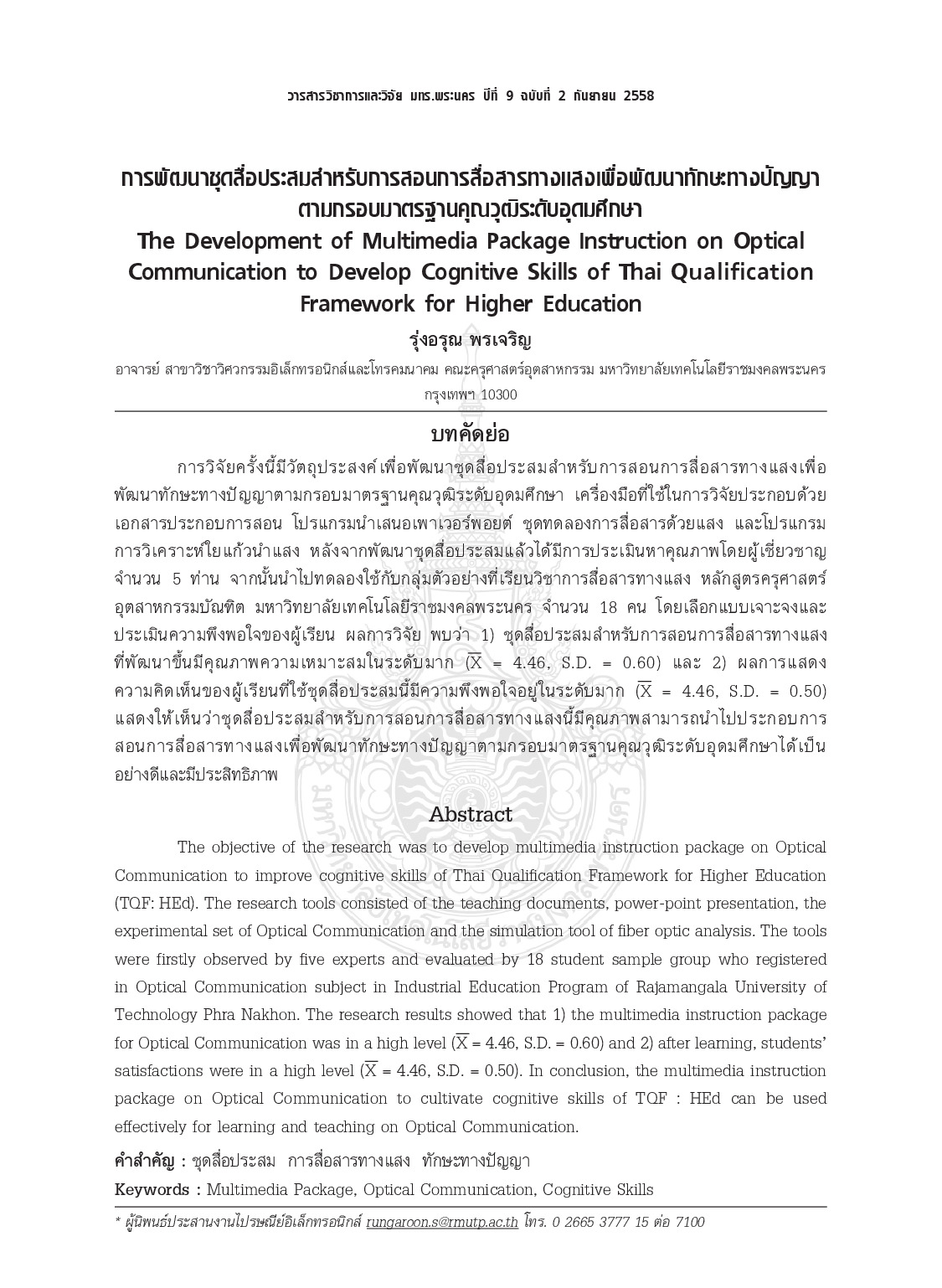
การพัฒนาชุดสื่อประสมสำหรับการสอนการสื่อสารทางแสงเพื่อพัฒนาทักษะทางปัญญาตามกรอบมาตรฐานคุณวุฒิระดับอุดมศึกษา
The objective of the research was to develop multimedia instruction package on Optical Communication to improve cognitive skills of Thai Qualification Framework for Higher Education (TQF: HEd). The research tools consisted of the teaching documents power-point presentation the experimental set of Optical Communication and the simulation tool of fiber optic analysis. The tools were firstly observed by five experts and evaluated by 18 student sample group who registered in Optical Communication subject in Industrial Education Program of Rajamangala University of Technology Phra Nakhon. The research results showed that 1) the multimedia instruction package for Optical Communication was in a high level (X ̅=4.46S.D.=0.60) and 2) after learning students’ satisfactions were in a high level (X ̅=4.46S.D.=0.50). In conclusion the multimedia instruction package on Optical Communication to cultivate cognitive skills of TQF: HEd can be used effectively for learning and teaching on Optical Communication.
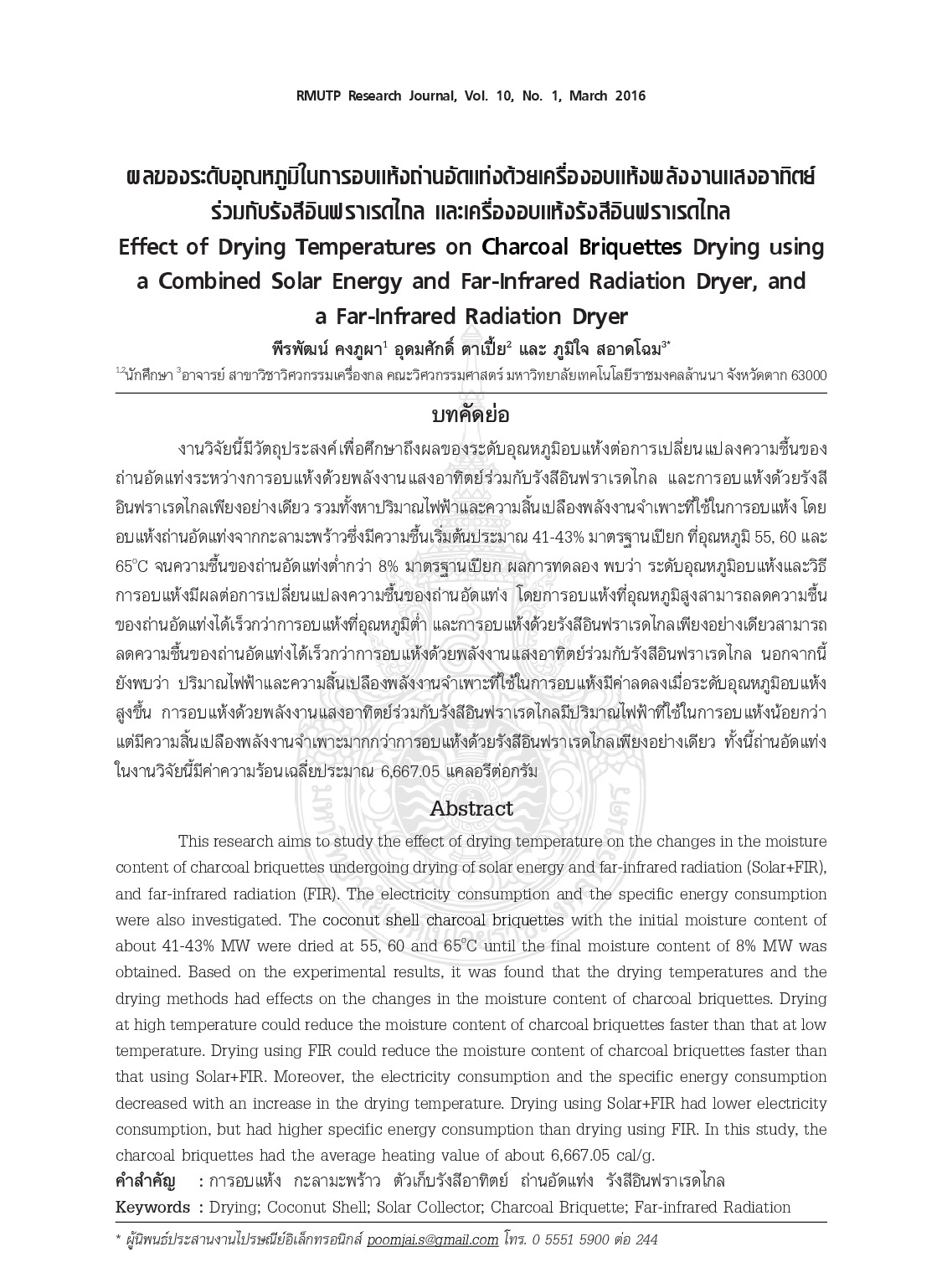
ผลของระดับอุณหภูมิในการอบแห้งถ่านอัดแท่งด้วยเครื่องอบแห้งพลังงานแสงอาทิตย์ร่วมกับรังสีอินฟราเรดไกล และเครื่องอบแห้งรังสีอินฟราเรดไกล
This research aims to study the effect of drying temperature on the changes in the moisture content of charcoal briquettes undergoing drying of solar energy and far-infrared radiation (Solar+FIR) and far-infrared radiation (FIR). The electricity consumption and the specific energy consumption were also investigated. The coconut shell charcoal briquettes with the initial moisture content of about 41-43% MW were dried at 55 60 and 65oC until the final moisture content of 8% MW was obtained. Based on the experimental results it was found that the drying temperatures and the drying methods had effects on the changes in the moisture content of charcoal briquettes. Drying at high temperature could reduce the moisture content of charcoal briquettes faster than that at low temperature. Drying using FIR could reduce the moisture content of charcoal briquettes faster than that using Solar+FIR. Moreover the electricity consumption and the specific energy consumption decreased with an increase in the drying temperature. Drying using Solar+FIR had lower electricity consumption but had higher specific energy consumption than drying using FIR. In this study the charcoal briquettes had the average heating value of about 6667.05 cal/g.