จำนวน Repository ( 14 )

การศึกษาการผลิตยำสามกรอบชนิดแท่งโดยใช้โปรตีนเกษตรทดแทนกระเพาะปลาทอดกรอบ
The study on textured vegetable protein as crispy fish maw compensate in Crispy Fish Maw in Spicy Salad Bar. The purpose of study on processing spicy salad Bar. Study amount of textured vegetable protein The result of this the spicy salad bar that has 50 grams. Study amount of dried squid cashew nut and dried shrimpThe result of this spicy salad bar that has 50:50:30 grams The most panelists score in them of color flavor odor texture and overall because product is the nice color texture has weakest smell of dried squid. Study amount of dried chive onion powder and celery powder The result of this spicy salad bar that has 0.5:0.4:4 grams because product is the weakest smell. Study of Total Soluble Solids (TSS) of sauce in spicy salad bar at 85 Brix product had not very hardness and crumble. Study thickness of this the spicy salad bar at 1.5 centimeter product is the nice texture. So that compare market product with physical and chemical textured vegetable protein as crispy fish maw compensate in Crispy fish maw compensate in Crispy Fish Maw in Spicy Salad Bar. The physical water activity were as follow in the rage 0.41 which similar as market product and light brown. The analysis of product contained fat protein fiber and ash is height value as market product. And test about microorganisms (TPC) in product is less than 10 CPU/g and lower then benchmark (it must be lower than 1x10 ) CFU/g) and yeast and mold less than 10 CFU/g (it must be lower than 1x10 ) CFU/g) in 14 day. Acceptant the most consumers moderately.
The production of single cell protein from copra meal residue by saccharomyces cerevisiae and bacillus subtilis for development as animal feedstuff
This experiment was conducted to study on single cell protein production from copra meal residue by Saccharomyces cerevisiae and Bacillus subtilis as animal feedstuffs. The experimental design was 4x3 factorial in CRD experiment with two factors were design to experiment. The first factor was comprised of fermented period (0 15 30 and 45 days). While the second factor B was comprised of microorganism type (Saccharomyces cerevisiae Bacillus subtilis and Saccharomyces cerevisiae combined with Bacillus subtilis). The results showed that interaction between factor A and B on pH (4.00-4.53) and percentage yield (29.21-33.80) were highly significantly different (P<0.01). However Incubation temperature were not related between factor A and B. Additional both factor have no effect to incubation temperature (P?0.05). For nutrients composition the group was fermented Saccharomyces cerevisiae combined with Bacillus subtilis showed higher Crude Protein than other treatments (P<0.01). Optimum of period at days 45 showed that crude protein 14.77 percent was significantly (P<0.01) and pepsin digestibility 66.60 percent was significantly (p<0.01)
Effects of cryoprotectants on qualities of dorab wolf-herring gel and fish balls
The objectives of this study was to evaluate effects of cryoprotectants on Dorab wolf herring gel qualities using sucrose (3 and 6%) with sodium tripolyphosphate (STPP 0.3%) as cryoprotectants at 0 3 and 6 freeze-thaw cycle (-18 C 18 hr. freezing and 5 C 6 hr. thawing). The results showed that added 3 and 6% sucrose in combination with 0.3% STPP to washed minced fish resulted in whiter gel than washed minced fish with no cryoprotectants and unwashed minced fish at 0 3 and 6 freeze-thaw cycles (P0.05). Besides expressible moisture of washed minced fish with cryoprotectants added was found lower than washed minced fish with no cryoprotectants and unwashed minced fish at 0 3 and 6 freeze-thaw cycle (P 0.05). Textural properties i.e. washed minced fish with cryoprotectants gel strength (breaking force g) was higher than washed minced fish with no cryoprotectants at 0 freeze-thaw cycle but gel elasticity (deformation cm.) was not statistically different (P>0.05).
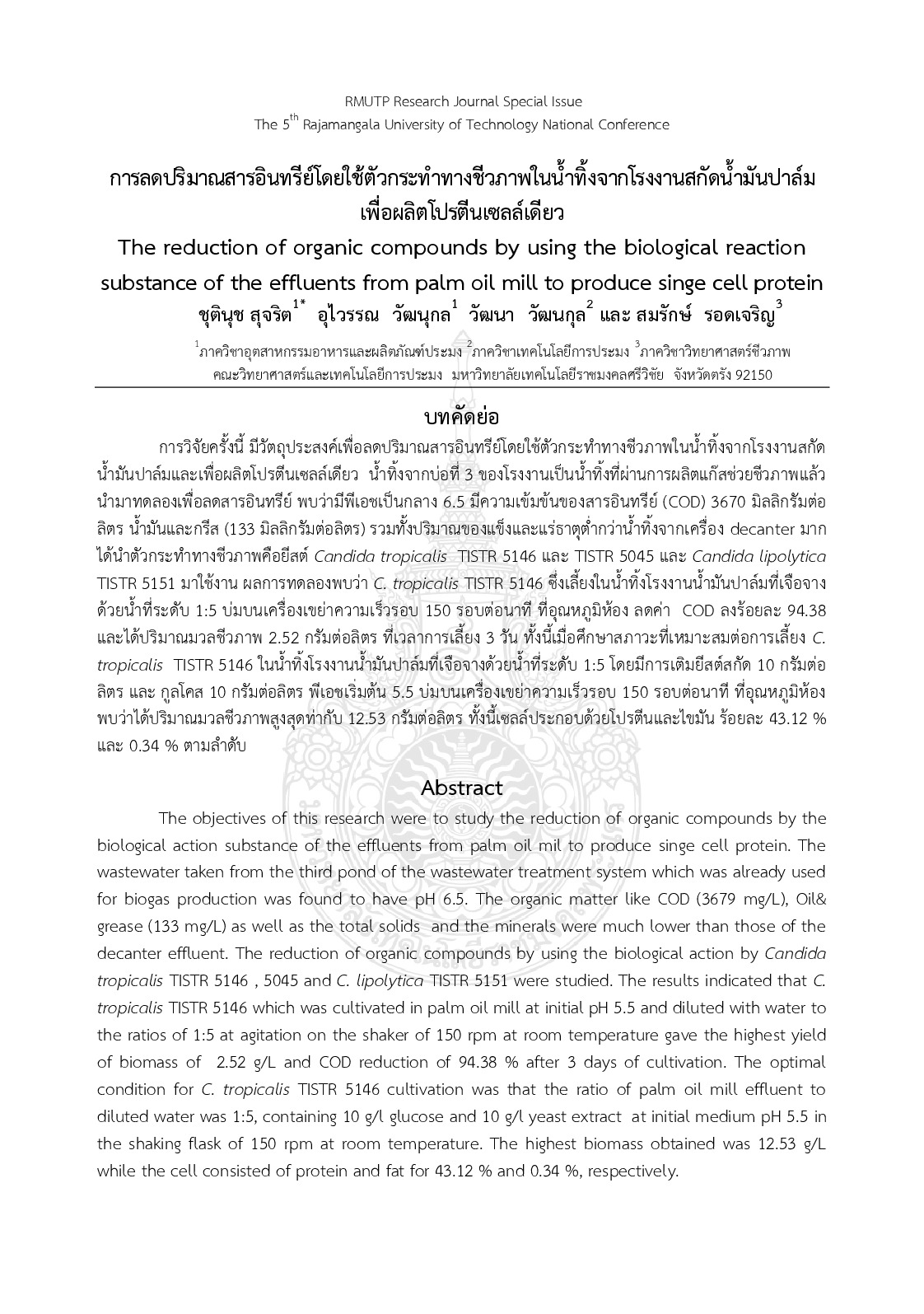
The reduction of organic compounds by using the biological reaction substance of the effluents from palm oil mill to produce singe cell protein
The objectives of this research were to study the reduction of organic compounds by the biological action substance of the effluents from palm oil mil to produce singe cell protein. The wastewater taken from the third pond of the wastewater treatment system which was already used for biogas production was found to have pH 6.5. The organic matter like COD (3679 mg/L) Oil& grease (133 mg/L) as well as the total solids and the minerals were much lower than those of the decanter effluent. The reduction of organic compounds by using the biological action by Candida tropicalis TISTR 5146 5045 and C. lipolytica TISTR 5151 were studied. The results indicated that C. tropicalis TISTR 5146 which was cultivated in palm oil mill at initial pH 5.5 and diluted with water to the ratios of 1:5 at agitation on the shaker of 150 rpm at room temperature gave the highest yield of biomass of 2.52 g/L and COD reduction of 94.38 % after 3 days of cultivation. The optimal condition for C. tropicalis TISTR 5146 cultivation was that the ratio of palm oil mill effluent to diluted water was 1:5 containing 10 g/l glucose and 10 g/l yeast extract at initial medium pH 5.5 in the shaking flask of 150 rpm at room temperature. The highest biomass obtained was 12.53 g/L while the cell consisted of protein and fat for 43.12 % and 0.34 % respectively.