จำนวน Repository ( 26 )
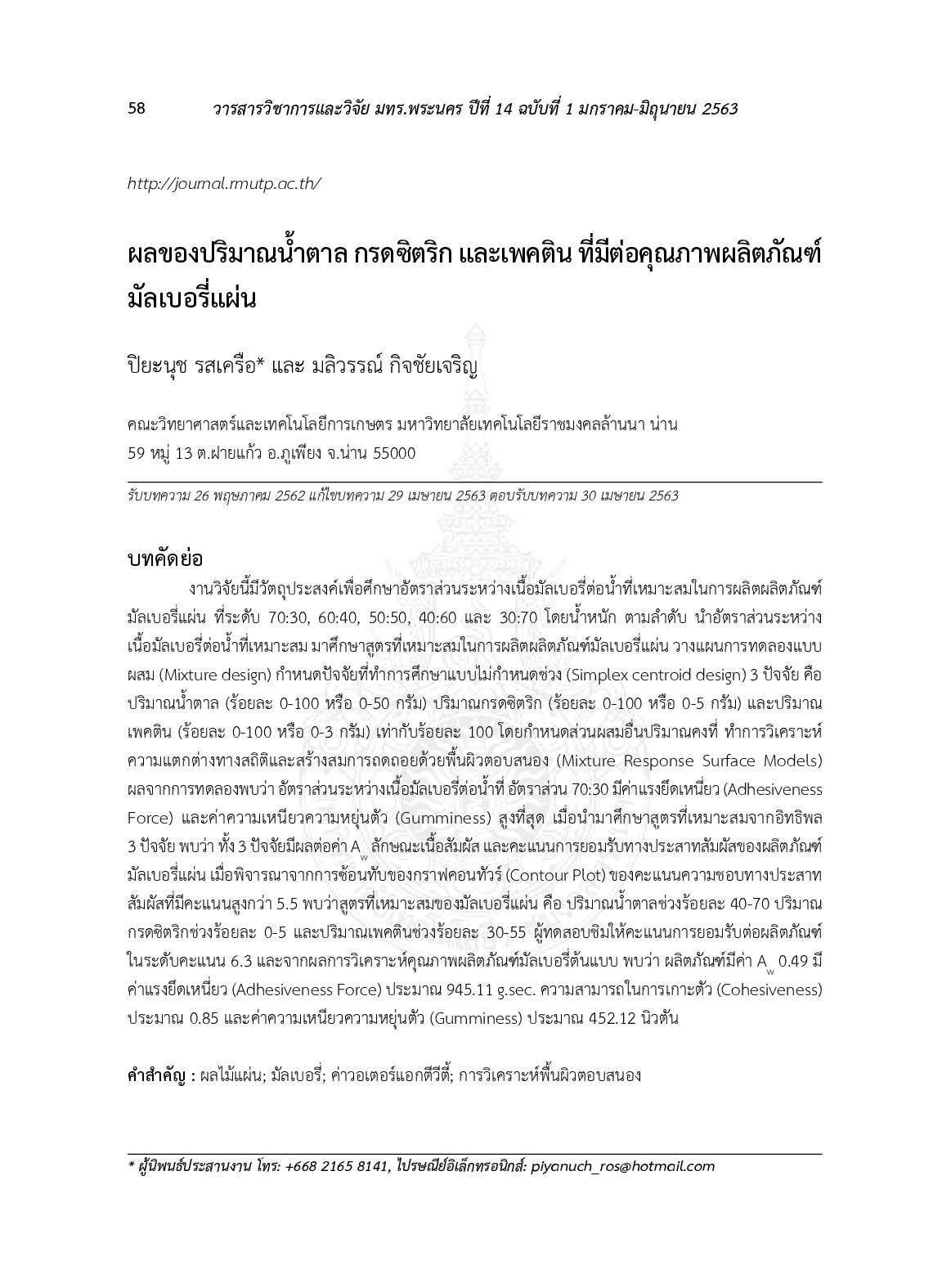
ผลของปริมาณน้ำตาล กรดซิตริก และเพคติน ที่มีต่อคุณภาพผลิตภัณฑ์มัลเบอรี่แผ่น
The objective of this study was to investigate the optimal formulation of mulberry fruit leather product when varying the weight ratio of mulberry fruit: water as 70:30 60:4050:50 40:60 and 30:70. Three factors were then determined by simplex centroid design; sugar (0-100% or 0-50 grams) citric acid (0-100% or 0-5 grams) and pectin (0-100% or 0-3 grams) which the sum of them equivalent to 100% while other ingredients remained constant. Analysis of the data was performed using ANOVA and Mixture Response Surface Models. The results indicated that the highest adhesiveness force and gumminess of mulberry fruit leather product were founded when the weight ratio of mulberry fruit to water was 70:30. The amount of sugar acid and pectin had effects on water activity (Aw) texture profile and sensory score of overall liking of product. From contour plot the predictive models were obtained by plottin g the contour line of all sensory attributes with acceptable score greater than 5.5 and thus the optimization area was selected. After overlapping contour plots an optimal formulation obtained was composed of 40-70% sugar 0-5% citric acid and 30-55% pectin. The sensory score of overall liking of product using a 9-point hedonic scale was 6.3. The water activity (Aw)adhesiveness force cohesiveness and gumminess of the prototype mulberry fruit leather product was 4.9 945.11 g. sec. 0.85 N and 452.12 N. respectively.

ความรู้และพฤติกรรมการบริโภคอาหารที่มีกรดไขมันทรานส์ของนักศึกษาสาขาการโรงแรมและการท่องเที่ยว วิทยาลัยอาชีวศึกษาสันติราษฎร์ในพระอุปถัมภ์ฯ จังหวัดกรุงเทพมหานคร
The purpose of this research are to investigate 1) personal factors of students majoring in Hotel and Tourism at Santirat Vocational College. 2) The students’ knowledge of trans fatty acids. 3) The students’ consumption behavior of trans fatty acids. 4) The relationship between the personal factors (gender age education average monthly income of students) and their knowledge of trans fatty acids. 5) The differences of consumption behavior among gender age education and average monthly income of students. The samples are 254 of vocational students. The questionnaire was used to collect the data. The statistics used to analyze data in this research were frequency percentage Mean Standard Deviation Chi-Square (χ2) t-test and ANOVA. The data was analyzed by statistical tools. It was found that most students knew very little about trans fatty acids. They sometimes consumed food with trans fatty acids. The finding also found that there were a relationship between knowledge of trans fatty acids and personal factors; gender age education and average monthly income of students with statistically significant level at .05. It was also found that different gender had different consumption behavior whereas age education average income of students were not different with statistically significant level at .05.
Screening and identification of lactic acid bacteria with antimicrobial activity against food-borne pathogen
This study focused on screening and identification of lactic acid bacteria with antimicrobial activity against Escherichia coli from milk samples. There were 250 isolates showing different antimicrobial activities. Five isolates with predominant anti-E. coli efficiency were chosen for the study of bacteria identification bacterial growth as well as the stability in pH change heating and proteolytic treatment. The sequences of 16s rDNA indicated that selected isolates were Lactobacillus sp.. The antimicrobial efficiency described in the term of Antimicrobial Index (AI) ranged from 0.63 to 0.84. However the anti-E coli activity did not change when performing the test under proteinase-treated condition and high temperature-treated condition. Conversely the pH adjustment of cell-free bacterial culture to 7.0 demolished their antimicrobial activity. This data implied that their antimicrobial activities were results of acidic condition produced by lactic acid bacteria. From this study the selected lactic acid bacteria showed their potential as a starter culture for fermented foods.
การปรับปรุงความเหนียวและความทนแรงกระแทกของพอลิแลกติกแอซิดโดยการใช้น้ำมันถั่วเหลืองที่ผ่านการดัดแปรและเส้นใยธรรมชาติ
This research work was to study the improvement of toughness and impact resistance of polylactic acid (PLA) with modified soybean oil (MSBO) and palm fiber (PF). The detail of this work was divided into three parts. The first was to find the suitable condition for modification of soybean oil with ozonolysis. The second and last parts were to study the effects of MSBO and PF contents on the properties of PLA respectively. For oil modification the reaction times were varied from 0 to 3 hours and the chemical changes in molecules of soybean oil were investigated by Nuclear magnetic resonance (NMR) and Fourier transform infrared (FTIR) spectroscopies. The result suggested that the most suitable condition for ozonolysis reaction was 2 hours considering the decrease in double bond between carbon atoms and the increase in hydroxyl group into molecular structure of MSBO. For the effect of MSBO content on mechanical properties it was evaluated by tensile and impact testing. Differential scanning calorimeter (DSC) and scanning electron microscope (SEM) were used for thermal and morphology analyses. The result showed that elongation at break and impact strength of modified PLA by MSBO increased about 89 and 25 % compared to those of neat PLA respectively. MSBO act as the efficient plasticizer for PLA considering the conversion of fracture behavior from brittle to ductile good dispersions of MSBO droplets in PLA and the decrease of glass transition temperature (Tg) with addition of MSBO. The addition of PF improved the impact strength of modified PLA. Strong interfacial bonding between PLA and PF indicated MSBO being both coupling agent for PLA and natural fiber and plasticizer for PLA. For migration test it was found that contents of released heavy metal and migrated chemical from specimens of PLA and PLA/PF composite were under the criteria according to Notification of the Ministry of Public Health (No. 295) B.E. 2548.
Preparation of polymer blends fiber between poly (lactic acid) and poly (butylene succinate) for textile applications
Biodegradable polymer blend fibers were prepared by melt spinning technique. Poly(lactic acid) (PLA) and poly(butylene succinate) (PBS) were blended in a twin screw extruder at various contents of PBS at 0-50 wt%. PLA/PBS blends were melt spun using a single screw extruder equipped with multifilaments spinnerette. The effect of PBS contents on morphology thermal properties and mechanical performance of PLA/PBS blend fiber was investigated. SEM micrographs indicated that the addition of PBS at 10 wt% showed miscibility of PLA/PBS blends while the other contents of PBS exhibited phase separation of the blends. The incorporation of PBS affected on the declination of crystallinity in the blends. It can be noted that the addition of PBS could enhance the elasticity of PLA/PBS blend fibers.