จำนวน Repository ( 18 )
การออกแบบเครื่องทอพรมไร้รอยต่อที่บังคับกระสวยด้วยรีโมทเพื่อพัฒนาผลิตภัณฑ์ ชุมชนเชิงพาณิชย์
The purposes of this research were to study a seamless carpet weaving by shuttle remote to develop communities of commercial products. Including studied the needed problems to use the seamless carpet weaving loom to be effective for responding the most demand of weavers and brought the data to analyze for prototype of a seamless carpet weaving loom by shuttle remote to develop communities of commercial products. As well as bring the knowledge transfer of technology to workshop. The research was experiment research by the field survey. There were 25 specific samples selected of hand carpet weavers in the lower northern district that were the carpet weavers group of Ban Huay Bong Tambon Ban Sao Muang district in Uttaradit province. The application developed into commercial products such as floor carpets and decorating carpet for various rooms. The results of this study found that the experiment to find the effective satisfaction of carpets weavers by hand weaving loom were as follows: The production can be woven carpets with maximum 3 meters width and 90 centimeters. It was the seamless carpet to satisfy quickly for customer demands in time. It was depending on the structure and complexity of the carpet design. The basic design can be woven faster than original for three times and seamless. In working can reduce the process to use workers to tend the traditional shuttle up to two times. In production costs were lower than industrial because it was produced in each time a lot to breakeven to open the loom. In treatments were easy to use and were not complicated in installation equipments with the shuttles remote control which using the shuttle tended to convert to chart in 220-volt and 12-volt battery etc. The power wheel drives in the channel on weft yarn back and forth for a time to charge the battery for an hour. This seamless carpet weaving loom forced by shuttle remote to develop communities of commercial products brought the basic of knowledge to develop the loom equipments patterns design and develop communities of commercial products in the future.
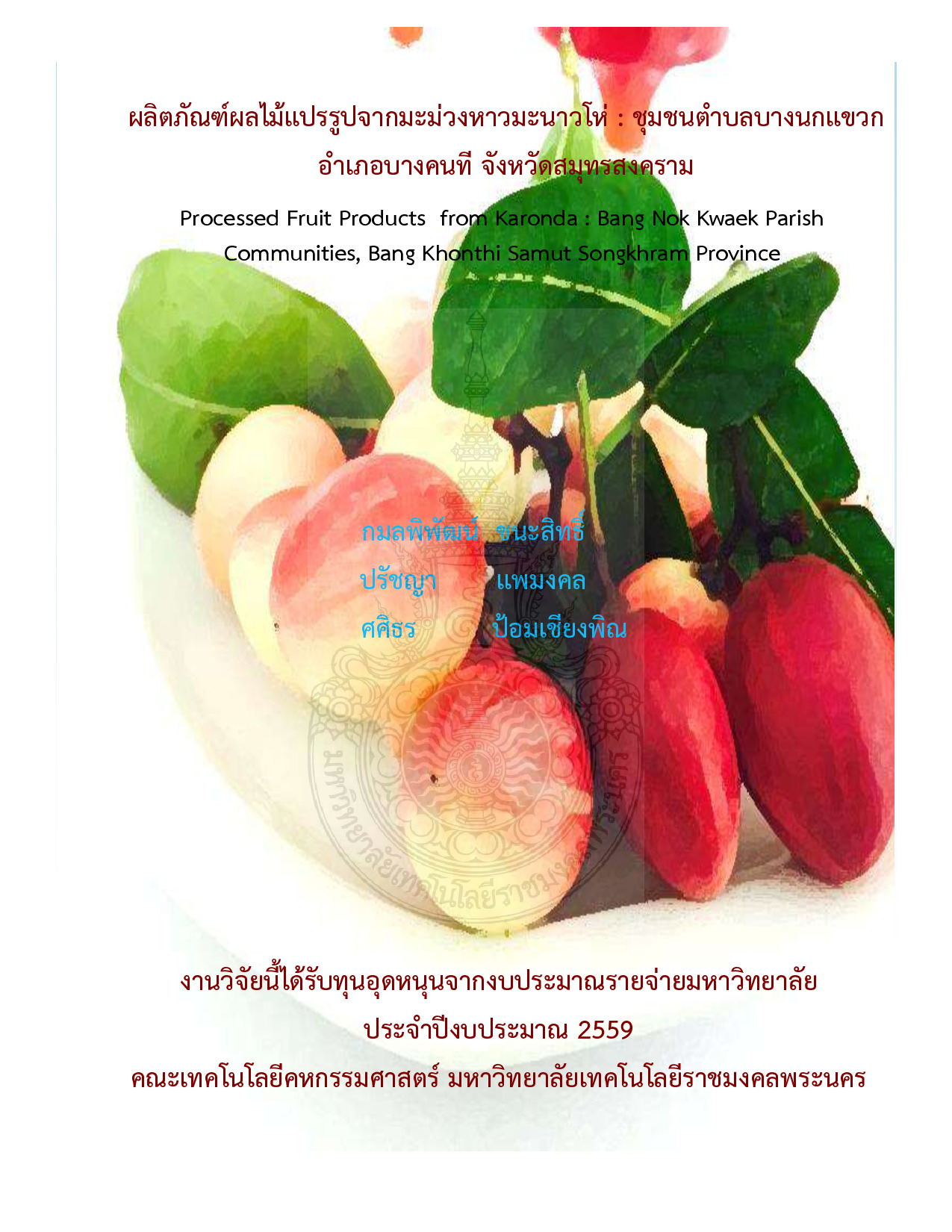
ผลิตภัณฑ์ผลไม้แปรรูปจากมะม่วงหาวมะนาวโห่ : ชุมชนตำบลบางนกแขวก อำเภอบางคนที จังหวัดสมุทรสงคราม
The purpose of the study of processed fruit products from Karonda : Bang Nok Kwaek parish communities Bang Khonthi Samut Songkhram Province is to study the proper quantity of the Koranda fruit in the product the quality in the product’s process and the consumers’ acceptance (Consumer Test) in the product. The processed products are Karonda fruit jelly instant pasteurized Karonda fruit juice with extra fiber Karonda fruit sorbet Karonda fruit yoghurt ice-cream and concentrated juice (sauce) for drink mixing. The product has been tested by Randomized Complete Block Design (RCBD) method. The process was consisted with offering a tasting and evaluated in color scent taste matter and overall satisfaction by giving 9 point Hedonic scale from 70 consumers. And has been compared the difference of average means at 95% trustiness by Duncan’s New Multiple Range Test (DMRT) by an instant statistical analysis software. The result information is as the followings; The physical properties indicates of Karonda fruit the total acidity of 2.30 with the pH and the color was found that the brightness (L *) of 16.52 fee (a *) equal to 8.95 and (b. *) equals 5.37. The study of the chemical quality of Karonda fruit amount of energy in calories carbohydrates 73.2 percent 18.3 percent protein 1.57 percent 1.32 percent humidity fats fiber 83.7 percent ash 4.26 percent and 0.75 Vitamin C is found. The duration of ripening fruit yawning lemon booed affect the vitamin C in the fruit of the mango yawning lemon booed the oil will have more vitamin C than ripe to t 2 so I scratched the reduction of vitamin C may. Is due to be deployed as a compound to breathe. And led to the synthesis of new carbon structures during ripening. Karonda fruit jelly. The most acceptances level for Karonda fruit juice in the product is at 1:6 for its best flexibility. Since the juice concentration affects the jelly as it lowers the matter (flexibility). Too much of acid in Karonda fruit juice is able to unstabilize jelly matter. From the study of Pectin quantity the consumer has the most acceptance at the level of 10 grams which is the best recipe that keeps the good jelly matter (flexibility) stabilized. The physical properties indicates that there are the level of color hue at 5R color brightness at Value 4 Chroma at 14 sweetness at 35 Brix and pH at 3.05. The study of the chemical quality of Karonda fruit jelly in each 100 grams provides 120 kilocalories of energy 69.60 grams of humidity 0.11 gram of fat 29.80 grams of carbohydrate 0.41 gram of fiber 0.50 gram of ash and 0.45 gram of acidity. The consumer satisfaction is at 97.30 percent. Instant pasteurized Karonda fruit juice with extra fiber. The acceptance is at 100 percent of replacing Okra fruit juice by Karonda fruit juice. The acceptance study shows that the most proper fiber quantity adding to Karonda fruit juice is at 15 percent. The acceptance study shows that the most proper Pectin quantity affecting coconut jelly spreading is at 3 percent. The analysis results of the physical properties indicate that instant pasteurized Karonda fruit juice with extra fiber has color hue level at 5R value at 4 and Chroma at 12 which rendered the product to dark red. Also the pH level is at 3.29 sweetness is at 17 Brix firness g force 1 is at 11.29 g Viscosityag.sec AREA F-T 1:2 is at 339.507 ag.sec. The study of the chemical quality of Karonda fruit juice in each 100 grams provides 63.3 kilocalories of energy 83.9 grams of humidity 0.01 gram of fat 0.10 gram of protein 15.8 grams of carbohydrate 0.41 gram of fiber 0.24 gram of ash and 0.18 gram of pH balance. The consumer satisfaction to instant pasteurized Karonda fruit juice with extra fiber is at 98.66 percent. Karonda fruit sorbet. The most proper quantity of Karonda fruit juice is at 30 percent. The physical properties of Karonda fruit sorbet contain the brightness level at L*34.32 red color level at a*41.26 yellow color level at b*21.18 meltable solid quantity at 30*Brix and pH balance at 2.40. The study of the chemical quality of Karonda fruit sorbet in each 100 grams provides 91.8 kilocalories of energy 77.1 grams of humidity 0.15 gram of fat <0.20 gram of protein 22.6 grams of carbohydrate 0.11 gram of fiber and 0.12 gram of ash. The consumer satisfaction to Karonda fruit sorbet is at 100 percent. Karonda fruit yoghurt ice-cream. The most proper quantity of Karonda fruit added in the yoghurt ice-cream is at 10 percent of the whole ingredient. The consumers’ acceptance has been given the most for its scent taste matter (smoothness) and overall satisfaction which has the average mean at 7.24 7.77 7.17 and 7.67 consequently. The physical properties of Karonda fruit yoghurt ice-cream contain the viscosity level at 364.798 cps. color hue at 10P Value at 8/6 Chroma at N9/.5 overrun statistics at 4.55 and Karonda fruit yoghurt ice-cream melting rate at 89.90. The chemical quality of Karonda fruit yoghurt ice-cream in each 100 grams provides 214 kilocalories of energy 64.0 grams of humidity 14.6 gram of fat 3.14 gram of protein 17.5 grams of carbohydrate 0.76 gram of fiber 0.74 gram of ash and 5.67 pH balance. The consumer satisfaction to Karonda fruit yoghurt ice-cream is at 100 percent. Concentrated juice (sauce) for drink mixing. The most acceptance recipe is the strawberry sauce recipe number 1 with the replacement of Karonda fruit at 80 percent. The physical properties contain the viscosity level at 9.28 cps sweetness at 21 Brix color hue at 5R Value at 2 and Chroma at 4. The chemical quality of concentrated juice (sauce) for drink mixing in each 100 grams provides 91.1 kilocalories of energy 77.2 grams of humidity 0.30 gram of fat 0.1 gram of protein 22.3 grams of carbohydrate 0.76 gram of fiber 0.4 gram of vitamin C and 0.56 of pH balance. The consumer satisfaction concentrated juice (sauce) for drink mixing is at the maximum satisfaction at 92.0 percent as the concentrated juice (sauce) emphasizes the better taste of smoothie drink mixing and easy to consume.
The development of a participatory learning process model for conserving the forest-resources of communities around doi-khun-tan national park
The purposes of this study were: 1) to develop the model of a participatory learning process for conserving the forest-resources of communities around Doi-Khun-Tan National Park 2) to compare knowledge attitudes and behaviors of the samples’ in conserving the forest resources and 3) to study the satisfaction of participatory learning process. The sample selected by a purposive sampling consisted of 48 subjects representing the communities around the area of Doi Khun Tan. The instruments included all these: 1) an interview 2) a participatory learning process program for conserving the forest-resources the area of Doi Khun Tan National Park 3) a questionnaire about the knowledge attitude and behavior of conserving forest resources and 4) a questionnaire about their satisfaction with the program. The data elicitation was drawn from three sources: 1) interviews and brainstorming 2) the assessment of the knowledge attitudes behaviors by the questionnaire and 3) the assessment of the satisfaction with the participatory learning process by the questionnaire. The study revealed these findings: 1) the participatory learning process of model fell into 6 steps consisting of a) the analysis of communities key informants and literature reviews b) the implementation of the knowledge to conserve the forest resources c) the implementation of the attitude towards conserving the forest resources d) the implementation of the behaviors of conserving the forest resources e) the assessment of the participatory learning process and f) the evaluation of satisfaction with the program; 2) the subjects’ knowledge attitudes and behaviors regarding forest conservation at the boundary of Doi Khun Tan before and after the participatory learning process are statistically different at the significance level of .05; and 3) the level of their satisfaction with the participatory learning process was high.
การพัฒนาและถ่ายทอดเทคโนโลยี ผลิตภัณฑ์เครื่องใช้จากผ้าสู่ชุมชนในเขตจังหวัดลพบุรี
The research of developmental and transferable technology in household fabric items from cloth in Lopburi province community was given the budget from the upper central part research networks of the Office of higher education commission in 2005. The objective of the project were developing household fabric items from local weaving cloth in Lopburi province in order to create the training course curriculum and transfer to Lopburi province community increase income of the community and also create the new career. The training courses ware under the scope of using cotton and silk fabrie from Lopburi community. The procedures were devided the participants into 2 groups each group would be 30 people. They were trained 2 courses for 12 hours. After the training course the researcher evaluated the curriculum and training proudures by questionnaire and anylysed by mean. The result found that the objective of the curriculums were the most suitable on the demand of the participants and community at the level of 4.00 and 4.30 respectively. For all the structures of the courses the duration of theory practical lessons and details were rated most. All activities during the training courses carried out at most suitable for contents of the activities. For the instructors all the items of the evaluation test; number preparation knowledge expertise the ability to transfer and answer the questions were rated most. For all the items of the equipments documents place were rated most. All the sufficiency of number and size of the training room the efficiency of tools equipments and the attractiveness of the finishing products were also rated most.
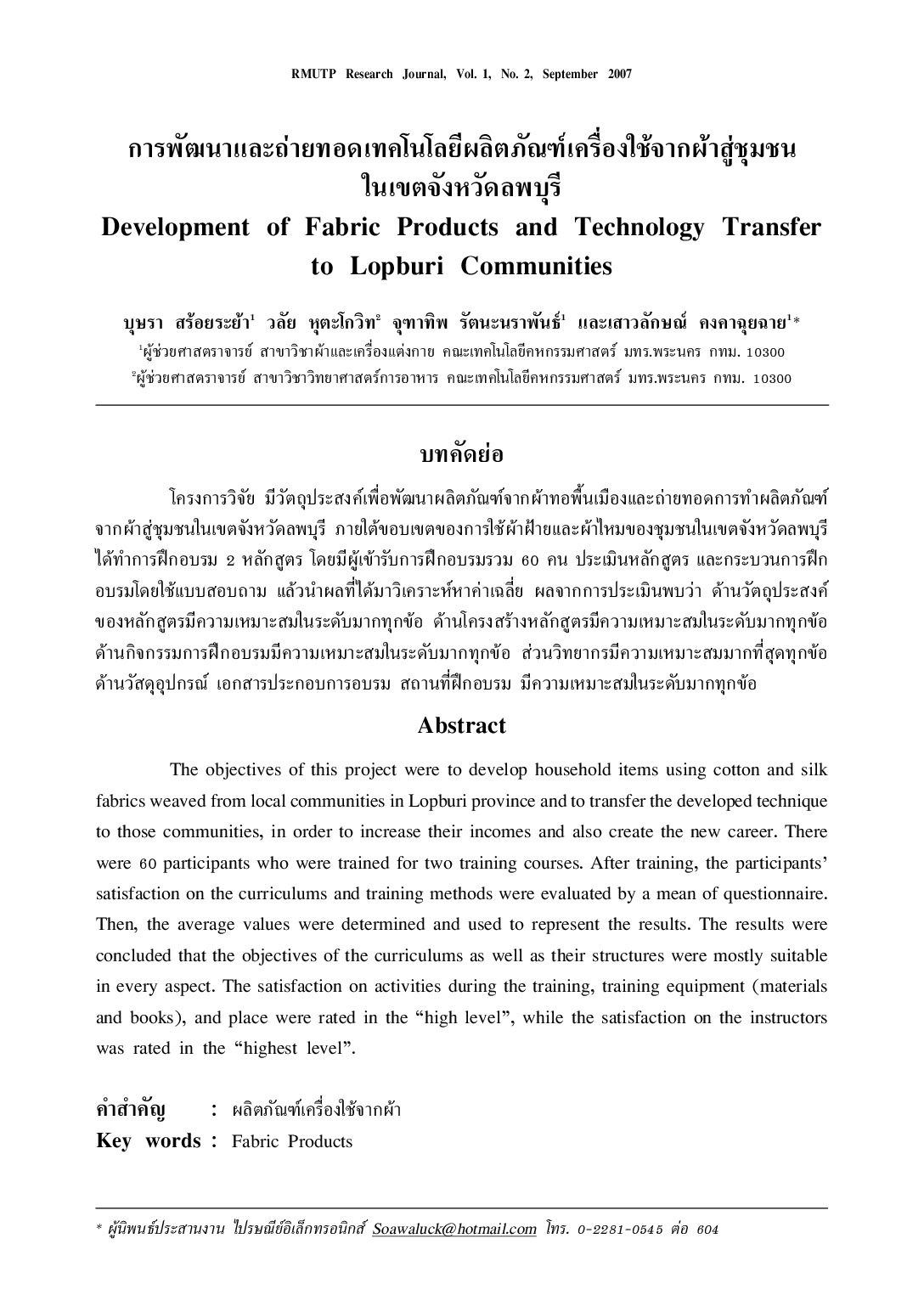
Development of Fabric Products and Technology Transfer to Lopburi Communities
The objectives of this project were to develop household items using cotton and silk fabrics weaved from local communities in Lopburi province and to transfer the developed technique to those communities in order to increase their incomes and also create the new career. There were 60 participants who were trained for two training courses. After training the participants’ satisfaction on the curriculums and training methods were evaluated by a mean of questionnaire. Then the average values were determined and used to represent the results. The results were concluded that the objectives of the curriculums as well as their structures were mostly suitable in every aspect. The satisfaction on activities during the training training equipment (materials and books) and place were rated in the “high level” while the satisfaction on the instructors was rated in the “highest level”.