จำนวน Repository ( 18 )
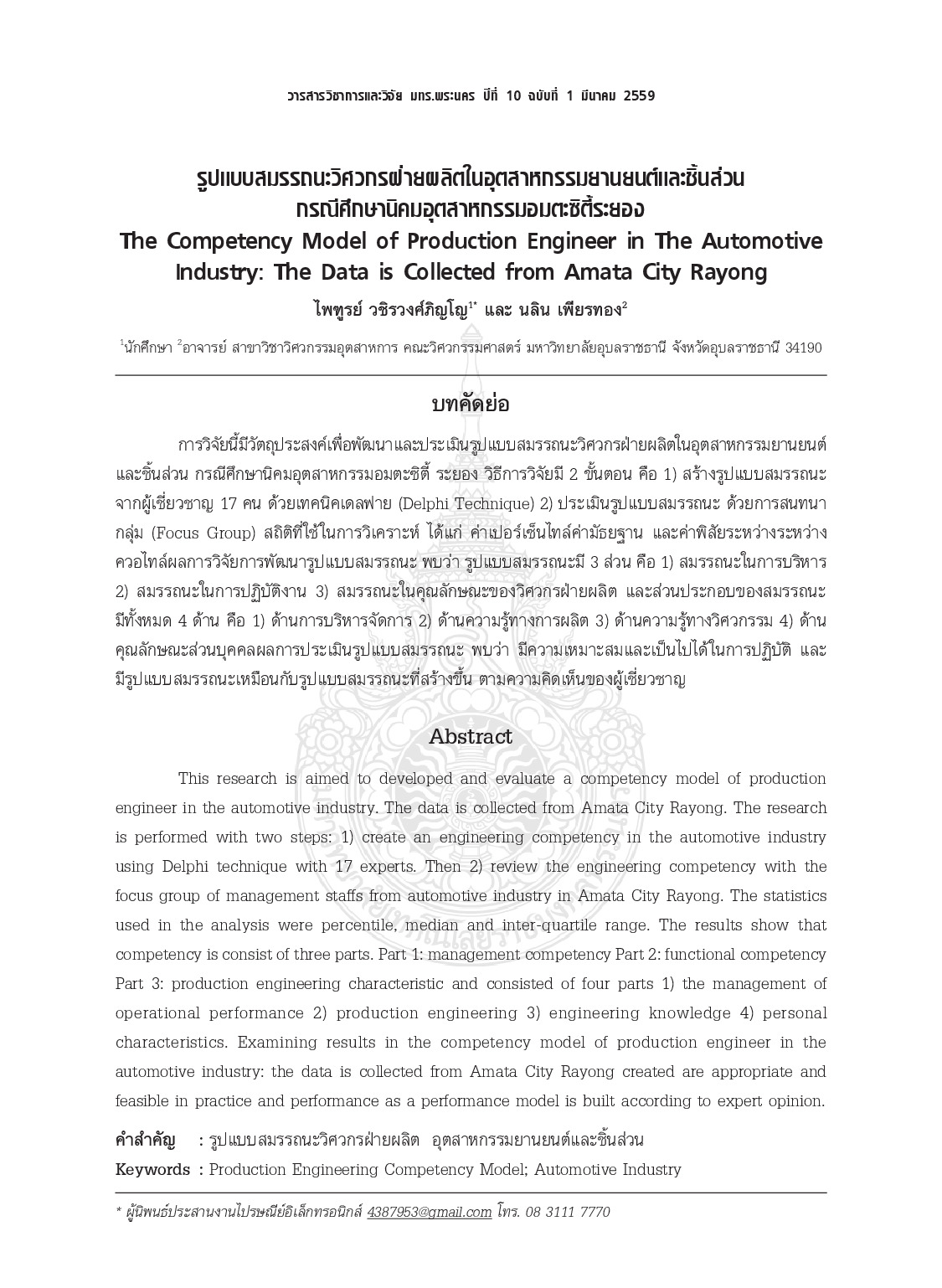
รูปแบบสมรรถนะวิศวกรฝ่ายผลิตในอุตสาหกรรมยานยนต์และชิ้นส่วน กรณีศึกษานิคมอุตสาหกรรมอมตะซิตี้ระยอง
This research is aimed to developed and evaluate a competency model of production engineer in the automotive industry. The data is collected from Amata City Rayong. The research is performed with two steps: 1) create an engineering competency in the automotive industry using Delphi technique with 17 experts. Then 2) review the engineering competency with the focus group of management staffs from automotive industry in Amata City Rayong. The statistics used in the analysis were percentile median and inter-quartile range. The results show that competency is consist of three parts. Part 1: management competency Part 2: functional competency Part 3: production engineering characteristic and consisted of four parts 1) the management of operational performance 2) production engineering 3) engineering knowledge 4) personal characteristics. Examining results in the competency model of production engineer in the automotive industry: the data is collected from Amata City Rayong created are appropriate and feasible in practice and performance as a performance model is built according to expert opinion.

Analysis of needs and expert’s opinions on the competency required of computer Job category for work integrated learning (WiL) in higher education
The aim of this research is to analyze the needs and opinions of experts concerning competency required for computer related jobs in the present and the future. Its outcomes would be used in designing a Work-integrated learning (WiL) programs in undergraduate computer related programs (Computer Engineering Software Engineering Computer Science Information Technology and Information System) which meet quality standard specified by The Association for Computing Machinery (ACM) The Association for Information Systems (AIS) and The Institute of Electrical and Electronics Engineer - Computer Society (IEEE-CS). The forty educational institutions and industries in line with the development of hardware and software the installation of operating system the installation and maintenance of the network the application of information technology and the use of information system in management were invited to participate in this study. The instruments employed for data collection were questionnaires comprising six parts: 1) General Knowledge of Computer Personnel; 2) Knowledge of Computer Engineering Personnel; 3) Knowledge of Software Engineering Personnel. 4) Knowledge of Computer Science Personnel; 5) Knowledge of Information Technology Personnel and 6) Knowledge of Information System Personnel. Statistic devices used in analyzing the data were frequency percentage arithmetic mean and standard deviation. The results were also compared with the performance analysis of Competency of Computer Jobs Category in ASEAN countries Japan Europe and America. The results were also validated by 12 specialists using a purposive sampling from educational institutions enterprises and the professional associations. It was found that the Competency Required of Computer Job Category for educational management on WIL program were: 1) Computer Architect 2) Computer Support 3) Computer Specialist 4) Project Manager 5) Software Development 6) Applied Program Specialist 7) Computer Consultant 8) Sale and Marketing and 9) Computer Education Trainer. All job positions should be consistent with the empirical data which are statistically significant at p-value =0.05. The Competency Required of Computer Job Category overall fit are accepted.
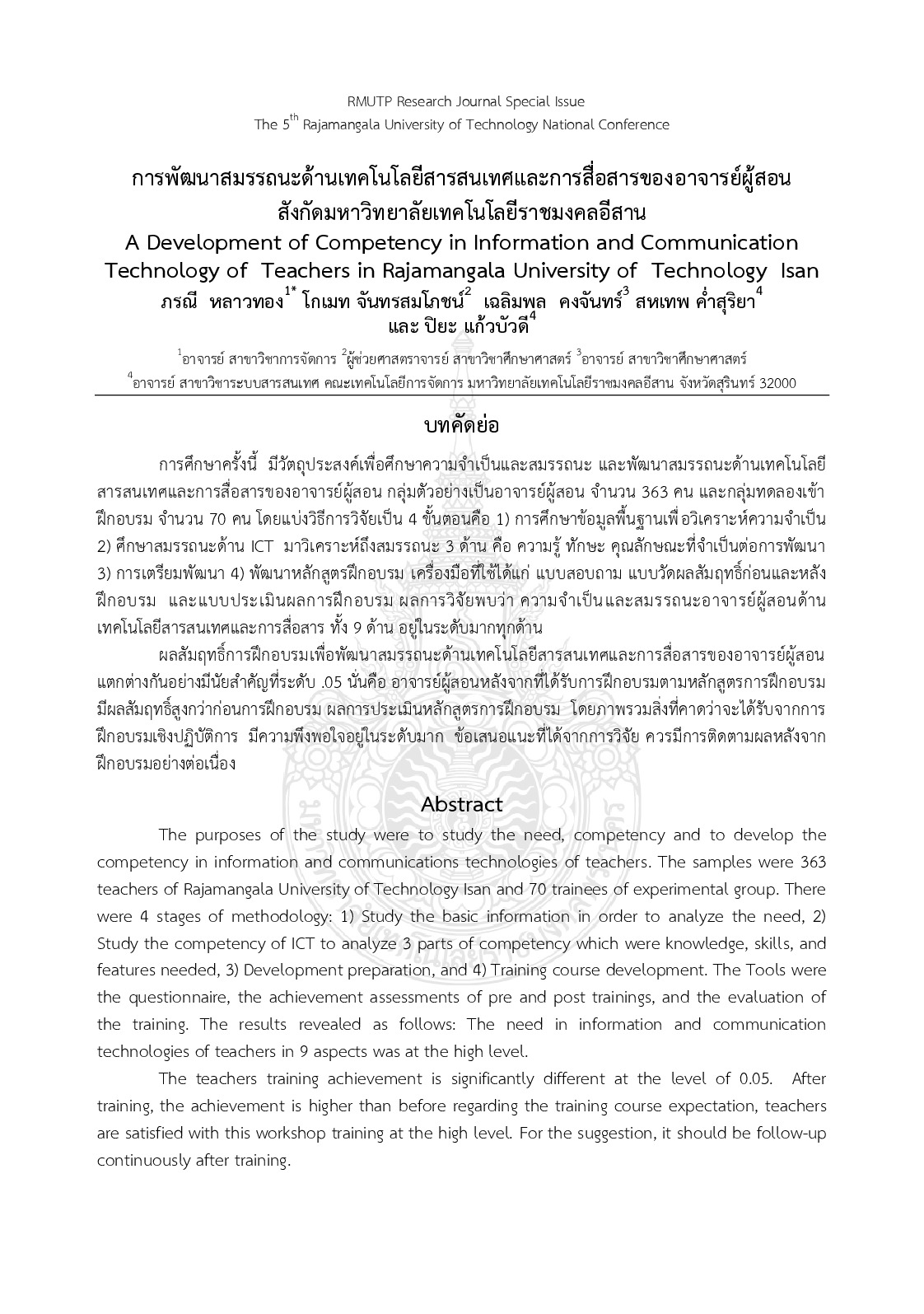
A development of competency in information and communication technology of teachers in Rajamangala University of Technology isan
The purposes of the study were to study the need competency and to develop the competency in information and communications technologies of teachers. The samples were 363 teachers of Rajamangala University of Technology Isan and 70 trainees of experimental group. There were 4 stages of methodology: 1) Study the basic information in order to analyze the need 2) Study the competency of ICT to analyze 3 parts of competency which were knowledge skills and features needed 3) Development preparation and 4) Training course development. The Tools were the questionnaire the achievement assessments of pre and post trainings and the evaluation of the training. The results revealed as follows: The need in information and communication technologies of teachers in 9 aspects was at the high level. The teachers training achievement is significantly different at the level of 0.05. After training the achievement is higher than before regarding the training course expectation teachers are satisfied with this workshop training at the high level. For the suggestion it should be follow-up continuously after training.
การพัฒนาชุดการเรียนสำหรับผู้ขอใบอนุญาตประกอบวิชาชีพครูเพื่อเพิ่มสมรรถนะด้านการจัดการเรียนรู้กับความเป็นครู
การวิจัยเรื่องการพัฒนาชุดการเรียนรู้สำหรับผู้ขอใบอนุญาตประกอบวิชาชีพครู เพื่อเพิ่มสมรรถนะด้านการจัดการเรียนรู้กับความเป็นครู มีวัตถุประสงค์เพื่อพัฒนาชุดการเรียนรู้สำหรับผู้ขอใบอนุญาตประกอบวิชาชีพครู เพื่อเพิ่มสมรรถนะด้านการจัดการเรียนรู้กับความเป็นครู กลุ่มตัวอย่างเป็นนักศึกษาระดับประกาศนียบัตรบัณฑิตวิชาชีพครู ของมหาวิทยาลัยเทคโนโลยีราชมงคลพระนคร (ทั้งนี้เนื่องจากมหาวิทยาลัยเทคโนโลยีราชมงคลพระนคร ได้รับการรับรองหลักสูตรประกาศนียบัตรบัณฑิตวิชาชีพครู จากคุรุสภาเป็นแห่งแรก) จำนวน 45 คน โดยใช้วิธีเลือกแบบเจาะจง (Purposive Sampling) ผลการวิจัยพบว่า 1. ประสิทธิภาพของชุดการเรียนรู้สำหรับผู้ขอใบอนุญาตประกอบวิชาชีพครู เพื่อเพิ่มสมรรถนะด้านการจัดการเรียนรู้กับความเป็นครู มีประสิทธิภาพ เท่ากับ 88.97/88.43 ซึ่งสูงกว่าเกณฑ์ 80/80 ที่ตั้งไว้ 2. ผลสัมฤทธิ์ทางการเรียนของนักศึกษาหลังเรียนด้วยการใช้ชุดการเรียนรู้สำหรับผู้ขอใบอนุญาตประกอบวิชาชีพครู เพื่อเพิ่มสมรรถนะด้านการจัดการเรียนรู้กับความเป็นครู สูงกว่าก่อนเรียนอย่างมีนัยสำคัญทางสถิติที่ระดับ .05 3. ระดับความพึงพอใจของนักศึกษาที่มีต่อการใช้ชุดการเรียนรู้สำหรับผู้ขอใบอนุญาตประกอบวิชาชีพครู เพื่อเพิ่มสมรรถนะด้านการจัดการเรียนรู้กับความเป็นครู มีค่าเฉลี่ยโดยรวมทุกด้านอยู่ในระดับมาก (𝑥̅=4.30S.D.=0.69)
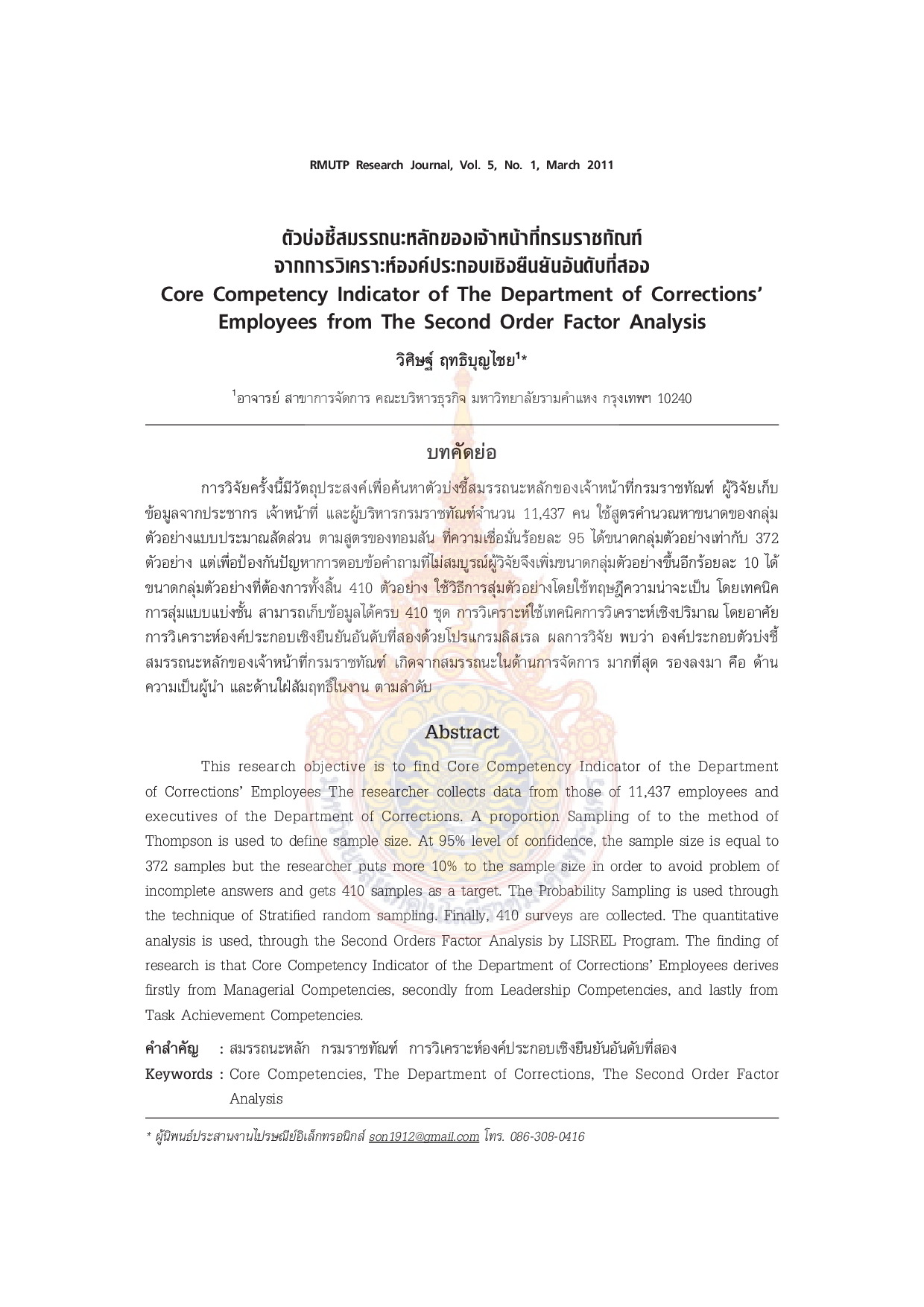
Core Competency Indicator of The Department of Corrections’ Employees from The Second Order Factor Analysis
This research objective is to find Core Competency Indicator of the Department of Corrections’ Employees The researcher collects data from those of 11437 employees and executives of the Department of Corrections. A proportion Sampling of to the method of Thompson is used to define sample size. At 95% level of confidence the sample size is equal to 372 samples but the researcher puts more 10% to the sample size in order to avoid problem of incomplete answers and gets 410 samples as a target. The Probability Sampling is used through the technique of Stratified random sampling. Finally 410 surveys are collected. The quantitative analysis is used through the Second Orders Factor Analysis by LISREL Program. The finding of research is that Core Competency Indicator of the Department of Corrections’ Employees derives firstly from Managerial Competencies secondly from Leadership Competencies and lastly fromTask Achievement Competencies