จำนวน Repository ( 24 )

The evaluation of achievement of cooperative education program, faculty of science and technology, Rajamangala University of Technology Phra Nakhon
Objectives of this research were 1) to study the environment of coopertive education program of the Faculty of Science and Technology Rajamangala University of Technology Phra Nakorn and 2) to study the achievement of this cooperative education program towards the development of graduates competency in the first semester of academic year 2013. Three sampling groups were from educational institutes enterprises and students. The number was 240 in total. Tools used in the research was a questionnaire opened and closed form number 4 sets were 1) questionnaire for coordinator or cooperative education officer advisor and lecturers 2) questionnaire for the executives coordinators or heads of human resources 3) questionnaire for employees consultant 4) questionnaire for cooperative education students. Performance analysis of cooperative education in the part of educational standard and the operation of science and technology using the content analysis method to comparing their content to the standard of Thai Association for Cooperative Education. To study satisfaction by using application program for statistical analysis such as frequency percentage mean standard deviation of mean values and descriptive discussion. The overall findings form this study showed that every relevant had high satisfaction with the management of the Cooperative Education Program of the Faculty of Science and Technology Rajamangala University of Technology Phra Nakorn.
The development of critical thinking about financial ratio by cooperative learning : numbered heads together technique. case study undergraduate of Sripatum University chonburi campus
The objectives of this research were 1) study about educational achievement in financial ratio of undergraduate of Sripatum University by cooperative learning: numbered heads together. 2) compare the learning achievement in financial ratio being taught by cooperative learning: numbered heads together technique and the Traditional teaching method . The population used in the research was 80 students that enrolled in business finance on semester 1/2012. The population was divided into a control group and an experimental group. Each group contained 40 students. For data analysis mean standard deviation t-test were used. The research finding indicated that the learning achievements of students using the cooperative learning : numbered heads together technique and the traditional teaching method were at variance with statistical significance at the level of .05 whereas the learning achievement of students of the experimental group treated by cooperative learning: numbered heads together was found higher than the experimental group treated by the traditional teaching method.
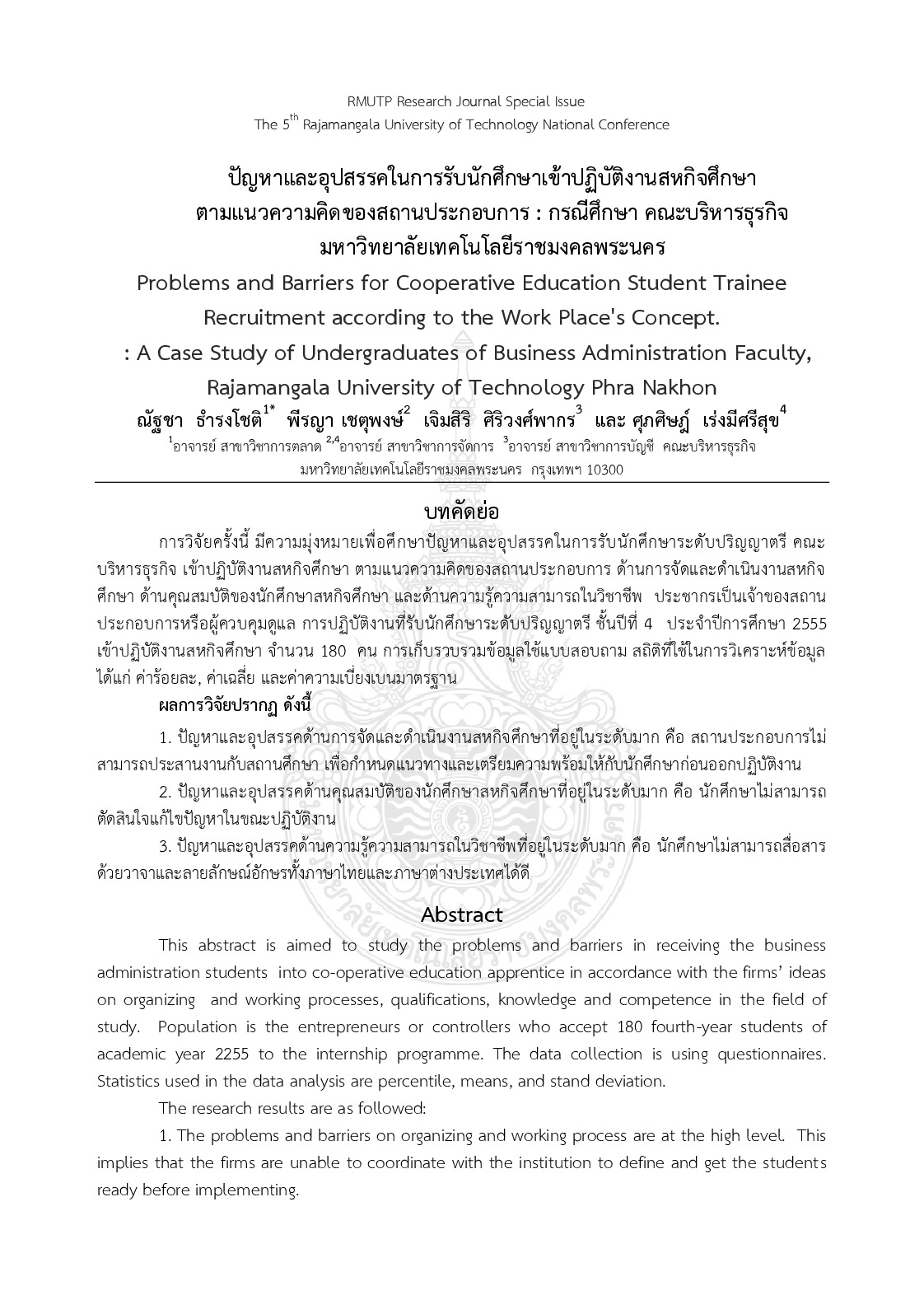
Problems and barriers for cooperative education student trainee recruitment according to the work place's concept. : a case study of undergraduates of business administration faculty, Rajamangala University of Technology Phra Nakhon
This abstract is aimed to study the problems and barriers in receiving the business administration students into co-operative education apprentice in accordance with the firms’ ideas on organizing and working processes qualifications knowledge and competence in the field of study. Population is the entrepreneurs or controllers who accept 180 fourth-year students of academic year 2255 to the internship programme. The data collection is using questionnaires. Statistics used in the data analysis are percentile means and stand deviation. The research results are as followed: 1. The problems and barriers on organizing and working process are at the high level. This implies that the firms are unable to coordinate with the institution to define and get the students ready before implementing.2. The problems and barriers on the qualifications of cooperative study students are at the high level. This implies that those students are unable to make decision to solve problems during internship. 3. The problems and barriers on knowledge and competence in their fields of study are at the high level. This implies that students are unable to communicate well both verbally and alphabetically in Thai and foreign languages.
Problems and Barriers for cooperative Education Student Trainee Recruitment according to the Work Place’s concept : A Case Study of Undergraduates of Business Administration Faculty : A Case Study of Undergraduates of Business Administration Faculty, Rajamangala University of Technology Phra Nakhon
This research is to study the problems and barriers for cooperative education student trainee recruitment according to the work place’s concept the aspects of training management training format training students’ qualifications and training students’ knowledge. The population are owners of various workplaces who accept 180 fourth year undergraduate students in training. Questionnaires are used to collect data statistically analyzed by Percentage Mean and Standard Deviation. The findings of the research reveals problems and obstacles as follow : 1. For the training management aspect the workplaces are not able to cooperate with the university to set aims and prepare the students before training the workplaces do not recognize purposes of the university’s training course the suitable positions for the students are not provided by the workplaces. 2. For the training students’ qualifications the students are unlikely to make decision in their performances’ problem solving no self-confidence and carefulness in their performances. 3. For the training students’ knowledge the students are unable to analyze and plan their performances; they have not a good command of both written and spoken English and Thai. In addition they lack of vocational skills.
การพัฒนาผ้าบาติกเพื่อผลิตภัณฑ์ของที่ระลึก สำหรับกลุ่มอาชีพสหกรณ์ศิลปประดิษฐ์ เกาะเกร็ด จังหวัดนนทบุรี
The purposes of this research were 1) to develop batik cloth to be the souvenir of Art and Craft Occupational Group Cooperative in Koh Kred Nonthaburi 2) to conduct the knowledge and technology transfer on souvenir production from batik cloth and 3) to follow up the research’s accomplishment. The research methodology was conducted as follows: Study the related data to develop the batik souvenir by creating batik patterns and sketch designs. The souvenirs included women’s clothing hat scarf handbag tissue box cushion cover home decorating picture mobile case ipad case and laptop bag. There were three collections for each product and there were five patterns for each collection. 100 of the tourists and some people in Kog Kred were asked about the sketch design satisfaction in order to select only one pattern among each collection; finally the researcher made the product according to the chosen patterns. There were fifty patterns all in all. The target groups’ satisfaction with the pattern was identified by using questionnaires. Data were statistically analyzed by frequency percent and arithmetic mean. The research found that the respondents were female and were aged between 41 and 50 years old. Most of the respondents worked as civil servants were master’s degree holders and have earned more than 30001 baht per month. For the satisfaction on the product pattern design technique the product pattern differentiation the pattern creativity the appropriateness of the product and the color the product style the appropriateness of the product pattern and the product style the overall beauty of the product symbolic meaning of the pattern and the appropriateness of the product original model it was found that the respondents were satisfied with every aspect with the high level. The product knowledge transfer on the original model of the product to members of the Art and Craft Occupational Group Cooperative in Koh Kred Nonthaburi was chosen from one of the members who were interested. For the knowledge transfer the satisfaction of 30 respondents was explored by the questionnaires and data were statistically analyzed by frequency percentage and arithmetic mean. Most of the respondents were female were aged between 46 and 55 years old and held Matthayom Suksa 3. The satisfaction consisted of 4 aspects; lecturer operation facility and period knowledge and the application. The result was found that the respondents were extremely satisfied with every aspect at the highest level.