จำนวน Repository ( 16 )
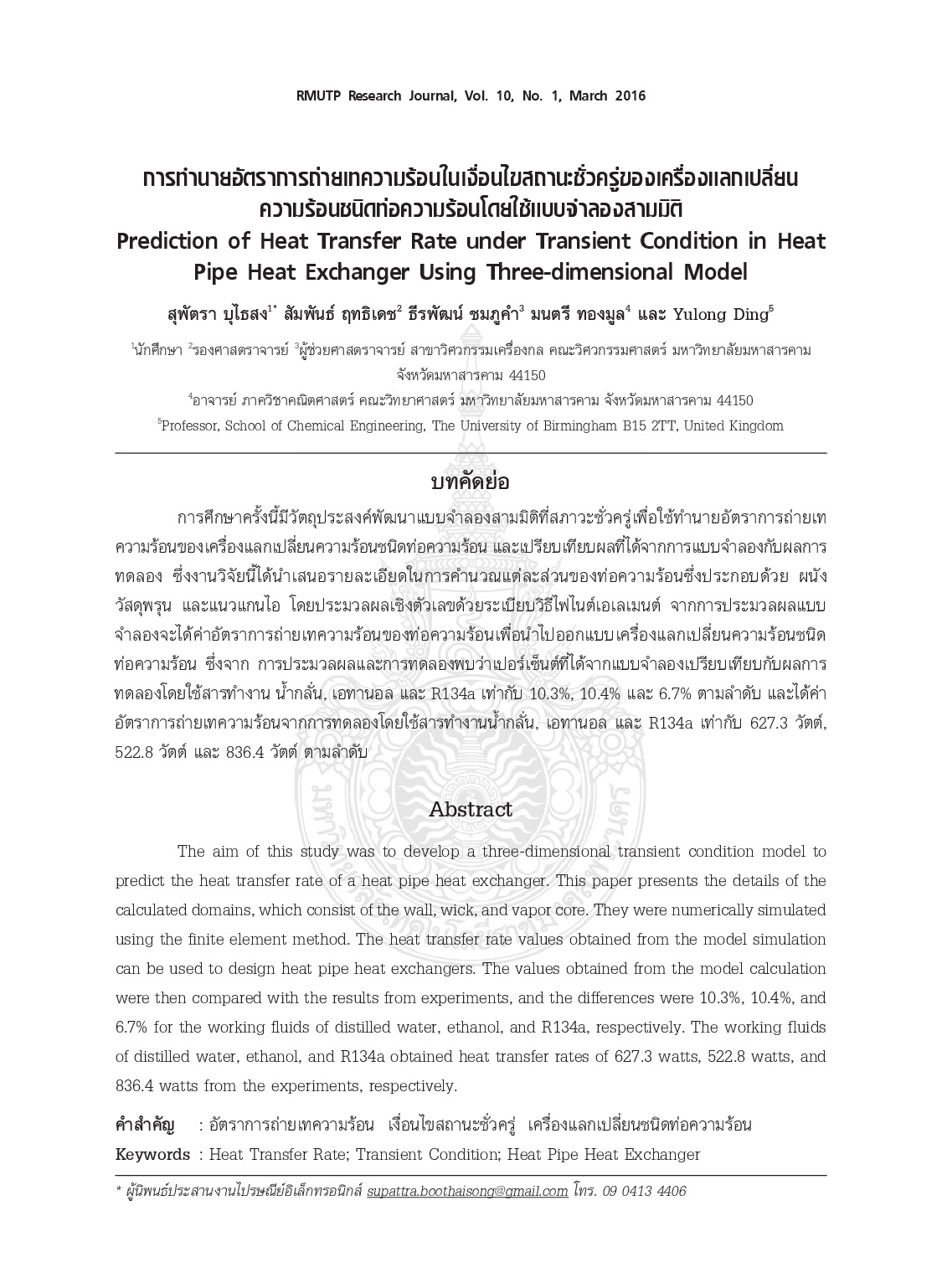
การทำนายอัตราการถ่ายเทความร้อนในเงื่อนไขสถานะชั่วครู่ของเครื่องแลกเปลี่ยนความร้อนชนิดท่อความร้อนโดยใช้แบบจำลองสามมิติ
The aim of this study was to develop a three-dimensional transient condition model to predict the heat transfer rate of a heat pipe heat exchanger. This paper presents the details of the calculated domains which consist of the wall wick and vapor core. They were numerically simulated using the finite element method. The heat transfer rate values obtained from the model simulation can be used to design heat pipe heat exchangers. The values obtained from the model calculation were then compared with the results from experiments and the differences were 10.3% 10.4% and 6.7% for the working fluids of distilled water ethanol and R134a respectively. The working fluids of distilled water ethanol and R134a obtained heat transfer rates of 627.3 watts 522.8 watts and 836.4 watts from the experiments respectively.
การออกแบบจานเบรกเชิงการสะสมความร้อนเพื่อความปลอดภัย
Admittedly a disc brake plays an important role in the auto part industry since it concerns directly with safety. Therefore the wide range of disc brake has been designed in order to develop its heat ventilation. Thus this project has designed a back-vented brake disc which is difference the current one (front-vented) and tried to create the test to find out the temperature diffusion of the disc brake with the hope to evaluate the coefficient of the heat convection varied by the temperature changing in both kinds of brakes under the forced heat convection in the steady condition. However the steady heat conduction and radiation value will not be counted because it is insignificant. The JASO C406: 2000 Standard is adopted as a guideline in the test. The outcome coefficient of heat conduction will be used in the simulation via the Finite Element Method (FEM) in order to study the temperature diffusion and heat ventilation of both kinds of brakes at each temperature level. Consequently the experimental work reveals then the heat convection coefficients of both kinds are unidirectional. The heat convection coefficient of the front-vented disc brake is 4.40 % in average higher than that of the back-vented disc brake. From the simulation the front-vented disc brake can ventilate the heat better than the back-vented disc brake at 3.02 % in average. It can be summarized that the front-vented disc brake has more temperature difference than the back-vented disc brake. Hence the front-vented disc brake likely gets more stress from the temperature than the back-vented disc brake and might be damaged during the operation more than the another type. Therefore this is tendency that the back-vented is safer than the front-vented brake disc for usage.

การพัฒนาวัสดุอาหารจากวัสดุเหลือทิ้งทางการเกษตรเพื่อการประหยัดพลังงานและลดการถ่ายเทความร้อนเข้าสู่อาคาร
The objective of this research is to study the implementing the agricultural residue to the design of outdoor paving block for lowering the building temperature. The base layer admixture (layer no.1) is selected from cement type1: quarry dust: rice husk: rice straw: water ratios equal to 1: 3: 0: 0: 0.3 1: 1: 0: 1: 0.5 1: 1. 0.25: 0.75: 0.5 1: 1: 0.5: 0.5: 0.5 1: 1: 0.75: 0.25: 0.5 and 1: 1: 1: 0: 0.5 by weight. The surface layer admixture (layer no.2) is white silica cement: yellow stone chip no.4: water equals to 1: 4: 0.3 by weight. The exterior floor-covering blocks were tested following density testing water absorption testing compressive testing and surface temperature testing compare with laterite sandstone paving concrete block marble and granite. Resulting the best ratio of cement type1: quarry dust: rice husk: rice straw: water is 1: 1: 0.75: 0.25: 0.5 that has properties at 28 days following 1939.43 kg/m of density 14.97 % of water absorption 284.69 ksc of compressive strength and lower than other paving blocks around 3 – 13 degrees Celsius of surface temperature
A Modeling of Heat Transfer in Cooling Coil using Finite Element Method
In general for the refrigeration the cooling coil is almost used to be the device to decrease the temperature. Thus in order to design heat exchange we should study the heat transfer into the cooling coil. This research proposes the numerical using finite element method for calculating the temperature at any position of the cooling point for considering to porous media. After that to create an algebraic equation fmite element for writing the program to search the solution by estimating the temperature. The research demonstrates that the changing of temperature will be decreased to saturated condition that is the temperature around the region of the cooling coil model edge will be decreased. The longer time the lower temperature around each position will decrease respectively until the temperature at each position inside the model are the same as region of the cooling coil model edge. Therefore this search result can be the basic for the comparison with the similar problem of other
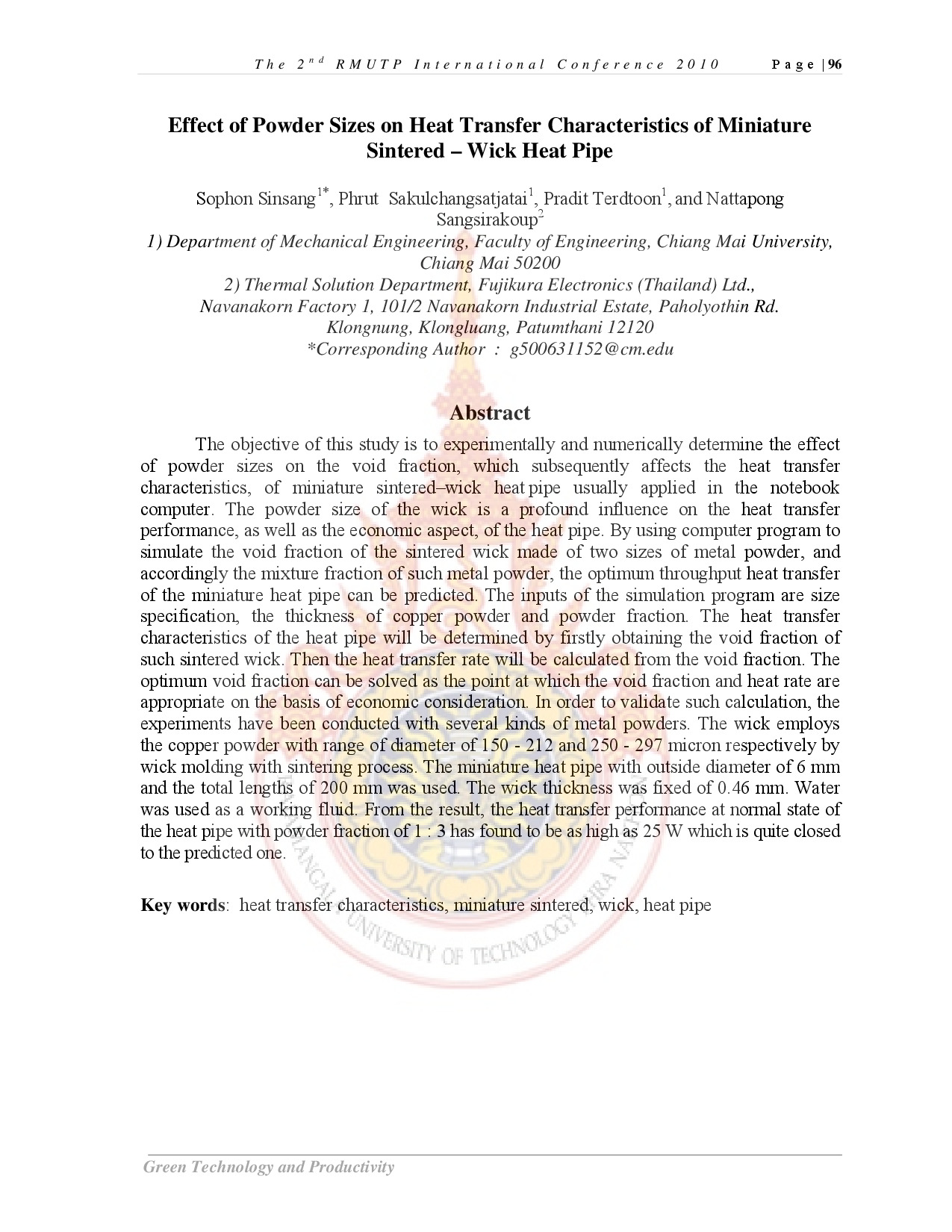
Effect of Powder Sizes on Heat Transfer Characteristics of Miniature Sintered – Wick Heat Pipe
The objective of this study is to experimentally and numerically determine the effect of powder sizes on the void fraction which subsequently affects the heat transfer characteristics of miniature sintered–wick heat pipe usually applied in the notebook computer. The powder size of the wick is a profound influence on the heat transfer performance as well as the economic aspect of the heat pipe. By using computer program to simulate the void fraction of the sintered wick made of two sizes of metal powder and accordingly the mixture fraction of such metal powder the optimum throughput heat transfer of the miniature heat pipe can be predicted. The inputs of the simulation program are size specification the thickness of copper powder and powder fraction. The heat transfer characteristics of the heat pipe will be determined by firstly obtaining the void fraction of such sintered wick. Then the heat transfer rate will be calculated from the void fraction. The optimum void fraction can be solved as the point at which the void fraction and heat rate are appropriate on the basis of economic consideration. In order to validate such calculation the experiments have been conducted with several kinds of metal powders. The wick employs the copper powder with range of diameter of 150 - 212 and 250 - 297 micron respectively by wick molding with sintering process. The miniature heat pipe with outside diameter of 6 mm and the total lengths of 200 mm was used. The wick thickness was fixed of 0.46 mm. Water was used as a working fluid. From the result the heat transfer performance at normal state of the heat pipe with powder fraction of 1 : 3 has found to be as high as 25 W which is quite closed to the predicted one.