จำนวน Repository ( 17 )
ปัจจัยที่มีผลต่อการตัดสินใจเลือกศึกษาต่อหลักสูตรภาษาอังกฤษด้านสื่อสารมวลชนของนักเรียนระดับมัธยมศึกษาตอนปลายในเขตกรุงเทพมหานคร
The objectives of this research is to study (1) The factor of decision making in Bangkok high school students affected to study in bachelor of Mass Communication (English Program) (2) The factor that is correlated in decision making in Bangkok high school students affected to study in bachelor of Mass Communication (English Program). The sample population consisted of four hundreds high school students in Bangkok. The instrument of research was a questionnaire. The Statistical Package for the Social Sciences (SPSS) for Windows computer program was applied for analyzing formulating and tabulating the data collected. The techniques of descriptive statistics used were percentage mean and standard deviation. Techniques of inferential statistics utilized were t-test one-way analysis of variance (ANOVA) in order to analyze differences between variables taken as a group. If there is a statistically significant differences found between pairs in a group Scheff?’s pair testing were deployed. Multiple Regression Analysis were applied in order to analyze the factors of decision making in Bangkok high school students affected to study in bachelor of Mass Communication (English Program). If there is a statistically significant found in Multiple Regression Coefficient of Correlation under paired testing will be used to identify the correlation between factors. The results were as following: 1. The factors of student program in high school affected the decision making to study in bachelor of Mass Communication (English Program) were high school program. 2. The marketing factor of Mass Communication Technology affected to Bangkok high school students decision making to study in Bachelor of Mass Communication (English Program) is product price place promotion.

การพัฒนาเว็บไซต์การจัดการองค์ความรู้ของคณะเทคโนโลยีราชมงคลพระนคร
The objectives of the research to gain an understanding of satisfaction feedbacks and needs of the users of knowledge management website of the Faculty of Mass Communication Technology Rajamangala University of Technology Phra Nakhon as well as to develop a proper knowledge management website. This research is a survey-based research which questionnaires are used as research tools. The research sampling consists of 256 lecturers students and staffs of the Faculty of Mass Communication Technology. Statistical methods used are average percentage standard deviation t-test Oneway ANOVA LSD chi-square and multiple regression analysis. The research findings are as follow: 1. Different demographics of the target group do not make much difference in satisfaction level. Factors such as sex status within the faculty age education monthly income and communication devices used do not effect user satisfaction. This fact does not correspond with our assumption. However there are some aspects that coincide statistically with our other assumptions for example age effects satisfaction level of website design while education effects satisfaction level of data utilization. 2. The access of knowledge management website is related to the utilization satisfaction. The relationship can be explained as follow: The access frequency of the Faculty of Mass Communication Technology’s knowledge management website has the maximum correlations of 10 while picture has 4 correlations which are device used for website access internet usage location usage time and access frequency of the website. Feedbacks and needs for website development has the maximum correlations of 4 in term of access frequency. In-depth knowledge has the maximum correlations of 2 in term of website development which are internet usage experience and access of knowledge management website. 3. Knowledge of the target group relates to the satisfaction feedbacks and needs of the knowledge management website development which can be explained as follow: Opinions and satisfaction in knowledge management site • Best Equation y = 1.457 +0.332 (faculty knowledge) +0.259 (knowledge attention) • Standard Equation ZY = 0.346 Z(faculty knowledge) + 0.264 Z(knowledge attention) Opinions and needs in the development of knowledge management site • Best Equation y = 1.391 +0.379 (faculty Knowledge) +0.235 (knowledge attention) • Standard Equation ZY = 0.386 Z(faculty knowledge) + 0.234 Z(knowledge attention)
Computer for mass communication instruction to blind students
This qualitative research by non-participative observation and in-depth interview with blind students aims to improve Computer for Mass Communication instruction to blind students. The research found that blind students could not learn with their classmates because they could not catch up with the practice instructed by the teacher. The teacher changed her teaching method for the blind students. She gave additional individual tutorial in Computer for Mass Communication subject for blind student in her room every week together with practice and assignment. Result of this instruction method shows that the blind student can work better and learn faster. They are also more ready for learning and show very good attention in practice.
Users’ satisfaction in knowledge management website of faculty of mass communication technology
The objectives of the research are to study users’ behavior and to compare of users’ satisfaction in knowledge management website of the Faculty of Mass Communication Technology Rajamangala University of Technology Phra Nakhon. This research is a survey-based research which uses questionnaires as research tools. The research sampling consists of purposive sampling stratified sampling and accidental sampling of 265 lecturers students and staffs of the Faculty of Mass Communication Technology. Statistical methods used are average percentage standard deviation t-test Oneway ANOVA and LSD. The research findings show that in terms of users’ behavior most users use desktop computer at their homes during 20.01-00.00 am. Most users use the internet mainly to chat. Use of faculty’s website is rare at less than 1-3 time/week. Use of faculty’s knowledge management website is also very few. Different characteristics of the target group do not provide significant difference in satisfaction level. Demographic factors such as sex status within the faculty age education monthly income and communication devices used do not affect users’ satisfaction. This finding does not correspond with the assumption. However there are some aspects that significantly correspond with other assumptions. For example age affects satisfaction level in website design while education affects satisfaction level in data utilization.
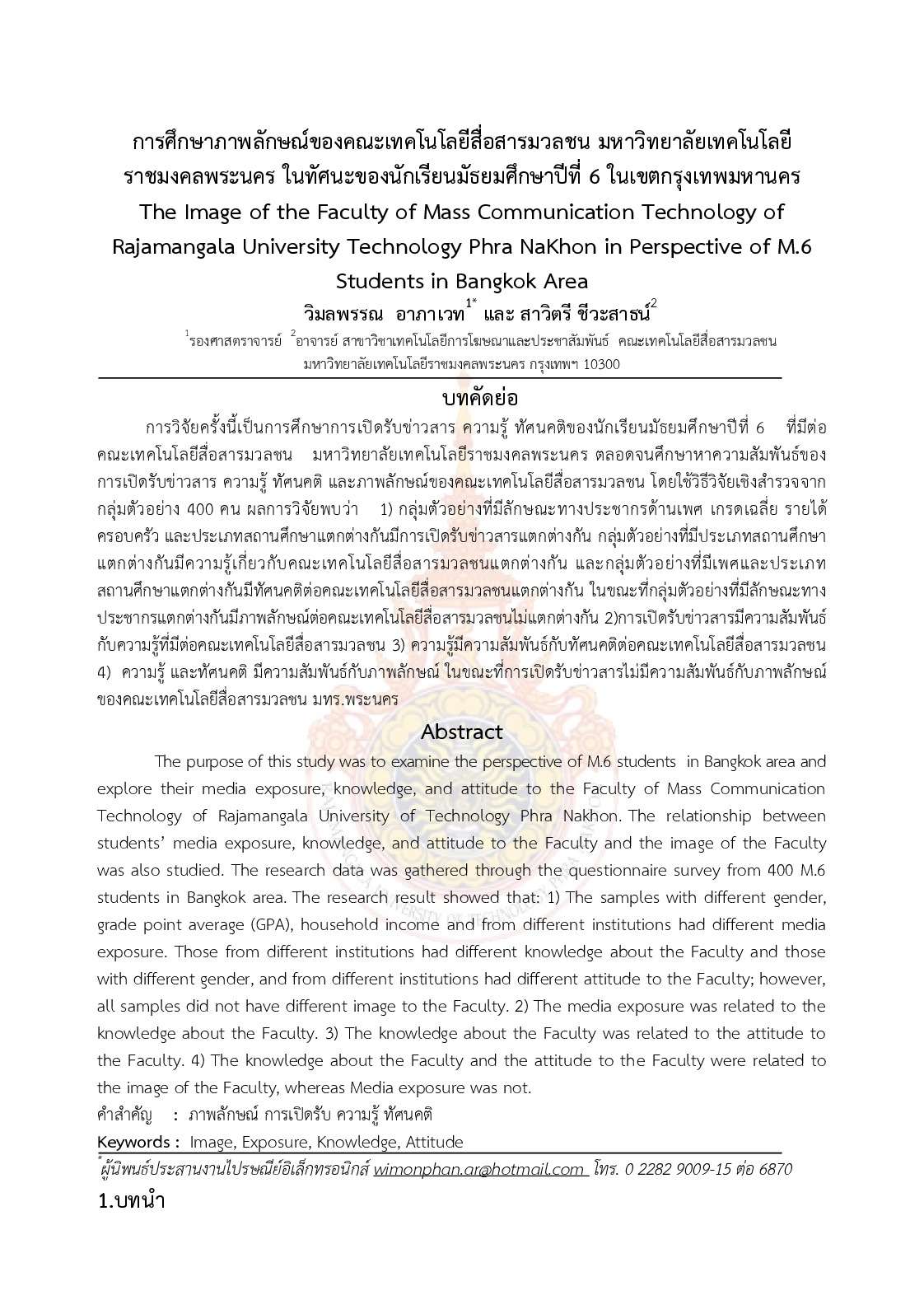
The Image of the Faculty of Mass Communication Technology of Rajamangala University Technology Phra NaKhon in Perspective of M.6 Students in Bangkok Area
The purpose of this study was to examine the perspective of M.6 students in Bangkok area and explore their media exposure knowledge and attitude to the Faculty of Mass Communication Technology of Rajamangala University of Technology Phra Nakhon. The relationship between students’ media exposure knowledge and attitude to the Faculty and the image of the Faculty was also studied. The research data was gathered through the questionnaire survey from 400 M.6 students in Bangkok area. The research result showed that: 1) The samples with different gender grade point average (GPA) household income and from different institutions had different media exposure. Those from different institutions had different knowledge about the Faculty and those with different gender and from different institutions had different attitude to the Faculty; however all samples did not have different image to the Faculty. 2) The media exposure was related to the knowledge about the Faculty. 3) The knowledge about the Faculty was related to the attitude to the Faculty. 4) The knowledge about the Faculty and the attitude to the Faculty were related to the image of the Faculty whereas Media exposure was not.