จำนวน Repository ( 20 )

การศึกษาวิเคราะห์อิทธิพลของธาตุเจือทองแดงและดีบุกที่มีผลต่อสมบัติทางกลและโค่รงสร้างจุลภาคของโลหะเงินเจือต่ำ 58.33 wt%AgCuSn
การวิจัยนี้เป็นการศึกษาสมบัติของโลหะเงินเจือต่า 58.33% ที่มีธาตุทองแดง (Cu) และดีบุก (Sn) เป็นธาตุผสม ซึ่งมีปริมาณการผสมอยู่ในช่วงระหว่าง 36.66 - 41.57% และ 0.10-5.01% ตามล่าดับ โดยท่าการเปรียบเทียบกับสมบัติของโลหะเงินสเตอร์ลิง 925 และโลหะเงินเจือต่า 58.33% เพื่อศึกษา วิเคราะห์อิทธิพลของธาตุเจือทองแดงและดีบุกที่มีผลต่อสมบัติทางกลและโครงสร้างจุลภาของโลหะเงินเจือ ต่า 58.33 wt% AgCuSn และหาปริมาณของธาตุเจือทองแดงและดีบุกที่เหมาะสมในการผลิต เครื่องประดับเงินเจือต่า 58.33% ผลจากการศึกษาโลหะเงินเจือต่า 58.33 % ที่ประกอบด้วยเงิน (Ag) และทองแดง (Cu) เมื่อ น่ามาเปรียบเทียบกับโลหะเงินสเตอร์ลิง 925 จากการศึกษาเปรียบเทียบพบว่าโลหะเงินผสมเจือต่า 58.33Ag + 36.66Cu +5.01Sn มีค่า Yield Strength 195.2 Mpa Ultimate tensile strength 345.25 MPa Breaking point 301 MPa และ Elongation 61.58 % ซึ่งเป็นอัตราส่วนผสมของแต่ละ ธาตุที่เหมาะสมที่สุด ค่าความแข็งของโลหะเงินเจือต่า 58.33Ag + 41.57Cu + 0.10Sn มีค่าความแข็ง น้อยที่สุด เท่ากับ 93.03 HV ซึ่งปริมาณดีบุก (Sn) ที่ผสมเข้าไปในอัตราส่วน 0.10Sn จะท่าให้โครงสร้าง ของเงินเจือต่า เป็น β-phase เกิดการเปลี่ยนแปลงจาก β phase ที่มีขนาดเล็กลงเป็นโครงสร้าง Eutectic phase ที่มี α-phase และ β-phase ขนาดเล็กและละเอียด ผลจากการวิเคราะห์ส่วนผสมทางเคมีของโลหะเงินเจือต่า 58.33% พบว่าส่วนผสมทางเคมี ของโลหะเงินเจือต่าในแต่ละอัตราส่วนผสมมีสัดส่วนของธาตุใกล้เคียงกับอัตราส่วนผสมจริง จึงท่าให้โลหะ เงินเจือต่าที่ได้ท่าการทดลองมีค่าที่เป็นไปตามมาตรฐานของเครื่องประดับเงินตามมาตรฐานอุตสาหกรรม การผลิตเครื่องประดับทั้งของในประเทศและต่างประเทศ
Mechanical properties of concrete mixed with reused ceramic tiles reinforced with steel fiber from milling processed
This research study the mechanical properties of concrete mixed with reused ceramic tiles reinforced with steel fiber from milling processed. The compressive strength of all concretes were designed at 300 ksc at 28 days and control slump in the range of 10 ? 2.5 cm. The steel fiber from milling processed was reinforced at 0.50 1.00 and 1.50 by the weight of cement content. The compressive strength Flexural and tensile splitting for all concrete samples were tested compare with control concrete which it as concrete mixed with reused ceramic tiles not reinforced with steel fiber. The results shown that the reinforcing with steel fiber from milling process at 0.5 and 1.0% was affect to the higher compressive strength than control concrete of 2 and 7% but increasing steel fiber at 1.5% was affect to lower compressive strength than control concrete of 6%. Concrete mixed with steel fiber from milling processed at 1.0% have higher splitting tensile strength than control concrete of 16% while concrete mixed with steel fiber at 0.5 and 1.5% have splitting tensile strength equal with control concrete. The flexural strength of these concretes have higher more than control concrete about 9 17 and 11% for reinforcing with steel fiber at 0.50 1.00 and 1.50 respectively. In addition the water permeability of concretes were increased when the steel fiber were reinforced increases too.
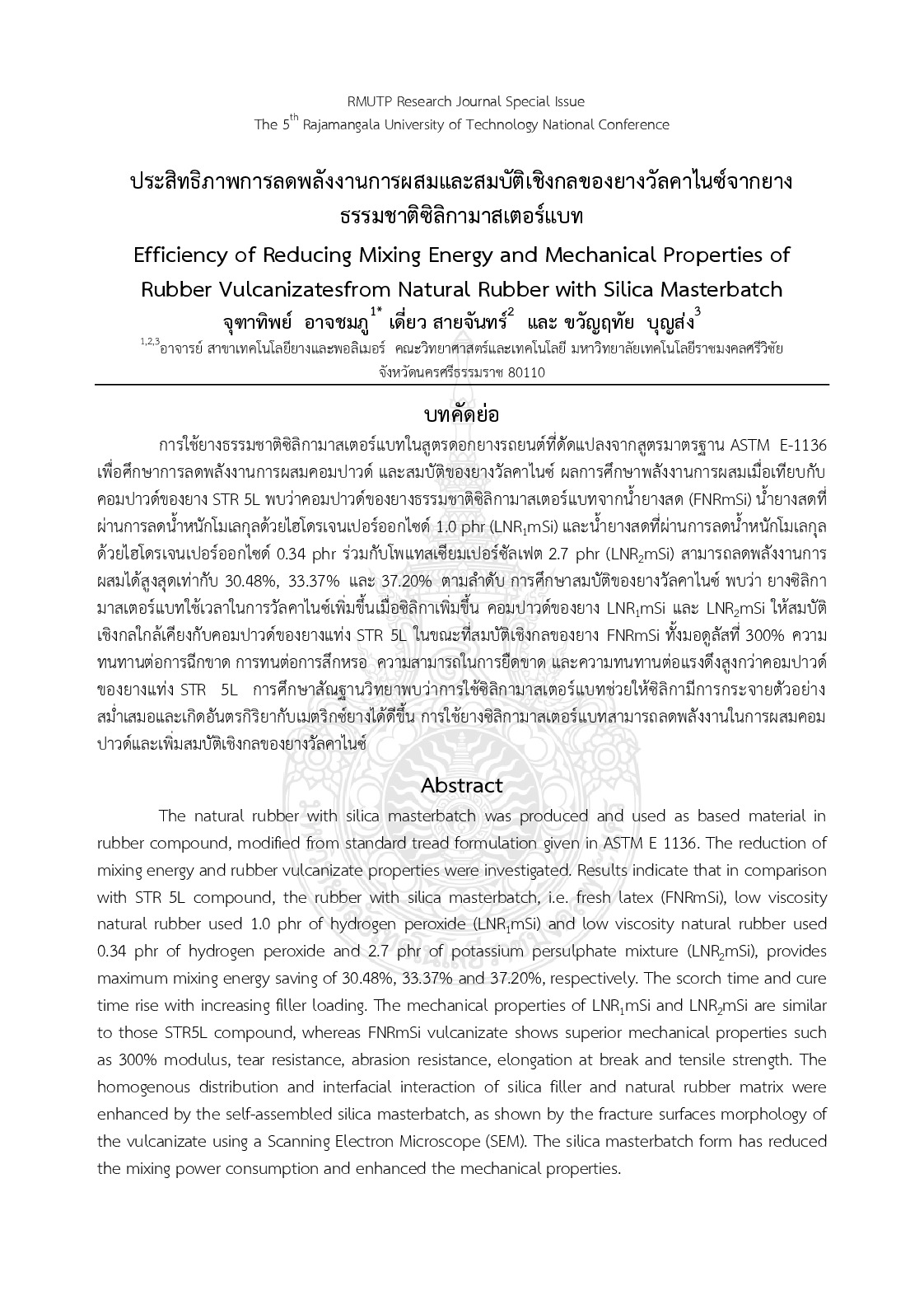
Efficiency of reducing mixing energy and mechanical properties of rubber vulcanizatesfrom natural rubber with silica masterbatch
The natural rubber with silica masterbatch was produced and used as based material in rubber compound modified from standard tread formulation given in ASTM E 1136. The reduction of mixing energy and rubber vulcanizate properties were investigated. Results indicate that in comparison with STR 5L compound the rubber with silica masterbatch i.e. fresh latex (FNRmSi) low viscosity natural rubber used 1.0 phr of hydrogen peroxide (LNR1mSi) and low viscosity natural rubber used 0.34 phr of hydrogen peroxide and 2.7 phr of potassium persulphate mixture (LNR2mSi) provides maximum mixing energy saving of 30.48% 33.37% and 37.20% respectively. The scorch time and cure time rise with increasing filler loading. The mechanical properties of LNR1mSi and LNR2mSi are similar to those STR5L compound whereas FNRmSi vulcanizate shows superior mechanical properties such as 300% modulus tear resistance abrasion resistance elongation at break and tensile strength. The homogenous distribution and interfacial interaction of silica filler and natural rubber matrix were enhanced by the self-assembled silica masterbatch as shown by the fracture surfaces morphology of the vulcanizate using a Scanning Electron Microscope (SEM). The silica masterbatch form has reduced the mixing power consumption and enhanced the mechanical properties.
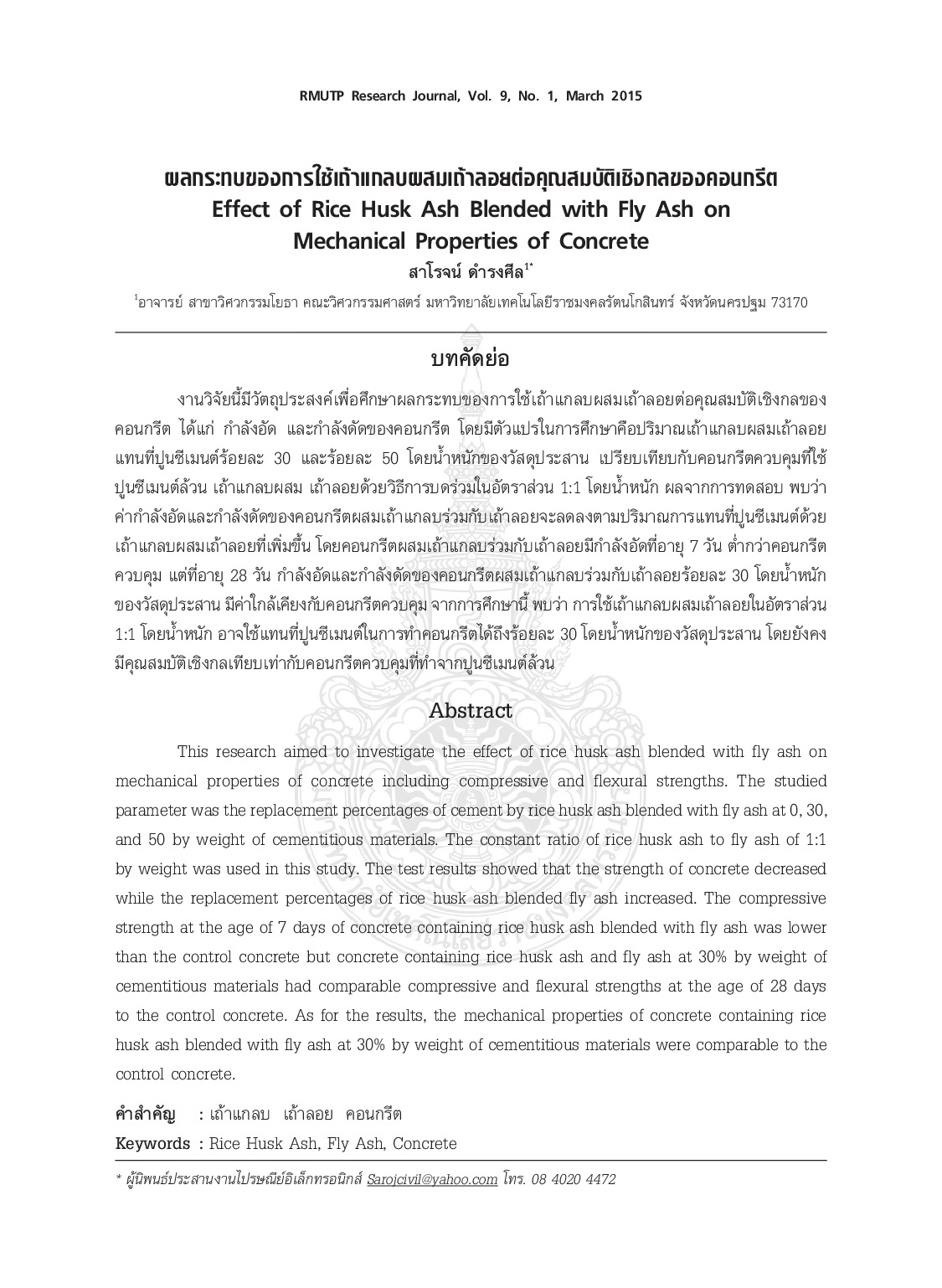
Effect of rice husk ash blended with fly Ash on mechanical properties of concrete
This research aimed to investigate the effect of rice husk ash blended with fly ash on mechanical properties of concrete including compressive and flexural strengths. The studied parameter was the replacement percentages of cement by rice husk ash blended with fly ash at 0 30 and 50 by weight of cementitious materials. The constant ratio of rice husk ash to fly ash of 1:1 by weight was used in this study. The test results showed that the strength of concrete decreased while the replacement percentages of rice husk ash blended fly ash increased. The compressive strength at the age of 7 days of concrete containing rice husk ash blended with fly ash was lower than the control concrete but concrete containing rice husk ash and fly ash at 30% by weight of cementitious materials had comparable compressive and flexural strengths at the age of 28 days to the control concrete. As for the results the mechanical properties of concrete containing rice husk ash blended with fly ash at 30% by weight of cementitious materials were comparable to the control concrete.
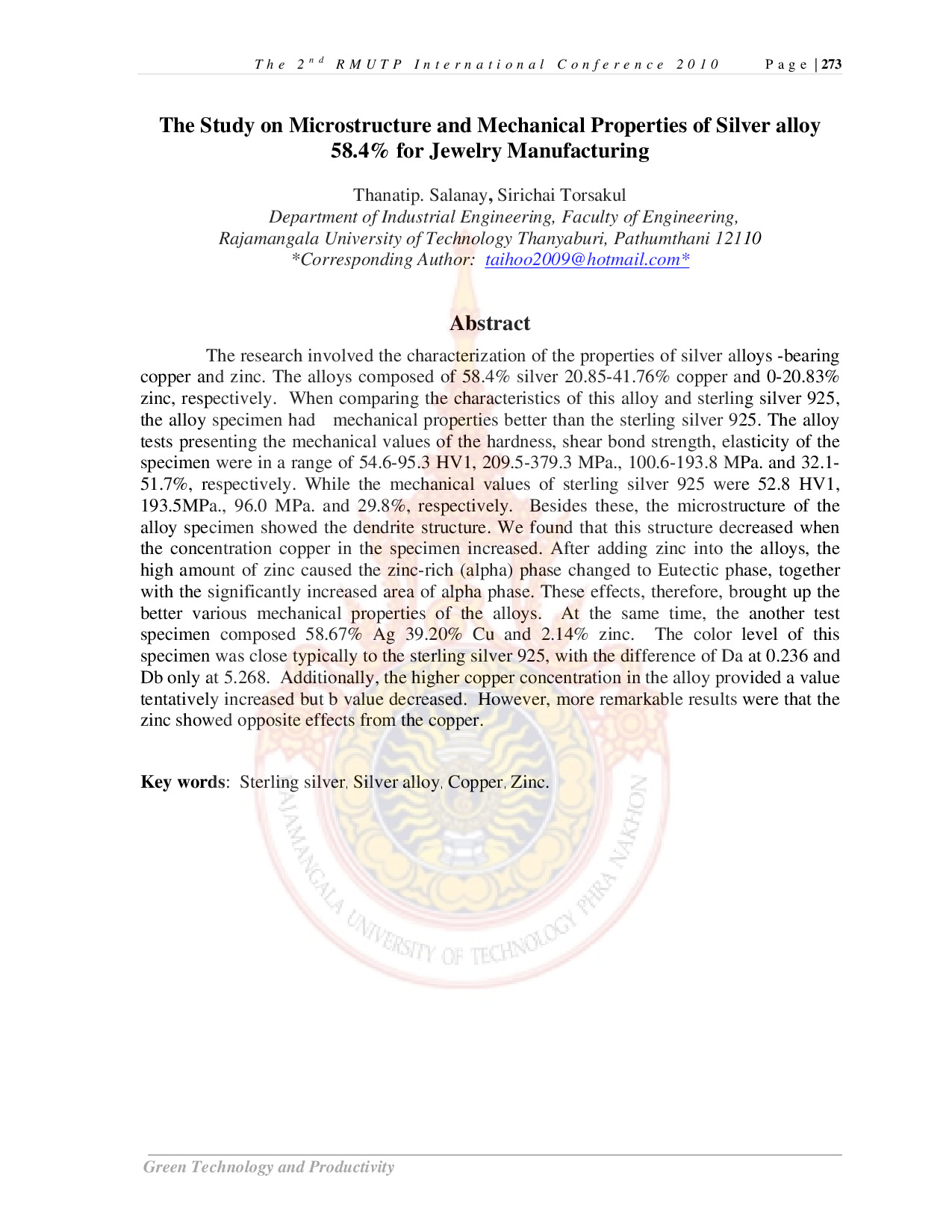
The Study on Microstructure and Mechanical Properties of Silver alloy 58.4% for Jewelry Manufacturing
The research involved the characterization of the properties of silver alloys -bearing copper and zinc. The alloys composed of 58.4% silver 20.85-41.76% copper and 0-20.83% zinc respectively. When comparing the characteristics of this alloy and sterling silver 925 the alloy specimen had mechanical properties better than the sterling silver 925. The alloy tests presenting the mechanical values of the hardness shear bond strength elasticity of the specimen were in a range of 54.6-95.3 HV1 209.5-379.3 MPa. 100.6-193.8 MPa. and 32.1-51.7% respectively. While the mechanical values of sterling silver 925 were 52.8 HV1 193.5MPa. 96.0 MPa. and 29.8% respectively. Besides these the microstructure of the alloy specimen showed the dendrite structure. We found that this structure decreased when the concentration copper in the specimen increased. After adding zinc into the alloys the high amount of zinc caused the zinc-rich (alpha) phase changed to Eutectic phase together with the significantly increased area of alpha phase. These effects therefore brought up the better various mechanical properties of the alloys. At the same time the another test specimen composed 58.67% Ag 39.20% Cu and 2.14% zinc. The color level of this specimen was close typically to the sterling silver 925 with the difference of Da at 0.236 and Db only at 5.268. Additionally the higher copper concentration in the alloy provided a value tentatively increased but b value decreased. However more remarkable results were that the zinc showed opposite effects from the copper.