จำนวน Repository ( 29 )

Measurement and mapping of noise level for Rajamangala University of Technology Phra Nakhon North Phra Nakhon Campus
The purpose of this research was characterized the noises at North Phra Nakhon campus Rajamangala University of Technology Phra NakhonThailand. The instrument of this study was instrument noises. Volume of noise levels were measured in terms of 15 hr and equivalent sound level (Leq 9 hr). 10 samples of noise levels were collected at Rajamangala University Technology Phra Nakhon from 10 stations. The results shown that the average noises volume of 9 hours were in range of 63.10 to 71.20 dBA by measuring station with highest mean of monitoring Station Building Civil Engineering in the area of Electrical Engineering and Mechanical Engineering were found 67.68 and 67.39 dBA respectively. The results of this study indicated that volume of noises in Rajamangala University of Technology Phra Nakhon were a little bit more than the standard of Pollution Control Department of Thailand and weren’t affected to teaching and learning in North Phra Nakhon campus.
The potential predictability of the northeast monsoon forecasts by the educational global climate model as measured by the supremum lyapunov exponent
Weather predictions by an atmospheric model are determined by the uncertainties in the initial condition and the imperfection of the model. It is difficult to provide accurate weather prediction. The efficiency of weather predictions model is obtained from the analyses of Lyapunov exponent. In addition the predictability measurements is applied from Lyapunov exponent are finite size Lyapunov exponent finite time Lyapunov exponent local Lyapunov exponent together with a new method called supremum Lyapunov exponent are used to measure predictability of the northeast monsoon (winter monsoon) by the Educational Global Climate Model (EdGCM) and to test sensitivity of the model to small initial perturbations. The EdGCM sensitive to initial perturbations it is suitable for predictability of the northeast monsoon. The EdGCM is run for 142-year predictions from the year 1958 to 2100. However only the outputs of geopotential height at 500hPa of December from 2012 to 2100 are used for predictability measurement. The results show that the EdGCM predictability for the northeast monsoon forecast is about 120 years. So the EdGCM can be predictability of the long range forecast. Supremum Lyapunov Exponent Click to buy NOW! PDF-XChange Viewer www.docu-track.com Click to buy NOW! PDF-XChange Viewer www.docu-track.com
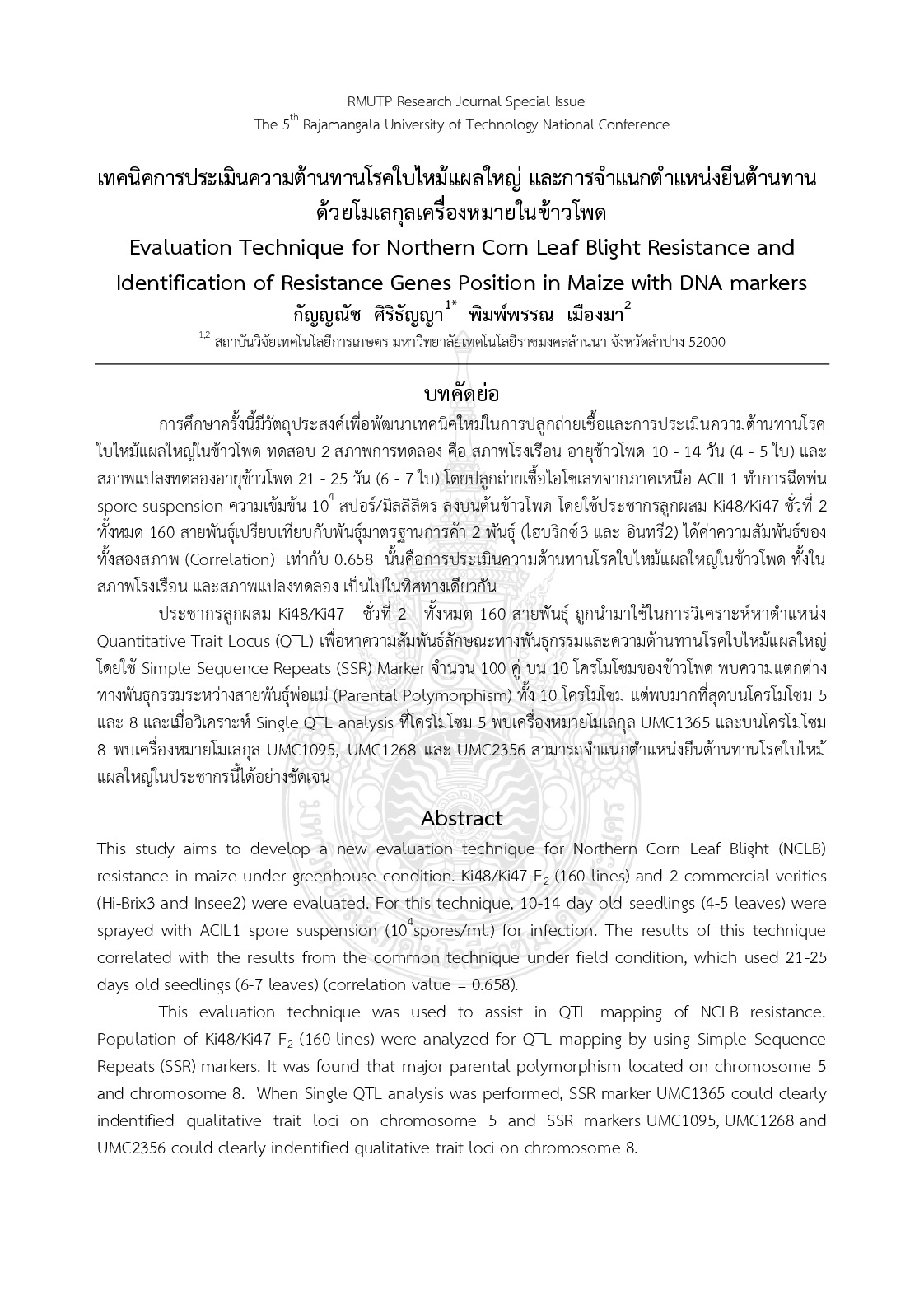
Evaluation technique for northern corn leaf blight resistance and identification of resistance genes position in maize with dna markers
This study aims to develop a new evaluation technique for Northern Corn Leaf Blight (NCLB) resistance in maize under greenhouse condition. Ki48/Ki47 F2 (160 lines) and 2 commercial verities (Hi-Brix3 and Insee2) were evaluated. For this technique 10-14 day old seedlings (4-5 leaves) were sprayed with ACIL1 spore suspension (104spores/ml.) for infection. The results of this technique correlated with the results from the common technique under field condition which used 21-25 days old seedlings (6-7 leaves) (correlation value = 0.658). This evaluation technique was used to assist in QTL mapping of NCLB resistance. Population of Ki48/Ki47 F2 (160 lines) were analyzed for QTL mapping by using Simple Sequence Repeats (SSR) markers. It was found that major parental polymorphism located on chromosome 5 and chromosome 8. When Single QTL analysis was performed SSR marker UMC1365 could clearly indentified qualitative trait loci on chromosome 5 and SSR markers UMC1095 UMC1268 and UMC2356 could clearly indentified qualitative trait loci on chromosome 8.
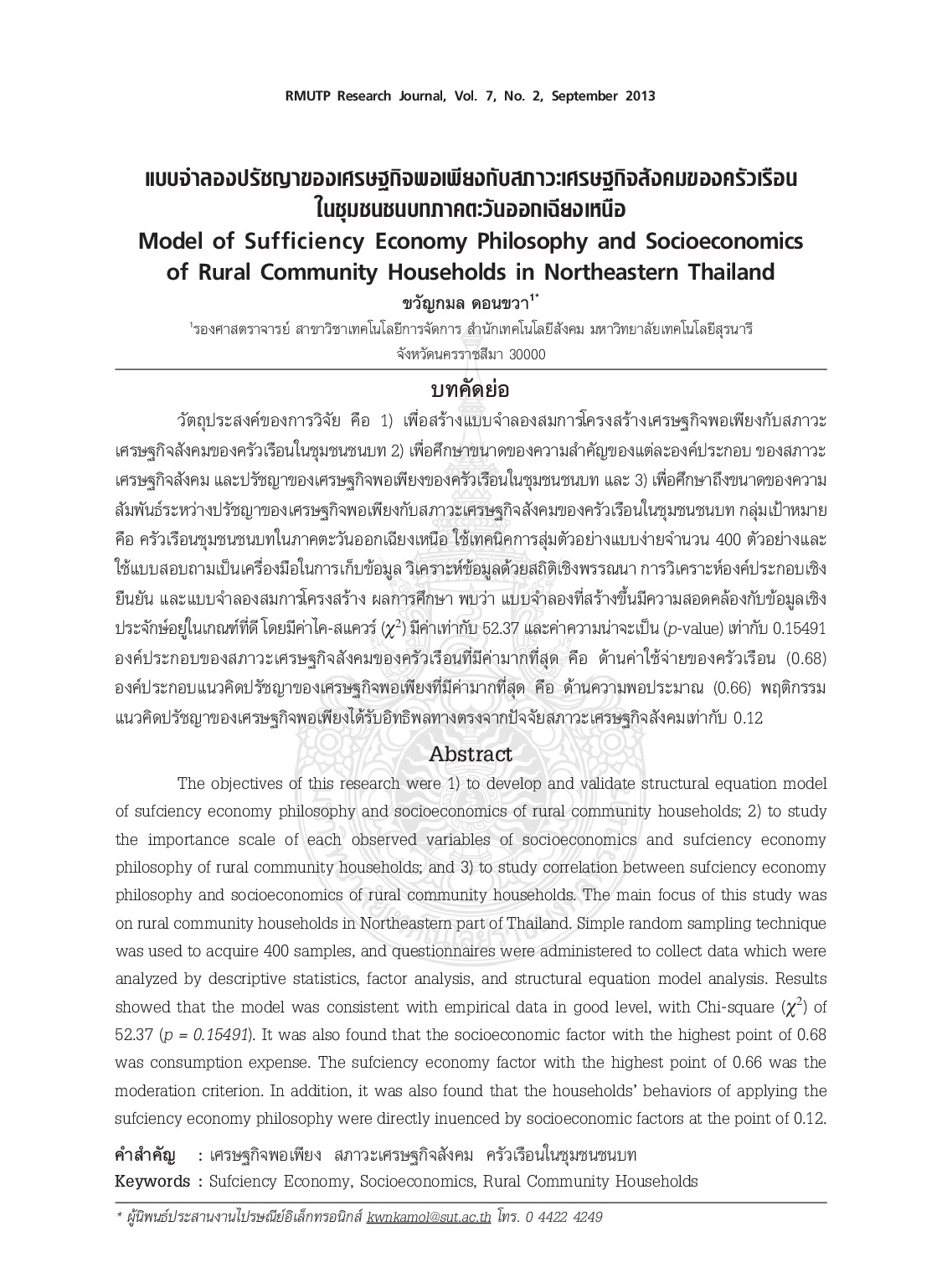
The model of a sufficiency economy philosophy with socioeconomics of rural community’s households, Northeastern Thailand
The objectives of this research were 1) to develop and validate the structural equation model of application of the sufficiency economy philosophy with socioeconomics of rural community households 2) to study the importance scale of each of the observed variables with socioeconomics and the sufficiency economy philosophy of rural community households and 3) to study the correlation level between the sufficiency economy philosophy and socioeconomics of rural community households. The main focus of this study was on rural community households. Simple random sampling technique was used to arrive at 400 samples and a questionnaire was administered to collect data and analyzed by descriptive statistics factor analysis and structural equation model analysis. The result showed that the model was consistent with the empirical data. Goodness of fit measures were found to be: Chi-square 52.37(p- value= 0.15491). It was also found that the factor loading of socioeconomics with the highest point was the consumption expenditure at 0.68 whereas the factor loading of the sufficiency economy philosophy with the highest point was the criterion of moderation at 0.66. Besides it was found that the rural community households’ behavior of applying the sufficiency economy philosophy received direct influence from the socioeconomic factors at the point of 0.12.
ศึกษาวิถีวัฒนธรรม อนุรักษ์และพัฒนาผ้าชนเผ่าสู่เชิงพาณิชย์ กรณีศึกษา ผ้าทอกะเหรี่ยงจังหวัดภาคเหนือ
The purpose of this research was to study the ways of Karieng tribal culture conserve and develop Karieng’s fabric and transfer technology to the target groups. The research instruments consisted of the interview the product prototype the opinion evaluation the performance evaluation the training evaluation. The sample groups used for this study comprised Karieng of Tambon Sridongyen Amphur Chaiprakan in Chaingmai province Karieng of Tambon Pangmoo Amphur Muang in Maehongson province Karieng of Tambonkhanaechue Amphur Maeramad in Tak province. Groups of 100 people were interested in these products and 25 trainees of Karieng of Tambon Sridongyen Amphur Chaiprakan in Chaingmai. Statistics used were percentage average and standard deviation. The results revealed that 3 Karieng groups were the same culture ways in the religion languages the life ways costumes occupation culture tradition residents and family systems. They were different from Karieng of Tambon Pangmoo Amphur Muang in Maehongson who wore a brass collar were called long neck Karieng but some people weren’t wearing them in this day. Groups of Karieng Tumbon Khanechue Amphur Maeramad in Tak province will use the urban lifestyle and costumes. Groups of Karieng Tumbon Sridongyen Amphur Chaiprakan in Chiangmai will use in sufficient style farmers and employees. All of them were similar to wear Karieng’s fabric in ceremonies. The researchers concluded that the development of tribe’s fabric were applied the costumes style from the origins. We used two methods: the striped fabric and decorative materials were made in ten patterns. The evaluation of Karieng’s fabric product found that the sixth clothes pattern were the best suitable in decoration the pattern and design averaged 4.45. and the transfer technology evaluation trainees groups were Karieng of Tumbon Sridongyen Amphur Chaiprakan in Chaingmai province wanted to know and practice to develop the modern garment pattern base on the conservative of wisdom and creation the economic communities. The assessment result found that the female trainees who were farmer’s occupation primary education income less than 4000 baht were over 40 years. Before training they knew the Karieng garment design in moderate level. Sewing and decoration of Karieng garment were in high level. After training they knew more three things. They brought the knowledge to use in high level. The trainees want to train the next time in the highest.