จำนวน Repository ( 26 )

Mechanical properties of concrete mixed with reused ceramic tiles reinforced with steel fiber from milling processed
This research study the mechanical properties of concrete mixed with reused ceramic tiles reinforced with steel fiber from milling processed. The compressive strength of all concretes were designed at 300 ksc at 28 days and control slump in the range of 10 ? 2.5 cm. The steel fiber from milling processed was reinforced at 0.50 1.00 and 1.50 by the weight of cement content. The compressive strength Flexural and tensile splitting for all concrete samples were tested compare with control concrete which it as concrete mixed with reused ceramic tiles not reinforced with steel fiber. The results shown that the reinforcing with steel fiber from milling process at 0.5 and 1.0% was affect to the higher compressive strength than control concrete of 2 and 7% but increasing steel fiber at 1.5% was affect to lower compressive strength than control concrete of 6%. Concrete mixed with steel fiber from milling processed at 1.0% have higher splitting tensile strength than control concrete of 16% while concrete mixed with steel fiber at 0.5 and 1.5% have splitting tensile strength equal with control concrete. The flexural strength of these concretes have higher more than control concrete about 9 17 and 11% for reinforcing with steel fiber at 0.50 1.00 and 1.50 respectively. In addition the water permeability of concretes were increased when the steel fiber were reinforced increases too.
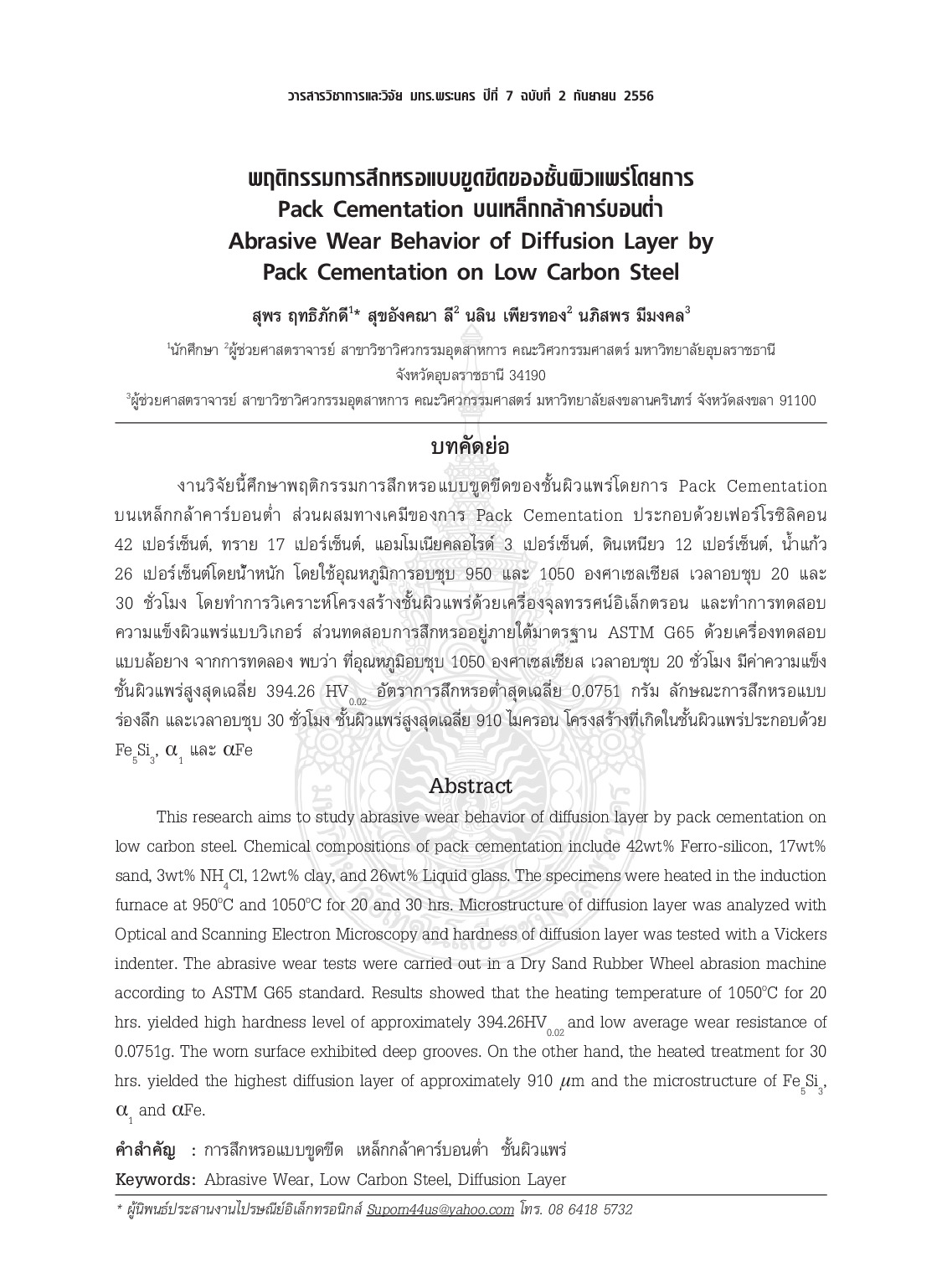
Abrasive wear behavior of diffusion layer by Pack Cementation on low carbon steel
This research aims to study abrasive wear behavior of diffusion layer by pack cementation on low carbon steel. Chemical compositions of pack cementation include 42wt% Ferro-silicon 17wt% sand 3wt% NH4Cl 12wt% clay and 26wt% Liquid glass. The specimens were heated in the induction furnace at 950?C and 1050?C for 20 and 30 hrs. Microstructure of diffusion layer was analyzed with Optical and Scanning Electron Microscopy and hardness of diffusion layer was tested with a Vickers indenter. The abrasive wear tests were carried out in a Dry Sand Rubber Wheel abrasion machine according to ASTM G65 standard. Results showed that the heating temperature of 1050?C for 20 hrs. yielded high hardness level of approximately 394.26HV0.02 and low average wear resistance of 0.0751g. The worn surface exhibited deep grooves. On the other hand the heated treatment for 30 hrs. yielded the highest diffusion layer of approximately 910?m and the microstructure of Fe5Si3 ?1 and ?Fe.
การเปรียบเทียบวัสดุที่ใช้ทำแม่พิมพ์ฉีดที่ทำจากอลูมิเนียมเกรด A7075 กับ เหล็กเกรด P20
Material selection for mold making are not only material prices wages but also there are other factors such as thermal strength shine and resistance to temperature changing that caused distortion and cracks. Preform injection molding from Polyethylene Terephthalate (PET) consumes time for drying granulated plastic in 4 – 6 hours at 140 - 160°C and injects at 280 – 300 °C. This is a very high temperature to inject into mold at 10 – 15°C in cool area. The material for mold making must be able to resist to thermal shock. Today molding machines are made of grade P20 steel (Standard JIS) to produce preform that takes long cycle time due to poor cooling. The research aims to compare the pricing time in mold making to preform injection time that made of aluminum -A7075 grade and grade P20 steel. The experiment is to make a mold that made of aluminum A7075 grade and grade P20 steel injects 15 gram preform. The PET is used to blow into a blow mold with pressure at 30 – 35 bar (Two – Stage) that are 2 bottles of 350 ML. The results of material selection for preform mold making showed that aluminum A7075 grade is cheaper 27.04% the mold price is cheaper 23.6% and consumes less cycle time than grade P20 steel.
ตัวแบบการพยากรณ์ความต้องการเหล็กภายใต้ความไม่แน่นอนโดยวิธีเบย์
The objective of this research is to propose a forecasting model for uncertain demand index data of steel. The forecasting model proposed by Yelland (2010) was modified by adjusting the prior distributions of some parameters in the model in order that it is suitable for the demand of steel in Thailand. The algorithms for model fitting were written in OpenBUGS. The proposed model was compared to a classical exponential smoothing model. The research found that the forecast errors from the proposed forecasting model were minimum.
การวิเคราะห์ระบบสินค้าคงคลังโดยใช้ตัวแบบสินค้าคงคลังเชิงสโตคาสติก: กรณีศึกษาอุตสาหกรรมเหล็กและเหล็กกล้าของไทย
The objectives of this research were to select the most appropriate forecasting model for uncertain demand of hot-rolled steel and to find the purchase amount and the reorder point of some raw materials in order to minimize the total cost of production in an iron and steel production planning. The three forecasting models which were exponential model ARIMS model and the proposed Bayesian model were studied. An iron and steel factory in Samutprakarn province was a prototype for this study. Because of their uncertain high demand the Steel H-Beam Steel plate steel round bar and black steel round bar with various sizes were selected and their parameters including demand rate inventory cost back order cost and setup cost were collected. The study found that the proposed Bayesian forecasting model is the most appropriate. The predicted demand and all parameter values were used to find the purchase amounts and the reorder points of the raw materials under the (rQ) policy of the stochastic inventory model.