จำนวน Repository ( 23 )
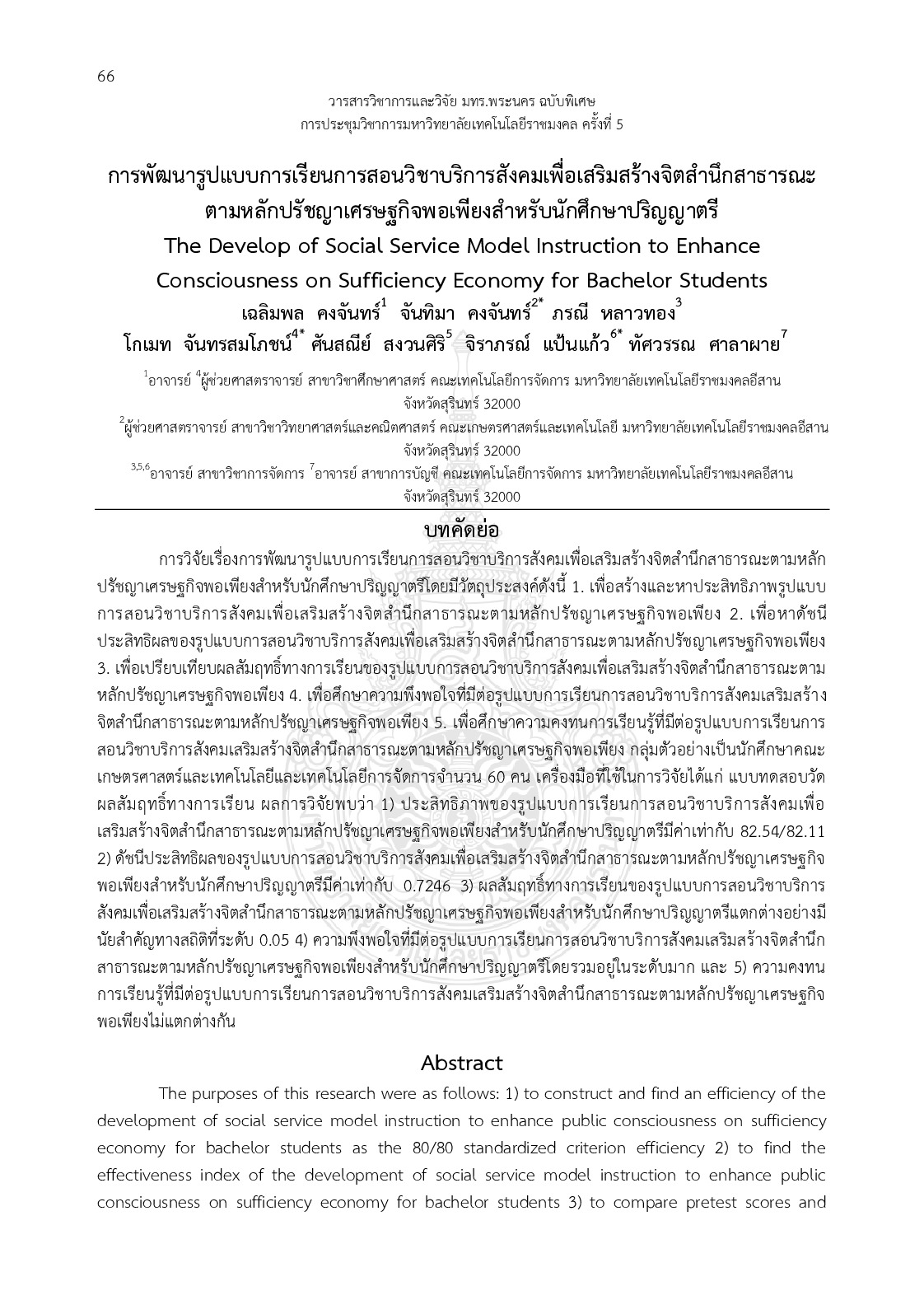
The develop of social service model instruction to enhance consciousness on sufficiency economy for bachelor students
The purposes of this research were as follows: 1) to construct and find an efficiency of the development of social service model instruction to enhance public consciousness on sufficiency economy for bachelor students as the 80/80 standardized criterion efficiency 2) to find the effectiveness index of the development of social service model instruction to enhance public consciousness on sufficiency economy for bachelor students 3) to compare pretest scores and post-test scores all lessons 4) to study the satisfaction of students after they join the class 5) to study the attitude of students after they join the class and 6) to find the retention of students after join the class in two weeks. The sixty students were area on simple random sampling selected from students in Rajamangala Technology University. The results the study was as follows: 1) An efficiency of the development of social service model instruction to enhance public consciousness on sufficiency economy for bachelor students was 82.54/82.11 which higher than the 80/80 standardized criterion efficiency. 2) The efficiency index of the development of social service model instruction to enhance public consciousness on sufficiency economy for bachelor students was 0.7246. 3) The results of the comparisons of pre-test scores and post-test scores all lesson significantly different at 0.05. 4) The results of the satisfaction of the development of social service model instruction to enhance public consciousness on sufficiency economy for bachelor students was found to be a high level. 5) The retention of the teachers after join the class in two was no significantly different.
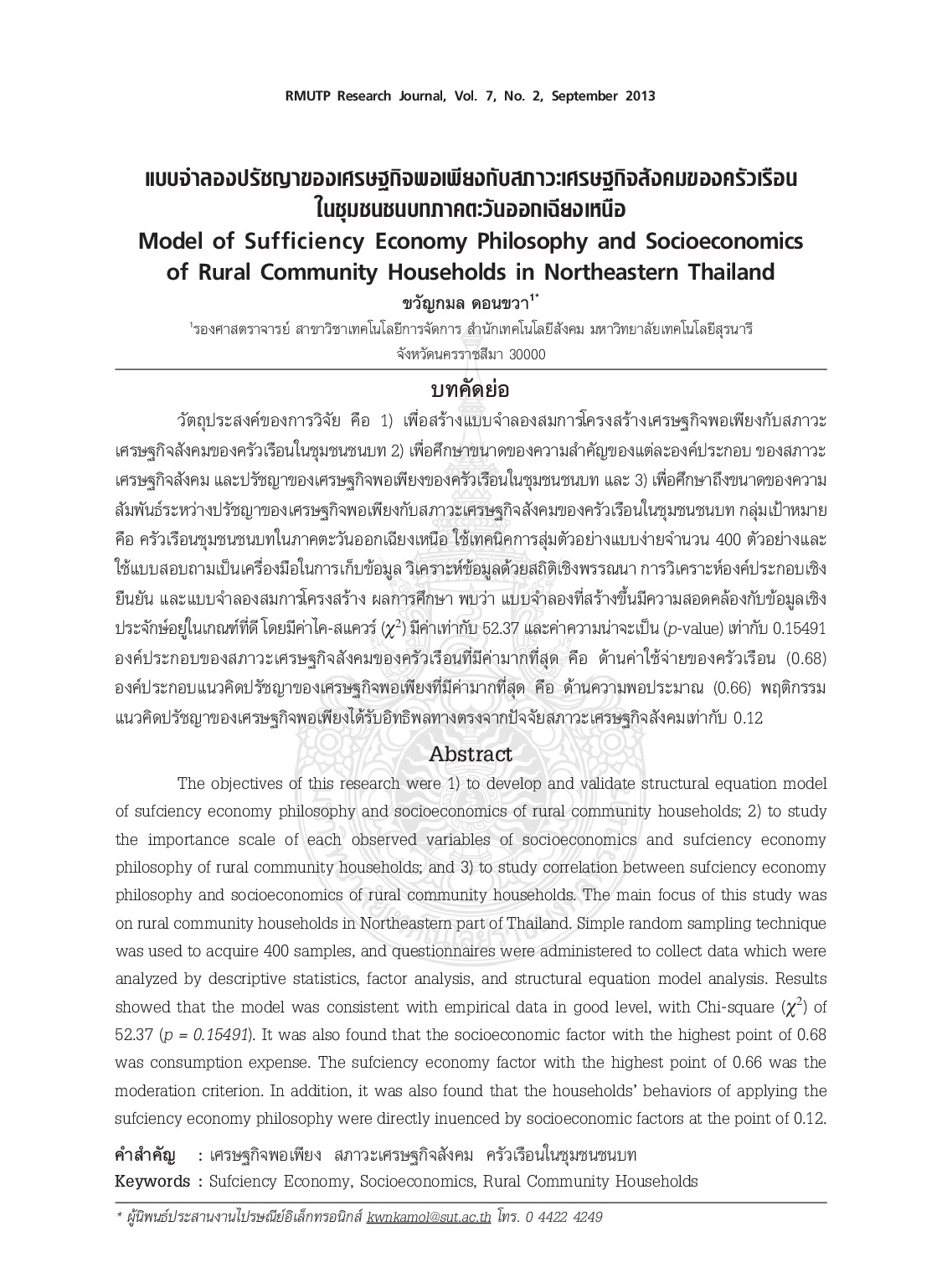
The model of a sufficiency economy philosophy with socioeconomics of rural community’s households, Northeastern Thailand
The objectives of this research were 1) to develop and validate the structural equation model of application of the sufficiency economy philosophy with socioeconomics of rural community households 2) to study the importance scale of each of the observed variables with socioeconomics and the sufficiency economy philosophy of rural community households and 3) to study the correlation level between the sufficiency economy philosophy and socioeconomics of rural community households. The main focus of this study was on rural community households. Simple random sampling technique was used to arrive at 400 samples and a questionnaire was administered to collect data and analyzed by descriptive statistics factor analysis and structural equation model analysis. The result showed that the model was consistent with the empirical data. Goodness of fit measures were found to be: Chi-square 52.37(p- value= 0.15491). It was also found that the factor loading of socioeconomics with the highest point was the consumption expenditure at 0.68 whereas the factor loading of the sufficiency economy philosophy with the highest point was the criterion of moderation at 0.66. Besides it was found that the rural community households’ behavior of applying the sufficiency economy philosophy received direct influence from the socioeconomic factors at the point of 0.12.
Cognition in philosophy of sufficiency economy towords consumer behavior Of undergraduate students in Rajamangala University ofTechnology Phra Nakhon
The purposes of this research Cognition in Philosophy of Sufficiency Economy Towords Consumer Behavior of Undergraduate Students in Rajamangala University of Technology Phra Nakhon of six education level and Faculty of study Results of the research are as Collows : respondents were male female and Faculty of study different cognition and perception influencing towarde behavioral decising making an behavioral consumer. Regarding the behavior of advertising media exposure most of the singles choose to be exposed to television media. For the other type the are study to knowledge and understanding but behavior consumer more than size effect from student have knowledge and Cognitive Philosophy of Safficiency economy loss.
The Formation and Stability of Sufficiency Economy
The purpose of this research were 1) to study the application of sufficiency economy philosophy in business small and middle 2) to compare the sufficiency economy philosophy levels of business on economic social environment culture good governance and Balanced Scorecard 3) to compare the sufficiency economy philosophy performance among business with different grade levels. The samples were small and middle business in Bangkok and near Bangkok. The sample size with 350 answered the questionnaires with and another group with 15 business were interviewed. The research instruments were a set of questionnaire with a reliability of 0.9210 and an interview form . The data form the questionnaires were analyzed by frequency distributions percentage mean standard deviation and one way ANOVA and the data from interview form were analyzed by frequency distributions. The findings of the study were: I) Sufficiency economy philosophy application among small and middle business were high sequently form their practices as follows: economic social good governance and Balanced Scorc Card 2) Performance on sufficiency economy philosophy application in business of small and middle were significantly different at 0.05 level when comparing in different aspects. 3) Sufficiency economy philosophy performance level of business in each grade levels were not significantly different at 0.05 levels.
Expenditure Behavior Following the Sufficiency Economy Concept of Teachers Faculty of Business Administration Rajamangala University of Technology Pha Nakhon.
The objectives of this study were to study expenditure behaviors following the Sufficiency Economy Concept of teachers Faculty of Business Administration Rajamangala University of Technology Pha Nakhon in 3 aspects : moderation reasonableness immunization; compare the expenditure behaviors of the teachers by sex monthly incomes debt conditions and years of work experiences. The sample consisted of 92 teachers Faculty of Business Administration Rajamangala Univerity of Technology Pha Nokhon. The instrument used in data collection was a 5-level scale questionnaire with an alpha reliability of 0.95. The descriptive statistics used in data analysis were frequency percentage mean standard deviation. The statistics used in hypothesis tests were t-test One-Way ANOVA and post hoc LDS tests. The result of the study are as follows. 1. The expenditure behaviors following the Sufficiency Economy Concept of teachers Faculty of Business Administratjon Rajamangala University of Technology Pha Nakhon as a whole and individual 3 aspects : moderation reasonableness and immunization were at the high level. 2. The male and female teachers did not have different expenditure behaviors following the Sufficiency Economy Concept as a whole and individual 3 aspects. 3. The teachers having different monthly incomes had significantly different expenditure behaviors following the Sufficiency Economy Concept as a whole the moderation and the reasonableness at .01 level; teachers having > 29519 Baht monthly incomes had higher mean of the expenditure behaviors as a whole the moderation and the reasonableness than those having < 22251 Baht monthly incomes and 22251-29519 Baht monthly incomes. 4. The teachers having different debt conditions had significantly different expenditure behaviors following the Sufficiency Economy Concept as a whole and individual aspects at .01 level; teachers having no debt and teachers having manageable debt had higher means of the expenditure behaviors as a whole and the 3 aspects than those having unmanageable debt. 5. The teachers having different years of work experiences did not have different expenditure behaviors following the Sufficiency Economy Concept as a whole. When considered individual aspects it was found that means of 2 aspects were significantly different at .05 level as follows : teachers having 20-27 years of work experiences and > 27 years of work experiences had significantly higher means in the moderation aspect than teachers having < 20 years of work experiences; and teachers having > 27 years of work experiences had significantly higher mean in the reasonableness than teachers having < 20 years of work experiences.