จำนวน Repository ( 62 )
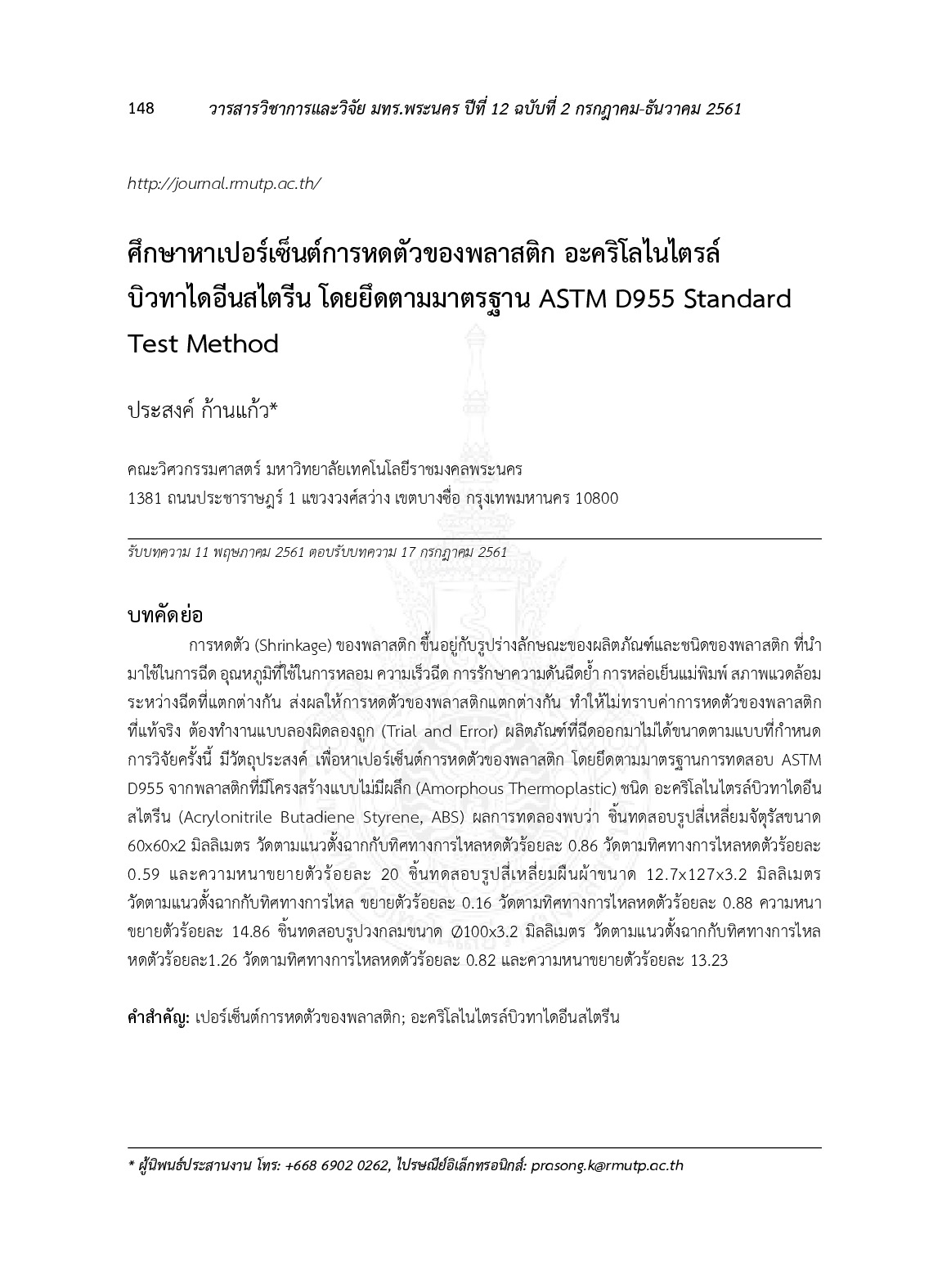
การศึกษาหาเปอร์เซ็นต์การหดตัวของพลาสติก อะคริโลไตรล์บิวทาไออีนสไตรีน โดยยึดตามาตรฐาน ASTM D955 standard test method
The shrinkage of plastic was caused by the shape of the product and the type of plastic used in the injection. The plastic shrinkage difference was resulted from the temperature used in melting the injection speed mold cooling and different injection surroundings. These led to unknown exact value of plastic shrinkage and the trial and error work has been done. As a result of trial and error work the injection products were not in the determined size. This research aims to find the percentage of plastic shrinkage according to standard test ASTM D955 from (Amorphous Thermoplastic) (Acrylonitrile Butadiene Styrene ABS). The findings showed that square specimen size 60x60x2 mm measured from vertical perpendicular to flowing direction the shrinkage was at 0.86% the shrinkage was at 0.59% when measured from flowing direction and the thickness expanded at 20%. For the rectangular specimen size 12.7x127x3.2 mm measured from vertical perpendicular to flowing direction the expanding was at 0.16% the shrinkage was at 0.88% when measured from flowing direction and the thickness expanded at 14.86%. The circular specimen size 100x3.2 mm the shrinkage was at 1.26 when measured from vertical perpendicular to flowing direction the shrinkage measured from flowing direction was at 0.82% and the thickness expanded at 13.23%
ออกแบบและสร้างหุ่นทดสอบการชนของรถจักรยานยนต์ภายใต้สัดส่วนโครงสร้างของคนไทย
The aim of this research is to design a prototype of a male dummy chest for motorcycle crash tests. The primary criteria discussed in this study are based on the unique features of Thai ergonomic body sizes with an age range of the highest fatal rate and the fundamental design of the Hybrid III 50th percentile male crash test dummy. A comprehensive experimental study of crash behavior of the prototype undergoing axial compressive loading is performed using the mutual procedure of cadaveric chest testing. For design criteria the largest chest deflection of 80 mm the maximum acceleration of 38.47g and the absorbed energy of 178.369 Joules are considered in the experiment. The obtained results show a good agreement with the experimental data of other researches in which the capability of the energy absorption depends on impact velocities. In addition the energy absorption capability of this prototype can accurately assess an injury level under AIS 3+. For this reason the first prototype of a male chest dummy is particularly suitable for an assessment of a lower serious injury level in a motorcycle crash test.
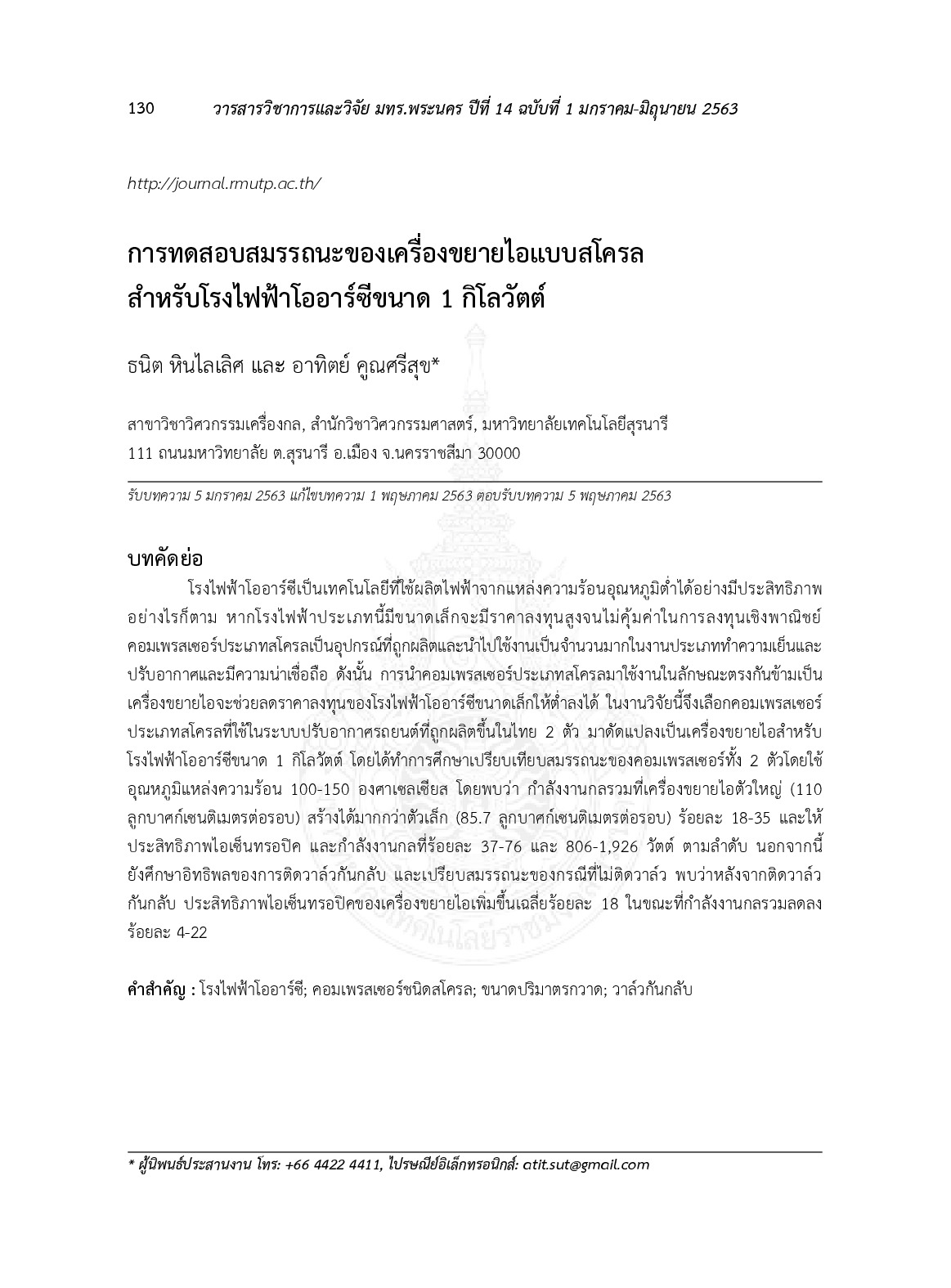
การทดสอบสมรรถนะของเครื่องขยายไอแบบสโครลสำหรับโรงไฟฟ้าโออาร์ซีขนาด 1 กิโลวัตต์
The ORC power plant is a promising technology to generate electricity from low-temperature heat sources. However implementation of the ORC for low capacity electricity generation is unattractive at the commercial level. Scroll compressors are massively produced to be used in refrigeration and air-conditioning applications. Using a scroll compressor in reverse as an expander can reduce the investment cost of low-capacity ORC power plants. In this study 2 scroll compressors that are available in the automotive air-conditioning market of Thailand were modified and used as the expander of a 1 kW ORC power plant. The performances of these 2 scrolls were compared and the plant performance was investigated. A heat source temperature from 100°C to 150°C was supplied to the plant. It was found that the gross power is higher by 18-35% for the larger expander (110 cc/rev) than for the smaller expander (85.7 cc/rev). The larger one provides the isentropic efficiency of 37-76% and the gross power of 806-1926 W. In addition the effects of check valve installation were examined and compared with those of the tests without check valve installation. It was revealed that the isentropic efficiency increases by 18% while the gross power decreases by 4-22% when the check valve was installed.
การเปรียบเทียบกำลังทางไฟฟ้าของรถจักรดีเซลไฟฟ้า ระหว่างการตรวจวัดด้วยเครื่องติดตามระยะไกลและเครื่องมือวัดประจำสถานี
Rail transport is a type of transportation that strongly influences economic due to its ability to transport a large number of passengers and products per trip relying on diesel-electric engines. The objectives of this thesis were set to investigate and develop the electrical performance tracking system of long-distance diesel electric locomotives and compare the electrical performance measured by the diesel electric locomotive performance tracking system and measured from the measuring instrument at Diesel Engine Maintenance Station in Bang Sue. The electric diesel locomotive no. 4513 (Cummins KTA50-L) was selected as the study subject of the experimentation. The results showed that the power loss of the diesel electric locomotive from the conversion of alternating current to direct current was inversely proportional to the engine speed. The power losses between the low and high engine speeds were equal to 77.11 and 2.49 percent respectively. The above data reflects the limitation of diesel electric engine performance and should lead to the construction of a database for making decision on the right engine selection suitable for the towing load of the locomotive.
การตรวจสอบความเสียหายของถังเก็บน้ำมันด้วยการตรวจสอบแบบไม่ทำลายโดยใช้เทคนิคการปลดปล่อยคลื่นเสียง
Non-destructive test with Acoustic Emission technique was used for monitoring of the corrosion in the above ground oil storage tank. In the analytical characteristics of acoustic emission wave however Acoustic Emission test has to be prior used for the location detection of corrosion especially indication of the severity of corrosion. In this research the relationship between the corrosion rate and the sound wave energy was studied. The corrosion and damage detected on the surface of the aboveground storage tank was determined by the Acoustic Emission Test. Nine pieces of low carbon steel grade SS400 was soaked in sodium chloride solution in simulated tanks at concentrations of 1.5 3.5 and 5.5 wt%. Next the corrosion activity was checked by performing with the Acoustic Emission Testing for 1 hour and thus calculating the corrosion rate of the test specimens. From the experiment it was found that the rate of corrosion affects the Acoustic Emission Energy. The corrosion rate was increased with the concentrations of the solution increasing from the corrosion process. The corrosion rate was also increased with the sound wave power increases. Therefore in order to achieve the corrosion rate and the position of the defects on the inner surface of the tank non-destructive testing with acoustic emission technique can be factually chosen for this specific application.