จำนวน Repository ( 36 )
การออกแบบและพัฒนาผลิตภัณฑ์จากผ้าใยกล้วยด้วยการพิมพ์แบบกราฟิกและตกแต่งนวัตกรรมนาโนสู่การพัฒนาเศรษฐกิจชุมชนเชิงพาณิชย์
This research is Design and development of banana fiber textiles with graphic printing and decoration Nano innovation to the Economic Communities Commercial The purpose of this research were 1) study the fundamental properties of banana fiber textiles with graphic printing and decoration Nano innovation on products 2) to design and develop products of banana fiber textiles with graphic printing and decoration Nano innovation 3) to produce the women handbags prototypes products of banana fabric with graphic printing and decoration Nano innovation to the Economic Communities Commercial. 4) to assess the opinion of the women handbags products of banana fabric by Questionnaire of user’s 5) to transfers knowledge of product design from banana fabric by printing graphics and decoration nanotechnology innovations. Economic development to commercialization. To be useful in the design and development of the product forward. Research tools are 1) the three graphic design drafts and create five women handbags prototypes product 2) Questionnaire of user’s opinion : an assessment of the design and the satisfaction of users of 25 people to inquiries random coincidence. Using the percentage and averages 3) implementation of knowledge transfer to the community of interest 17 – 18 September 2016 at the Chedi district office in Suphanburi province total 25 people including community enterprise Various womens groups And others interested in the surrounding area 4) Questionnaire of consumers satisfaction : the assessment of satisfaction of participants to design and develop products from banana fibers by printing graphics and decoration nanotechnology innovations. Data were analyzed using the statistical average of the results as table and descriptive. The results were as follows: 1) Innovative nano-fiber cloth decorated banana fabric can be antibacterial at 99.95% and staphylococcus bacteria klebsiella pneumonia at 99.93% and water reflection / water level of 80 percent water which can be absorbed into the cloth and wet it a bit. 2) The mostly respondents were female aged 21-25 years students earn less than 15000 baht in the inquiry satisfaction of consumers on the use of products from cotton banana fiber with printing. graphic and decorative nanotechnology innovation. All have beensatisfied at maximum average and highest level of satisfaction that with an average 4.91 percent to 98.24 satisfaction is at the highest level. 3) Execution Technology The workshop schedule for the two-day workshop on 17 - 18 September 2559 at the Chedi district office in Suphanburi province 25 people including community enterprise. Various womens groups and interested parties within the surrounding area. Most of the participants were satisfied with the level in most every question.
ผลิตภัณฑ์กระเบื้องยางพาราผสมเศษขยะพลาสติกเหลือทิ้งจากโรงงานอุตสาหกรรม
This research aims to develop the Para-rubber floor tiles mixed with ethylene vinyl acetate plastic wastes (EVA plastics) from the factories. The study use Para-rubber STR 20 at 100 phr with various contents of EVA plastics (e.g. 0 5 10 20 40 and 80 phr) and then mixed with chemical substance at constant ratio include zinc oxide at 5 phr stearic acid at 2 phr sulfur at 3 phr mercaptobenzothiazole at 0.5 phr and diphenyl guanidine at 0.2 phr. The samples are ground by two-roll mill and formed by compression molding at 150 degree Celsius with 30x30x0.2 cm of dimension. The properties of the Para-rubber floor tiles are tested under ASTM standard. From the results it is found that the Para-rubber floor tiles mixed with 10 phr of EVA plastics is the suitable ratio for using as the rubber floor tiles and rubber wall tiles in building. This ratio can increase the hardness and wear resistant properties and decrease the density and thermal insulation properties when compare to the Para-rubber floor tiles without EVA plastic.

Mechanical properties of concrete mixed with reused ceramic tiles reinforced with steel fiber from milling processed
This research study the mechanical properties of concrete mixed with reused ceramic tiles reinforced with steel fiber from milling processed. The compressive strength of all concretes were designed at 300 ksc at 28 days and control slump in the range of 10 ? 2.5 cm. The steel fiber from milling processed was reinforced at 0.50 1.00 and 1.50 by the weight of cement content. The compressive strength Flexural and tensile splitting for all concrete samples were tested compare with control concrete which it as concrete mixed with reused ceramic tiles not reinforced with steel fiber. The results shown that the reinforcing with steel fiber from milling process at 0.5 and 1.0% was affect to the higher compressive strength than control concrete of 2 and 7% but increasing steel fiber at 1.5% was affect to lower compressive strength than control concrete of 6%. Concrete mixed with steel fiber from milling processed at 1.0% have higher splitting tensile strength than control concrete of 16% while concrete mixed with steel fiber at 0.5 and 1.5% have splitting tensile strength equal with control concrete. The flexural strength of these concretes have higher more than control concrete about 9 17 and 11% for reinforcing with steel fiber at 0.50 1.00 and 1.50 respectively. In addition the water permeability of concretes were increased when the steel fiber were reinforced increases too.
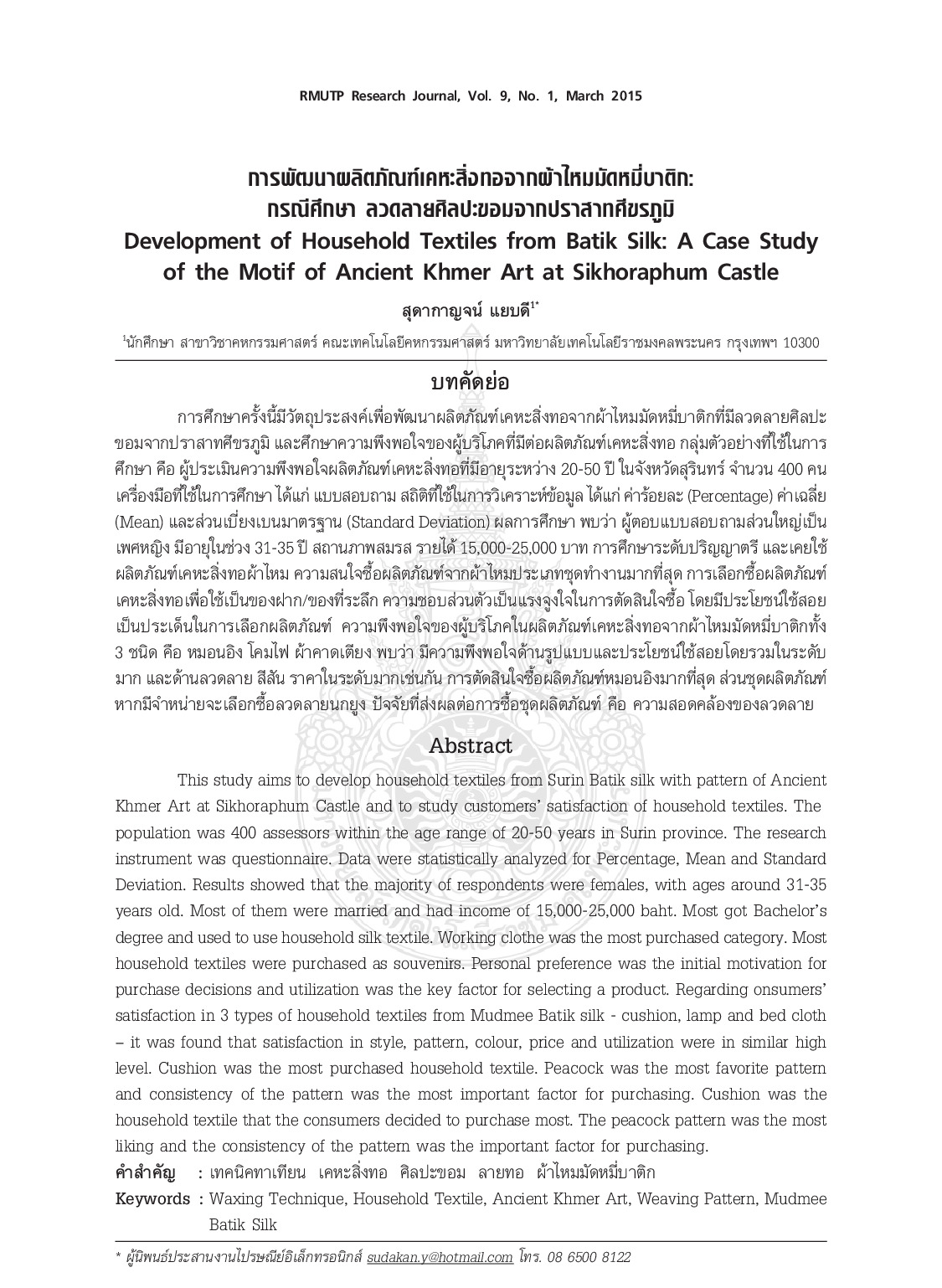
Development of household textiles from batik silk: a case study of the motif of ancient khmer art at sikhoraphum castle
This study aims to develop household textiles from Surin Batik silk with pattern of Ancient Khmer Art at Sikhoraphum Castle and to study customers’ satisfaction of household textiles. The population was 400 assessors within the age range of 20 - 50 years in Surin province. The research instrument was questionnaire. Data were statistically analyzed for Percentage Mean and Standard Deviation. Results showed that the majority of respondents were females with ages around 31 - 35 years old. Most of them were married and had income of 15000 – 25000 baht. Most got Bachelor’s degree and used to use household silk textile. Working clothe was the most purchased category. Most household textiles were purchased as souvenirs. Personal preference was the initial motivation for purchase decisions and utilization was the key factor for selecting a product. Regarding onsumers’ satisfaction in 3 types of household textiles from Mudmee Batik silk - cushion lamp and bed cloth – it was found that satisfaction in style pattern colour price and utilization were in similar high level. Cushion was the most purchased household textile. Peacock was the most favorite pattern and consistency of the pattern was the most important factor for purchasing.
The environment of the faculty of industrial textiles and fashion design at Rajamangala University of Technology Phra Nakhon as Perceived by Undergraduate students
The purpose of this research were 1) to study the environment of The Faculty of Industrial Textiles and Fashion Design at Rajamangala University of Technology Phra Nakhon as perceived by undergraduate students. in overall and 5aspects : lecturers teaching and learning management premises students services and students activities. 2) to compare perceived of the environment of the Faculty of Industrial Textiles and Fashion Design at Rajamangala University of Technology Phra Nakhon. In overall and 5 aspects classified by gender years of study student achievement and major of studies 416 under graduate students were used as samples. The instruments used in the study was a five-point 58 items rating scale questionnaire with the reliability of 0.97. The data were analyzed by mean percentage standard deviation and t-test. The results revealed that : 1) the environment of the Faculty of Industrial Textiles and Fashion Design at Rajamangala University of Technology Phra Nakhon as perceived by undergraduate students in overall and 5 aspects were at moderate level. 2) the environment of The Faculty of Industrial Textiles and Fashion Design at Rajamangala University of Technology Phra Nakhon as perceived by undergraduate students classified by gender years of study student achievement and faculties were significant different.