จำนวน Repository ( 131 )
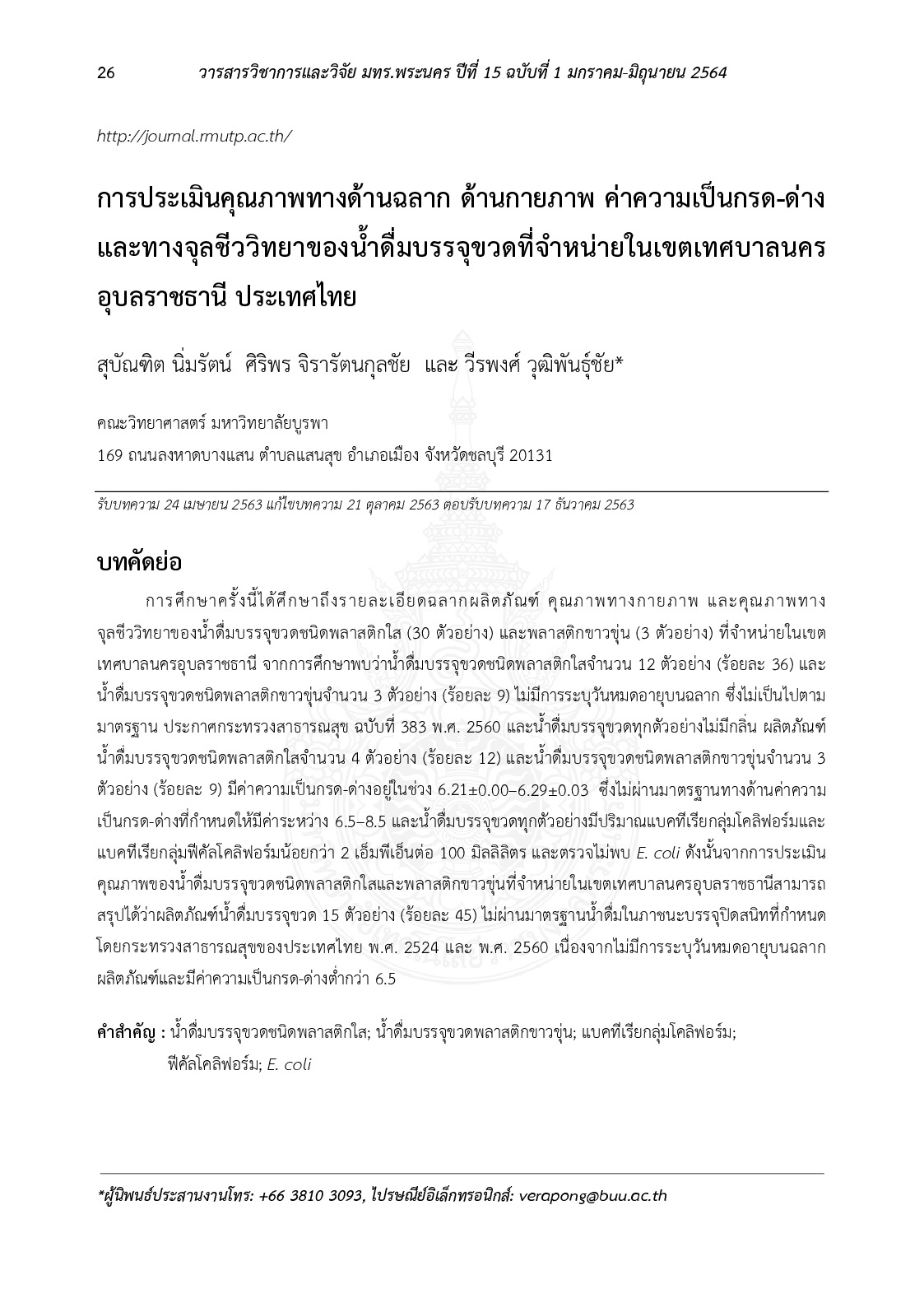
การประเมินคุณภาพทางด้านฉลาก ด้านกายภาพ ค่าความเป็นกรด-ด่าง และทางจุลชีววิทยาของน้ำดื่มบรรจุขวดที่จำหน่ายในเขตเทศบาลนครอุบลราชธานี ประเทศไทย
. In this study examination of label information physical and microbiological qualities was performed in 30 clear-plastic and 3 opaque-plastic bottled drinking water products distributed in city municipality of Ubon Ratchathani. Results showed that 12 clear-plastic (36%) and 3 opaque-plastic (9%) bottled drinking water samples had no expiry date on the product labels which were discordant to the criteria for drinking water in sealed containers imposed by the Ministry of Public Health of Thailand no. 383 (2017). Odorless appearances of all drinking water samples were observed. Values of pH in 4 clear-plastic (12%) and 3 opaque-plastic (9%) bottled drinking water samples were in the ranges of 6.21±0.00–6.29±0.03 which were below the allowable limit (pH 6.5–8.5). All bottled drinking water products contained numbers of total coliform and fecal coliform bacteria less than 2 MPN/100 mL and were devoid of E. coli. Therefore based on the quality of clear-plastic and opaqueplastic bottled drinking water products distributed in city municipality of Ubon Ratchathani 1 5 samples (45%) did not meet standard for drinking water in sealed containers declared by the Ministry of Public Health of Thailand (1981 and 2017) owing to no expiry date labeled on the products and pH value below 6.5.
การวิเคราะห์ปัญหาน้ำเสียที่มาจากกากการเผาไหม้ของเหง้าทลายปาล์มที่โรงไฟฟ้าพลังงานชีวมวลและพลังงานก๊าซชีวภาพเพื่อหาแนวทางควบคุมคุณภาพน้ำด้วยระบบไฟฟ้าแรงดันสูง
This research study analyzes the problem of waste water from the burning of palm trees which are used as fuel for power generation of palm ash. It is used to ferment biogas as a fuel for power generation where a large amount of wastewater from the gas digester is completed. The wastewater is then pumped out of the gas digester. Biological in large quantities Therefore to study the analysis of wastewater to find a method for designing a wastewater treatment system from high voltage systems from the corona discharge principle when adding ozone it is necessary to analyze the chemical effects of the wastewater according to the standard values of the Department of Industrial Works.
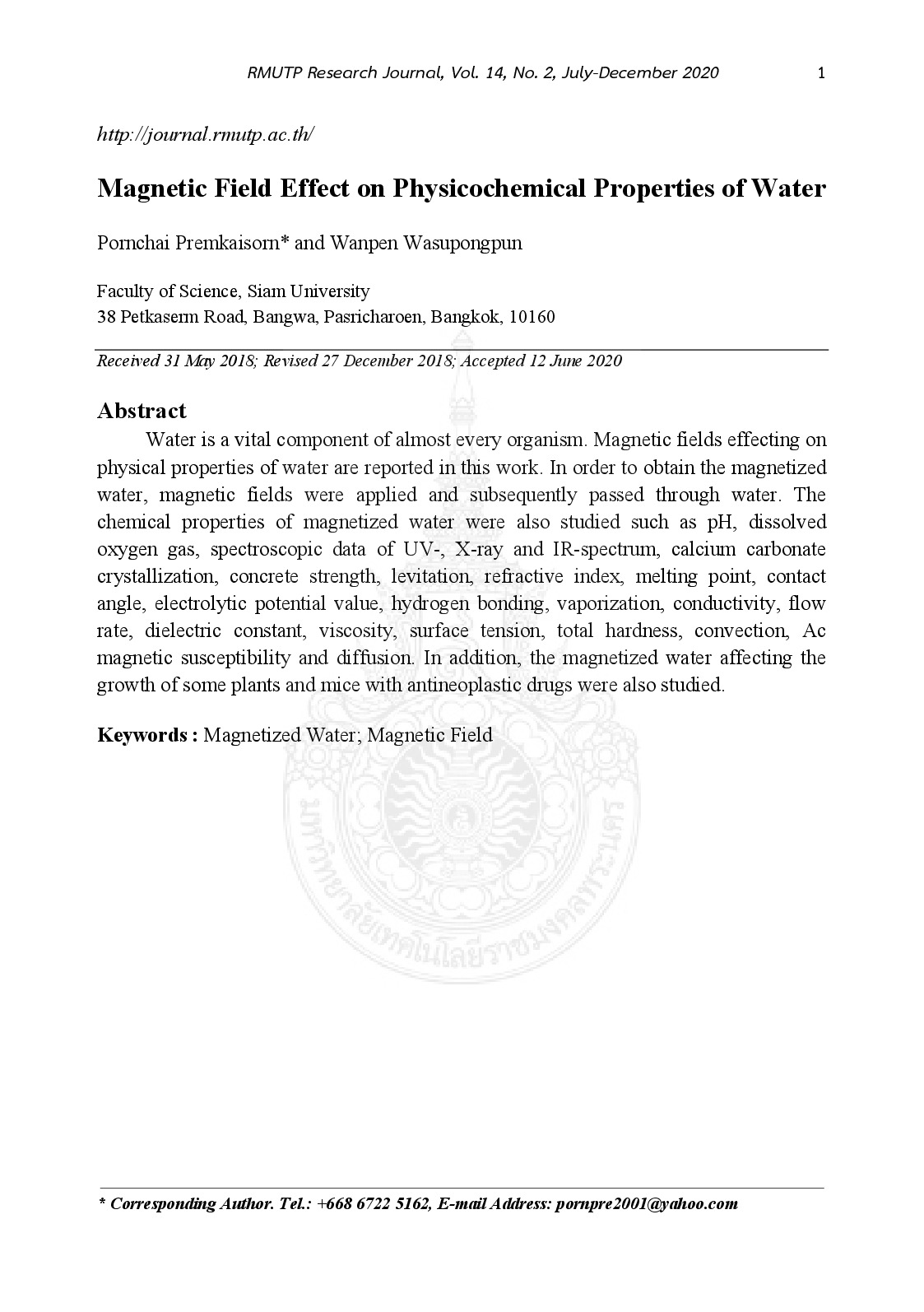
Magnetic field effect on physicochemical properties of water
Water is a vital component of almost every organism. Magnetic fields effecting on physical properties of water are reported in this work. In order to obtain the magnetized water magnetic fields were applied and subsequently passed through water. The chemical properties of magnetized water were also studied such as pH dissolved oxygen gas spectroscopic data of UV- X-ray and IR-spectrum calcium carbonate crystallization concrete strength levitation refractive index melting point contact angle electrolytic potential value hydrogen bonding vaporization conductivity flow rate dielectric constant viscosity surface tension total hardness convection Ac magnetic susceptibility and diffusion. In addition the magnetized water affecting the growth of some plants and mice with antineoplastic drugs were also studied.
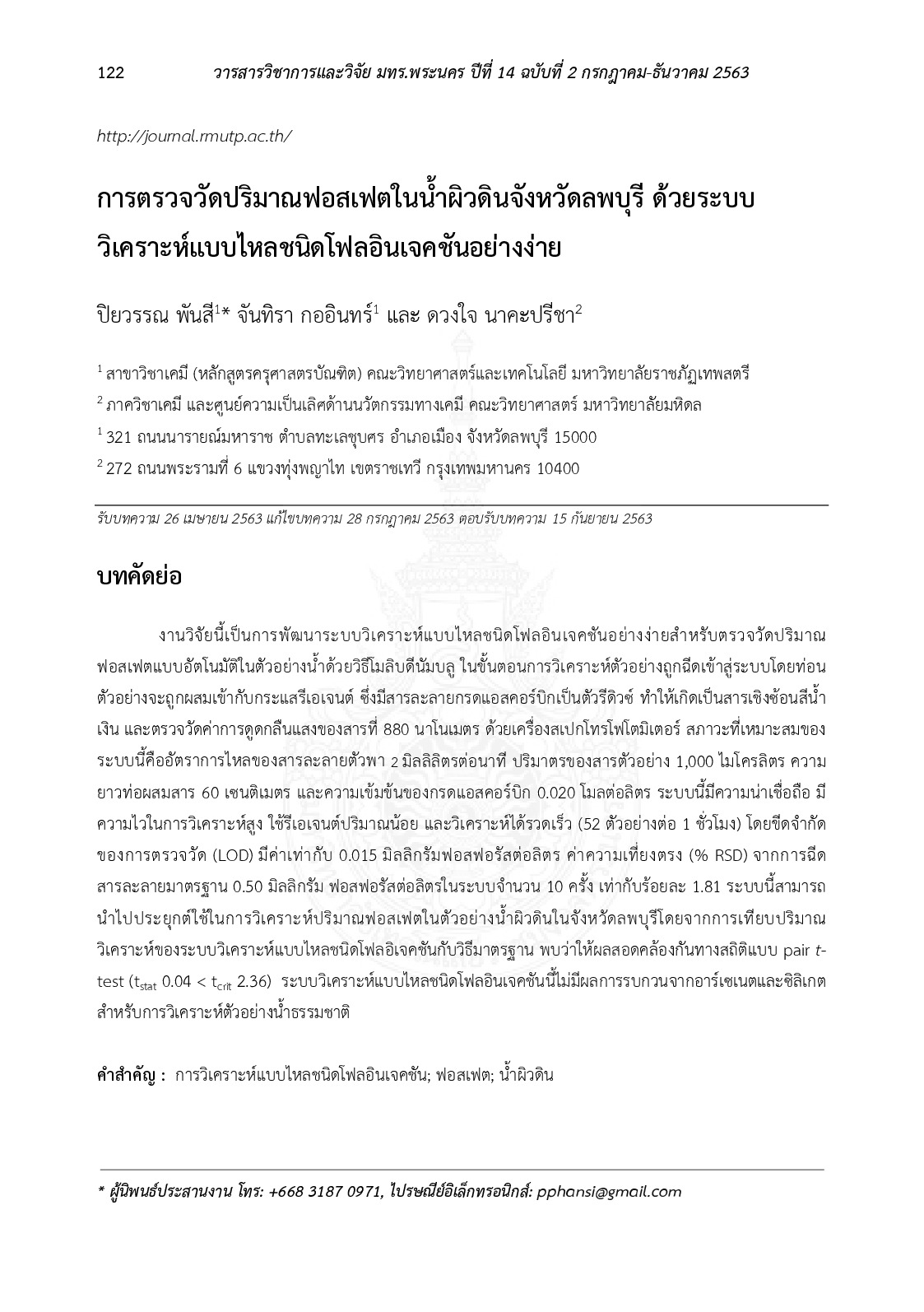
การตรวจวัดปริมาณฟอสเฟตในน้ำผิวดินจังหวัดลพบุรี ด้วยระบบวิเคราะห์แบบไหลชนิดโฟลอินเจคชันอย่างง่าย
A simple flow injection analytical system for an automatic determination of phosphate in water samples using the molybdenum blue method was developed. Samples were injected and mixed with ascorbic acid used as a reducing agent. The absorbance of the resulting molybdenum blue complex was measured at 880 nm by a spectrophotometer. The optimal conditions of this system were 2 mL/min of carrier flow rate 1000 μL of sample volume 60 centimeters of mixing tube length and 0.020 mol/L of ascorbic acid. The proposed method showed reliability high sensitivity spend small amount of reagents and samples and fast sample throughput (52 samples/hour). The limit of detection (LOD) was 0.015 mg P/L of phosphate. Precision obtained injecting a phosphate standard solution of 0.50 mg P/L (n=10) was 1.81%. This system can be applied to determination of phosphate content in surface water samples in Lopburi province by comparing with a standard method. It was found that obtained from the developed system agreed well with the standard method using the pair t-test (tstat 0.04 < tcrit 2.36). This flow injection analysis system has no effect from arsenate and silicate interference for the analysis of natural water samples.
การเพิ่มมูลค่าของเปลือกกล้วยเหลือทิ้ง เพื่อกำจัดสารพิษในน้ำ
An ability of fresh banana peel without surface modification was evaluated for the removal of lead ions from aqueous solution. Batch adsorption was performed at room temperature. The experimental conditions including dosage contact time initial concentration of lead( II) ion were studied. The characterization of fresh banana peel was carried out by Fourier-transform infrared spectroscopy (FTIR) and energy dispersive X-ray fluorescence ( ED-XRF) . The isotherm models of Langmuir and Freundlich were used to describe the adsorption mechanism involving the relationship between adsorbent surface capacity and adsorbed degree of lead(II)ion in the equilibrium conditions. The experimental data fitted well to the Langmuir isotherm with a correlation coefficient of r2 greater than 0.86. The Maximum adsorption capacity (qm) was found to be 0.9151 mg/g. The results of ED-XRF of fresh banana peels before and after treatment with lead( II) ion confirmed that lead( II) ion was occupied onto the surface of fresh banana peel. Moreover the inside of fresh banana peels was found the lead(II)ion larger than the outside peels. It was concluded that waste of banana could be used as a low-cost adsorbent for removal of lead(II)ion from aqueous solution based on a simple adsorption method.