จำนวน Repository ( 17 )

การพัฒนาเครื่องย้อมสีเส้นด้ายผักตบชวาและวัสดุเสริมเพื่อพัฒนาวิสาหกิจขนาดกลางและขนาดย่อม
Water Hyacinth Yarns and Their Transformed Materials Dyeing Machine for Developing Small and Medium-Sized Enterprises was a research project what an aim for producing a prototype dyeing machine. The machine was used at the small enterprise in Nakhon Prathom province. The dyeing machine was contributed by stainless steel. The outer dimension was 100 centimeters in height 130 centimeters in length and 90 centi-meters in width. The inner structure contains with perforate stainless steel drum. It had diameter as 80 centimeters with 90 centimeters length. The container capacity was 27 liters for the raw material as 10 kg of the dry Water Hyacinth Yarns or 5 kg of the dry Water Hyacinth roots. The machine was running test for reactive dyeing process at 80oC for 30 minutes. The machine was achieved for reduce time operation as 5 times and gas consumption as 2.38 times. The break-even point was 1.09 year and B/C as 2.22. Moreover it can solve the fuzzy yarns problem and the volatile smoke during the tradition dyeing. The knowledge was transferred to the stakeholders at the target area as “Chumchonjaksanpaktobchawha Bann klongnokkratum” enterprise in Nakhon Pra thom province. They were satisfied in this benefit in good to very good level.
การใช้ประโยชน์จากเส้นใยผักตบชวาในผลิตภัณฑ์แผ่นใยอัดซีเมนต์ภายนอกอาคารสำหรับวิสาหกิจชุมชน
This research aims to study the water hyacinth fiber inside high density cement fiber board. By using ratio components among cement : fine sand : water hyacinth fiber : water : catalyst accelerated the formations of cement (aluminum sulfate (AI2 (SO4) 3) calcium chloride (CaCl2) sodium silicate (Na2SiO3)) on the ratio 1: 0.2: 0.075: 0.3: 0.03 by weight of total water hyacinth fiber. The 5 ratios consist of 0.0 (A1 D1 formulae) 0.025 (A2 B2 C2 D2 formulae) 0.050 0.03 (A4 B4 C4 D4 formulae) and 0.1 (A5 B5 C5 D5 formulae) by weighted all fibers were treated with sodium hydroxide solution (NaOH) at a concentration of 12%. The fiber to solution ratio was 1: 10 boiled in open system at 100 °C for 1 - 3 hours. By compressing the mixture cast machine at normal temperature (30 - 35 °C). Use a density of 0.75 g / cm3. From the test results the ratio B4 is the appropriate ratio. Can pass TIS 878- 2537 Cement Board: high density and physical properties mechanical properties and thermal insulation are good. Accelerate the formation of the most suitable cement is calcium chloride (CaCl2)
การศึกษาความเป็นไปได้ในการผลิตโครงสร้างกันแรงกระแทกของรถยนต์จากกากผักตบชวา
Nowadays an automotive industry steadily has been growing and playing a major role on economy development for many years. The crash box is one of the most important parts for safety but it was found that the crash boxes manufactured domestically are not met international standard requirements. This is due to process and material limitation. This process for automotive safety test requires high budget and there is unclear approach for specific test. Therefore a study of crash boxes referred to energy absorption project was conducted as the alternative materials for product. Consequently this project was aimed to design and test crash boxes which made from the diversity of the alternative materials such as aluminum aluminum reinforced by foam resin reinforced by fiberglass resin reinforced by water hyacinth and resin reinforced by water hyacinth and husk. In addition it was also emphasized in studying energy absorption behavior and physical deformation of crash boxes after dynamic and static energy being applied. The experimental works were applied for these tests in partly referenced to US NCAP and ECE R29 standard for automobile collision test. Testing all types of crash boxes indicated that the aluminum reinforced by foam type was able to absorb energy at 189 MJ/m3. It is higher than resin reinforced by water hyacinth and husk at 1 MJ/m3 as 188 times. Furthermore the comparison of the energy absorption (per unit volume) between the aluminum reinforced by foam type and the steel type from the previous project equivalent 20 MJ/m3 found that it is 8.45 times of difference. While the front impact test was not successful because the size of crash boxes was not suitable for the energy volume. It was a cause for non-available calculation of energy absorption value.
การพัฒนาและแปรรูปผลิตภัณฑ์ผักตบชวา กลุ่มบ้านผักตบชวา อำเภอบางไทย จังหวัดพระนครศรีอยุธยา
This research has been object to development weaving machine design weave dye and Hyacinth paper and Instruct technology give community District Bangsai Amphur Province Ayutthaya which get instruct technology 20 persons. Research result to invention make up weaving machine. Fiber from Water Hyacinth dye Yarh Pa Per from water Hyacinth and product about 11 products. Evaluation from the participants were female aged 35-55. They were workers and earned 500-1000 Baht per month. Before training they had little knowledge. The training contents were correct and up-to-date. The trainers were excellent. The material equipment and documents were the most appropriate. The Participants had good attitude and the designing and developing of water Hyacinth’s was the most appropriate.
การตรึงอะโซโตแบคเตอร์แบคทีเรียตรึงไนโตรเจนในอากาศด้วยวัสดุธรรมชาติและผลต่อการเจริญเติบโตของผักกวางตุ้งในดิน
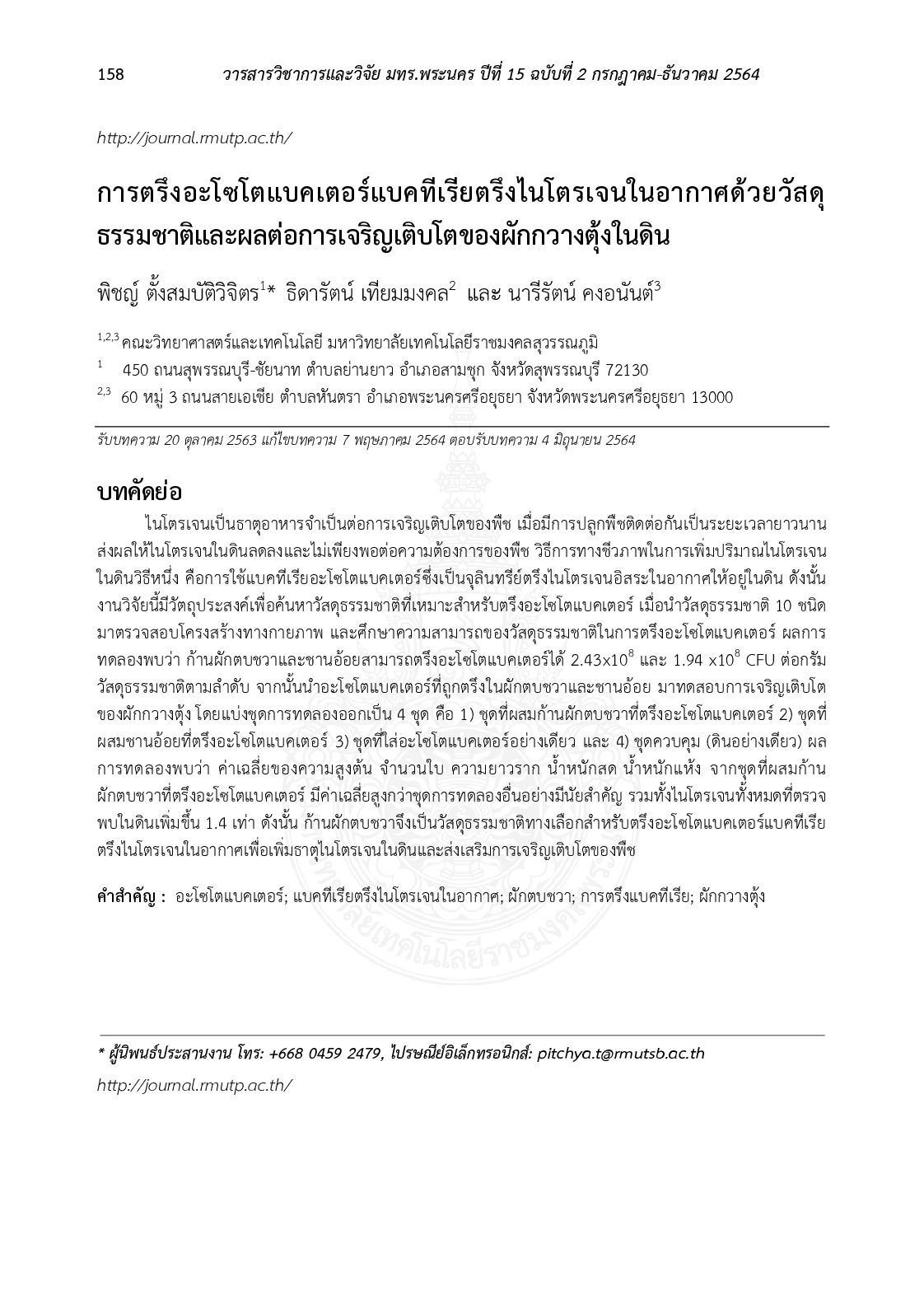
Nitrogen is an essential nutrient for plant growth. When the plants have been grown for a long-term effect to decreased nitrogen in soil and insufficiency of the plant growth. One biological method for increasing the nitrogen content in soil is utilize of free nitrogen-fixing bacteria Azotobacter. Therefore the objective of this research was to search natural material suitable for Azotobacter fixation. The 10 natural materials were observed physical structure and investigated the ability of natural materials for Azotobacter fixation. The results showed that water hyacinth and bagasse stalks were fixed the Azotobacter of 2.43x10⁸ and 1.94 x10⁸ CFU per gram of each natural material respectively. After that the selected fixed Azotobacter of water hyacinth and bagasse stalks were studied the growth of Brassica Chinensis. This experiment was designed to 4 treatments. The first treatment was mixed of water hyacinth stalks and the Azotobacter. Second treatment was mixed of bagasse stalks and the Azotobacter. The third treatment was the Azotobacter only. The last treatment was soil only. The results indicated that the average of plant growth include height leaf number root length fresh weight and dry weight of the mixed of water hyacinth stalks and the Azotobacter had significantly higher growth rates than other treatments. The total nitrogen was also increased 1.4 fold in the soil. All results suggest that the water hyacinth stalk is alternative for the fixation of the free nitrogen-fixing bacteria Azotobacter as induce nitrogen in the soil and plant growth promotion.