จำนวน Repository ( 13 )

Yield trial of 8 karen type chilli varieties grown under two cultivated
A yield trial of 8 Karen type chilli varieties in 2 cultivated systems was studied under intercropping with corn and monocropping. Row spacing and tree spacing was 0.4 m x 0.8 m. for single-row. In paired-row used row and tree spacing was 0.4 m. x 0.6 m. From June 2011 to May 2012 at the Agricultural Technology Research Institute Lampang Province. Data of plant growth and yield were also collected. Results plant growth of the single-row intercropping gave average of plant height 57.2cm. Plant width of paired-row averaged 59.1 cm. Yield of the single-row of the ‘Khiri rat 4’ and ‘Khiri rat 7’ gave 0.37 and 0.36 ton per rai respectively. Paired–row of ‘Khiri rat 3’ and ‘Khiri rat 5’ were yielded 0.70 and 0.66 ton per rai. Monocropping of ‘Khiri rat 8’ gave 0.34 ton per rai of fresh yield. In addition yield was significantly different statistically among varieties Paried-row was the highest fresh yield of the systems.
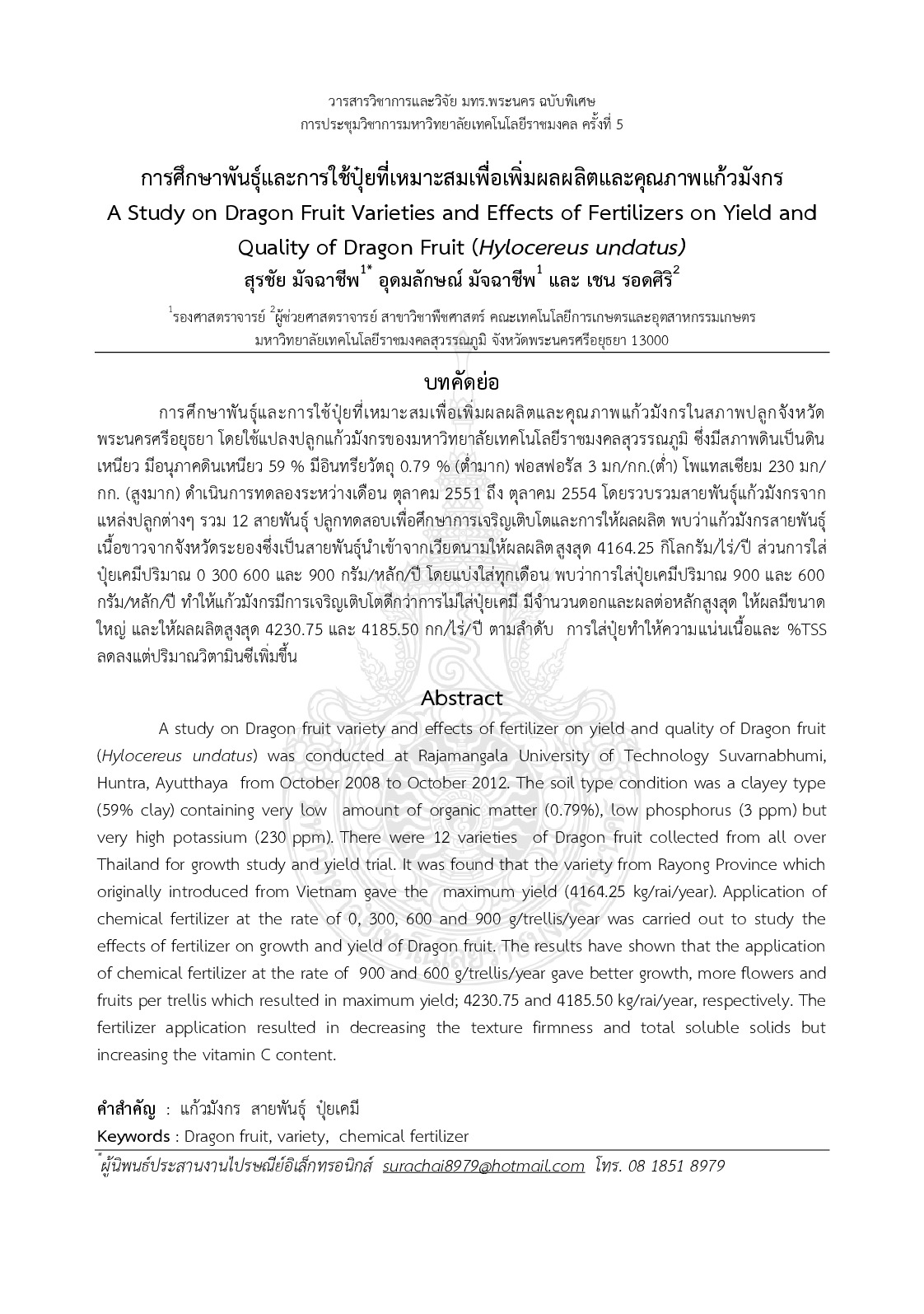
A study on dragon fruit varieties and effects of fertilizers on yield and quality of dragon fruit (hylocereus undatus)
A study on Dragon fruit variety and effects of fertilizer on yield and quality of Dragon fruit (Hylocereus undatus) was conducted at Rajamangala University of Technology Suvarnabhumi Huntra Ayutthaya from October 2008 to October 2012. The soil type condition was a clayey type (59% clay) containing very low amount of organic matter (0.79%) low phosphorus (3 ppm) but very high potassium (230 ppm). There were 12 varieties of Dragon fruit collected from all over Thailand for growth study and yield trial. It was found that the variety from Rayong Province which originally introduced from Vietnam gave the maximum yield (4164.25 kg/rai/year). Application of chemical fertilizer at the rate of 0 300 600 and 900 g/trellis/year was carried out to study the effects of fertilizer on growth and yield of Dragon fruit. The results have shown that the application of chemical fertilizer at the rate of 900 and 600 g/trellis/year gave better growth more flowers and fruits per trellis which resulted in maximum yield; 4230.75 and 4185.50 kg/rai/year respectively. The fertilizer application resulted in decreasing the texture firmness and total soluble solids but increasing the vitamin C content.
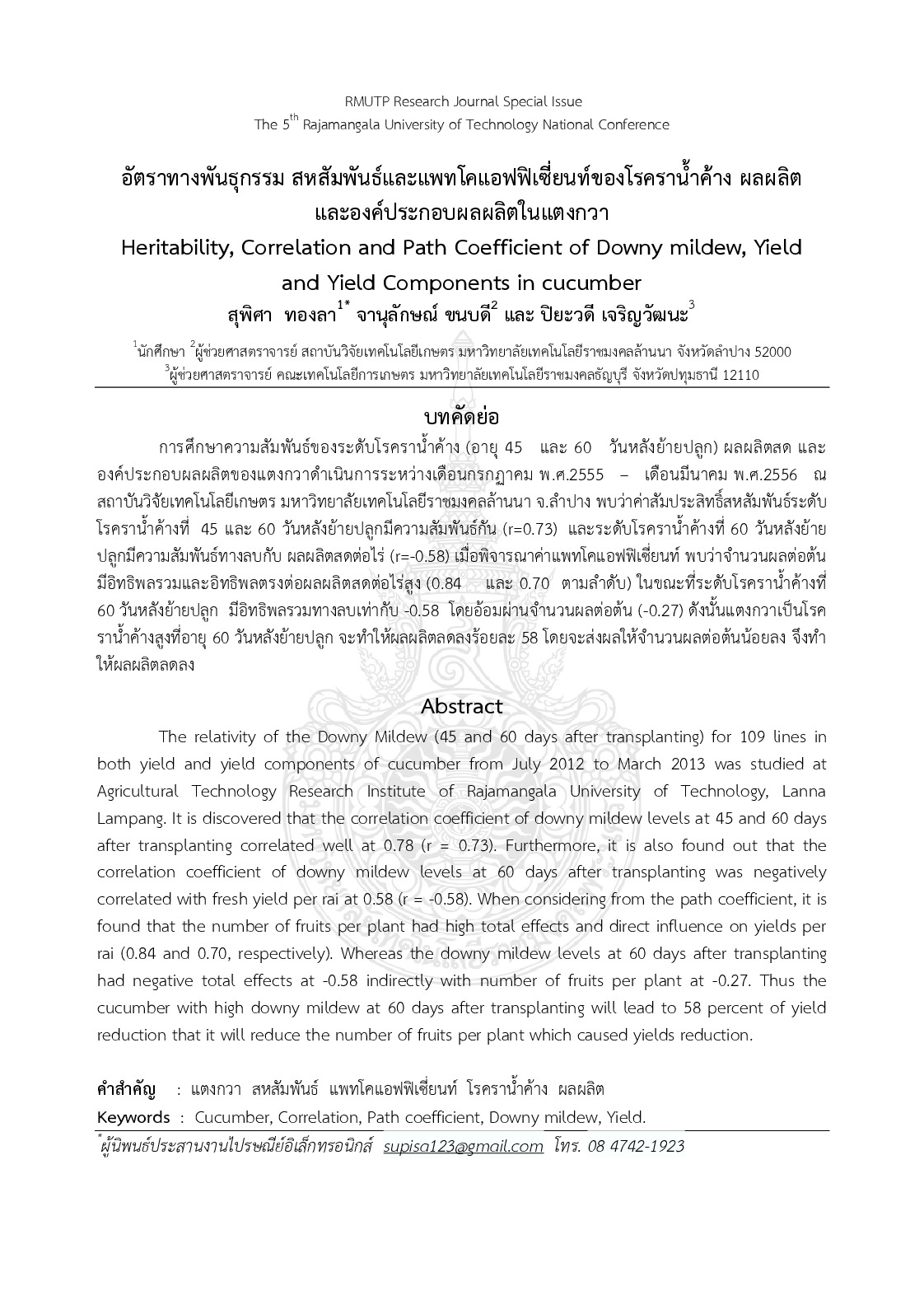
Heritability, correlation and path coefficient of downy mildew, yield and yield components in cucumber
The relativity of the Downy Mildew (45 and 60 days after transplanting) for 109 lines in both yield and yield components of cucumber from July 2012 to March 2013 was studied at Agricultural Technology Research Institute of Rajamangala University of Technology Lanna Lampang. It is discovered that the correlation coefficient of downy mildew levels at 45 and 60 days after transplanting correlated well at 0.78 (r = 0.73). Furthermore it is also found out that the correlation coefficient of downy mildew levels at 60 days after transplanting was negatively correlated with fresh yield per rai at 0.58 (r = -0.58). When considering from the path coefficient it is found that the number of fruits per plant had high total effects and direct influence on yields per rai (0.84 and 0.70 respectively). Whereas the downy mildew levels at 60 days after transplanting had negative total effects at -0.58 indirectly with number of fruits per plant at -0.27. Thus the cucumber with high downy mildew at 60 days after transplanting will lead to 58 percent of yield reduction that it will reduce the number of fruits per plant which caused yields reduction.