จำนวน Repository ( 17 )
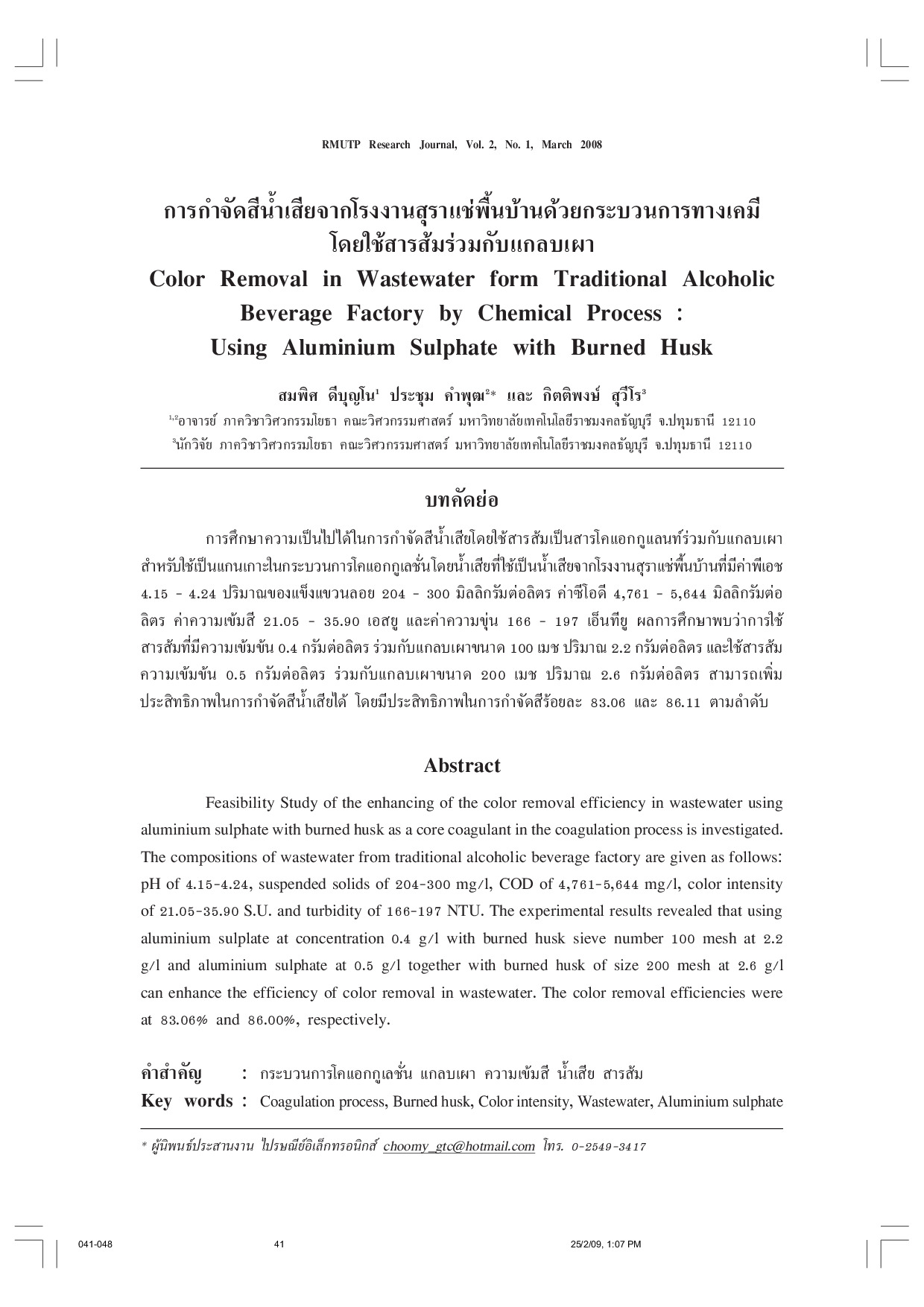
Color Removal in Wastewater form Traditional Alcoholic Beverage Factory by Chemical Process : Using Aluminium Sulphate with Burned Husk
Feasibility Study of the enhancing of the color removal efficiency in wastewater using aluminium sulphate with burned husk as a core coagulant in the coagulation process is investigated. The compositions of wastewater from traditional alcoholic beverage factory are given as follows: pH of 4.15-4.24 suspended solids of 204-300 mg/l COD of 4761-5644 mg/l color intensity of 21.05-35.90 S.U. and turbidity of 166-197 NTU. The experimental results revealed that using aluminium sulplate at concentration 0.4 g/l with burned husk sieve number 100 mesh at 2.2 g/l and aluminium sulphate at 0.5 g/l together with burned husk of size 200 mesh at 2.6 g/l can enhance the efficiency of color removal in wastewater. The color removal efficiencies were at 83.06% and 86.00% respectively.

คุณภาพทางจุลชีววิทยาของเครื่องดื่มนมสดปั่นที่ไม่ได้บรรจุในภาชนะปิดสนิทซึ่งจัดจำหน่ายในร้านค้าในตลาดนัด ร้านค้าริมถนน และแผลลอยโดยรอบมหาวิทยาลัยมหาสารคาม
The aim of this study was to investigate the microbiological quality of milk-shaked drinks including Bacillus cereus Escherichia coli Salmonella spp. Staphylococcus aureus yeast and molds in unsealed containers sold in market fair roadside and stall around Mahasarakham university. The analytical results revealed that microbiological quality of 30 samples of milk-shaked drinks in unsealed containers that did not pass the criteria of department of medicine ministry of public health Thailand were 50 % of total samples. Bacteriological counts of Bacillus cereus Escherichia coli Salmonella spp. And Staphylococcus aureus of milk-based drinks that did not pass the criteria were 13.3 10 13.3 and 10% of total samples respectively. Yeasts and molds counts of milk-based drinks that did not pass the criteria were 3.3 and 30% of total samples respectively. Microbiological contamination of milk-shaked drinks was related to the hygiene of the shop and the supplier. It was found that the location of stall which high dust particles and animal carriers also contributed to the contamination of microorganisms. Moreover the hygiene of the supplier may cause the milk-shaked drinks to be contaminated with microorganisms.
การผลิตโยเกิร์ตพร้อมดื่มจากน้ำเงาะและการเหลือรอดของแบคทีเรียแลคติก
The study aimed to investigate appropriate formula for drinking yoghurt production. The conditions were ratio of yoghurt : concentrated rambutan juice at 100 : 0 90 : 10 85: 20 and 75: 25 the effect of concentrated rambutan juice on physical and chemical and microbiological lactic acid bacteria survival appropriate proportion of syrup and lactic acid bacteria survival during storage of drinking yoghurt from rambutan juice. It was found that proportion of concentrated rambutan juice had no effect in color (L* a*) of the yoghurt (p>0.05) but its impact to b* and viscosity were significant (p≤0.05) they increased with the increased proportion of the concentrated rambutan juice. Yoghurt with 15% concentrated rambutan juice had 88% survival rate of lactic acid bacteria after stimulated digestive system. The results showed that optimal production formula of drinking yoghurt from concentrated rambutan juice and syrup were 90:10 Z(yoghurt: concentrated rambutan juice; 85:15) : syrup) Drinking yoghurt stored in the refrigerator at 4±1oC for 15 day was evaluated and found that LAB survival numbers were 9.90 log CFU/mL.
พฤติกรรมการบริโภคกาแฟสดของบุคลากรสายวิชาการ มหาวิทยาลัยเทคโนโลยีราชมงคลพระนคร
The purposes of the research were to study 1) personal factors of the academic staff at Rajamangala University of Technology Phra Nakhon (RMUTP) 2) fresh-coffee consumption behavior of the academic staff at RMUTP and 3) relationship between personal factors and fresh-coffee consumption behavior of the academic staff at RMUTP. The sample group consisted of 237 academic freshcoffee consuming personnels The instrument was a questionnaire. Frequency percentage mean standard deviation Chi-square and Phi correlation were used in data analysis via computer program. The results of the study indicated that 1) majority of the samples were female aged between 41-45. Most of them were master’s degree holding instructors with 25001-30000 baht monthly income; 2) most of the staff consumed approximately 4-5 glasses of freshly-brewed coffee weekly spending 41-50 baht per glass. Most purchased the fresh-coffee from a coffee booth or a coffee corner from 09.01-12.00 in the morning. Most of the samples preferred to drink iced (cold) fresh-coffee which had bitter sweet rich taste. Milk was once in a while added. Moreover they liked to drink fresh-coffee together with something sweet such as cake bread and pie; and 3) concerning the relationship between personal factors of academic staff at RMUTP it was found that age work status education level faculty and average monthly income had a statistically significant correlation at the level of 0.5 with the consumption behavior. None of the gender was found.
การใช้ประโยชน์จากพืชในท้องถิ่นสำหรับการพัฒนาเป็นเครื่องดื่มสมุนไพร: กรณีศึกษาพืชในท้องถิ่นชุมชนแพรกหนามแดง อำเภออัมพวา จังหวัดสมุทรสงคราม เพื่อความมั่นคงด้านอาหารอย่างยั่งยืน
This research aims to study the properties of local plants Phraek Nam Daeng community for the development of a herbal drink and development drink herbal tea. Local plants used in the study was Khlu (Pluchea indica (L.) Less). The leaves Khlu tested phytochemical composition antioxidant testing by testing their ability to reduce the amount of chemicals 11-diphenyl-2-picrylhydrazyl (DPPH) tests the amount of phenol used Folin-Ciocalteus reagent nutritional analysis and the amount of cellulose and developed the herbal drink tea. The research found that 1. Phytochemical composition of Khlu leaf is mainly flavonoids and tannins anthracnones. 2. Extracted from the leaf extract with methanol showed the ability to reduce the amount of substance 11-Diphenyl-1-picrylhydrazyl (DPPH) was the most abundant. Fresh leaves dried leaves and dried leaves were 30 days values at 131.23 ± 1.42 127.55 ± 1.03 and 125.90 ± 1.28 μg / ml respectively. 3. Extracts from the leaf extract with methanol showed the highest phenolic content as follows: fresh leaves dried leaves and dried leaves for 30 days were 84.91 ± 0.54 82.44 ± 1.09 and 81.01 ± 1.25 mg GAE / g dw respectively. 4. The optimal conditions for the process of making Khlu tea is a temperature of 70 °C for 7 hours. The score of sensory evaluation in terms of appearance color aroma flavor (astringent) and overall were 7.37 ± 1.22 7.23 ± 1.16 6.97. ± 1.30 7.00 ± 1.14 and 7.63 ± 1.10 respectively.