จำนวน Repository ( 24 )

การผลิตถ่านอัดแท่งจากวัสดุเหลือทิ้งทางการเกษตรโดยใช้เปลือกทุเรียนผสมเปลือกลูกจาก
This research focuses on the production of charcoal briquettes from agricultural residues by using durian and nypa palm peel mixtures. The objectives of this study are to study the combustion efficiency of charcoal briquettes; study the suitable ratio for the production of briquettes with the ratios of durian : nypa palm peel mixtures as 100:0 50:50 25:75 and 0:100; recycle the agricultural residues as the renewable energy sources and analyze the fuel characteristics; moisture content ash content volatile matters fixed carbon and heating value. The results showed that the best ratio for the combustion efficiency of charcoal briquettes is 50:50 with the minimum moisture content of 4.68% the minimum ash content of 2.70% the volatile matters of 10.33% ; the maximum fixed carbon of 25.56% and all characteristics are met with the standard of charcoal briquettes from the local community products. In the ratio of 100:0 it showed the maximum heating value as 5399 calories per gram. Therefore the 50:50 charcoal briquettes are suitable as the renewable energy source. Besides the capacity of odor adsorption was analyzed by adding the odor substances (mothball) in two bottles with three mothballs for each bottle for two consecutive days before removal. Then sic of 50:50 charcoal briquettes were added into one bottle. Ten testers smelled the bottle every two days for six days. The result showed that the bottle with the charcoal briquettes had odor less than the bottle without briquettes. Hence the charcoal briquettes from durian and nyla palm peel mixtures have the best odor adsorption capacity and are suitable for household uses.
การพัฒนาศักยภาพเปลือกทุเรียนในผลิตภัณฑ์ขนมอบ
The objective of this research to study the process of durian rind including of tart Danish pastry cookies Brownie and breadstick. To determine the quality of processed food products from Durian rind. To study consumer acceptance (Consumer test) on food products from durian rind. Bakery products used in the trial including tart Danish pastry cookies Brownie and breadstick. The substitution of wheat flour with durian peel powder products bakery substitute at 0 percent to 30 percent panelists recognized that the 0 percent to 10 percent except sample brownies that taste to recognize. However the replacement of 30 per cent on the amount of compensation increases. Make an example of a more solid texture. The panelists acknowledged the least clear. And not according to the way that it should be. However durian peel powder supplementation resulted in increased amount of fiber which is beneficial to the health of consumers. Acceptance testing of consumer substitution of wheat flour with durian peel powder products in bakeries 100 by means of random chance that the test of more than 80 percent of the product acceptance bakeries are replacement of wheat flour with durian rind powder. For bakery products technology transfer from Japan selected durian powder at the Faculty of Economics of Technology. Trainee There is satisfaction in all aspects of technology transfer.
การพัฒนาศักยภาพเนื้อทุเรียนสุกในการแปรรูปผลิตภัณฑ์อาหาร
This research has the purpose to study about the process of transforming of food products supplemented with five types of ripe durian having grade failure. It aims to study about quality of food products transformed from ripe durian having grade failure. It is the study about consumer test having effect towards food products transformed from ripe durian having grade failure and transferring of technology for developing of processed food product from ripe durian texture to the community. The experiment found that study of suitable quantity of pipe durian having grade failure in supplementing food products in 5 types by testing about acceptance of testers who were 40 instructors in Field of Food and Nutrition Field of Food Science and Nutrition and Field of Food Service Industry. The researcher used methods of giving scores of favor in type of 9-point hedonic scale. The researcher added ripe durian having grade failure into durian coconut milk at levels of 0 30 60 and 90 per cent of total ingredients. It was found that testers accepted the durian coconut milk at level of 90 per cent which was in much favor level. Coconut Custard in golden cup (dessert stuffed ingredient) was supplemented at level of 0 50 75 and 100 per cent of all cooked taro ingredient it was found that testers accepted such coconut custard at level of 100 per cent. Coconut Custard in golden cup pastry flour ingredient) was supplemented at level of 0 10 20 and 30 per cent of total ingredient. It was found that testers accepted such coconut custard at level of 30 per cent which was in level of moderate favor to much favor (7-8). Moose supplemented with ripe durian texture having grade failure at level of 0 10 20 and 30 per cent of total ingredient it was found that testers accepted the moose at level of 20 per cent which was in the level of moderate favor to much favor (7-8). Marshmallow supplemented with ripe durian texture having grade failure at level of 10 20 and 30 per cent of total ingredient it was found that testers accepted such marshmallow at level of 20 per cent; which was in level of moderate favor to much favor (7-8). Ancient toffee supplemented with ripe durian texture having grade failure at level of 0 20 40 and 60 per cent of total ingredient it was found that testers accepted the ancient toffee at level of 40 per cent which was in the most level which was in the much favor (8). When physical feature of food products supplemented with five types of ripe durian having grade failure was studied it was found that only one product of durian coconut milk had value of 88.933 cp or centipoises. Regarding nutritional value of processed food product with ripe durian having grade failure it was found that durian coconut milk supplemented with 100% ripe durian having grade failure had protein for 3.23 per cent fat for 8.58 per cent ash for 0.78 per cent fiber residue for 2.01 per cent and moisture quantity for 54.87 per cent. It was found that coconut custard in golden cup with stuffed pastry supplemented with ripe durian having grade failure for 100 per cent and coconut custard with pastry flour in golden cup with ripe durian having grade failure for 30 per cent had protein for 10.87 per cent fat for 18.67 per cent ash for 0.91 per cent fiber residue for 2.35 per cent and moisture quantity for 25.31 per cent. It was found that moose supplemented with 20% ripe durian having grade failure had protein for 3.67 per cent fat for 17.09 per cent ash for 0.55 per cent fiber residue for 1.45 per cent and moisture quantity for 62.26 per cent. It was found that marshmallow supplemented with 20% ripe durian having grade failure had protein for 5.89 per cent fat for 0.68 per cent ash for 0.28 per cent fiber residue for 0.56 per cent and moisture quantity for 41.64 per cent. It was found that ancient toffee supplemented with 40% ripe durian having grade failure had protein for 18.22 per cent fat for 23.11 per cent ash for 12.1 per cent fiber residue for 1.10 per cent and moisture quantity for 8.91 per cent. However supplementing with ripe durian having grade failure in five types of food product can be done but there should be realizing about chemical elements of the initial components for example moisture quantity and fat. These components may affect physical features such as smell taste and texture. These features have effect on product acceptance. From transfer of food product technology from ripe durian texture having grade failure at Faculty of Home Economics Technology Rajamangala University of Technology Phra Nakhon there were 40 receivers of technology transfer. Result of evaluation of satisfaction for 5 aspects of providing service including providing service of officials resource persons service providing process/step facilities and benefit from service receiving all these aspects obtained scores in much satisfaction level in every aspect.
การพัฒนาศักยภาพเมล็ดทุเรียนในผลิตผลิตภณัฑ์ขนมไทย
Research Title : Developing the potential of durian peel in bakery products Author : Chakkrawut Bhoosem Photchanee Bunna Apinya Manarote and Prassanee Tubbiyam Department : Food and Nutrition Faculty : Home Economics Technology Academic year : The objective of this research to study the process of durian seed including of Durian seed in syrup Look Choup Durian Seed Chinese Mochi Cake Durian seed filling Durian Seed Custard and Meung Durian Seed. To determine the quality of processed food products from Durian seed. To study consumer acceptance (Consumer test) on food products from durian seed. Processed food products from durian seed used in the trial including of Durian seed in syrup Look Choup Durian Seed Chinese Mochi Cake Durian seed filling Durian Seed Custard and Meung Durian Seed. The substitution of main ingredients with durian seed products the sample substitute at percent to percent panelists recognized that the percent to percent except sample to recognize. However the replacement of percent on the amount of compensation increases. Make an example of a more solid texture. The panelists acknowledged the least clear. And not according to the way that it should be. However durian seed supplementation resulted in increased amount of protein which is beneficial to the health of consumers. Acceptance testing of consumer substitution of wheat flour with durian peel powder products in bakeries by means of random chance that the test of more than percent of the product acceptance bakeries are replacement of wheat flour with durian rind powder. For bakery products technology transfer from Japan selected durian powder at the Faculty of Economics of Technology. Trainee There is satisfaction in all aspects of technology transfer. Keywords: durian seed Thai dessert
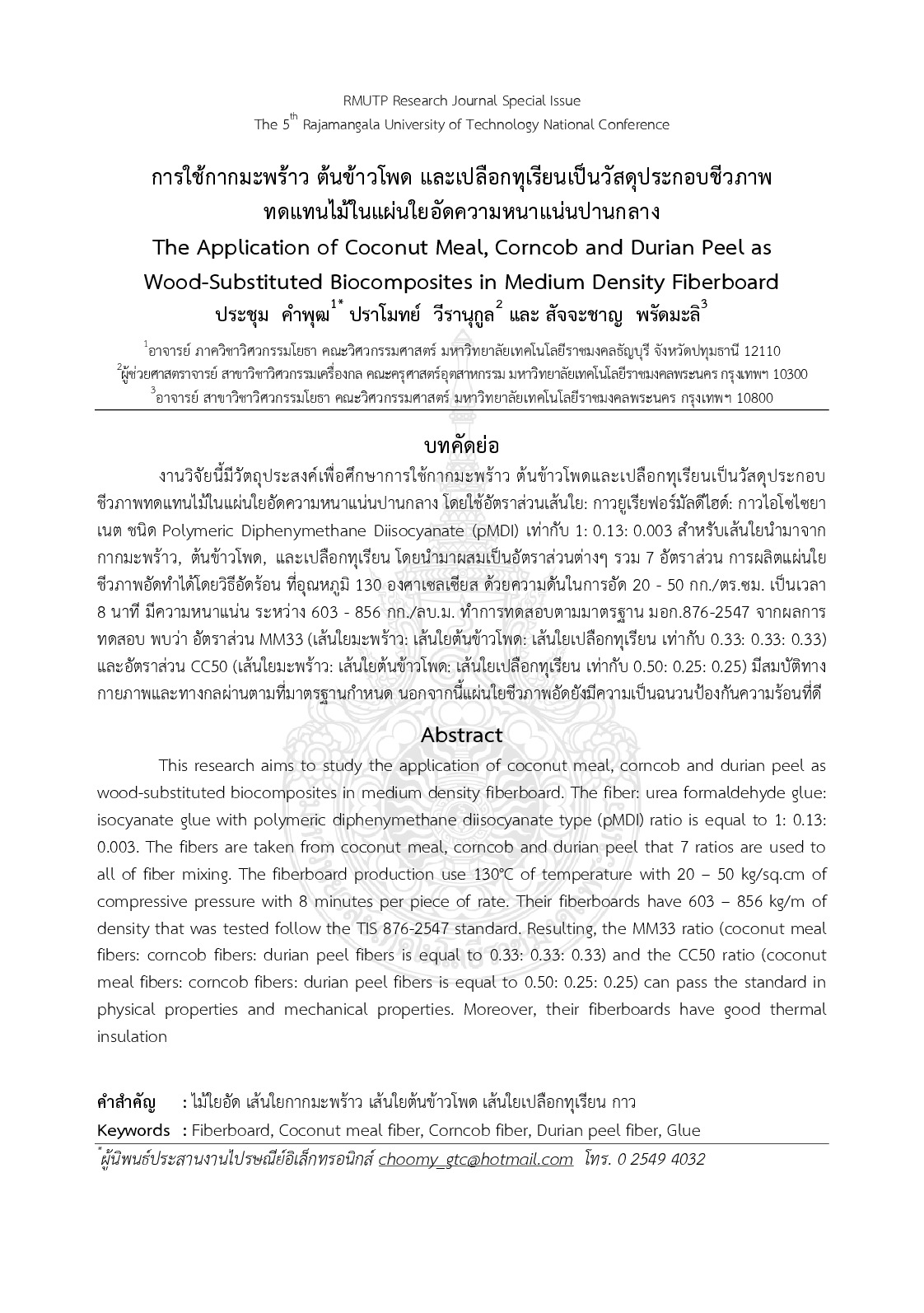
The application of coconut meal, corncob and durian peel as wood-substituted biocomposites in medium density fiberboard
This research aims to study the application of coconut meal corncob and durian peel as wood-substituted biocomposites in medium density fiberboard. The fiber: urea formaldehyde glue: isocyanate glue with polymeric diphenymethane diisocyanate type (pMDI) ratio is equal to 1: 0.13: 0.003. The fibers are taken from coconut meal corncob and durian peel that 7 ratios are used to all of fiber mixing. The fiberboard production use 130?C of temperature with 20 – 50 kg/sq.cm of compressive pressure with 8 minutes per piece of rate. Their fiberboards have 603 – 856 kg/m of density that was tested follow the TIS 876-2547 standard. Resulting the MM33 ratio (coconut meal fibers: corncob fibers: durian peel fibers is equal to 0.33: 0.33: 0.33) and the CC50 ratio (coconut meal fibers: corncob fibers: durian peel fibers is equal to 0.50: 0.25: 0.25) can pass the standard in physical properties and mechanical properties. Moreover their fiberboards have good thermal insulation