จำนวน Repository ( 45 )

ผลิตภัณฑ์ผลไม้แปรรูปจากมะม่วงหาวมะนาวโห่ : ชุมชนตำบลบางนกแขวก อำเภอบางคนที จังหวัดสมุทรสงคราม
The purpose of the study of processed fruit products from Karonda : Bang Nok Kwaek parish communities Bang Khonthi Samut Songkhram Province is to study the proper quantity of the Koranda fruit in the product the quality in the product’s process and the consumers’ acceptance (Consumer Test) in the product. The processed products are Karonda fruit jelly instant pasteurized Karonda fruit juice with extra fiber Karonda fruit sorbet Karonda fruit yoghurt ice-cream and concentrated juice (sauce) for drink mixing. The product has been tested by Randomized Complete Block Design (RCBD) method. The process was consisted with offering a tasting and evaluated in color scent taste matter and overall satisfaction by giving 9 point Hedonic scale from 70 consumers. And has been compared the difference of average means at 95% trustiness by Duncan’s New Multiple Range Test (DMRT) by an instant statistical analysis software. The result information is as the followings; The physical properties indicates of Karonda fruit the total acidity of 2.30 with the pH and the color was found that the brightness (L *) of 16.52 fee (a *) equal to 8.95 and (b. *) equals 5.37. The study of the chemical quality of Karonda fruit amount of energy in calories carbohydrates 73.2 percent 18.3 percent protein 1.57 percent 1.32 percent humidity fats fiber 83.7 percent ash 4.26 percent and 0.75 Vitamin C is found. The duration of ripening fruit yawning lemon booed affect the vitamin C in the fruit of the mango yawning lemon booed the oil will have more vitamin C than ripe to t 2 so I scratched the reduction of vitamin C may. Is due to be deployed as a compound to breathe. And led to the synthesis of new carbon structures during ripening. Karonda fruit jelly. The most acceptances level for Karonda fruit juice in the product is at 1:6 for its best flexibility. Since the juice concentration affects the jelly as it lowers the matter (flexibility). Too much of acid in Karonda fruit juice is able to unstabilize jelly matter. From the study of Pectin quantity the consumer has the most acceptance at the level of 10 grams which is the best recipe that keeps the good jelly matter (flexibility) stabilized. The physical properties indicates that there are the level of color hue at 5R color brightness at Value 4 Chroma at 14 sweetness at 35 Brix and pH at 3.05. The study of the chemical quality of Karonda fruit jelly in each 100 grams provides 120 kilocalories of energy 69.60 grams of humidity 0.11 gram of fat 29.80 grams of carbohydrate 0.41 gram of fiber 0.50 gram of ash and 0.45 gram of acidity. The consumer satisfaction is at 97.30 percent. Instant pasteurized Karonda fruit juice with extra fiber. The acceptance is at 100 percent of replacing Okra fruit juice by Karonda fruit juice. The acceptance study shows that the most proper fiber quantity adding to Karonda fruit juice is at 15 percent. The acceptance study shows that the most proper Pectin quantity affecting coconut jelly spreading is at 3 percent. The analysis results of the physical properties indicate that instant pasteurized Karonda fruit juice with extra fiber has color hue level at 5R value at 4 and Chroma at 12 which rendered the product to dark red. Also the pH level is at 3.29 sweetness is at 17 Brix firness g force 1 is at 11.29 g Viscosityag.sec AREA F-T 1:2 is at 339.507 ag.sec. The study of the chemical quality of Karonda fruit juice in each 100 grams provides 63.3 kilocalories of energy 83.9 grams of humidity 0.01 gram of fat 0.10 gram of protein 15.8 grams of carbohydrate 0.41 gram of fiber 0.24 gram of ash and 0.18 gram of pH balance. The consumer satisfaction to instant pasteurized Karonda fruit juice with extra fiber is at 98.66 percent. Karonda fruit sorbet. The most proper quantity of Karonda fruit juice is at 30 percent. The physical properties of Karonda fruit sorbet contain the brightness level at L*34.32 red color level at a*41.26 yellow color level at b*21.18 meltable solid quantity at 30*Brix and pH balance at 2.40. The study of the chemical quality of Karonda fruit sorbet in each 100 grams provides 91.8 kilocalories of energy 77.1 grams of humidity 0.15 gram of fat <0.20 gram of protein 22.6 grams of carbohydrate 0.11 gram of fiber and 0.12 gram of ash. The consumer satisfaction to Karonda fruit sorbet is at 100 percent. Karonda fruit yoghurt ice-cream. The most proper quantity of Karonda fruit added in the yoghurt ice-cream is at 10 percent of the whole ingredient. The consumers’ acceptance has been given the most for its scent taste matter (smoothness) and overall satisfaction which has the average mean at 7.24 7.77 7.17 and 7.67 consequently. The physical properties of Karonda fruit yoghurt ice-cream contain the viscosity level at 364.798 cps. color hue at 10P Value at 8/6 Chroma at N9/.5 overrun statistics at 4.55 and Karonda fruit yoghurt ice-cream melting rate at 89.90. The chemical quality of Karonda fruit yoghurt ice-cream in each 100 grams provides 214 kilocalories of energy 64.0 grams of humidity 14.6 gram of fat 3.14 gram of protein 17.5 grams of carbohydrate 0.76 gram of fiber 0.74 gram of ash and 5.67 pH balance. The consumer satisfaction to Karonda fruit yoghurt ice-cream is at 100 percent. Concentrated juice (sauce) for drink mixing. The most acceptance recipe is the strawberry sauce recipe number 1 with the replacement of Karonda fruit at 80 percent. The physical properties contain the viscosity level at 9.28 cps sweetness at 21 Brix color hue at 5R Value at 2 and Chroma at 4. The chemical quality of concentrated juice (sauce) for drink mixing in each 100 grams provides 91.1 kilocalories of energy 77.2 grams of humidity 0.30 gram of fat 0.1 gram of protein 22.3 grams of carbohydrate 0.76 gram of fiber 0.4 gram of vitamin C and 0.56 of pH balance. The consumer satisfaction concentrated juice (sauce) for drink mixing is at the maximum satisfaction at 92.0 percent as the concentrated juice (sauce) emphasizes the better taste of smoothie drink mixing and easy to consume. Keyword: jelly Karonda fruit instant fruit juice fiber sorbet ice-cream yoghurt concentrated sauce mixed drink
การพัฒนาผลิตภัณฑ์ขนมทองม้วนเสริมฟักข้าว
The objectives of this study were to: 1) select the basic recipe of Tongmuan dessert (rolled wafer) 2) study the proportionate quantity of gac Fruit added to Tongmuan dessert with added gac Fruit and 3) to study the shelf life of Tongmuan dessert with added gac Fruit. The study was conducted through Randomized Block Design (RBD) by which the satisfactory in each aspect included color properties scents texture properties flavors and overall preferences were estimated. 50 taste testers were asked to signify their satisfactory points according to 9- point hedonic scale. The finding suggests that recipe 1 with 50 grams of tapioca flour 150 grams of wheat flour 100 grams of eggs 720 grams of coconut cream 220 grams of brown sugar 110 grams of coconut sugar and 5 grams of salt obtained the highest average score. Sequentially the proportionate quantity of gac Fruit added to Tongmuan dessert with added gac Fruit were studied in 3 degrees: 10 20 and 30 percent of coconut cream’s quantity. The finding suggests that the 30 percent obtained the highest average points. In terms of the shelf life during week 0 2 4 and 6 it was found through the color space of L* and a* values that the colors had gotten darker as time progressed while b* value revealed no change. The water activity value (aw) also remained unchanged upon the extended shelf life which increases the presented color properties and moisture content. The texture had become tougher. Less than 10 colonies of microorganisms were found with less than 10 colonies of yeast and mold found during week 0 week 2 and week 4. However 120 colonies were found in week 6 which did not exceed the regulated limit of Community Product Standards and therefore can be concluded that it can be stored for the minimum of 6 weeks.
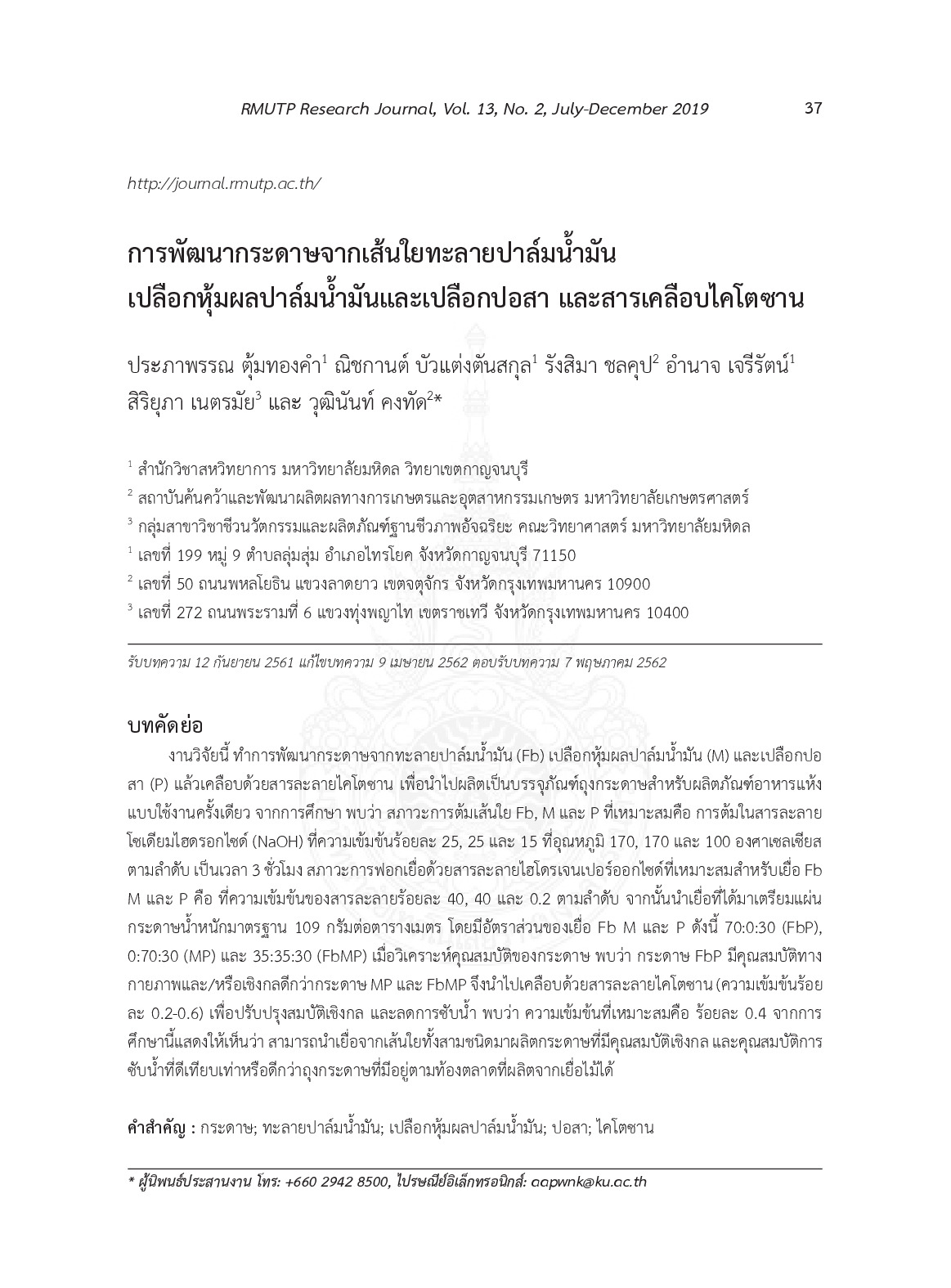
การพัฒนากระดาษจากเส้นใยทะลายปาล์มน้ำมันเปลือกหุ้มผลปาล์มน้ำมันและเปลือกปอสา และสารเคลือบไคโตซาน
This research aimed to develop paper from oil palm empty fruit bunch (Fb) oil palm mesocarp (M) and paper mulberry (P) with chitosan coating to be used as single-use paper bag for dry food products. The optimal pulp preparation conditions for Fb M and P fibers were boiling in 25 25 and 15% NaOH solution at 170 170 and 100°C for 3 hours respectively. The optimal H2O2 concentrations for bleaching of Fb M and P pulps were 40% 40% and 0.2% respectively. The obtained pulps were used to prepare papers with the basis weight of 109 g/m2 . The papers consisted of Fb M and P pulps at ratios of 70:0:30 (FbP) 0:70:30 (MP) and 35:35:30 (FbMP). It was found that FbP paper showed superior physical and/or mechanical characteristics than those of MP and FbMP. FbP papers were then coated with chitosan solutions (0.2-0.6%) to further improve their mechanical properties and reduce their water absorption characteristics. The optimal concentration of chitosan was 0.4%. This study showed that all three types of pulps could be used to produce papers that had equal or superior mechanical- and water adsorption properties as compared to those of commercially available paper bags made from wood pulp.
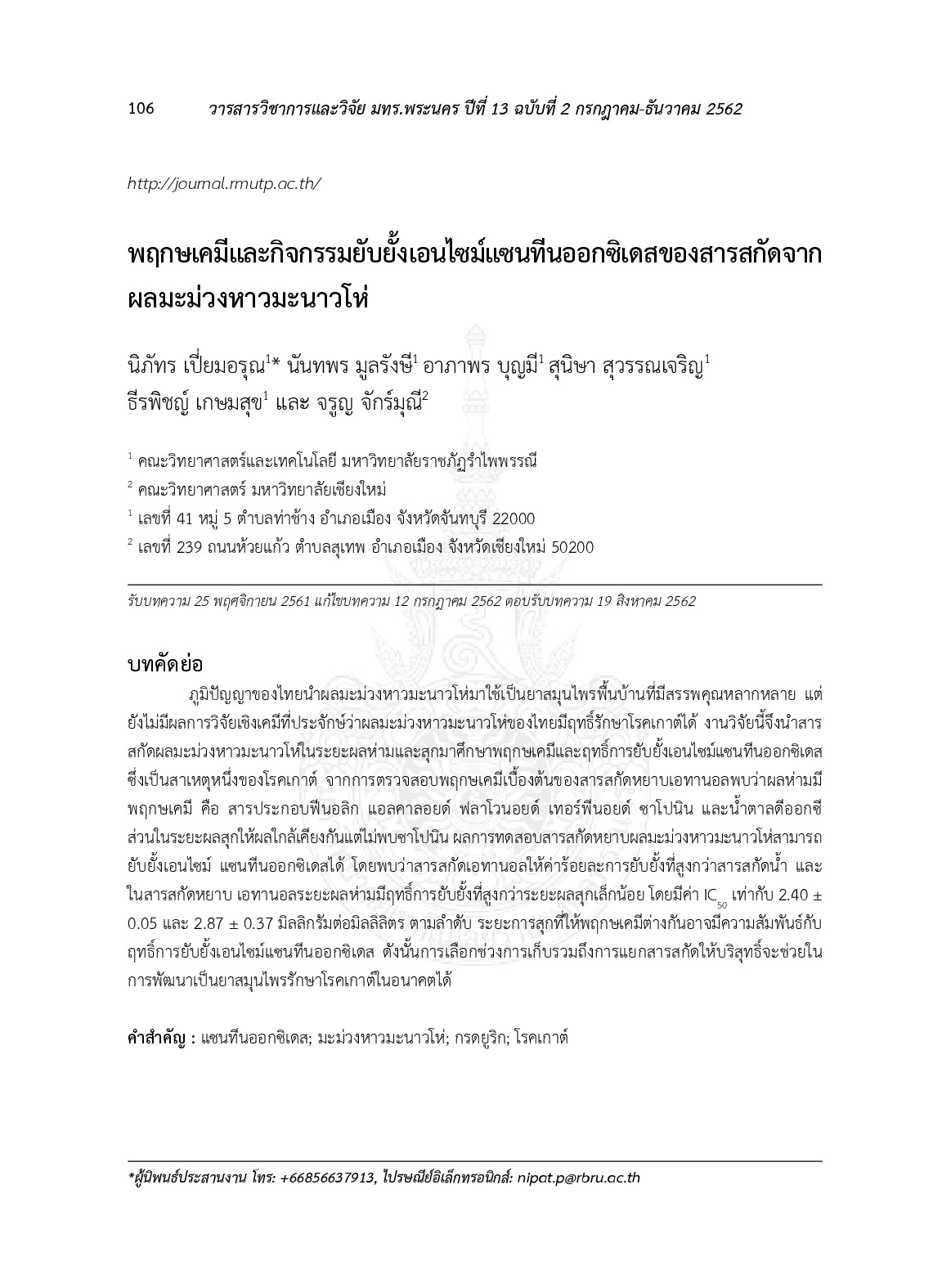
พฤกษเคมีและกิจกรรมยับยั้งเอนไซม์แซนทีนออกซิเดสของสารสกัดจากผลมะม่วงหาวมะนาวโห่
The Thai wisdom knows the benefits of Carissa carandas L. to be used as a traditional herbal medicine. However there was no scientific evidence to show that Carissa carandas L. of Thailand can treat gout or not. In this research the Carissa carandas L. fruit extract in semi-ripening and ripe stage were studied for the phytochemical and inhibitory activity of xanthine oxidase one of the causes of gout. The result of hytochemical indicated that the crude extract from semi-ripening stage fruit contained many substances; phenolic compounds alkaloids flavonoids terpenoids saponins and deoxy sugars. While the ripe stage fruit contained the similar substances excepted saponins. The extract solution of Carissa carandas L. showed the xanthine oxidase inhibitory activity as the ethanolic extract solution gave the higher activity than water extract solution. The crude extracts of semi-ripening stage fruit presented the higher activity than the ripe stage one with the IC 50 values of 2.40 ± 0.05 and 2.87 ± 0.37 mg/mL respectively. The result of ripening stage with different phytochemical may be related to inhibition of xanthine oxidase activity. Therefore the selecting of sampling period and purification of extract may be a choice for using as medicine for gout
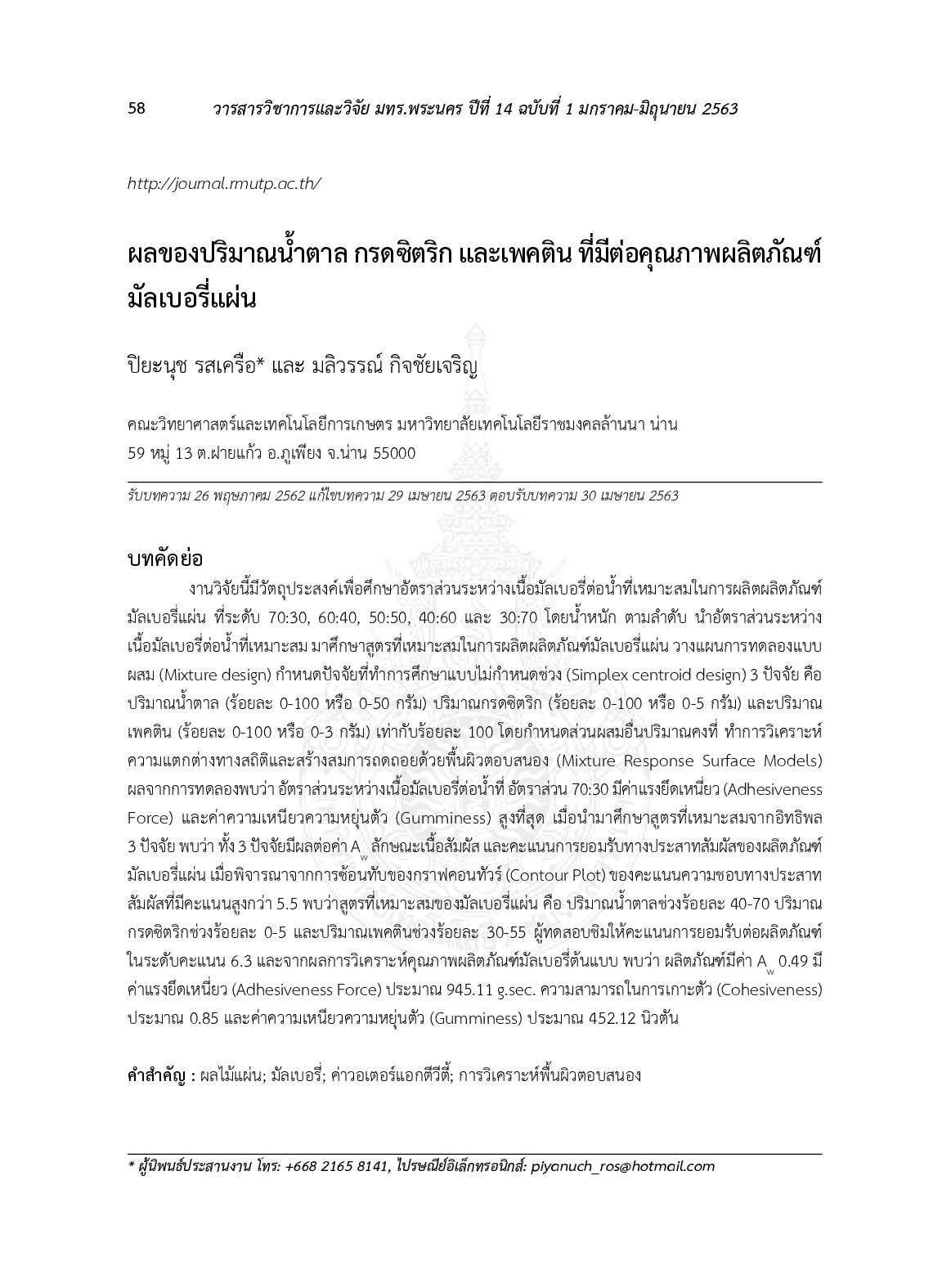
ผลของปริมาณน้ำตาล กรดซิตริก และเพคติน ที่มีต่อคุณภาพผลิตภัณฑ์มัลเบอรี่แผ่น
The objective of this study was to investigate the optimal formulation of mulberry fruit leather product when varying the weight ratio of mulberry fruit: water as 70:30 60:4050:50 40:60 and 30:70. Three factors were then determined by simplex centroid design; sugar (0-100% or 0-50 grams) citric acid (0-100% or 0-5 grams) and pectin (0-100% or 0-3 grams) which the sum of them equivalent to 100% while other ingredients remained constant. Analysis of the data was performed using ANOVA and Mixture Response Surface Models. The results indicated that the highest adhesiveness force and gumminess of mulberry fruit leather product were founded when the weight ratio of mulberry fruit to water was 70:30. The amount of sugar acid and pectin had effects on water activity (Aw) texture profile and sensory score of overall liking of product. From contour plot the predictive models were obtained by plottin g the contour line of all sensory attributes with acceptable score greater than 5.5 and thus the optimization area was selected. After overlapping contour plots an optimal formulation obtained was composed of 40-70% sugar 0-5% citric acid and 30-55% pectin. The sensory score of overall liking of product using a 9-point hedonic scale was 6.3. The water activity (Aw)adhesiveness force cohesiveness and gumminess of the prototype mulberry fruit leather product was 4.9 945.11 g. sec. 0.85 N and 452.12 N. respectively.