จำนวน Repository ( 20 )

The approach for sustainable development and growth community enterprise
The development method to sustainable and growth of community enterprises is a qualitative study. This aims to professional development model to community enterprise. This is done by collecting data by dept interview observation and analysis. By the result found that the government organization supported to subsidies capital and equipments but operating by private-owned enterprises. Problems concerning marketing weakness unable to expand the market. This weakness resulted in a slow pace of development of community enterprises and a high possibility of dissolution but are still operating in form of OTOP. Important characteristics of community enterprises that were able to expand business included strong leadership sacrificing being accepted among members continual progress and good governance should give emphasis to local market by making products which are accepted by local people and have community enterprise network.
The plant growth and production from swine farm wastewater usage
The usage of wastewater from swine farm for agriculture have study on the production of three plants such as shallot (Allium ascalonicum L.) marigold (Tagetes erecta L.) and ruzi grass (Bachiaria ruziziensis). The experiment was focusing on the growth production and metals accumulation (Pb Cu Fe Zn) in plant. The results shown that swine farm wastewater were a lot of organic substant and nutrient. The biological oxygen demand and chemical oxygen demand were out of standard. The heavy metals lead zinc copper and iron were amount 0.106 0.218 0.082 และ 0.866 mg/kg respectively. The productivity of shallot and ruzi grass were high growing that treated by swine farm wastewater. The marigold production (flower size dry weight and fresh weight) treated by swine farm wastewater found that were not significant from the marigold production that treated by control water. The amount of lead in shallot ruzi grass and marigold flower were out of standard. The shallot and ruzi root found the amount of zinc out of standard. The amount of copper and iron were not out of standard all three plant.
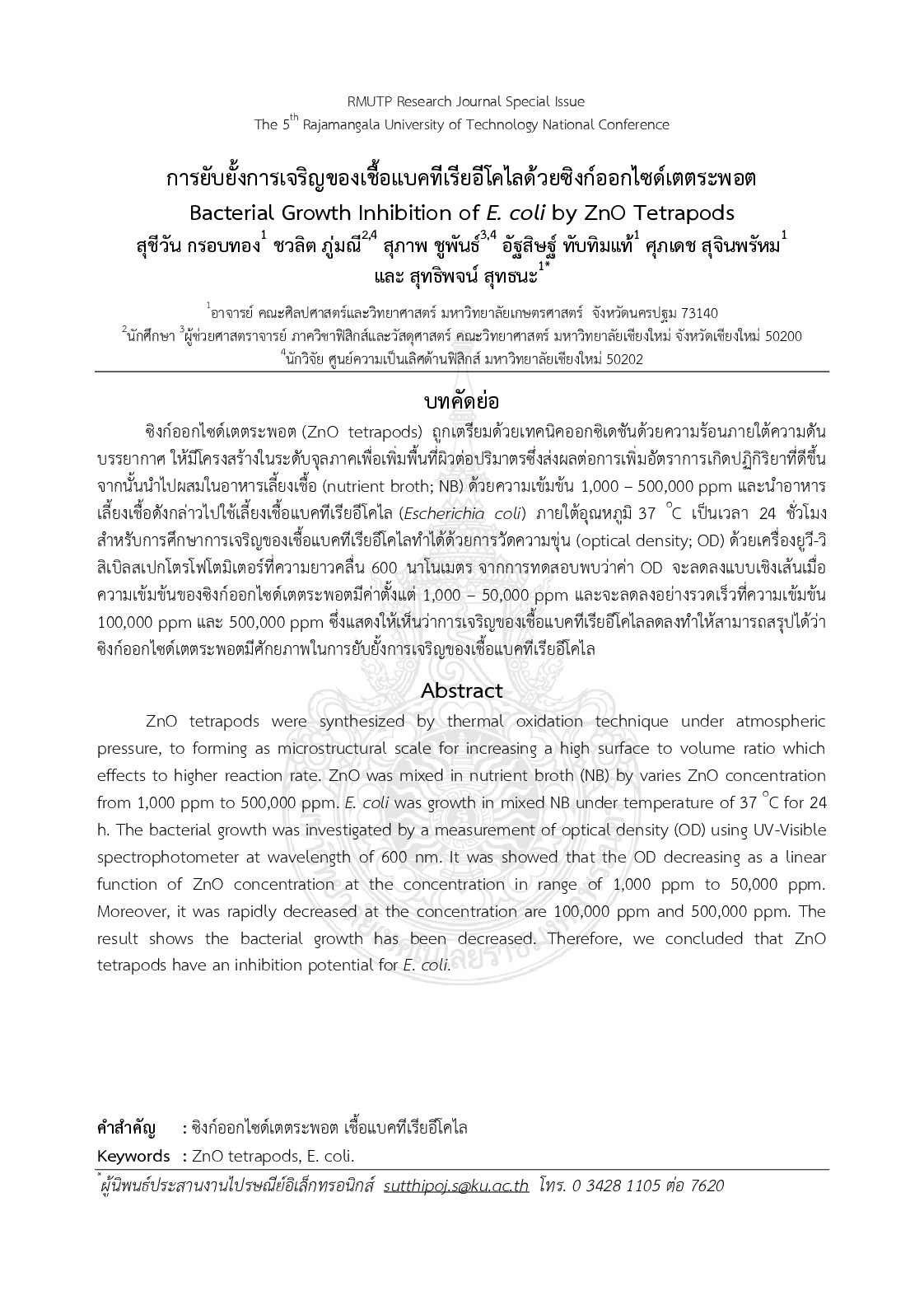
Bacterial growth inhibition of e. coli by zno tetrapods
ZnO tetrapods were synthesized by thermal oxidation technique under atmospheric pressure to forming as microstructural scale for increasing a high surface to volume ratio which effects to higher reaction rate. ZnO was mixed in nutrient broth (NB) by varies ZnO concentration from 1000 ppm to 500000 ppm. E. coli was growth in mixed NB under temperature of 37 oC for 24 h. The bacterial growth was investigated by a measurement of optical density (OD) using UV-Visible spectrophotometer at wavelength of 600 nm. It was showed that the OD decreasing as a linear function of ZnO concentration at the concentration in range of 1000 ppm to 50000 ppm. Moreover it was rapidly decreased at the concentration are 100000 ppm and 500000 ppm. The result shows the bacterial growth has been decreased. Therefore we concluded that ZnO tetrapods have an inhibition potential for E. coli.
Phytotoxicity assessment of polycyclic aromatic hydrocarbons Co-Contamination in Soil during Economic Legume Seedling Growth
This research studied combined toxicities of 4 generally found Polycyclic Aromatic Hydrocarbons (PAHs) - anthracene fluorene fluoranthene and phenanthrene – during growth of 3 legume seedlings - cow pea mungbean and longbean - planted in varied combination of PAH contaminant in soil. Results showed that mungbean growth was more sensitive to PAH co-contaminated soil than cow pea and longbean. Co-contamination of all 4 PAHs was more toxic to legume than each pair of PAHs. Shoot length and fresh weight of legume seedling were more sensitive to co-contamination of all 4 PAHs than root length. Dry weight of legume seedling was the least sensitive to co-contamination of all PAHs.
Factors Relating to the Growth of SME in Ratchaburi Province
The purposes of this study were to investigate factors which relate to the growth of SME and the relationships between general characteristics of entrepreneur organizations and entrepreneurs’ competencies on the growth of SME in Ratchaburi Province. The subjects of this study were 53 Phajoke (Cotton weaving) SME entrepreneurs and Phajoke weavers in Ratchaburi Province. The instruments for collecting data were rating scale questionnaires. The statistics used for data analysis were descriptive statistics One-Way Analysis of Variance and Pearson Moment Correlation Coefficient - testing at the .05 statistical significant level. The results of the research revealed as follows: Most entrepreneurs were female from 41 to 50 year of age holding primary school certificate without any experience in other previous business and having been conducting this business for over 10 years. Most entrepreneurs had their own business with business members ranging from 1-10 people selling their products at the community business centers. Core competency managerial competency and human relation competency related to business growth in terms of production quantity positively (r= .008 r = .111 and r=.192 respectively). Core competency related to the growth of SME positively in terms of business management : profit-lose (r = 0.073) Managerial competency and human relation competency did not relate to SME business conducting : profit-lose (r = -.251 and r = -.113 respectively). Core competency managerial competency and human relation competency related to the growth of SME positively in terms of quality product manufacturing (r = 0.070 .111 and .264 respectively).