จำนวน Repository ( 75 )

การศึกษาและพัฒนาบรรจุภัณฑ์กระดาษจากเส้นใยพืชมะละกอเพื่อการออกแบบบรรจุภัณฑ์ส่งเสริมการขายผลิตภัณฑ์ชุมชน
Economic development from foundations It is one that is considered and used in economic development throughout. Promoting community products is one way to help people in the country especially rural people live a better life. Today more emphasis is placed on the standard of community products. Including promotion. Therefore the packaging for community products should be easy to create which the villagers may create themselves. They are made from cheap raw materials or easily found in the community such as agricultural residues. There is a lot left over. It is also used to lessen the papaya. The research in the past research of the researcher to obtain information. About the papaya fiber. Can form sheet. The line in the basket. And in the fiber inside the papaya soaking time. When we peel the outer shell and the flesh in the decayed. The fiber is connected to the net It can be made into paper. If we develop paper production process using papaya fiber. Control the size and quantity of fibers. Has a good collider helps in adhesion. We can produce cardboard from papaya plant fibers. And the fiber in the mesh. Can also be used as a liner (Liner) with the nature of the current. Also can be sealed on corrugated paper. To get a beautiful textured paper (Texture) unique. Suitable for packaging boxes to promote the sale of community products. As well as other products as well. Research indicates that Physical properties of paper from papaya plant fibers. The paper is different. From the test it was found that the paprika plant fiber paprika on the plate and seal the skin. Physical properties are not suitable for processing into packaging. Because of the high thickness and fold lines do not match. Because the fiber is hard surface seal. When folding so frame And broken easily. Packaging of papaya plant fiber packaging. The paper is different. From the tests all three types can be packaged well because of the high strength of the fiber. There are also beautiful patterns. Can increase the value of the product as well. But the package of papaya fiber that is sealed with papaya fiber. The fiber is crisp in the body when folding. Fiber is broken. The satisfaction in paper packaging from papaya plant fibers. Based on three case studies the user satisfaction was assessed. Cardboard from papaya plant fibers up unprotected skin. Satisfaction was at the highest level. Cardboard from papaya plant fibers up the sheet and seal the skin. The satisfaction of the sample was at the highest level. And the corrugated paper seals the skin with a sheet of papaya. The satisfaction of the sample was at the highest level.
การศึกษาวัสดุธรรมชาติ เพื่อการออกแบบผลิตภัณฑ์สำหรับปลูกต้นไม้
The Study Natural Materials to Product Design for Tree Planting. Studying natural materials To design a product for a tree Study on utilization of natural materials. Study and development of natural materials and ratios of various materials suitable for planting products. And compare the properties of natural materials. Made to plant products. To achieve the objectives of the research. Researchers conducted various researches. And present the results of data analysis. The best ratio is natural material: cement: 1: 1.5: 2 water: 695 kg / m 3 Water absorption test of various materials mixed with all three types of materials. Water absorption of soil and glue mixture is best absorbed. The absorption was 88%. Experiment on the swelling of natural materials mixed with all three types of materials. The test results showed that the swelling rate of cement mixed materials. The smallest swelling was 0.332 millimeters (0.08 millimeters). The questionnaire was used to collect data from 150 questionnaires. Statistical analysis is used to determine frequency. Of the 150 respondents about 94.7% of the rubber tree structure was found. 65.3% of the products obtained from the rubber leaves were 49.3%. There were 5 - 10 types of rubber leaves. The 80 respondents commented that most of the products of the rubber leaves were flowers (53.3%). The answer was 132 respondents representing 88%. On the durability of natural products 49.3% said that the products of natural materials are durable medium. There were 10 - 50 species of natural materials 52.7% of them had opinions about 51% of natural plant products. 59% had good quality 53% were good in natural materials 53% satisfied with the color of natural plant products 60% satisfied with the products. At the same time 47% of the products were planted in natural materials 47% of which were of good quality. 98% of tree planting products. The research found that people are interested in products for planting trees from natural materials. It is a combination of natural materials to create a new material with unique patterns. It can also be developed into more products.
การใช้ประโยชน์จากพืชในท้องถิ่นสำหรับการพัฒนาเป็นเครื่องดื่มสมุนไพร: กรณีศึกษาพืชในท้องถิ่นชุมชนแพรกหนามแดง อำเภออัมพวา จังหวัดสมุทรสงคราม เพื่อความมั่นคงด้านอาหารอย่างยั่งยืน
This research aims to study the properties of local plants Phraek Nam Daeng community for the development of a herbal drink and development drink herbal tea. Local plants used in the study was Khlu (Pluchea indica (L.) Less). The leaves Khlu tested phytochemical composition antioxidant testing by testing their ability to reduce the amount of chemicals 11-diphenyl-2-picrylhydrazyl (DPPH) tests the amount of phenol used Folin-Ciocalteus reagent nutritional analysis and the amount of cellulose and developed the herbal drink tea. The research found that 1. Phytochemical composition of Khlu leaf is mainly flavonoids and tannins anthracnones. 2. Extracted from the leaf extract with methanol showed the ability to reduce the amount of substance 11-Diphenyl-1-picrylhydrazyl (DPPH) was the most abundant. Fresh leaves dried leaves and dried leaves were 30 days values at 131.23 ± 1.42 127.55 ± 1.03 and 125.90 ± 1.28 μg / ml respectively. 3. Extracts from the leaf extract with methanol showed the highest phenolic content as follows: fresh leaves dried leaves and dried leaves for 30 days were 84.91 ± 0.54 82.44 ± 1.09 and 81.01 ± 1.25 mg GAE / g dw respectively. 4. The optimal conditions for the process of making Khlu tea is a temperature of 70 °C for 7 hours. The score of sensory evaluation in terms of appearance color aroma flavor (astringent) and overall were 7.37 ± 1.22 7.23 ± 1.16 6.97. ± 1.30 7.00 ± 1.14 and 7.63 ± 1.10 respectively.
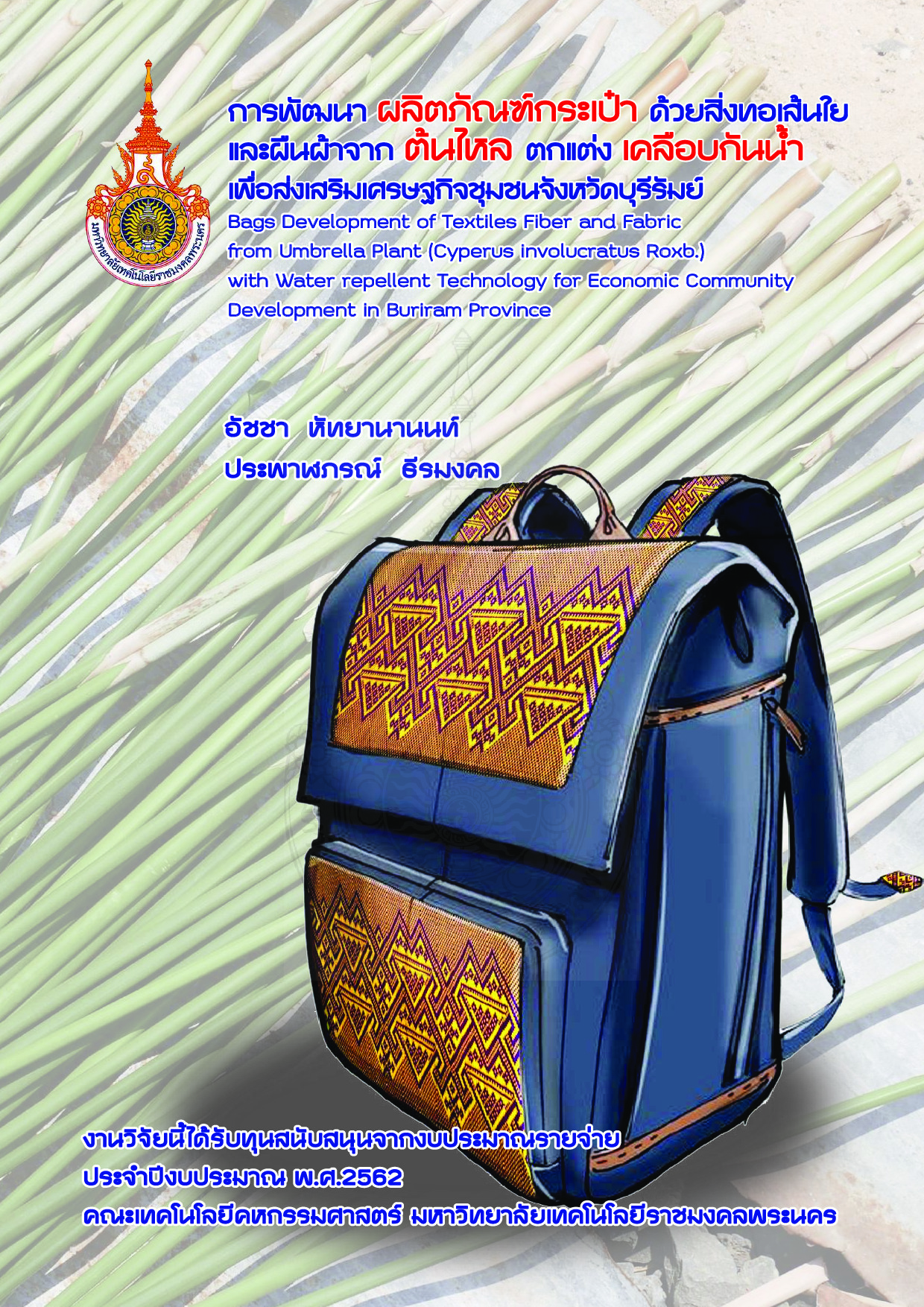
การพัฒนาผลิตภัณฑ์กระเป๋าด้วยสิ่งทอเส้นใยและผืนผ้า จากต้นไหลตกแต่งเคลือบกันน้ำ เพื่อส่งเสริมเศรษฐกิจชุมชนจังหวัดบุรีรัมย์
The proposes of this research were to study the development of bag products with textiles fibers and fabrics from decorative flowing water-resistant coating to promote community economy in Buri Ram Province. With the objective To study the process of producing yarn from fibers from the flow source To design and develop textile and bag products from yarn from the Lai Ton To study the effect of coating with waterproofing on bag products using textiles fibers and fabric from the flow. And to transfer knowledge and technology for utilization to community groups and interested people in next fiscal year This research can be summarized as follows: 1. The study of Ton Lai found that most villagers grow Lai Ton and make products as a supplementary career. In using this flow source in this research the researcher used a large flow source with a diameter of about 1 hour and can be separated into 4 small strands for research and production. The dyes used are synthetic because they will get fresh colors save time and be consistent. 2. The researcher designed 2 designs of weaving designs with the idea of using the original pattern to add edit and then create the pattern that the community groups like and can actually produce it as a product. After getting the fabric pattern then design into 10 bags of women and men bags using leather as an ingredient Decorate the bag to look interesting increase the price and increase the target audience. Which will be different from the original. That uses colored fabric and striped fabric as decorative items. 3. Coating with waterproofing on the bag products with textiles fibers and fabrics from the flow found that the fabric that has been coated with water repellent. When pouring water on the water surface there is a clumping together. No water penetration through fibers. When wiping clean the fibers are still dry not wet. Which is different from fabric that has not been coated namely water is able to penetrate immediately and create moisture on the fabric surface. If stored for a long time it can cause mold. 4. Schedule of technology transfer with the plan to transfer the research in the budget year 2020. For 3 day knowledge transfer and workshop was 30 participants. The group consisted of weaving mats from Ban Bu community Chorakhe Mak Subdistrict Prakhon Chai District. Buriram province
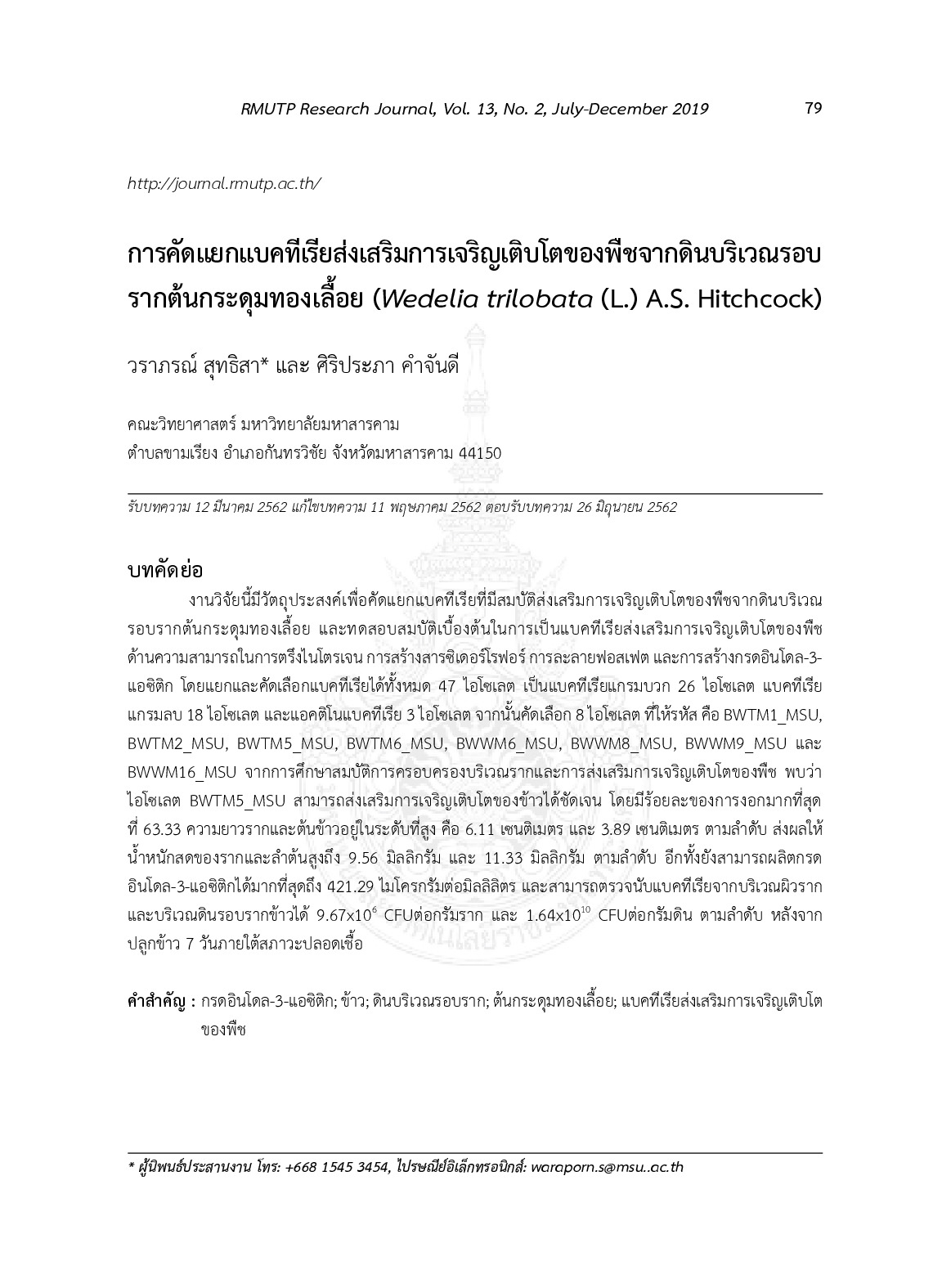
การคัดแยกแบคทีเรียส่งเสริมการเจริญเติมโตของพืชจากดินบริเวณรอบรากต้นกระดุมทองเลื้อย (Wedelia trilobata (L.) A.S. hitchcock)
The objective of this research was to isolate plant growth promoting rhizobacteria from Wedelia trilobata (L.) A.S. Hitchcock rhizosphere and preliminarily test their plant growth promoting properties such as nitrogen fixation siderophore production phosphate solubilization and indole-3-acetic acid production. Forty-seven bacterial isolates were obtained including 26 isolates of gram positive 18 isolates of gram negative and 3 isolates of actinobacteria. After that 8 isolates (including BWTM1_MSU BWTM2_MSU BWTM5_MSU BWTM6_MSU BWWM6_MSU BWWM8_MSU BWWM9_MSU and BWWM16_MSU) were selected for studying on root colonization and plant growth promoting properties under aseptic condition. The results showed that BWTM5_MSU had the evident on the promotion of plant growth with the most percentage of rice seed germination (63.33%) high level of root and shoot length with 6.11 cm and 3.89 cm respectively. As a result the root and shoot fresh weight was as high as 9.56 mg and 11.33 mg respectively. It also correlated with the highest production of indole-3-acetic acid up to 421.29 ug/ml. The root colonization was studied by counting rhizobacteria isolate BWTM5_MSU from rice rhizoplane and rhizosphere with presented bacterial number at 9.67x10⁶ CFU/g root and 1.64x10 10 CFU/g soil respectively.