จำนวน Repository ( 12 )
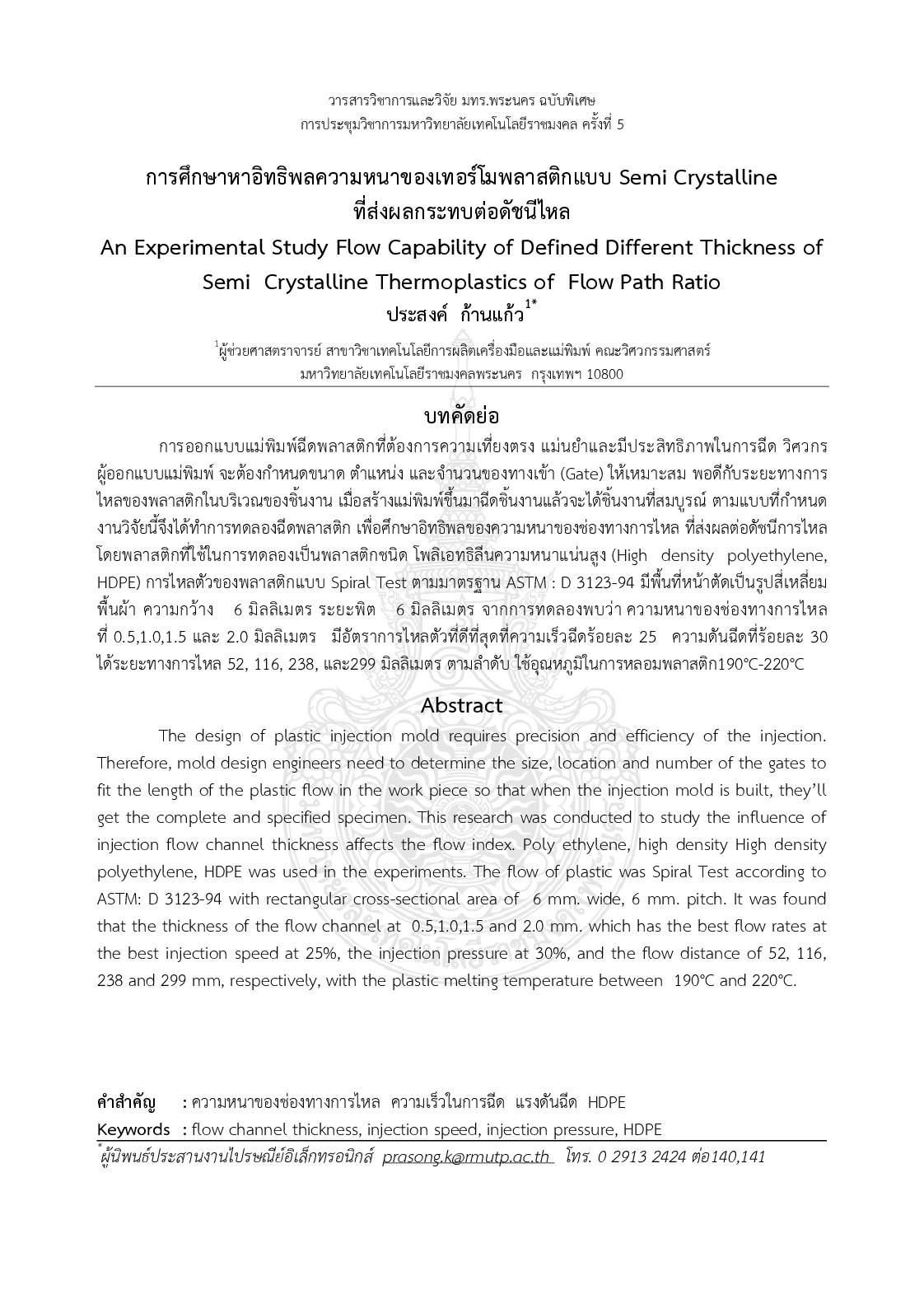
An experimental study flow capability of defined different thickness of semi crystalline thermoplastics of flow path ratio
The design of plastic injection mold requires precision and efficiency of the injection. Therefore mold design engineers need to determine the size location and number of the gates to fit the length of the plastic flow in the work piece so that when the injection mold is built they’ll get the complete and specified specimen. This research was conducted to study the influence of injection flow channel thickness affects the flow index. Poly ethylene high density High density polyethylene HDPE was used in the experiments. The flow of plastic was Spiral Test according to ASTM: D 3123-94 with rectangular cross-sectional area of 6 mm. wide 6 mm. pitch. It was found that the thickness of the flow channel at 0.51.01.5 and 2.0 mm. which has the best flow rates at the best injection speed at 25% the injection pressure at 30% and the flow distance of 52 116 238 and 299 mm respectively with the plastic melting temperature between 190 C and 220 C.
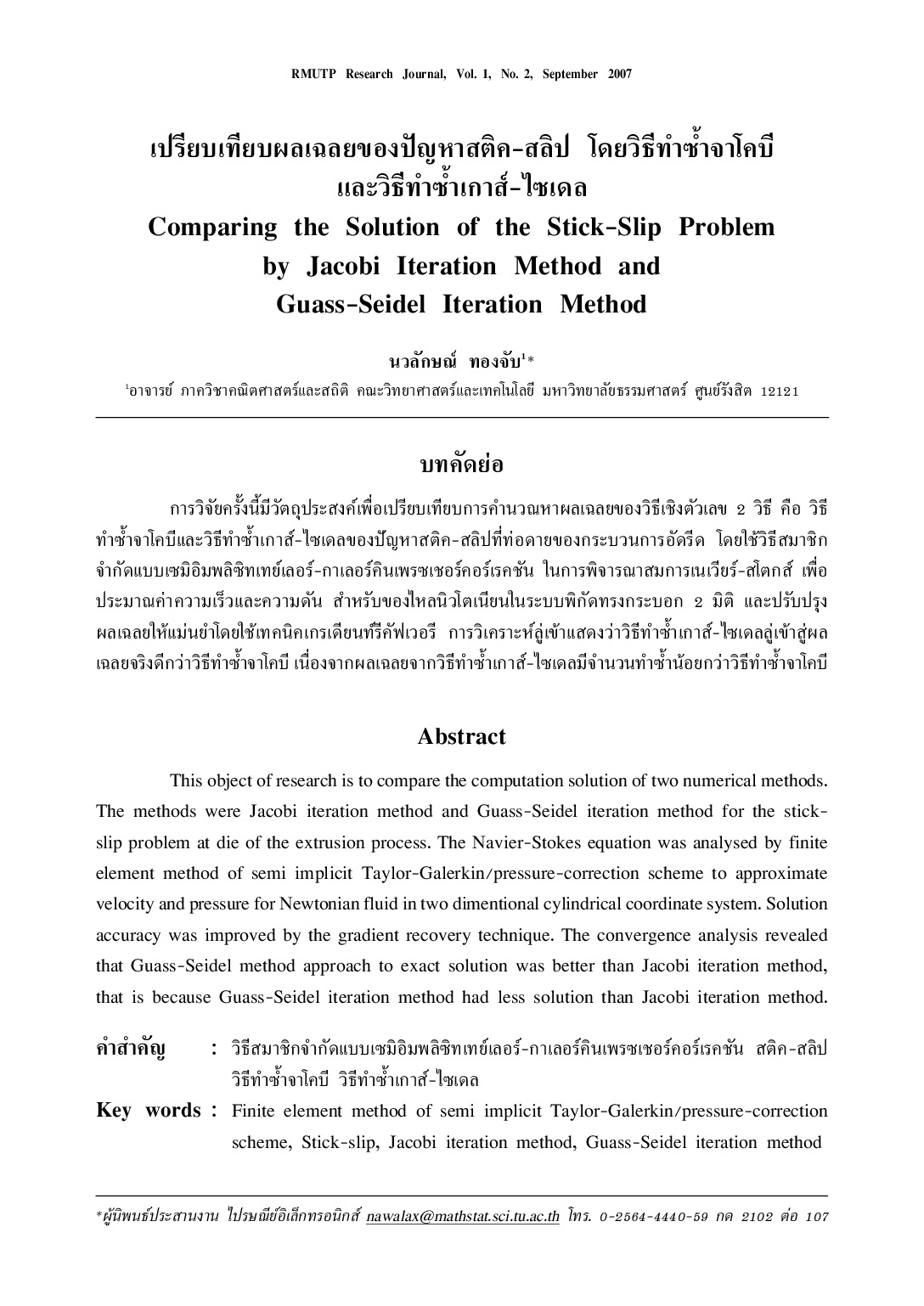
Comparing the Solution of the Stick-Slip Problem by Jacobi Iteration Method and Guass-Seidel Iteration Method
This object of research is to compare the computation solution of two numerical methods. The methods were Jacobi iteration method and Guass-Seidel iteration method for the stickslip problem at die of the extrusion process. The Navier-Stokes equation was analysed by finite element method of semi implicit Taylor-Galerkin/pressure-correction scheme to approximate velocity and pressure for Newtonian fluid in two dimentional cylindrical coordinate system. Solution accuracy was improved by the gradient recovery technique. The convergence analysis revealed that Guass-Seidel method approach to exact solution was better than Jacobi iteration method that is because Guass-Seidel iteration method had less solution than Jacobi iteration method.