จำนวน Repository ( 38 )

การศึกษาและพัฒนาบรรจุภัณฑ์ของฝากสำหรับผลิตภัณฑ์ปลาสลิดแปรรูป จังหวัดสมุทรปราการ
การวิจัยนี้มีวัตถุประสงค์เพื่อศึกษาแนวทางการออกแบบบรรจุภัณฑ์ของฝาก การพัฒนาปรับปรุงบรรจุภัณฑ์ของฝาก และประเมินประสิทธิภาพผลงานออกแบบบรรจุภัณฑ์ของฝากสำหรับผลิตภัณฑ์ปลาสลิดแปรรูป จังหวัดสมุทรปราการ ทั้งในด้านการใช้งานและด้านการตลาด กลุ่มตัวอย่างในการวิจัย คือ นักท่องเที่ยวต่างถิ่นจำนวน 50 คน และคนในท้องถิ่นจำนวน 50 คน ที่ต้องการซื้อสินค้าปลาช่อนแปรรูปจากร้านในจังหวัดสมุทรปราการ เครื่องมือที่ใช้ในการวิจัยเป็นแบบสอบถามความต้องการด้านต่าง ๆ ของกลุ่มเป้าหมาย มีค่าความเชื่อมั่น เท่ากับ .854 วิเคราะห์ค่าสถิติด้วยค่าร้อยละ ค่าเฉลี่ย ค่าฐานนิยม และแบบสอบถามเพื่อประเมินความพึงพอใจในด้านการใช้งานและในด้านการตลาดของบรรจุภัณฑ์ของฝาก ทั้งในขั้นตอนการประเมินทางเลือกและในขั้นตอนการประเมินเปรียบเทียบกับบรรจุภัณฑ์รูปแบบเดิม โดยแบบสอบภามทั้ง 2 ฉบับ มีค่าความเชื่อมัน เท่ากับ .839และ .844 ตามลำดับ วิเคราะห์ค่าสถิติด้วยค่าร้อยละ ค่าเฉลี่ย และทดสอบ สมมติฐานด้วยสถิติ t-test ชนิดDependent Sample ผลการวิจัยสรุปว่า 1. ผลงานออกแบบบรรจุภัณฑ์แนวทางที่ 1 เหมาะสำหรับฝากเจ้ายาย แนวทางที่ 2 เหมาะสำหรับฝากญาติ และแนวทางที่ 3 เหมาะสำหรับฝากคนในครอบครัว 2. กลุ่มเป้าหมายเลือกผลงานออกแบบบรรจุภัณฑ์ในแนวทางที่ 3 3. กลุ่มเป้าหมายมีความพึงพอใจในบรรจุภัณฑ์รูปแบบใหม่มากกว่ารูปแบบเดิมในทุก้านอย่างมีนัยสำคัญทางสถิติที่ระดับ .05 ผู้จำหน่ายมีความพึงพอใจมากกว่ารูปแบบเดิมในเกือบทุกด้านยกเว้นด้านภาพลักษฑ์ที่เป็นมิตรกับสิ่งแวดล้อมและบรรจุภัณฑ์ใหม่มีประสิทธิภาพการใช้งานได้มากว่าบรรจุภัณฑ์รูปแบบเดิม
การพัฒนาคุณภาพผลิตภัณฑ์จากฐานภูมิปัญญาท้องถิ่นเรื่องสมุนไพรแปรรูป ของกลุ่มสตรีสหกรณ์เกษไชโยจังหวัดอ่างทองเพื่อเพิ่มศักยภาพการผลิต
This research aims to 1) improve quality of processed herbal product by developing recipe and production procedures 2) develop packaging of processed herbal products in oder to add value exhibit uniqueness and response to customers’ need and 3) transfer technology and body of knowledge about improving products’ quality and developing packaging of processed herbal products. Results from developing of recipe and production procedure of kaffir lime in syrup show that period in boiling kaffir lime before sweetening in syrup has an effect on textures. The suitable period of 5 minutes for boiling kaffir lime results in reducing hardness of kaffir lime core increasing lightness and gaining the highest sensory scores from testers. The suitable amount of fructose syrup used in place of sugar in producing sweetened kaffir lime at 80 percent of sugar weight results in increasing lightness reducing hardness increasing value of red color (a*) and aw when compared with the control group and increasing quality of texture with the highest sensory scores from testers. Quality of microorganism appearance color ordor and texture of sweetened kaffir lime stored in tight-closed polypropylene (PP) bag at room temperature could be maintained for at least 24 days. Regarding satisfactory in packaging prototype it was found that customers were highly satisfied in both overall (4.48) and by aspect of packaging form (4.48) and packaging graphic (4.49). In terms of transferring the technology to a target group of 30 people it was found that trainees were highly satisfied with the technology transfer process (4.56). The highest satisfaction level by aspects was usefulness of service at 4.64 followed by service of staff trainers and service procedure at 4.58 4.57 and
การออกแบบและพัฒนาบรรจุภัณฑ์สำหรับผลิตภัณฑ์แปรรูป จากข้าวพันธ์ไรซ์เบอรี่สู่การส่งเสริมการเพิ่มมูลค่าการท่องเที่ยวเชิงนิเวศน์เศรษฐกิจ
: This research focus (1) to design and development of packaging for processed products from Rice varieties Rice Berry (2) to promote and increase the value tour ecological economy (3) to test the satisfaction of consumers who have to the product packaging processing of Rice varieties Rice Berry the samples is the public to shop for health in the supermarket Golden place branch Rama 9 number of 334 people divided by the survey draft design is at a time 167 people and expert printing design packaging and materials 5 and tool operators research 1) questionnaire the first comment design draft for the samples to use as a guide to design body work package and assess the quality step work package design 2) questionnaire satisfaction survey for the samples with a draft of the packaging product 1] Rice Berry 2] candy Tootsie processing of Rice Federation of Rice Berry 3] Rice gluten-processing of Rice Federation of Rice Berry the data were analyzed using how to sum up operators with the lectures mean and standard deviation findings summarized as follows: (1) The attention to the materials used in the production of plastic packaging materials. Create a frame on one floor and a label to indicate the product description. Experts and samples Pay attention to the style and material of packaging SET A1 is plastic material selection 63 percent representing 37.70 (2) effect of assess the design of the package herbal Thailand overall found that the samples comments to form set a1 the evaluation of design in the high level with an average equal to 3.76 3.76 s.d. = 0.69) shaped as tree easy-to-use nature of close to weep and the site label use printing process 4-color design in accordance with the regulatory to produce a clear used patterns graphics media to “individual product type” logo of the product to reflect the English view the delicacy colors used as a couple color with color of the paper make sense naturally in the core of sustainable development research this can be adjusted in step process used nature of type 1 color to save the cost of production in the part of the structure. If there is eminent the bent to develop I-oriented wisdom to comply with the material in the local structure can be used as erosion siege basketwork that will help to create unique local with self-esteem.
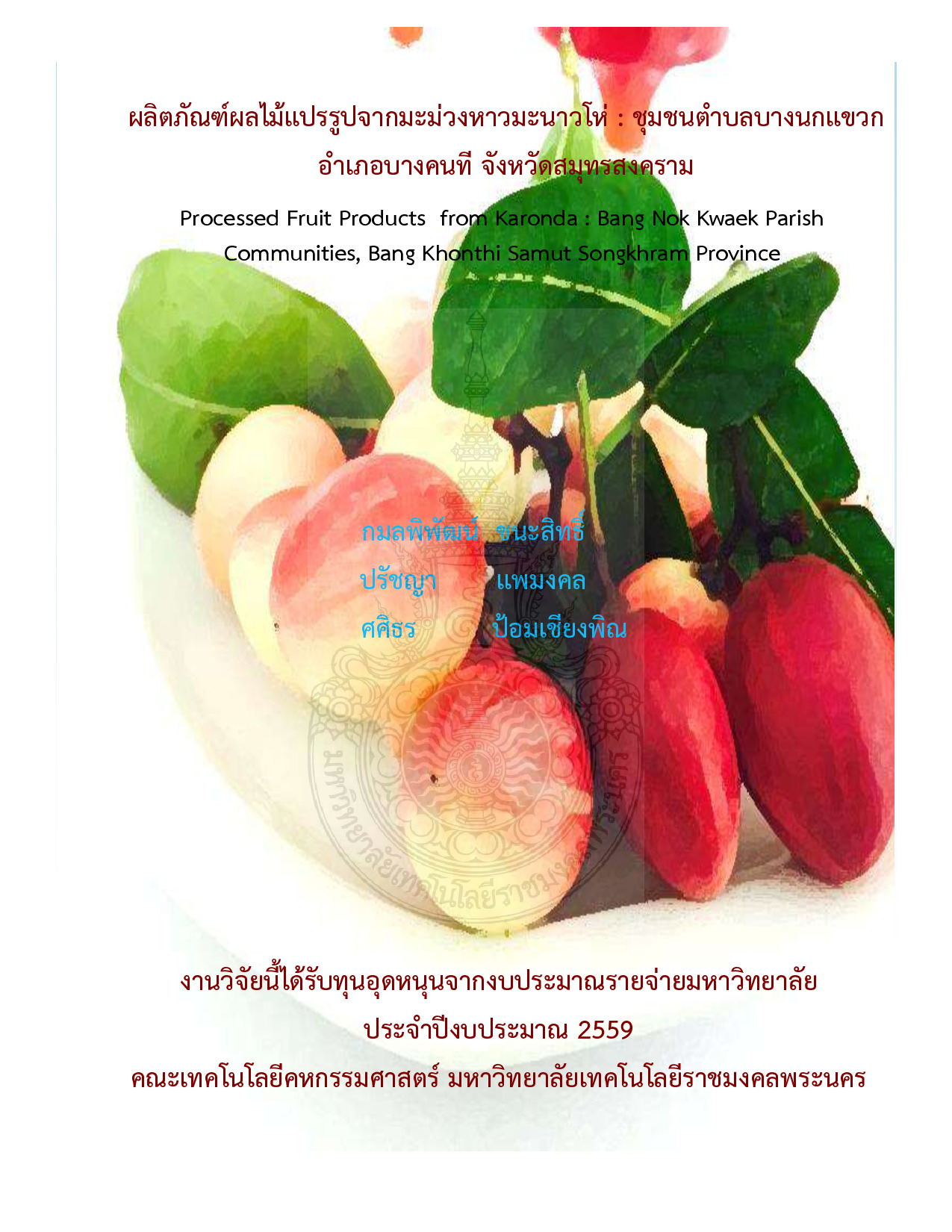
ผลิตภัณฑ์ผลไม้แปรรูปจากมะม่วงหาวมะนาวโห่ : ชุมชนตำบลบางนกแขวก อำเภอบางคนที จังหวัดสมุทรสงคราม
The purpose of the study of processed fruit products from Karonda : Bang Nok Kwaek parish communities Bang Khonthi Samut Songkhram Province is to study the proper quantity of the Koranda fruit in the product the quality in the product’s process and the consumers’ acceptance (Consumer Test) in the product. The processed products are Karonda fruit jelly instant pasteurized Karonda fruit juice with extra fiber Karonda fruit sorbet Karonda fruit yoghurt ice-cream and concentrated juice (sauce) for drink mixing. The product has been tested by Randomized Complete Block Design (RCBD) method. The process was consisted with offering a tasting and evaluated in color scent taste matter and overall satisfaction by giving 9 point Hedonic scale from 70 consumers. And has been compared the difference of average means at 95% trustiness by Duncan’s New Multiple Range Test (DMRT) by an instant statistical analysis software. The result information is as the followings; The physical properties indicates of Karonda fruit the total acidity of 2.30 with the pH and the color was found that the brightness (L *) of 16.52 fee (a *) equal to 8.95 and (b. *) equals 5.37. The study of the chemical quality of Karonda fruit amount of energy in calories carbohydrates 73.2 percent 18.3 percent protein 1.57 percent 1.32 percent humidity fats fiber 83.7 percent ash 4.26 percent and 0.75 Vitamin C is found. The duration of ripening fruit yawning lemon booed affect the vitamin C in the fruit of the mango yawning lemon booed the oil will have more vitamin C than ripe to t 2 so I scratched the reduction of vitamin C may. Is due to be deployed as a compound to breathe. And led to the synthesis of new carbon structures during ripening. Karonda fruit jelly. The most acceptances level for Karonda fruit juice in the product is at 1:6 for its best flexibility. Since the juice concentration affects the jelly as it lowers the matter (flexibility). Too much of acid in Karonda fruit juice is able to unstabilize jelly matter. From the study of Pectin quantity the consumer has the most acceptance at the level of 10 grams which is the best recipe that keeps the good jelly matter (flexibility) stabilized. The physical properties indicates that there are the level of color hue at 5R color brightness at Value 4 Chroma at 14 sweetness at 35 Brix and pH at 3.05. The study of the chemical quality of Karonda fruit jelly in each 100 grams provides 120 kilocalories of energy 69.60 grams of humidity 0.11 gram of fat 29.80 grams of carbohydrate 0.41 gram of fiber 0.50 gram of ash and 0.45 gram of acidity. The consumer satisfaction is at 97.30 percent. Instant pasteurized Karonda fruit juice with extra fiber. The acceptance is at 100 percent of replacing Okra fruit juice by Karonda fruit juice. The acceptance study shows that the most proper fiber quantity adding to Karonda fruit juice is at 15 percent. The acceptance study shows that the most proper Pectin quantity affecting coconut jelly spreading is at 3 percent. The analysis results of the physical properties indicate that instant pasteurized Karonda fruit juice with extra fiber has color hue level at 5R value at 4 and Chroma at 12 which rendered the product to dark red. Also the pH level is at 3.29 sweetness is at 17 Brix firness g force 1 is at 11.29 g Viscosityag.sec AREA F-T 1:2 is at 339.507 ag.sec. The study of the chemical quality of Karonda fruit juice in each 100 grams provides 63.3 kilocalories of energy 83.9 grams of humidity 0.01 gram of fat 0.10 gram of protein 15.8 grams of carbohydrate 0.41 gram of fiber 0.24 gram of ash and 0.18 gram of pH balance. The consumer satisfaction to instant pasteurized Karonda fruit juice with extra fiber is at 98.66 percent. Karonda fruit sorbet. The most proper quantity of Karonda fruit juice is at 30 percent. The physical properties of Karonda fruit sorbet contain the brightness level at L*34.32 red color level at a*41.26 yellow color level at b*21.18 meltable solid quantity at 30*Brix and pH balance at 2.40. The study of the chemical quality of Karonda fruit sorbet in each 100 grams provides 91.8 kilocalories of energy 77.1 grams of humidity 0.15 gram of fat <0.20 gram of protein 22.6 grams of carbohydrate 0.11 gram of fiber and 0.12 gram of ash. The consumer satisfaction to Karonda fruit sorbet is at 100 percent. Karonda fruit yoghurt ice-cream. The most proper quantity of Karonda fruit added in the yoghurt ice-cream is at 10 percent of the whole ingredient. The consumers’ acceptance has been given the most for its scent taste matter (smoothness) and overall satisfaction which has the average mean at 7.24 7.77 7.17 and 7.67 consequently. The physical properties of Karonda fruit yoghurt ice-cream contain the viscosity level at 364.798 cps. color hue at 10P Value at 8/6 Chroma at N9/.5 overrun statistics at 4.55 and Karonda fruit yoghurt ice-cream melting rate at 89.90. The chemical quality of Karonda fruit yoghurt ice-cream in each 100 grams provides 214 kilocalories of energy 64.0 grams of humidity 14.6 gram of fat 3.14 gram of protein 17.5 grams of carbohydrate 0.76 gram of fiber 0.74 gram of ash and 5.67 pH balance. The consumer satisfaction to Karonda fruit yoghurt ice-cream is at 100 percent. Concentrated juice (sauce) for drink mixing. The most acceptance recipe is the strawberry sauce recipe number 1 with the replacement of Karonda fruit at 80 percent. The physical properties contain the viscosity level at 9.28 cps sweetness at 21 Brix color hue at 5R Value at 2 and Chroma at 4. The chemical quality of concentrated juice (sauce) for drink mixing in each 100 grams provides 91.1 kilocalories of energy 77.2 grams of humidity 0.30 gram of fat 0.1 gram of protein 22.3 grams of carbohydrate 0.76 gram of fiber 0.4 gram of vitamin C and 0.56 of pH balance. The consumer satisfaction concentrated juice (sauce) for drink mixing is at the maximum satisfaction at 92.0 percent as the concentrated juice (sauce) emphasizes the better taste of smoothie drink mixing and easy to consume.
Mechanical properties of concrete mixed with reused ceramic tiles reinforced with steel fiber from milling processed
This research study the mechanical properties of concrete mixed with reused ceramic tiles reinforced with steel fiber from milling processed. The compressive strength of all concretes were designed at 300 ksc at 28 days and control slump in the range of 10 ? 2.5 cm. The steel fiber from milling processed was reinforced at 0.50 1.00 and 1.50 by the weight of cement content. The compressive strength Flexural and tensile splitting for all concrete samples were tested compare with control concrete which it as concrete mixed with reused ceramic tiles not reinforced with steel fiber. The results shown that the reinforcing with steel fiber from milling process at 0.5 and 1.0% was affect to the higher compressive strength than control concrete of 2 and 7% but increasing steel fiber at 1.5% was affect to lower compressive strength than control concrete of 6%. Concrete mixed with steel fiber from milling processed at 1.0% have higher splitting tensile strength than control concrete of 16% while concrete mixed with steel fiber at 0.5 and 1.5% have splitting tensile strength equal with control concrete. The flexural strength of these concretes have higher more than control concrete about 9 17 and 11% for reinforcing with steel fiber at 0.50 1.00 and 1.50 respectively. In addition the water permeability of concretes were increased when the steel fiber were reinforced increases too.