จำนวน Repository ( 22 )
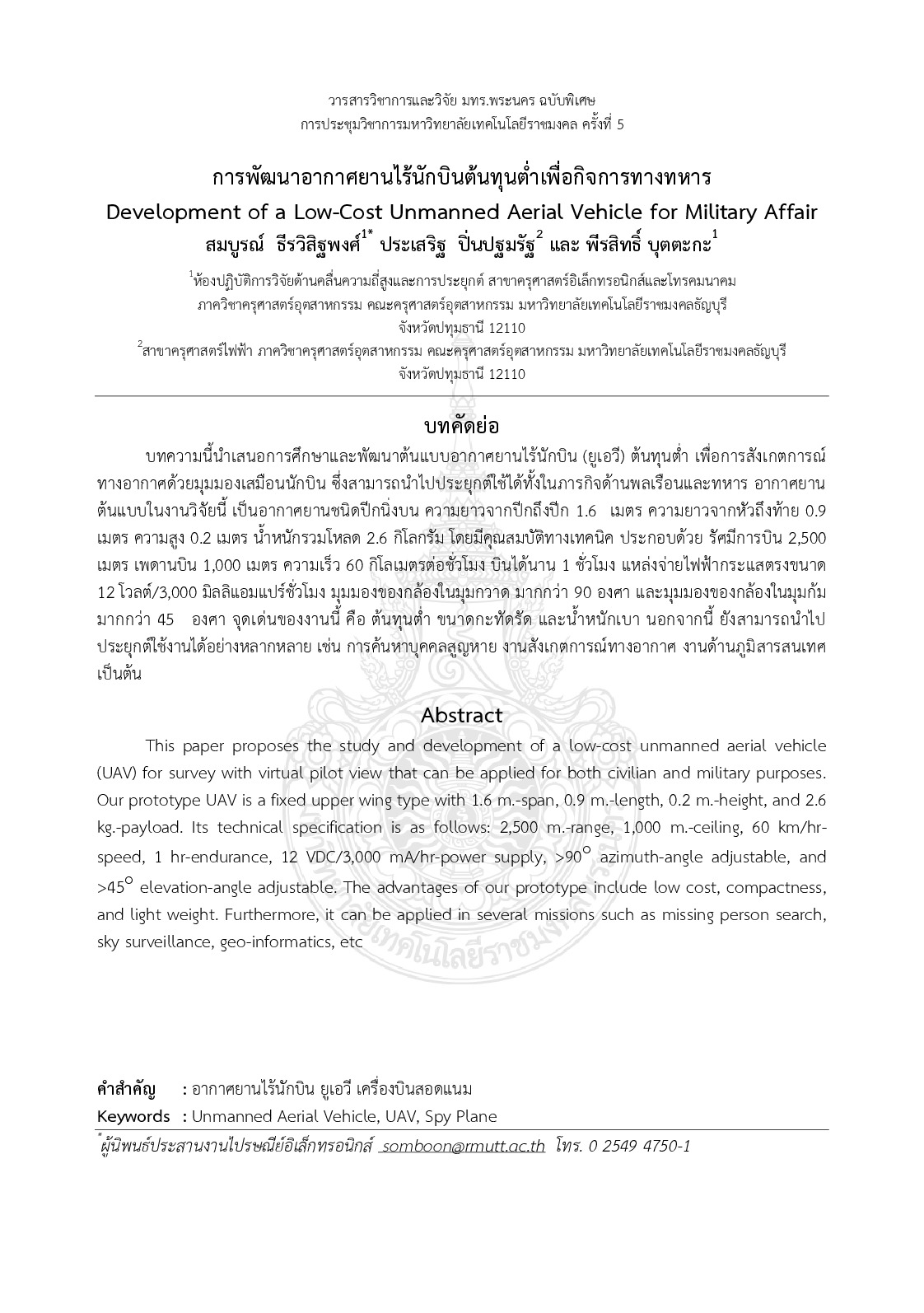
Development of a Low-Cost unmanned aerial vehicle for military affair
This paper proposes the study and development of a low-cost unmanned aerial vehicle (UAV) for survey with virtual pilot view that can be applied for both civilian and military purposes. Our prototype UAV is a fixed upper wing type with 1.6 m.-span 0.9 m.-length 0.2 m.-height and 2.6 kg.-payload. Its technical specification is as follows: 2500 m.-range 1000 m.-ceiling 60 km/hr-speed 1 hr-endurance 12 VDC/3000 mA/hr-power supply >90 azimuth-angle adjustable and >45 elevation-angle adjustable. The advantages of our prototype include low cost compactness and light weight. Furthermore it can be applied in several missions such as missing person search sky surveillance geo-informatics etc

The physical study of noise pollution cause by vehicles: For the case studies Wongsawang intersection and Rama VII intersection
The study noise pollutions at Wongsawang intersection and Rama VII intersection. According Pollution Control Department (PCD) methods. General sound level measurement used for this research and calculate the Leq24br Using the 5-day measurement period. For the result. The Sound level at Wongsawang intersection were exceeding the standard 70 dBA every day. The peak of Leq24br was 80.9 dBA. According the result of PCD. The Sound level at Rama VII intersection were exceeding 2days. Traffic density was a factor that affects the sound level. In addition the maximum sound level (Lmax) of all the measurements were not exceed 115 dBA
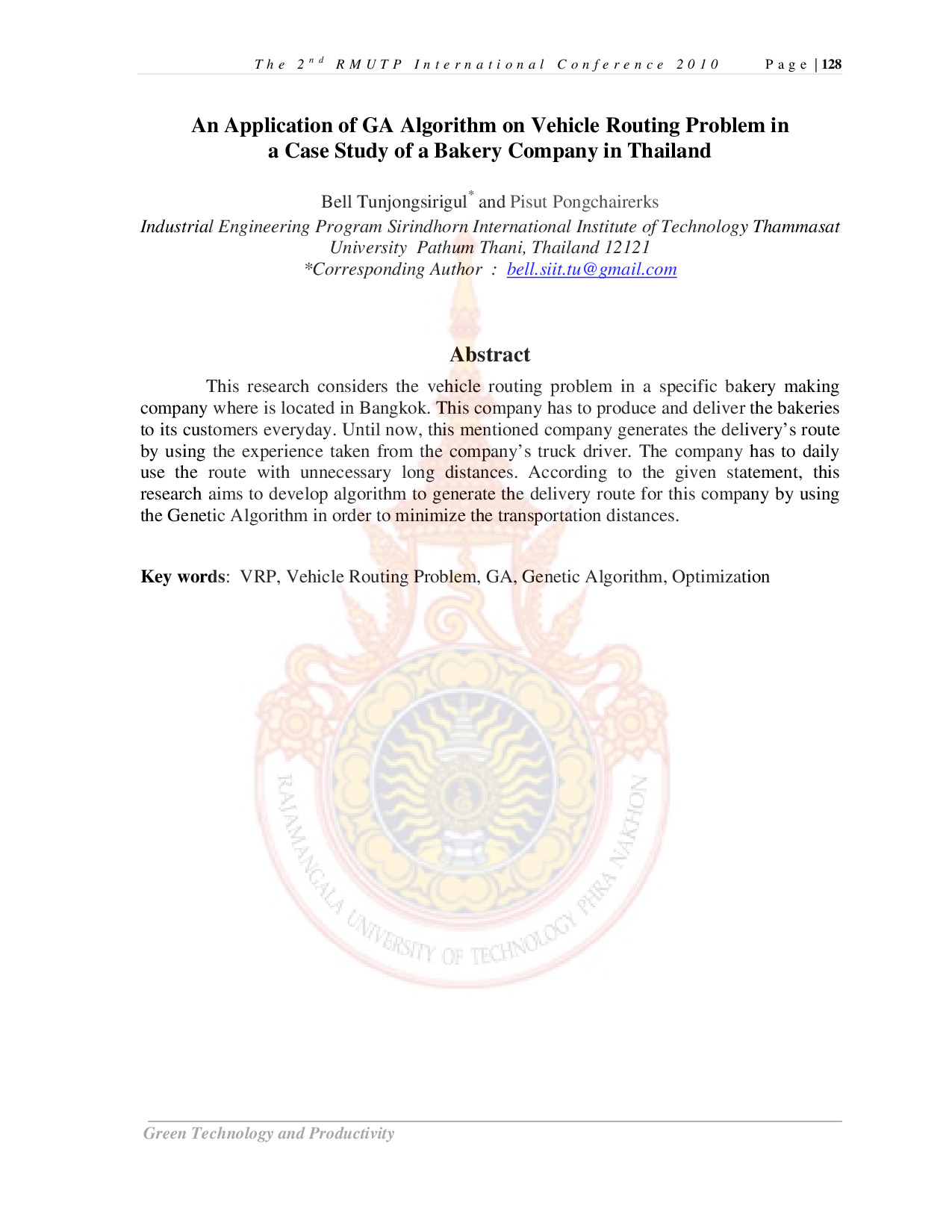
An Application of GA Algorithm on Vehicle Routing Problem in a Case Study of a Bakery Company in Thailand
This research considers the vehicle routing problem in a specific bakery making company where is located in Bangkok. This company has to produce and deliver the bakeries to its customers everyday. Until now this mentioned company generates the delivery’s route by using the experience taken from the company’s truck driver. The company has to daily use the route with unnecessary long distances. According to the given statement this research aims to develop algorithm to generate the delivery route for this company by using the Genetic Algorithm in order to minimize the transportation distances.
การวิเคราะห์มุมเอียงและความหนาของแผ่นเกราะที่มีผลกระทบต่อการต้านทานการเจาะทะลุของกระสุนบนแผ่นเกราะอลูมิเนียมและสแตนเลส ด้วยระเบียบวิธีไฟไนต์เอลิเมนต์
This thesis was an analysis of the significance of angle of inclination and the thickness of the armor plate on the penetration resistance of bullets on aluminum and stainless steel armor plates determined by the finite element method. In this study the information results obtained from actual firing of bulletproof armor and the finite element simulation according to NIJ 3 standards were compared to create a pattern of bulletproof and bulletproof armor using the SolidWorks program. The simulation model of the armor shooting was created by the Ansys/Explicit Dynamics program. The bullet material was 7.62 mm tungsten carbide (WC). There were three plate types used in the simulation were made of different bulletproof armor materials: 1) stainless steel SUS304 using for the plate thickness of 5 6 8 10 14 20 30 40 45 and 55 mm. 2) aluminum AL7075 using for the plate thicknesses of 6 8 10 and 20 mm. Additionally 3) tungsten carbide using for the plate thicknesses of 6 8 and 10 mm. Each of these plates had a width x length of 300 x 300 mm. The simulation models were divided into two types: Type 1 a simulation firing at one plate at a time. Type II a simulation firing at two layered plates stacked together without any gaps between plates. The front and the back plates made of stainless steel and aluminum respectively or tungsten carbide and stainless steel respectively were determined. The angles of firing at bulletproof armor were set at 0 30 and 45 degrees. The output results were that in Type I the stainless-steel plate with a thickness of 30 mm or more could resist the penetration of bullets. However in Type II 2 stacked layers of the armor plates using the front stainless plate with a thickness of only 20 mm and the back aluminum plate with a thickness of only 8 mm could provide the same constructive results as those of tungsten carbide and stainless steel plates for the front and back plates with both thickness setting at 16 mm. All of them showed the resistance of the penetration to the bullets. More observation was that the increases in angles as a result enhanced more resistance of the bulletproof plates to bullet penetration.
แผ่นเกราะโลหะกันกระสุน
This research project aimed to analyze and design the pattern of a bulletproof metal armor plate as well as build a bulletproof metal armor plate for a small armored regular truck. The methodology consisted of the NIJ standard test and the finite element analysis. The bulletproof plates created were tested for a real firing. Their firing results were compared with those of NIJ-standard using a finite element program in this case applying with the program Ansys/Explicit Dynamic. SolidWorks program is employed as a tool to design and create 3D models of armor plates and bullets. The materials taken in the finite element simulation were SKD11 and SUS304 and the parameters utilized in the research were material types hardness values spacing between the plates and thickness. In the case of two armor plates stacked SKD11 material was designed for the first armor plate to be hit by the bullet. It served to destroy bullets. In addition the second armor plate made of SUS304 material served to absorb energy and obstruct the movement of bullets. For testing a 30-06 caliber M2 AP 166 Gr bullet was selected at a 0-degree angle and the velocities measured and set by the Ansys/Explicit Dynamic program were 901.7 m/s and 880 m/s respectively. The front plate made of SKD11 material with a thickness of 10 mm and the back plate made of SUS304 material with a thickness of 10 mm were fired 1 shot. The results showed that the bullet could penetrate the front armor plate but not penetrate the back-armor plate. In the NIJ 3 standard tests the shooting with a 7.62x51 mm NATO FMJ 148 Gr shell at a 0-degree angle for 5 times with velocities equal to 846.4 841.3 839.1 838.2 and 845.3 m/s was performed on the stacking front and back armor plates both made of SUS304 material with a thickness of 8 mm. The bullet velocity simulated by the Ansys program was 847 m/s resulting in the front plate having a bullet penetration and a slight bulge on the back plate. From the finite element simulation results and the actual test results it was found that the damage to the armor plates detected by both methods was consistent. Therefore the finite element program was selected to simulate the damage of armor plates resistant to penetration according to the NIJ standard Level 4. The results of the research could be concluded that the use of armor plates stacked with suitable different materials in multiple layers would affect the penetration resistance. Increased thickness and optimal spacing between the armor plates were important parameters in penetration resistance. Moreover it revealed that the higher the material hardness the better its ability to resist penetration. In particular this suggestion should be applied to the first armor plate or front armor plate.