จำนวน Repository ( 182 )

การกินในประเพณีชีวิตที่เกี่ยวการเกิดและการตายในชุมชนไทยพวนแห่งหนึ่ง จังหวัดนครนายก
This thesis entitled Being Phuan in Contemporary Thai Society emphasized the aspeets of self-defining of the Phuan minority in Central Thailand an ethnic group migrating from Northern Laos two centuries ago perceived through the recognition and invention of Phuanness which has varied thoroughly up on different social contexts during the past several decades. It considered the existence of Phuanness in the contexts of the establishment and activities of the Phuan Association (Chomrom Thai-Phuan) the Phuans cultural revivals and the access of employing Phuanness to promote tourism business. There were many complicated aspects involved in the identification of Phuan people in Thailand during globalization period so the following questions were raised for a systematic analysis: (1) How could we understand the historical background and roots of the Phuan and their impacts on Phuan peoples self-identification today? (2) How were the Phuan peoples expression of their recognition and recall through cultural group formation characterized? (3) Under the tourism promotion and local cultural conservation phenomena that counted everything under the Contemporary Thainess umbrella and as a result transformed diversifying cultures into national commodities what were the identities of the Phuan and what were their positions in those phenomena? The analysis was based on both anthropological field data and library documents. The study of Phuans history showed that Phuan peoples self-identification existed in several forms which leaded to a difference in self-perception and self-connection of the Phuan based on sources of information. Nevertheless Phuans historical identities were linked to history of the state. Their historical backgrounds were occasionally selected for repeat to deepen the common understandings of the ethnic Phuans roots. But the Phuan in each area would choose the best set of history that fit them. The gatherings of Phuan people gave them an opportunity to express their common recognition and recall by organizing cultural events. Through these activities the Phuan could define their identities and choose to conserve and support what they have seen importance to them. The Phuan at present perceived their cultural root through the oral history and historiography complied under the Thai nation-state ideology. The variation ofPhuans culture history and cultural invention found among the Phuan groups in different parts ofThailand was explicable in the lights oflocal social contexts as well as ofthe ideal cultural and ethnic variation acceptable under the states political ideology. More recently the Phuanness expression has been sculptured and employed in the manner to promote Thai tourism.
Comparison of statistical techniques for forecasting The Stock Exchange of Thailand index
The purpose of this study is to compare four forecasting methods on SET Index SET 50 Index and SET 100 index. These methods are Simple Exponential Smoothing Holt’s Method Box-Jenkins Method and Regression Analysis. Two sets of Index data were used in this study. The first one used as a training set was collected at the end of each day from January 2 2008 to September 30 2011. The other one used as a testing set was collected at the end of each day from October 3 2011 to October 14 2011. The diagnostic check was used to test each method. The MAE MSE and MAPE from each method shows that Box-Jenkins is more appropriate to the forecasting of SET Index SET 50 Index and SET 100 Index because its MAE MSE and MAPE are fairly low and have no autocorrelations. This leads to the conclusion that the appropriate models for forecasting of SET Index SET 50 Index and SET 100 Index are ARIMA (212) ARIMA (213) and ARIMA (213) respectively. The most stock market indices are correlated to SET Index SET 50 Index and SET 100 Index is Composite Index of Indonesia
Risk factors for dengue fever in Thailand using mathematical Generalized Estimating Equation (GEE)
The objectives of this research were to investigate risk factors for Dengue fever in Thailand and to select an appropriate model. The generalized estimating equation (GEE) whose dependent variable has a Poisson distribution and a negative binomial distribution were studied. The secondary data consisting of the number of Dengue fever patients rainfall average temperature forest area household income were collected. Regions and seasons were also considered. The research found that the GEE whose dependent variable has a negative binomial is more appropriate to be used for Dengue patient data analysis. Central region and the season during Feb-Apr were assigned to be reference groups. Risk factors for Dengue fever were rainfall (Relative Risk (RR) = 1.0009) average temperature (RR = 1.1736) forest area (RR = 1.0482) southern region (RR = 2.7390) eastern region (RR = 2.0489) western region (RR = 1.4051) the season during May-Jul (RR = 3.0526) and Aug-Oct (RR = 3.2677)
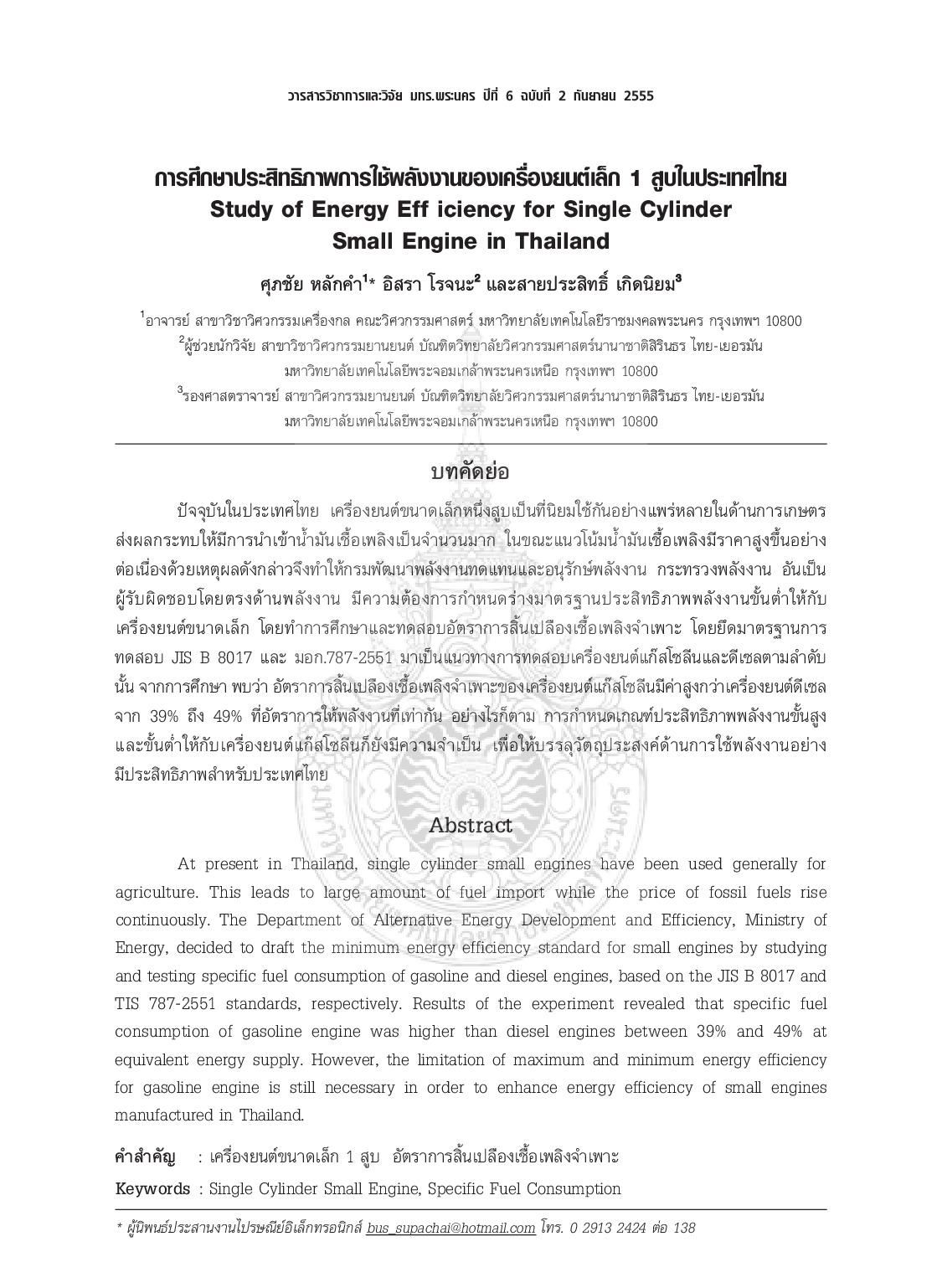
Study of Energy Efficiency for Single Cylinder Small Engine in Thailand
At present in Thailand single cylinder small engines have been used generally for agriculture. This leads to large amount of fuel import while the price of fossil fuels rise continuously. The Department of Alternative Energy Development and Eff iciency Ministry of Energy decided to draft the minimum energy eff iciency standard for small engines by studying and testing specif ic fuel consumption of gasoline and diesel engines based on the JIS B 8017 and TIS 787-2551 standards respectively. Results of the experiment revealed that specif ic fuel consumption of gasoline engine was higher than diesel engines between 39% and 49% at equivalent energy supply. However the limitation of maximum and minimum energy eff iciency for gasoline engine is still necessary in order to enhance energy eff iciency of small engines manufactured in Thailand
A Study of local identity of the lower northern of Thailand for graphic design on souvenir packaging
The Purpose of this research is to study about local identity in Lower Northern and product graphic design creation for local souvenir that leads to promotion in sales and promulgate in brand. The sample used in this research is entrepreneurs in the Lower Northern and customers or tourists by using cluster sampling method in 9 areas and accidental sampling in 3 weeks using 100 samples. Research tools have a 3 parts consisting of exploratory questionnaire for graphic design satisfaction questionnaire and efficiency performance evaluation. Data analysis is used by analysis frequency percentage and standard deviation. Process of research methodology consists of 1. Primary survey about identity attitude of Lower Northern 2. Analysis and conclude 3. Design and create graphic design 4. Satisfactory test 5. Efficiency performance of graphic design The results show that 1. The identity of Lower Northern should associate to religious place such as temple cathedral national park historical site occasion dialect language costume quotes and local souvenir. 2. The analysis of data about the relation of the most reminded Lower Northern place and the most participated place hasn’t correlative. For example “Tak Bart Tae Wo” tradition at Utaithani is the most participated needs but least memorized showing that special occasion has no relative or reminded to tourists but dimension and physical development do stick to them. 3. For upper northern area Graphic design pattern 2 is inspired from the “River Of Life”. 4. Efficiency form of lower north graphic design Overall is still well (Average 4.00). Overall of creation in color can tell and demonstrate to history of lower north and these can be applied for production design of souvenir is still well (Average 4.40). Next to below Pattern can communicate the local identity of lower north and dimension correlating to sight and restore form are still good (Average 3.80) At least Handiwork can tell and demonstrate to the identity of lower north (Average 3.60)