จำนวน Repository ( 255 )
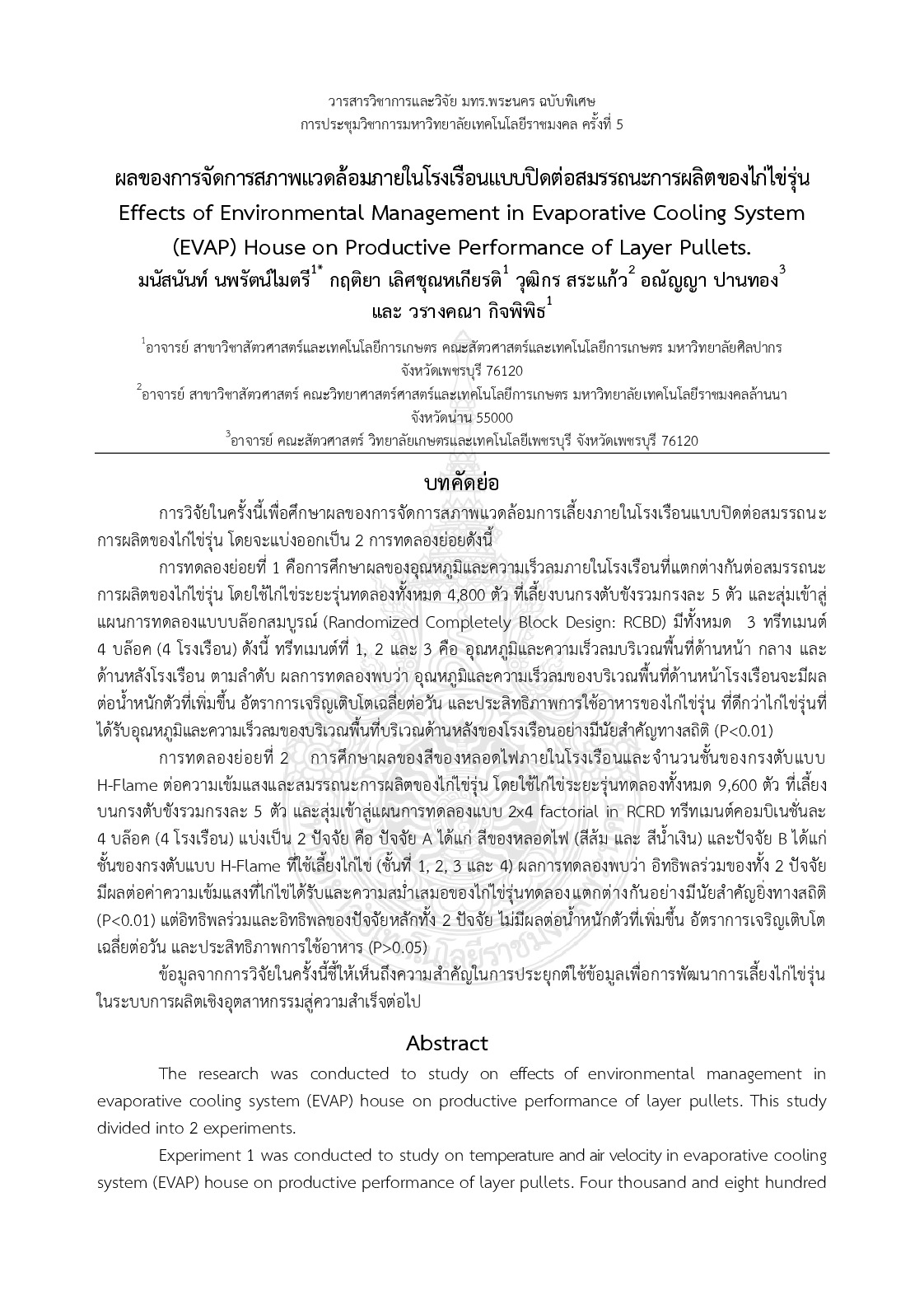
Effects of environmental management in evaporative cooling system (EVAP) house on productive performance of layer pullets
The research was conducted to study on effects of environmental management in evaporative cooling system (EVAP) house on productive performance of layer pullets. This study divided into 2 experiments. Experiment 1 was conducted to study on temperature and air velocity in evaporative cooling system (EVAP) house on productive performance of layer pullets. Four thousand and eight hundred layer pullets were raised on battery cage with 5 birds per cage and assigned in a Randomized Completely Block Design (RCBD) experiment with three treatments. Each treatment consisted of four blocks (four houses) and followed different temperature and air velocity in raising area of evaporative cooling system (EVAP) house as front area central area and back area. Results showed that temperature and air velocity in front area was grater body weight gain (BWG) average daily gain (ADG) and feed conversion ratio (FCR) of layer pullets than layer pullets were raised in back area of evaporative cooling system (EVAP) house (P<0.01) Experiment 2 was conducted to study on light color and number of H-Flame battery cage row in evaporative cooling system (EVAP) house on light intensity and productive performance of layer pullets. Nine thousand and six hundred layer pullets were raised on H-Flame battery cage with 5 birds per cage and assigned in a 2x4 factorial in Randomized Completely Block Design (RCBD) experiment with two factors. Factor A was light color comprised of range and blue). While Factor B was number of battery cage row comprised (first row second row third row and fourth row). Each treatment consisted of four blocks (four houses). Results showed that interaction between factor A and B on light intensity and uniformity of layer pullets with highly significantly different (P<0.01). However interaction between factor A and B and main effect (factor A and B) were investigated on body weight gain (BWG) average daily gain (ADG) and feed conversion ratio (FCR) (P>0.05). The data from this research was suggests the important for implicate to improve the egg production industry in further success.
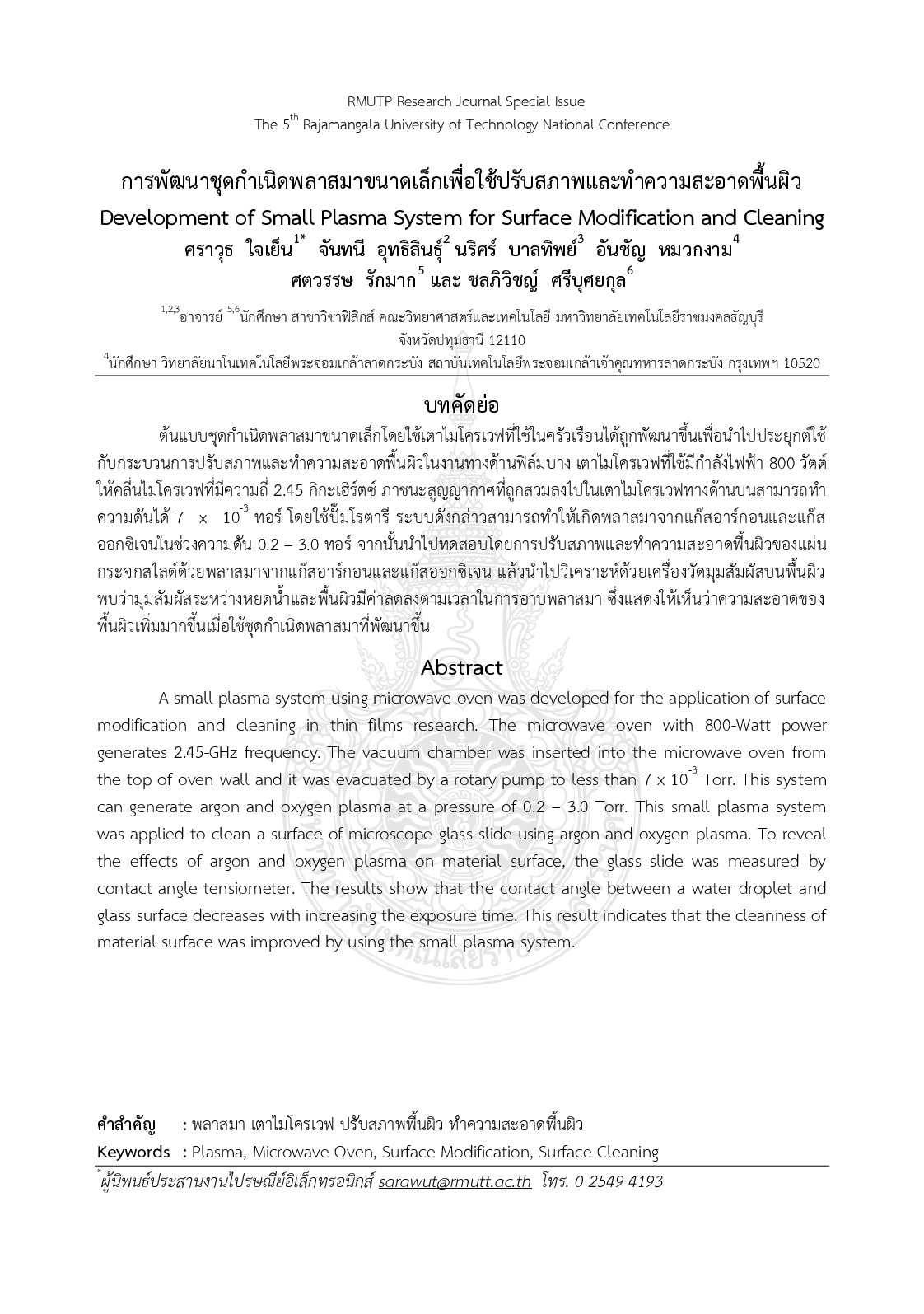
Development of small plasma system for surface modification and cleaning
A small plasma system using microwave oven was developed for the application of surface modification and cleaning in thin films research. The microwave oven with 800-Watt power generates 2.45-GHz frequency. The vacuum chamber was inserted into the microwave oven from the top of oven wall and it was evacuated by a rotary pump to less than 7 x 10⁻³ Torr. This system can generate argon and oxygen plasma at a pressure of 0.2 – 3.0 Torr. This small plasma system was applied to clean a surface of microscope glass slide using argon and oxygen plasma. To reveal the effects of argon and oxygen plasma on material surface the glass slide was measured by contact angle tensiometer. The results show that the contact angle between a water droplet and glass surface decreases with increasing the exposure time. This result indicates that the cleanness of material surface was improved by using the small plasma system.
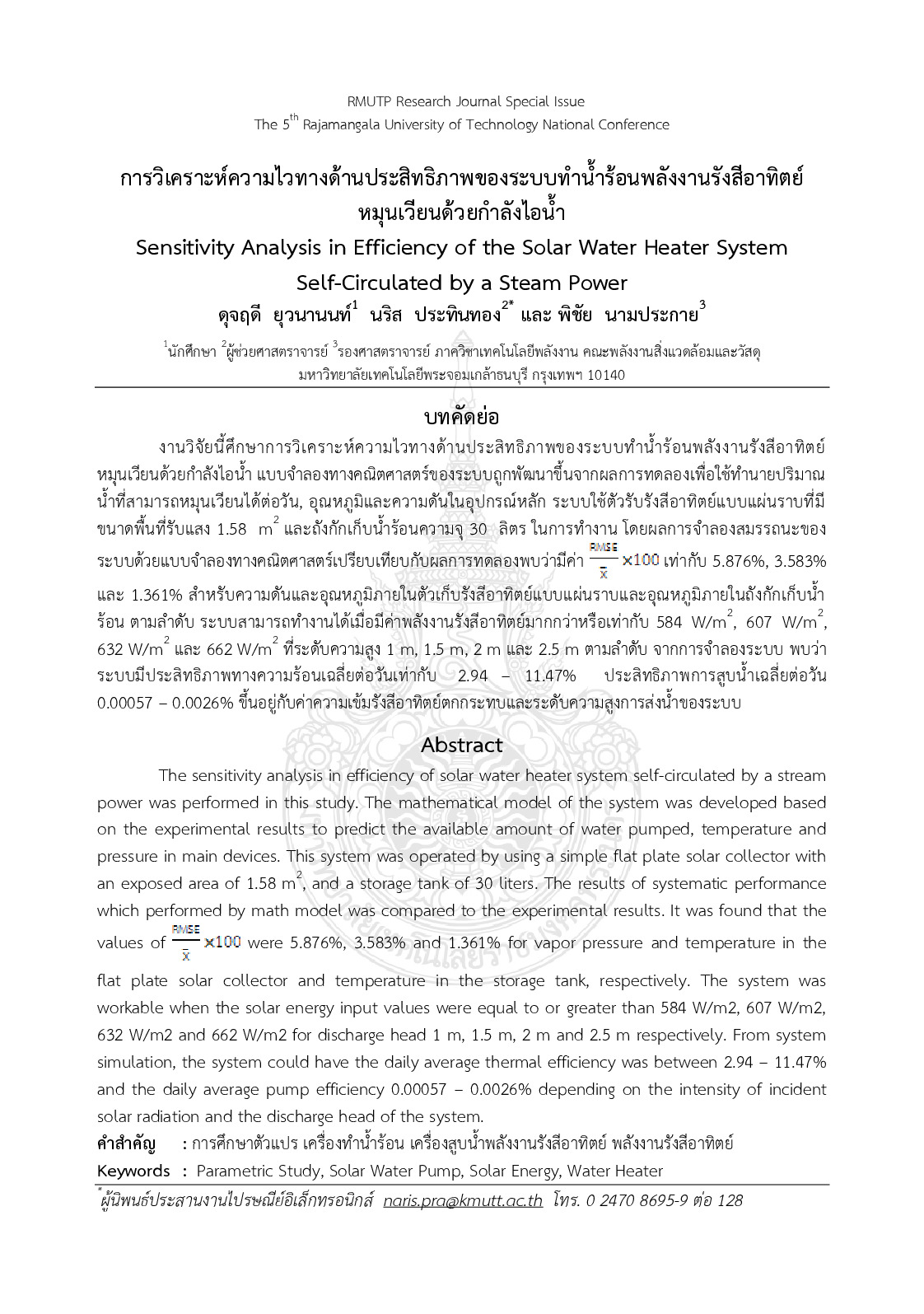
Sensitivity analysis in efficiency of the solar water heater system self-circulated by a steam power
The sensitivity analysis in efficiency of solar water heater system self-circulated by a stream power was performed in this study. The mathematical model of the system was developed based on the experimental results to predict the available amount of water pumped temperature and pressure in main devices. This system was operated by using a simple flat plate solar collector with an exposed area of 1.58 m2 and a storage tank of 30 liters. The results of systematic performance which performed by math model was compared to the experimental results. It was found that the values of were 5.876% 3.583% and 1.361% for vapor pressure and temperature in the flat plate solar collector and temperature in the storage tank respectively. The system was workable when the solar energy input values were equal to or greater than 584 W/m2 607 W/m2 632 W/m2 and 662 W/m2 for discharge head 1 m 1.5 m 2 m and 2.5 m respectively. From system simulation the system could have the daily average thermal efficiency was between 2.94 – 11.47% and the daily average pump efficiency 0.00057 – 0.0026% depending on the intensity of incident solar radiation and the discharge head of the system.
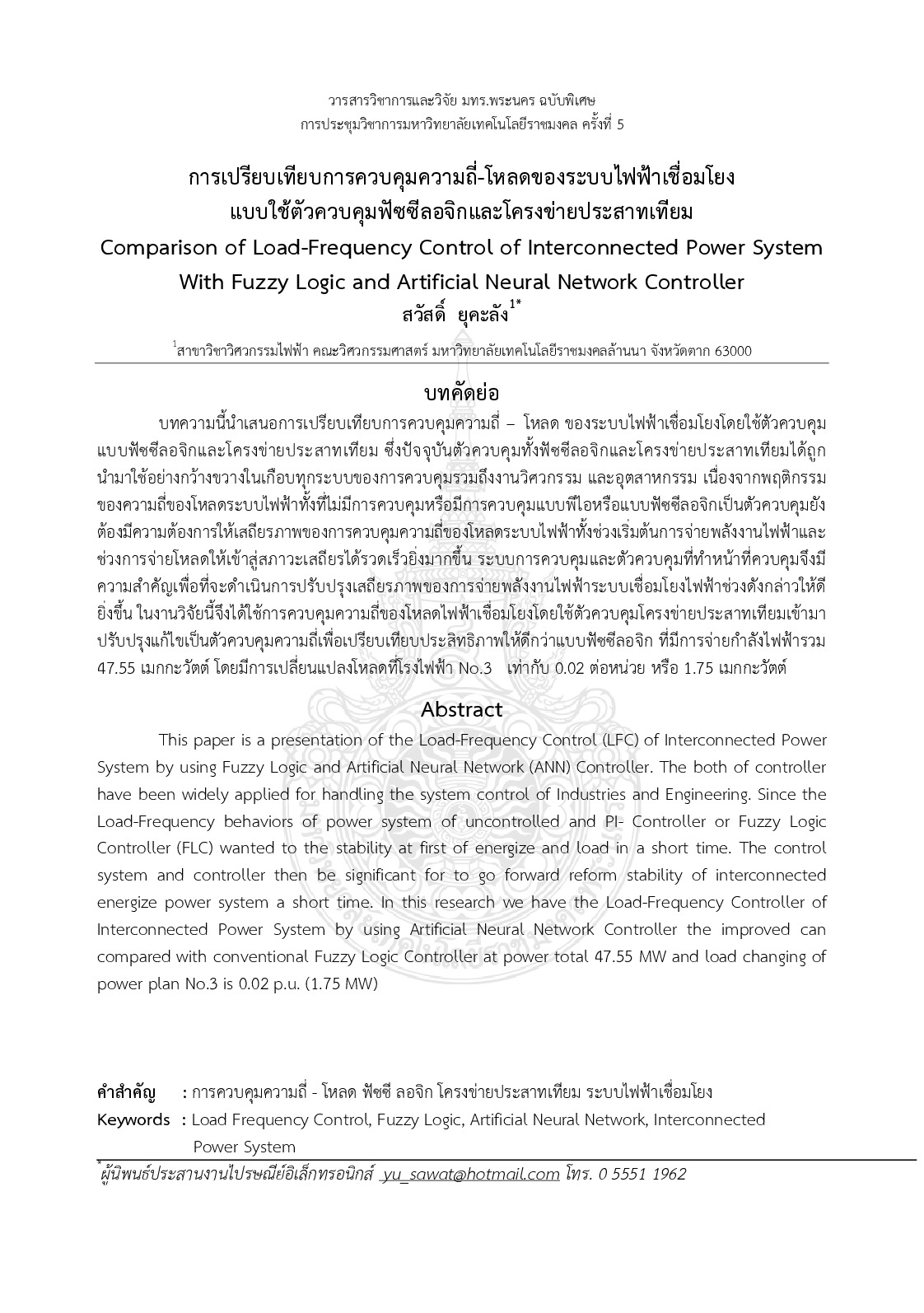
Comparison of load-frequency control of interconnected power system with fuzzy logic and artificial neural Network controller
This paper is a presentation of the Load-Frequency Control (LFC) of Interconnected Power System by using Fuzzy Logic and Artificial Neural Network (ANN) Controller. The both of controller have been widely applied for handling the system control of Industries and Engineering. Since the Load-Frequency behaviors of power system of uncontrolled and PI- Controller or Fuzzy Logic Controller (FLC) wanted to the stability at first of energize and load in a short time. The control system and controller then be significant for to go forward reform stability of interconnected energize power system a short time. In this research we have the Load-Frequency Controller of Interconnected Power System by using Artificial Neural Network Controller the improved can compared with conventional Fuzzy Logic Controller at power total 47.55 MW and load changing of power plan No.3 is 0.02 p.u. (1.75 MW)
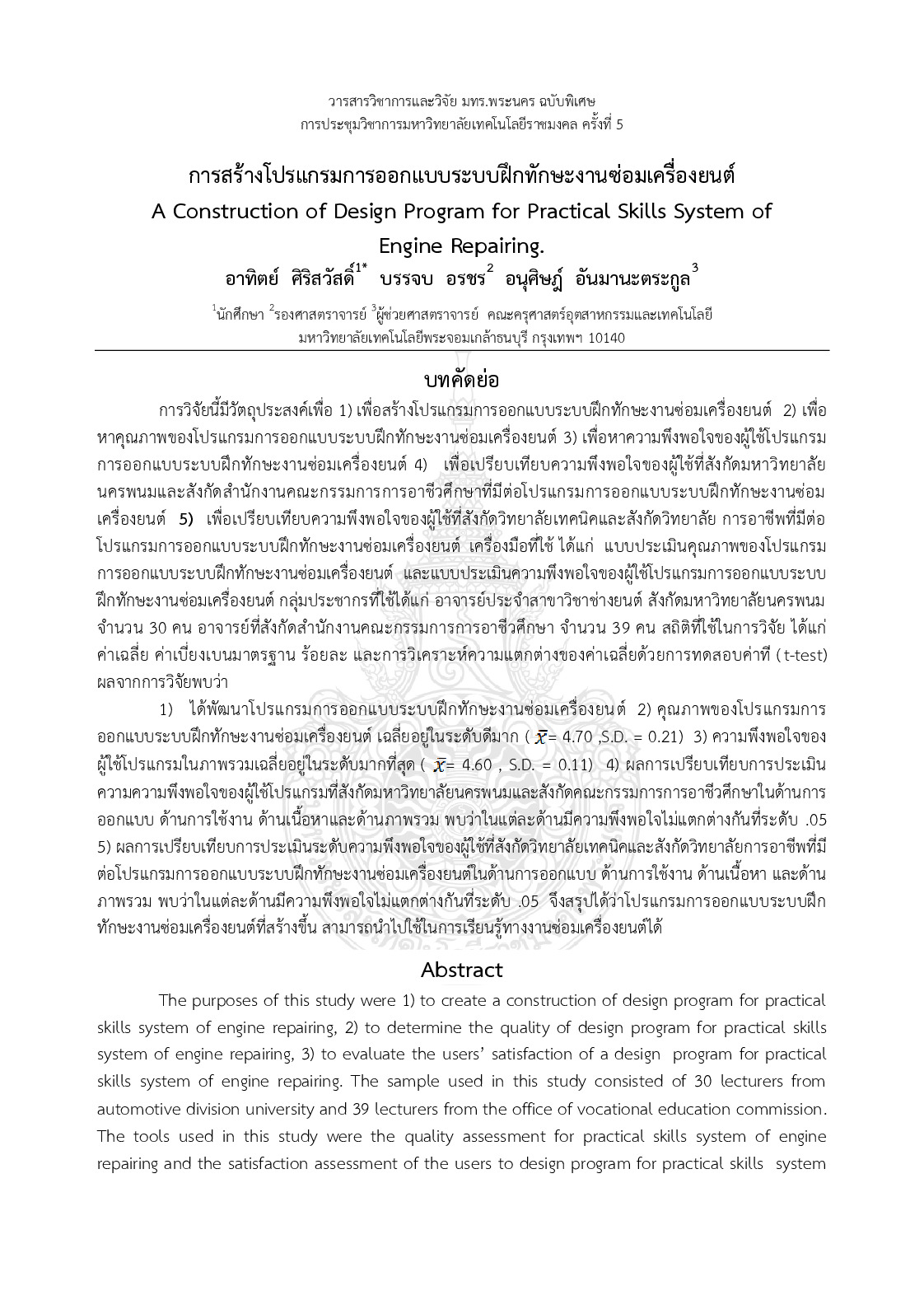
A construction of design program for practical skills system of engine repairing.
The purposes of this study were 1) to create a construction of design program for practical skills system of engine repairing 2) to determine the quality of design program for practical skills system of engine repairing 3) to evaluate the users’ satisfaction of a design program for practical skills system of engine repairing. The sample used in this study consisted of 30 lecturers from automotive division university and 39 lecturers from the office of vocational education commission. The tools used in this study were the quality assessment for practical skills system of engine repairing and the satisfaction assessment of the users to design program for practical skills system of engine repairing. The statistics used for data analysis were percentage mean standard deviation and t-test for dependent samples. The results of the study were as follows: 1) the quality of were very good level design program of for practical skills system of engine repairing( = 4.70 S.D. = 0.21). 2) User’s satisfaction level after accessing the program were very good level ( = 4.60 S.D. = 0.11). 3) The results were compared to assess the satisfaction level of the user from Nakhonphanom university and the office of vocational education commission towards of design program for practical skills system of engine repairing in the field of design content and application found that in each of the satisfaction level did not differ significantly at .05 level. 4) The results were compared to assess the satisfaction level of industrial community education and technical college towards of design program for practical skills system of engine repairing in the field of design content and the application found that in each of the satisfaction level did not difference at significance level .05