จำนวน Repository ( 1852 )

ความสัมพันธ์เชิงอำนาจระหว่างนักศึกษารุ่นพี่รุ่นน้องของคณะอุตสาหกรรมสิ่งทอและออกแบบแฟชั่น มหาวิทยาลัยเทคโนโลยีราชมงคลพระนคร
Senior and junior systems of each field of study In the Faculty of Textile and Fashion Design The seniors take care of the juniors into the hierarchy of the year. The second year students will conduct the new recruiting activities while the 3rd and 4th year seniors will have the duty to take care of them again. By the style of welcoming new students in each field of study It has a similar style: introducing itself to the juniors looking for the signature pattern the seniors holding the code line singing the format of welcoming the new juniors. Held by the Student Affairs Department It is in accordance with the new welcome activities organized by the university. In which recreation activities are organized under the facade without disconnecting disciplines As a whole group of activities Comments on activities to welcome freshmen I want to change activities every year With duplicate activities Guidelines for solving problems of non-creative recruiting Write a plan to organize a recruiting activity to the Student Affairs Department for consideration.
ความต้องการเปิดหลักสูตรปริญญาโท สาขารัฐประศาสนาศาสตร์ คณะศิลปศาสตร์ มหาวิทยาลัยเทคโนโลยีราชมงคลพระนคร
The objective of the study was to investigate the training needs of the general public and entrepreneurs including those who worked in professional services in Bangkok and suburbs such as Nonthaburi Samutprakan and Pathumthani that operated in workplace.The method used in this study was using questionnaire to gather information about meetings on various occasions.The participants and the sample were general public and entrepreneurs in the Bangkok and suburb areas. The sample of respondents was selected by random sampling consisting of 400 respondents.The instrument used for data collection was questionnaire related to short training courses. This questionnaire contains five parts as follows: Part 1-general information of respondents; Part 2-needs for short training of general public; Part 3-other interesting topics; Part 4- obstacles and problems for those who did not receive short training; Part 5-recommendations. The analyzed data were calculated by using descriptive statistics: percentage mean standard deviation. The results in the study can be summarized as follows: 1. Most of respondents were female whose age was over than 50 years old. Their education level was lower than bachelor’s degree. They worked as general officers with at least five years working experience. 2. The respondents reported their needs for short-training requirements provided by Rajamangala University of Technology Phra Nakhon. The questions asking the training program requirements include 24 items with 5 rating scales: 1. The least 2. Less 3. Moderate 4. High and 5. The highest. The results show that most respondents needed to participate in short-training programs especially in the highest need on item 3.4 Research and the Development of the Community Innovation (x̄ = 4.7649). The results also report that most respondents were highly interested in participating short training program on 21 categories for example Item 1.6 Innovative Social Science Research Methodologies (44.6%) Item 1.1 The Development of Managing International Culinary Training (34.1%) Item 3.3 Knowledge Management in Community of Practice (31.4%) and Item 3.5 Multidisciplinary Community Development. The results of the study reveal that the respondents with moderately needs were interested in Item 2.5 ASEAN Languages for communication (21.1%) The data analysis of readiness show that the faculty of arts Rajamangala University of Technology Phra Nakhon was capable of organizing these short-training programs on various topics so as to promote learning and to develop a guideline on academic service for society effectively and to prepare the readiness of places staff experts learning resources as well as collaboration network.

ปัจจัยด้านอุปสงค์ของผู้บริโภคที่มีต่อการตัดสินใจลงทุนในธุรกิจฟู้ดทรัค (food truck) กรณีศึกษา : เขตห้วยขวาง จตุจักร และลาดพร้าว
This research aimed to study consumer demand for food truck consumption decisions and to study food truck investment guidelines a case study: Huai Khwang Chatuchak and Lat Phrao. of 400 persons was a questionnaire. The statistics used were frequency percentage standard deviation. t-test F-test และ Chi-Square (𝑥2) The study found that Most of the consumers are female aged 21-30 years with a bachelors degree. Occupation student / student The cost of using the service per time 101-500 baht frequency for using the service 2-3 times / week The results of the study of consumer demand factors in making decisions on food truck consumption were found that the overall level was at a high level which was found to be the most cost factor. (𝑥̅ = 4.36) Followed by economic factors (𝑥̅ = 4.35) The results of the relationship between demographic factors and food truck service behavior in Bangkok showed that age affected the behavior of choosing to use food trucks in terms of expenses. Times you use food truck service And the frequency of using food truck service The status affects the behavior of choosing to use the food truck service on the cost of each time you use the food truck service. The educational level influenced the behavior of choosing to use the food truck service in terms of the cost of each service used and the frequency of using the service. Occupations affect the behavior of choosing to use food trucks as well as the costs of each time using food trucks. And information sources that affect the decision to use the food truck service Occupational income affects the behavior of choosing to use food truck services on the expenses of each time using food truck services. And the frequency of using food truck service Statistically significant at the 0.05 level.
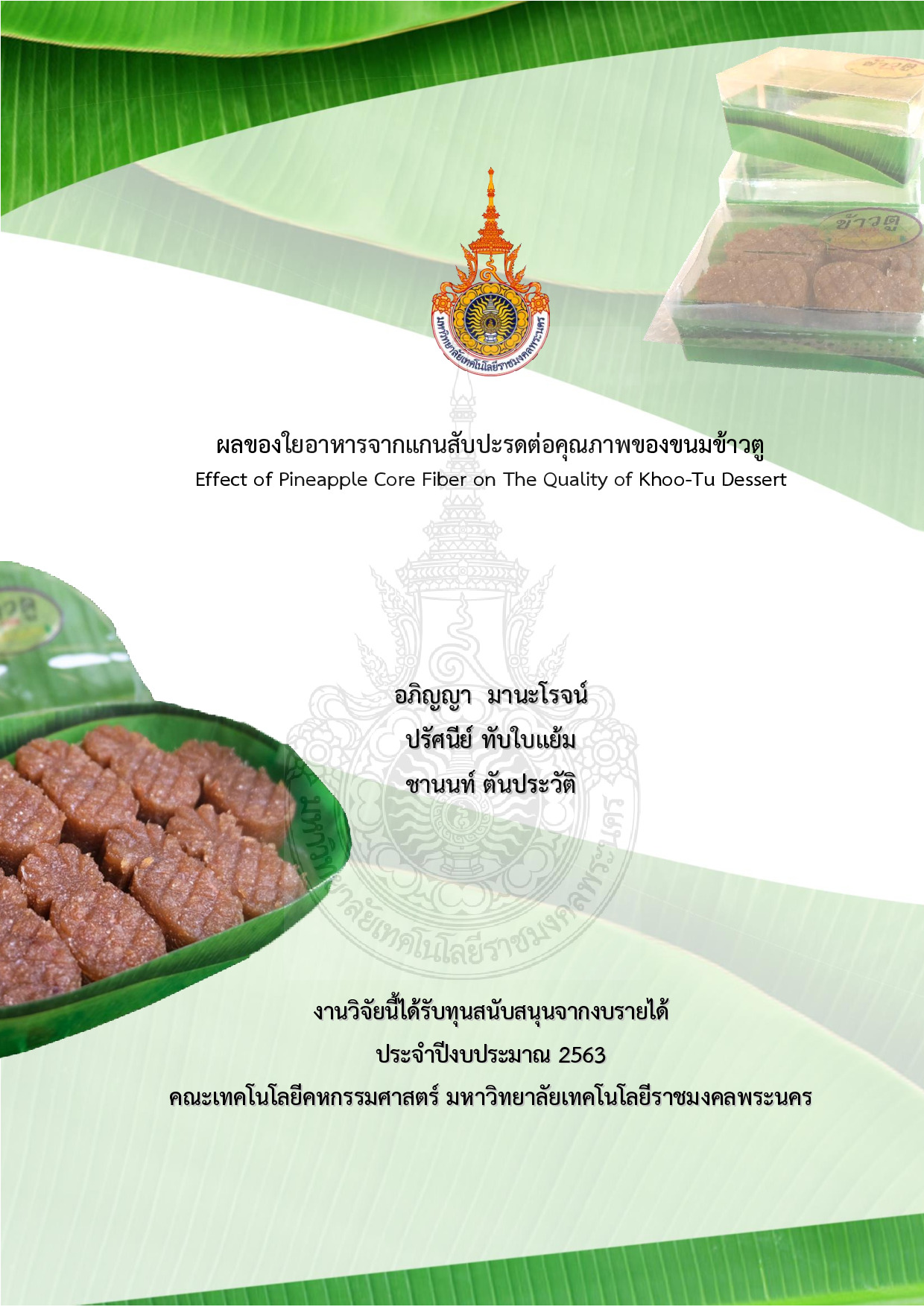
ผลของใยอาหารจากแกนสับปะรดต่อคุณภาพของขนมข้าวตู
These research objectives are to study the basic formulas of Khoo-Tu dessert (dried rice balls made from rice and coconut) and to study the volume of pineapple cores instead of coconut in Khoo-Tu. The test of Khoo-Tu dessert basic formulas by 9 - point hedonic scale method of 50 examiner laboratory the results show acceptance rated on a moderate scale (7). After that substituting coconut with pineapple core the amount of 0 25 50 75 and 100 of the weight coconuts.It was found that at 75% of the substitution level the tasters evaluated the greatest acceptance (p> 0.05). The basic formulas had a pH of 6.24 the Pineapple core formulas 5.94 (p> 0.05). Water Activity (aw)of Khoo-Tu the basic formula was 0.85 and the pineapple core formula was 0.90 (p> 0.05). The color value of the pineapple core Khoo-Tu was L * (brightness value) (37.31) b * (yellowness value) (9.45) rather than the basic formula Khoo-Tu (p> 0.05). The nutritional value of the pineapple core Khoo-Tu was 316 Kcals protein 2.71 % fat 8.86 % ash 0.52 % carbohydrates 56.3 % dietary fiber 3.99 % insoluble fiber 3.60 % and 0.39% of water-soluble dietary fiber that was found in the pineapple core Khoo-Tu to provide lower nutritional value than basic formula Khoo-Tu. The microbiological quality of basic formula and pineapple core formula was found that the total variable count fungi and bacillus serous were less than 10 colonies / 1 g sample and staphylococcus aurias were not found in both samples. The shelf life of rice (Room temperature) found that the basic recipe was 12 days and the pineapple core recipe It has a shelf life of 6 days. At chilled temperature (4 degrees Celsius) it was found that the basic formula and pineapple core formula had a shelf life of 25 days with all microorganisms less than 1 x 10⁴ colonies/sample 1 gram fungus less than 100 colonies /1 gram sample and All microorganisms and fungi exceeded the standard on the 28th day.
ความรู้ทางการเงินต่อการยอมรับความเสี่ยง : ความรู้ทางการเงินและระดับการยอมรับความเสี่ยง
As Financial Knowledge based on Financial Risk Taking: The effects of financial literacy on risk tolerance has been concerned the objectives of this study are to compare levels of perceived risk and levels of financial literacy between two groups which are one who are likely to be good at financial literacy and one who do not and to analyze these linear relationships. This study is a survey research which the research methodology is mixed method. The qualitative data were collected from in-dept interview questionnaire while the quantitative data were also collected from online survey questionnaire. The population is students who enrolled in Bachelor of Business Administration in two main groups which are one who do and do not have financial literacy. The sample is students who enrolled in Department of Finance which represent one who have financial literacy and students who enrolled in Department of Information Technology which represent one who do not have financial literacy. The selection method of the sample is a purposive sampling method which surveyed fundamental financial knowledge financial behavior and perceived risk. The survey method used online survey and constructed in-depth interview. The sample were divided into three groups according to their perceived risks which are risk lovers risk neutral and risk averse. The hypothesis of this study is that there are differences between financial knowledge between sample who assessed their perceived risk themselves and who did them using a survey assessment. The results can be concluded that the population mean between two independent samples is statistically significant at level of 0.10 significance and the population mean between two groups of different methods of perceived risks is statistically significant of differences between those two means at 0.01 significance. Moreover the linear relationship which is correlation of financial literacy and perceived risk self-assessment is 0.175 (0.013) while one which is of financial literacy and perceived risk assessed by a survey is 0.160 (0.023). Thus these hypotheses are statistically significant. The suggestions are 1)financial curriculum should take a course of risk and risk management 2)investors who do not have good in financial knowledge should concern more about their investment including risk 3) investment consultant should assess the risk and perceived risk of consultee and let them know about the risks before making a investment decision 4)government should promote financial knowledge of financial planning cash management and investment allocation and risk diversification.