จำนวน Repository ( 1852 )
การประเมินผลกระทบของแรงดันไฟฟ้าเกินในระบบส่งจ่ายไฟฟ้า
Electricity Generating Authority of Thailand (EGAT) encountered problems voltage swell from the changes of power system configuration high-voltage 115 kV substation name Lopburi2 to radial. Control Center closed capacitor bank caused the steel industry electric power plants and renewable energy solar tripped themselves out. As a result EGAT loosed of power produced of solar power plants. It also affected confidence in the systems power consumption. EGAT’s necessary to learn from this event. This research was simulation power system modeling of “High Voltage Substation Lopburi2” and grid connection both the system EGAT and PEA with EMTDC-PSCAD for analysis of the voltage swell caused by close capacitor bank at “Lopburi2” substation compared with actual events then calculated the voltage swell occurred at high voltage station linkage. Finally this research presents a method of reduction of their impact of close capacitor bank at “Loburi2” to avoid the voltage swell in the future.
การประเมินผลกระทบของการลัดวงจรในระบบจำหน่ายไฟฟ้าที่มีต่ออุปกรณ์วิกฤต
This research presents the studying of short circuit in distribution system that affect to critical equipment voltage sag and overvoltage while short circuit event. Lead into the quality of electric user. Effect on economics damaged Distribution system voltage level 22kV of The Provincial Electricity Authority. It is the analysis model by computer program. The event of short circuit set in a many distribution systems. The analysis result Magnitude of voltage while short circuit bring to assessment voltage sag and overvoltage from average voltage of the repeat event. Then set boundary of voltage at load point in a many. The experiment shows the problem of the quality of electric be affect to critical equipment less than load point close connection with substation.
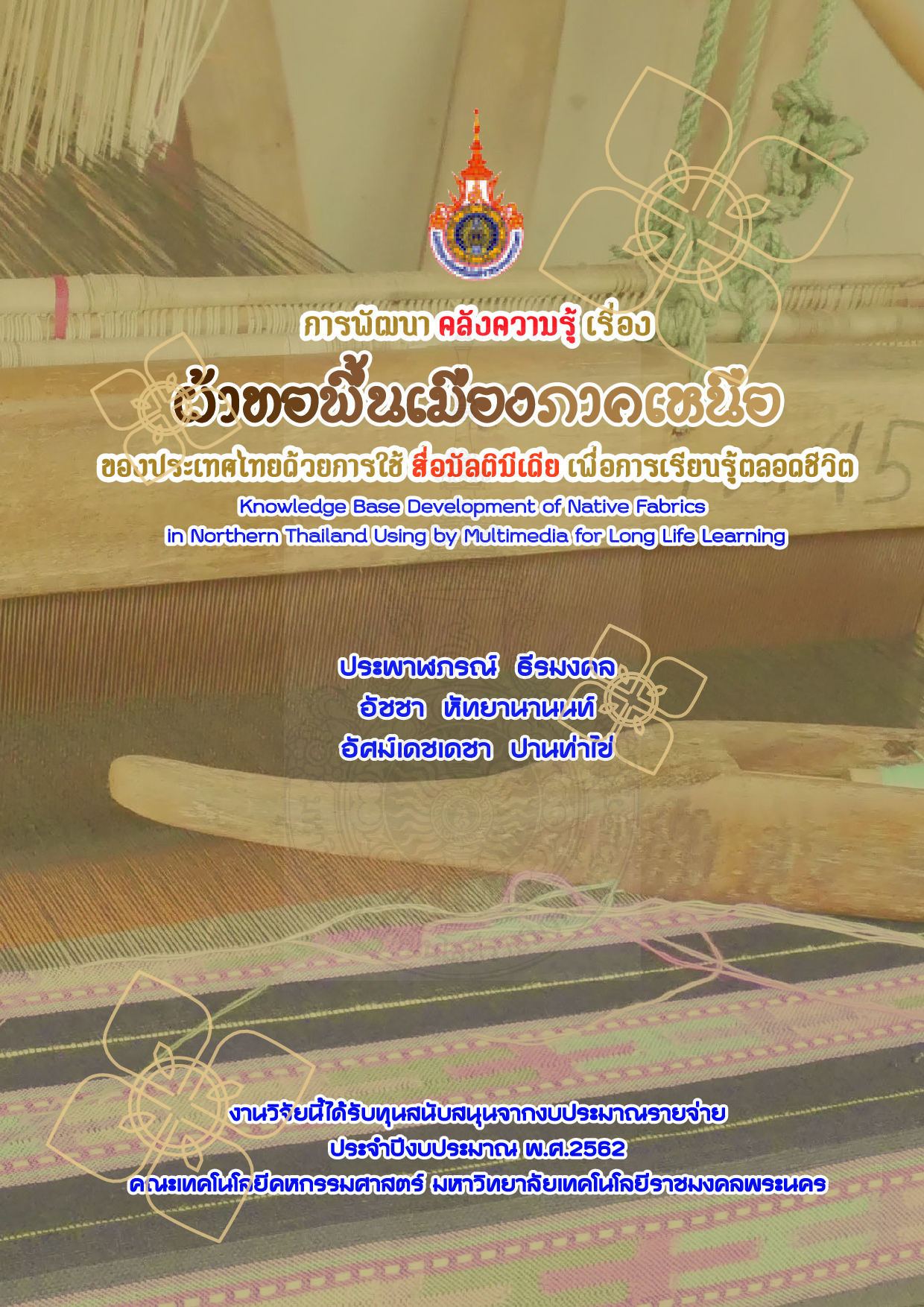
การพัฒนาคลังความรู้เรื่องผ้าทอพื้นเมืองภาคเหนือของ ประเทศไทยด้วย การใช้สื่อมัลติมีเดียเพื่อการเรียนรู้ตลอดชีวิต
This research is the development of the knowledge base on local textiles of northern Thailand by using multimedia for lifelong learning. The aim is to study compile and gather information of local cloths in northern Thailand. Develop a knowledge base by using multimedia on the local textiles of northern Thailand for lifelong learning and transferring knowledge and disseminating the knowledge base on northern Thai fabric by using multimedia for lifelong learning to the community. The research team proceeded to gather primary knowledge from the roots of the researchers who are interested in the local woven fabric. Therefore proceeding further knowledge in the upper reaches from literature reviews Including from field trips for data collection through in-depth interviews with important people Interviewing people who have knowledge about social context community local weaving characteristics weaving characteristics name of pattern type of fabric weaving technique of local textiles in northern Thailand in 9 provinces as well as studying primary data from textbooks textbooks and technical documents and in the internet. Thus the research shown that into 3 parts which are 1. Ethnic groups of Northern Thailand 2. Local woven fabric in northern Thailand and 3. Woven process and pattern. After that the knowledge library was developed by using multimedia on the local textiles of Northern Thailand for lifelong learning. This research can summarize the results in the form of a written description showing that the northern region of Thailand in the past was the Lanna Kingdom area. In the area of Xishuangbanna Before moving to the north of Thailand including the Tai Lue Tai Kheen Thai people Tai Yai people Meng (Mon) Lua people villages scattered throughout the highlands of the Lanna region such as Karen (Pak Kahen M) Mien (Yao) Hmong (Meo) Akha (Akha) Lahu (Mso) Lisu. In addition there are some groups in the Lanna fringe such as Khmu Labri (Tong Lueang). Each ethnic group has its own unique style especially Common skirt Has the same basis with the resin head the resin body and the resin tip but each part is not woven differently Have different colors Some ethnicities have a section called Lep which is the part that the weaver often weaves to keep the thread as for knowledge transfer. The research created a book Local woven cloth consists of videos from local knowledge sources and digital documents and to make the transfer of knowledge more complete Therefore held a forum and exhibition on the topic primary fabric of Lanna Kingdom as a medium for those interested in Local woven fabrics in the Lanna Kingdom of Thailand attended. Exchange ideas from various sources of knowledge from the research. While also receiving multimedia for lifelong learning from the inquiry regarding the satisfaction of the participants. The Keynote speakers are interesting and event condition caused the interest in the knowledge content that used to organize the exhibition. Overall the work is most satisfied.
การพัฒนาศักยภาพสับปะรดตกเกรด ในผลิตภัณฑ์ซอสสำเร็จรูป
The objective of this research is to study the suitable production process in the production of Pad Thai sauce Crispy rice noodle sauce (Mee krob) and three mixed flavors sauce (Sam-rod) by using pineapples juice as the main ingredient. To study the quality of this finished three sauce products from pineapples. And to study the consumer test of pineapple sauce products. The results of the development of a suitable recipe for Pad Thai sauce production. From the evaluation of the sensory quality of Pad Thai sauce (9 points Hedonic scale). It was found that panelist accepted the appropriate amount of pineapple juice in the production of Pad Thai sauce at 30 % in all attributes in terms of appearance color smell taste texture and overall liking with an average score of 8.08 7.83 7.93 8.15 8.05 and 8.13 respectively which was at a high level of preference. Sensory evaluation of crispy rice noodle it was found that 75% of pineapples accepted for the source production in terms of appearance color smell taste texture and overall liking. With an average score of 7.89 7.79 7.88 8.03 7.98 and 7.93 respectively which are in the high level. Sensory evaluation of three mixed flavor sauce. It was found that panelist accepted 100 % pineapple sauce using pineapple juice in terms of appearance color aroma taste texture and overall liking. With an average score of 8.35 8.04 8.25 8.22 8.15 and 8.24 respectively which is in the high level. The results of the study of the quality of Pad Thai sauce crispy rice noodle sauce and mixed three flavors sauce that use pineapple juice as the main ingredient found that increasing the amount of pineapple juice affects the pH value of the products. All 3 types of sauce with the pH value are in the acid range. The microbial quality of all 3 types of sauces has passed the standard of community product standards set by the Ministry of Industry. The results of the consumer test on pineapple sauce products. The majority of consumers are female. Most of them are between 19-29 years old and in the age of 40-49 years. In education the majority of consumers had a bachelors degree. Regarding marital status most of the respondents are married. In a career most of them have a daily occupation and government service/state enterprise. Most of the income of the consumer is less than 20000 baht. Consumers like the characteristics of 3 types of instant pineapples sauce products at the most like to most level. And most consumers are accepting all 3 types of pineapples sauce. If available most consumers buy because of the ease of use/ reduction of the process. The price of 3 kinds of ready-made sauce products from pineapples accepted by consumers at the price of 50 baht/bottle.
การใช้ผงข้าวโอ๊ตทดแทนแป้งสาลีบางส่วนในผลิตภัณฑ์คุกกี้ธัญพืช
The research about the development of Whole Grain cookie product aims to study about the amount of oat power that can be used instead of wheat flour in Whole Grain cookie product in order to study about the nutrition of the cookie product from oat power and the acceptance of the customer about the Whole Grain cookie product by having 40 testers which are students in faculty of technology home economics Rajamangala University of Technology Phra Nakhon. There are 5- ponit hedonic scale questionnaire. The comparison of the average uses Duncan’s New Multiple Range Test (DMRT) The tasting result found that the amount of oat power that has been used instead of wheat flour 100 percent has the most acceptances. When study about the nutrition of the Whole Grain cookie products from oat powder found that it found that they provide 68.64 Kcal carbohydrate 5.20 grams protein 1.48 grams and fats 5.33 grams. Then study more about the acceptance of Whole Grain products from oat powder. It found that the customers were satisfied with Whole Grain product from oat powder at good level and the customers accept the products from oat powder about 97.5 percent.