จำนวน Repository ( 170 )
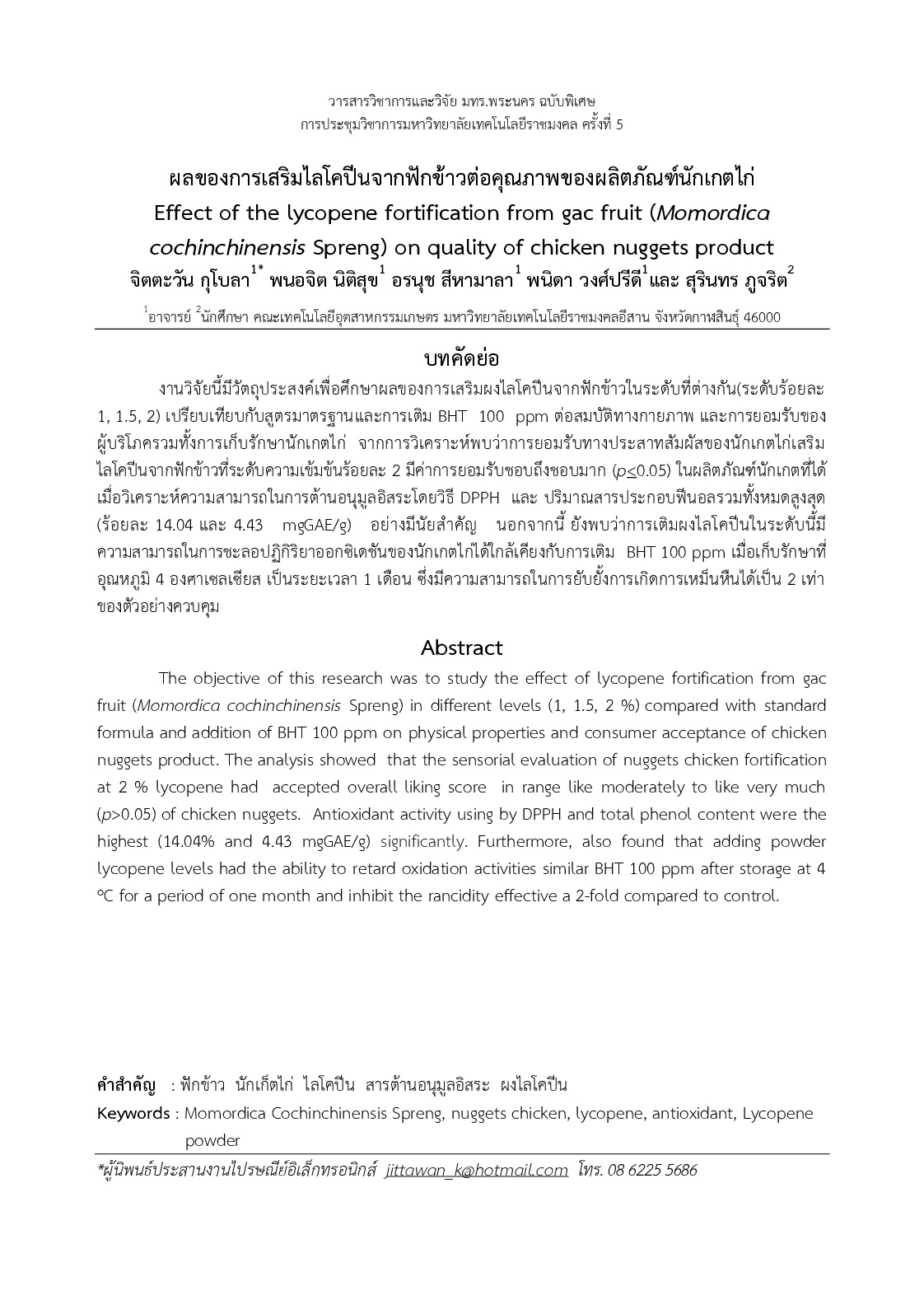
Effect of the lycopene fortification from gac fruit (momordica cochinchinensis spreng) on quality of chicken nuggets product
The objective of this research was to study the effect of lycopene fortification from gac fruit (Momordica cochinchinensis Spreng) in different levels (1 1.5 2 %) compared with standard formula and addition of BHT 100 ppm on physical properties and consumer acceptance of chicken nuggets product. The analysis showed that the sensorial evaluation of nuggets chicken fortification at 2 % lycopene had accepted overall liking score in range like moderately to like very much (p>0.05) of chicken nuggets. Antioxidant activity using by DPPH and total phenol content were the highest (14.04% and 4.43 mgGAE/g) significantly. Furthermore also found that adding powder lycopene levels had the ability to retard oxidation activities similar BHT 100 ppm after storage at 4 C for a period of one month and inhibit the rancidity effective a 2-fold compared to control.
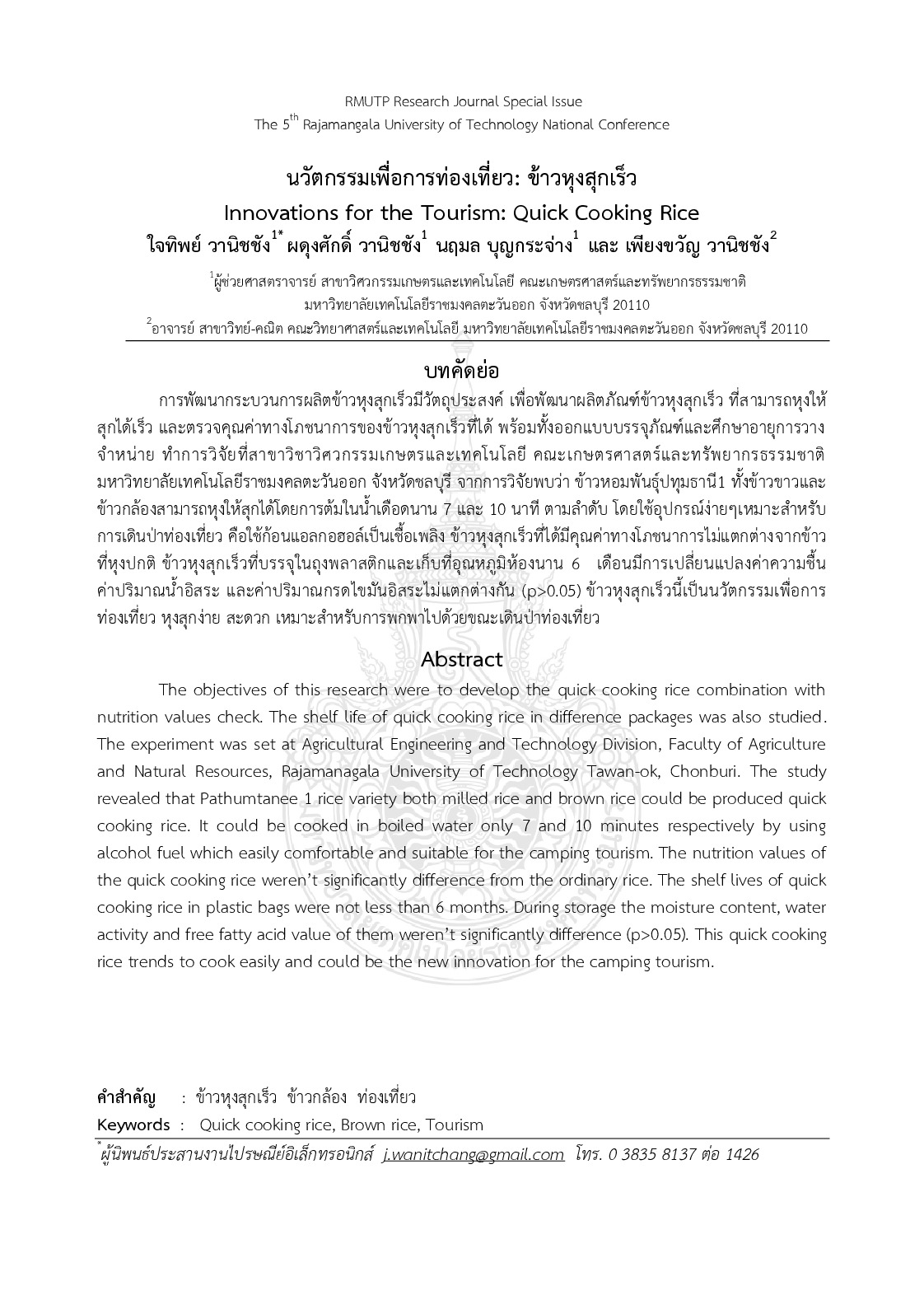
Innovations for the tourism: quick cooking rice
The objectives of this research were to develop the quick cooking rice combination with nutrition values check. The shelf life of quick cooking rice in difference packages was also studied. The experiment was set at Agricultural Engineering and Technology Division Faculty of Agriculture and Natural Resources Rajamanagala University of Technology Tawan-ok Chonburi. The study revealed that Pathumtanee 1 rice variety both milled rice and brown rice could be produced quick cooking rice. It could be cooked in boiled water only 7 and 10 minutes respectively by using alcohol fuel which easily comfortable and suitable for the camping tourism. The nutrition values of the quick cooking rice weren’t significantly difference from the ordinary rice. The shelf lives of quick cooking rice in plastic bags were not less than 6 months. During storage the moisture content water activity and free fatty acid value of them weren’t significantly difference (p>0.05). This quick cooking rice trends to cook easily and could be the new innovation for the camping tourism.
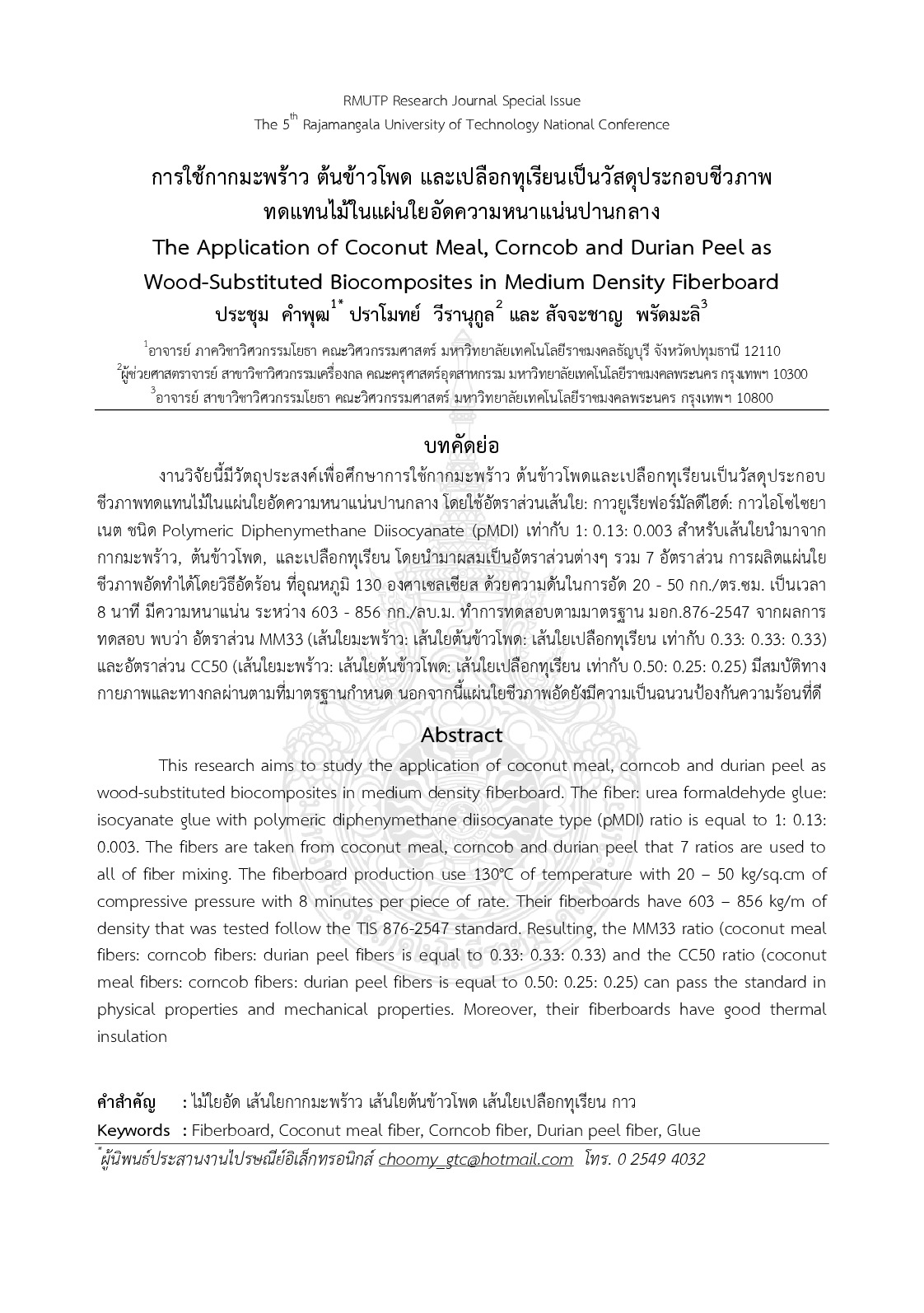
The application of coconut meal, corncob and durian peel as wood-substituted biocomposites in medium density fiberboard
This research aims to study the application of coconut meal corncob and durian peel as wood-substituted biocomposites in medium density fiberboard. The fiber: urea formaldehyde glue: isocyanate glue with polymeric diphenymethane diisocyanate type (pMDI) ratio is equal to 1: 0.13: 0.003. The fibers are taken from coconut meal corncob and durian peel that 7 ratios are used to all of fiber mixing. The fiberboard production use 130?C of temperature with 20 – 50 kg/sq.cm of compressive pressure with 8 minutes per piece of rate. Their fiberboards have 603 – 856 kg/m of density that was tested follow the TIS 876-2547 standard. Resulting the MM33 ratio (coconut meal fibers: corncob fibers: durian peel fibers is equal to 0.33: 0.33: 0.33) and the CC50 ratio (coconut meal fibers: corncob fibers: durian peel fibers is equal to 0.50: 0.25: 0.25) can pass the standard in physical properties and mechanical properties. Moreover their fiberboards have good thermal insulation

Study on the correlation between the degree of milling on quality of rice
The objectives of this research were to find the correlation between the milling degree and the milling quality of rice which was the basic data to investigate the milling degree equipment. Chainat 1 and KDML 105 rice varieties were milled at difference degree of milling (DOM) which calculated from bran removed. The study revealed that as the DOM increase the milled rice and head rice decreases. Therefore the whiteness transparency and milling degree of milled rice which was measured from Milling Meter also increased. When the DOM increased the whiteness transparency and milling degree also increased. The DOM had highly correlation not only to milled rice and bran but also to milling degree from Milling Meter at R2=0.99 and R2=0.97. So these correlations could be used to investigate the milling degree equipment.
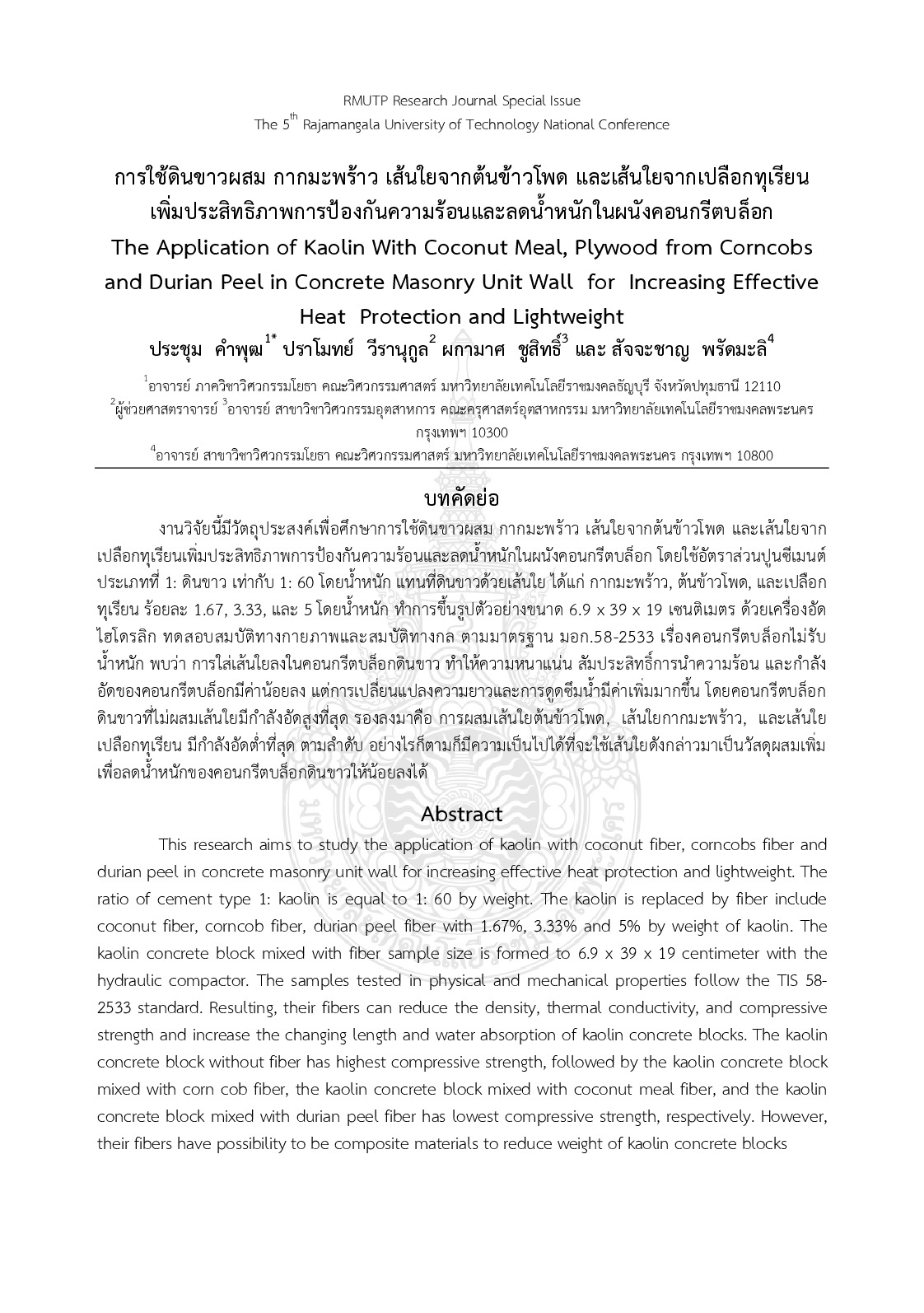
The application of kaolin with coconut meal, plywood from corncobs and durian peel in concrete masonry unit wall for increasing effective heat protection and lightweight
This research aims to study the application of kaolin with coconut fiber corncobs fiber and durian peel in concrete masonry unit wall for increasing effective heat protection and lightweight. The ratio of cement type 1: kaolin is equal to 1: 60 by weight. The kaolin is replaced by fiber include coconut fiber corncob fiber durian peel fiber with 1.67% 3.33% and 5% by weight of kaolin. The kaolin concrete block mixed with fiber sample size is formed to 6.9 x 39 x 19 centimeter with the hydraulic compactor. The samples tested in physical and mechanical properties follow the TIS 58-2533 standard. Resulting their fibers can reduce the density thermal conductivity and compressive strength and increase the changing length and water absorption of kaolin concrete blocks. The kaolin concrete block without fiber has highest compressive strength followed by the kaolin concrete block mixed with corn cob fiber the kaolin concrete block mixed with coconut meal fiber and the kaolin concrete block mixed with durian peel fiber has lowest compressive strength respectively. However their fibers have possibility to be composite materials to reduce weight of kaolin concrete blocks