จำนวน Repository ( 182 )
Manpower demand and characteristics of software personnel in Thailand
The objectives of this research are to study manpower demand characteristics of software personnel and the development trend of software industry. Both quantitative and qualitative approaches are applied by using questionnaire and in-depth interview for data collection. The research sample is 85 software industries. Descriptive and inference statistics are used; frequency percentage arithmetic mean and standard deviation The results showed that many of software personnel in software industry who operate in the position of Programmer/Software Developer/Tester. In the year 2011 and 2012 the software industry require software personnel in the position of Software Engineer and Graphic Designer the most. In addition the required qualification of such software personnel in the year 2011-2015 is the person with bachelor degree and experienced. Features of the software personnel who the software industry recognizes the importance of the top three include knowledge moral and ethics and relations and responsibilities between people. The development trend of software personnel in Thailand are the following: The development of teaching and learning curriculum in cooperation with enterprises and educational institutes teaching and learning process arrangement should be emphasis on practicing part establishing obvious intern plans and cooperative education plans. Also the software personnel should be trained concerning business administration management and presentation. Government sector should encourage the software personnel development in Thailand with regard to education and fund.

The study of bachelor of science programs in applied chemistry in Thailand's Higher Educational Institutions
The Purposes of1bis Research were to study of Bachelor of Science Programs in Applied Chemistry and in related other areas in Thailand s Higher Educational Institutions. The sample consisted of 27 Programs of Bachelor ofScience Programs in chemistry Applied Chemistry and Industrial chemistry in Thailand s Higher Educational Institutions. Instruments used for collecting data were Curriculum Data Sheets. The data were analyzed by using SPSS for window. The statistics used were frequency percentage and mean. The results were as follows: 1. Most of the Bachelor of Science programs are chemistry. The others are Applied Chemistry and Industrial chemistry respectively. 2. The Total Course Credits of Bachelor of Science Programs were 137.12 Credits including General Education Courses (34.46 credits) Specific Courses (96.50 credits) and free elective courses (6.42 credits). 3. The Total Course Credits of the Bachelor of Science Programs before 2005 were 140.67 credits including General Education Courses (35.28 credits) specific courses (99.22 credits) and free elective courses (6.61 credits). 4. The Total Course Credits of the Bachelor of Science Programs s after 2005 were 129.13 credits including General education courses (32.63 credits) specific courses (90.38 credits) and free elective courses (8.76 credits). 5. The Total Course Credits of Bachelor of Science Programs in Applied Chemistry were . 130.67 credit including General education courses (37.67 credits) specific courses (85.00 credits) and free elective courses (8.00 credits). 6. The minors of Bachelor of Science programs in Applied Chemistry consisted of Industrial Chemistry and Management Environmental Chemistry Material Chemistry Natural Products Chemistry Polymer Chemistry Applied Chemistry for Industry Chemistry Education and Medicinal Biochemistry.
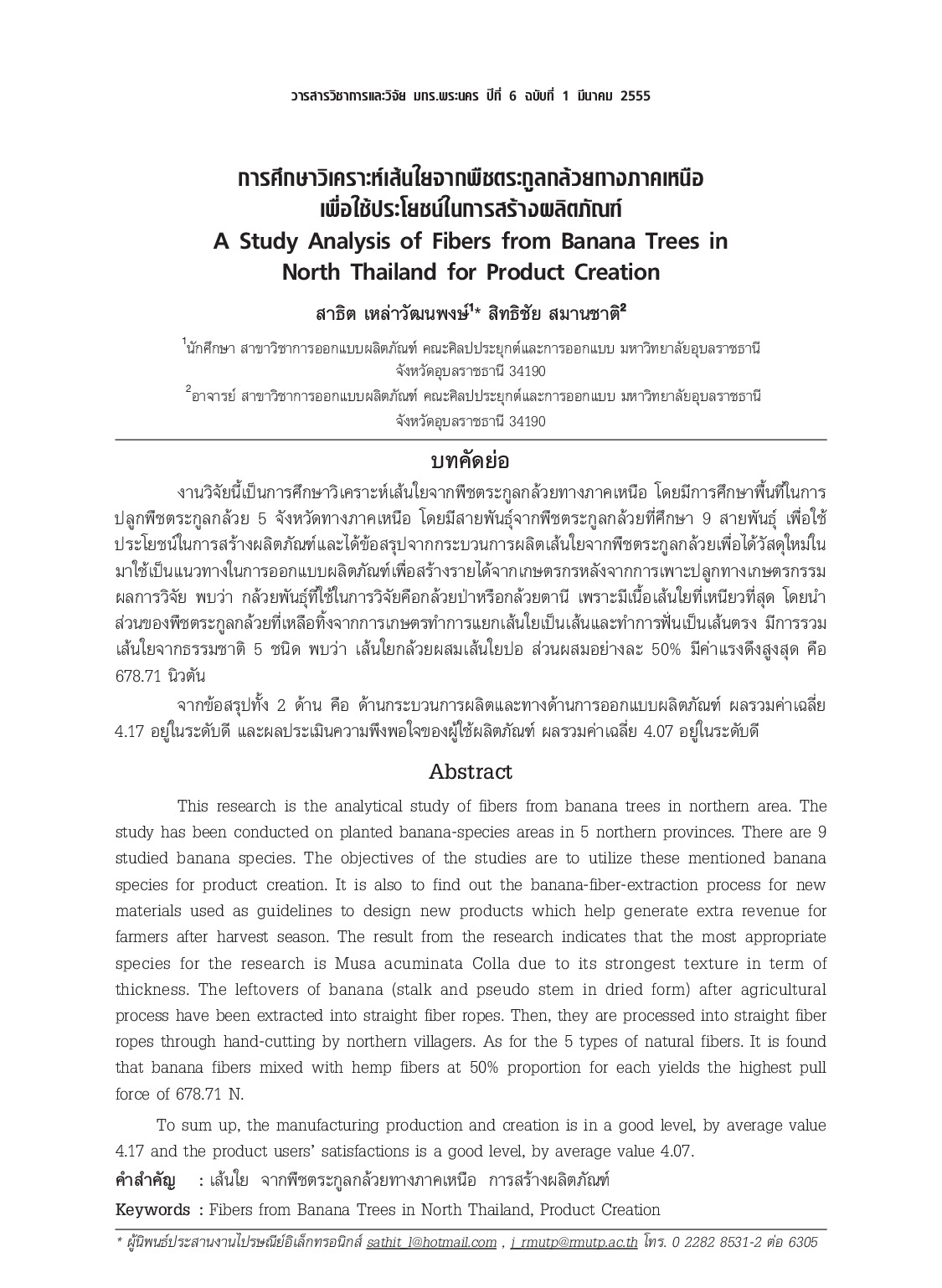
A Study Analysis of Fibers from Banana Trees in North Thailand for Product Creation
This research is the analytical study of fibers from banana trees in northern area. The study has been conducted on planted banana-species areas in 5 northern provinces. There are 9 studied banana species. The objectives of the studies are to utilize these mentioned banana species for product creation. It is also to find out the banana-fiber-extraction process for new materials used as guidelines to design new products which help generate extra revenue for farmers after harvest season. The result from the research indicates that the most appropriate species for the research is Musa acuminata Colla due to its strongest texture in term of thickness. The leftovers of banana (stalk and pseudo stem in dried form) after agricultural process have been extracted into straight fiber ropes. Then they are processed into straight fiber ropes through hand-cutting by northern villagers. As for the 5 types of natural fibers. It is found that banana fibers mixed with hemp fibers at 50% proportion for each yields the highest pull force of 678.71 N. To sum up the manufacturing production and creation is in a good level by average value 4.17 and the product users’ satisfactions is a good level by average value 4.07.