จำนวน Repository ( 207 )

Antimicrobial activity of endophytic fungi isolated from myrtaceae at kuankreng peatlands
The purpose of this research was to study antimicrobial activity of endophytic fungi isolated from Myrtaceae ( Melaleuca cajeputi Malaleuca leucadendra Syzygium cumini L. and Rhodomyrtus tomentasa (Ait.) Hassk.) at Kuankreng Peatlands. A total of 124 isolates of endophytic fungi were obtained from all plant types. Three week old fermentation broths of endophytic fungi were tested for antimicrobial activity against pathogenic microorganisms using the agar well diffusion method. Forty- six isolates (37.1%) inhibited at least 1 type of pathogen. Fermentation broth and cells of active endophytes were further extracted with organic solvents and tested for MIC using the microdilution broth method. The results show that 156 of the total of 174 crude extracts (89.6%) produced MIC ? 200 g/mL. The lowest MIC for S. aureus ATCC25923 MRSA SK1 P. aeruginosa ATCC27853 C. albicans ATCC90028C. neoformans ATCC90012 and M. gypseum were 128 200 200 64 200 16 and 200 g/mL respectively.
Evaluation of genetic variation of neolissochilus stracheyi wild populations in the nan river watershed using microsatellite dna markers
This study evaluated the genetic diversity of two natural populations of Neolissochilus stracheyi in Nan River watershed Amphoe Bokluea (BK) and Amphoe Mae Jarim (MJ). We analyzed microsatellite markers originally developed for Tor tambroides (Nguten et al. 2009). Three out of five microsatellite loci analyzed were polymorphic . Genetic variation within BK and MJ populations were not different. The number of allele per locus and allelic richness averaged over three loci was 2.33 and 2.67 for BK and MJ respectively. Observed heterozygosity value was 0.50 and 0.56 and the average expected heterozygosity was 0.41 and 0.53 for BK and MJ respectively. In addition the two populations were genetically distinct (P<0.05) and geographic isolation of two locations may explain this genetic pattern.
Preparation of polymer blends fiber between poly (lactic acid) and poly (butylene succinate) for textile applications
Biodegradable polymer blend fibers were prepared by melt spinning technique. Poly(lactic acid) (PLA) and poly(butylene succinate) (PBS) were blended in a twin screw extruder at various contents of PBS at 0-50 wt%. PLA/PBS blends were melt spun using a single screw extruder equipped with multifilaments spinnerette. The effect of PBS contents on morphology thermal properties and mechanical performance of PLA/PBS blend fiber was investigated. SEM micrographs indicated that the addition of PBS at 10 wt% showed miscibility of PLA/PBS blends while the other contents of PBS exhibited phase separation of the blends. The incorporation of PBS affected on the declination of crystallinity in the blends. It can be noted that the addition of PBS could enhance the elasticity of PLA/PBS blend fibers.
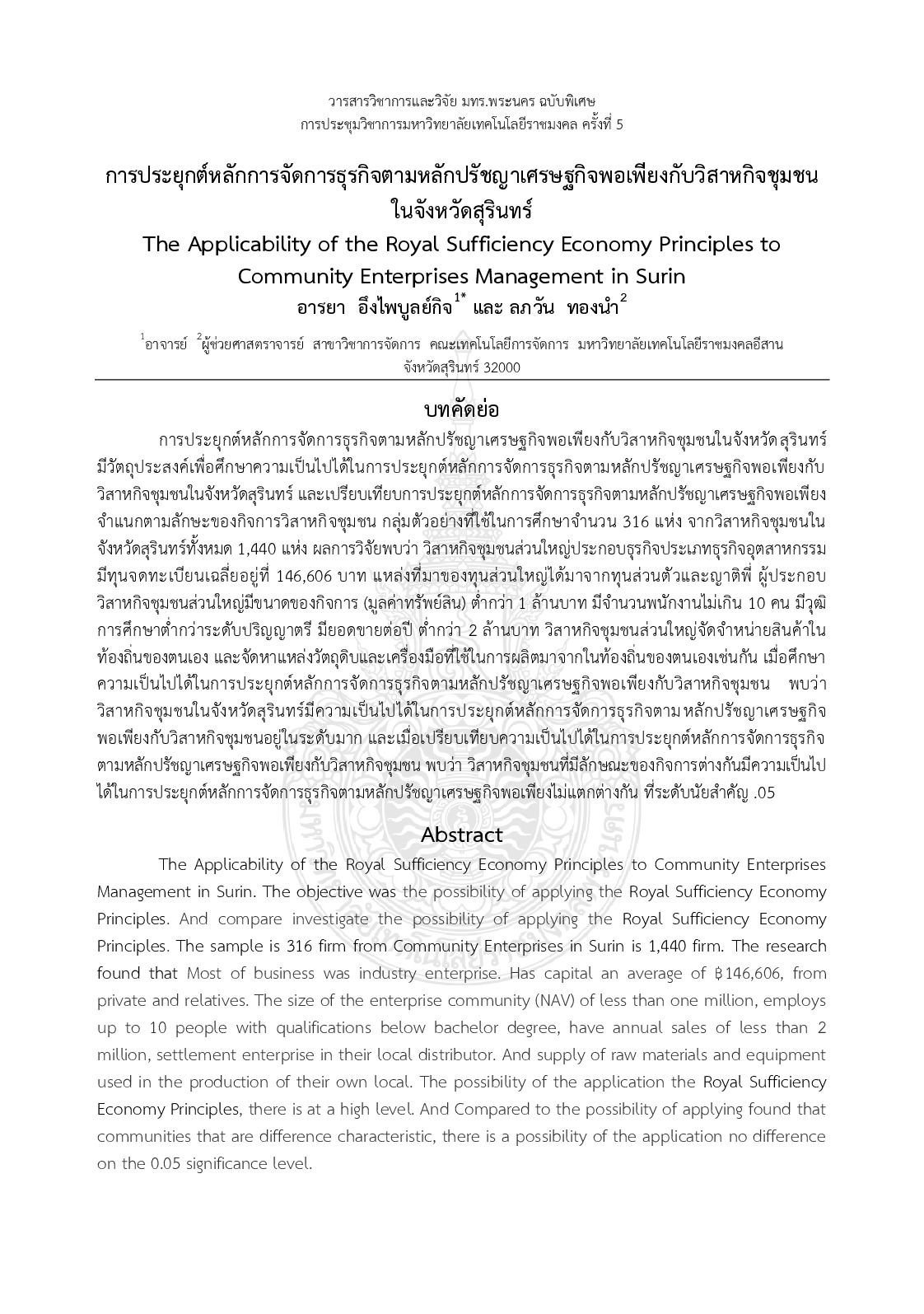
The applicability of the royal sufficiency economy principles to community enterprises management in Surin
The Applicability of the Royal Sufficiency Economy Principles to Community Enterprises Management in Surin. The objective was the possibility of applying the Royal Sufficiency Economy Principles. And compare investigate the possibility of applying the Royal Sufficiency Economy Principles. The sample is 316 firm from Community Enterprises in Surin is 1440 firm. The research found that Most of business was industry enterprise. Has capital an average of ฿146606 from private and relatives. The size of the enterprise community (NAV) of less than one million employs up to 10 people with qualifications below bachelor degree have annual sales of less than 2 million settlement enterprise in their local distributor. And supply of raw materials and equipment used in the production of their own local. The possibility of the application the Royal Sufficiency Economy Principles there is at a high level. And Compared to the possibility of applying found that communities that are difference characteristic there is a possibility of the application no difference on the 0.05 significance level.
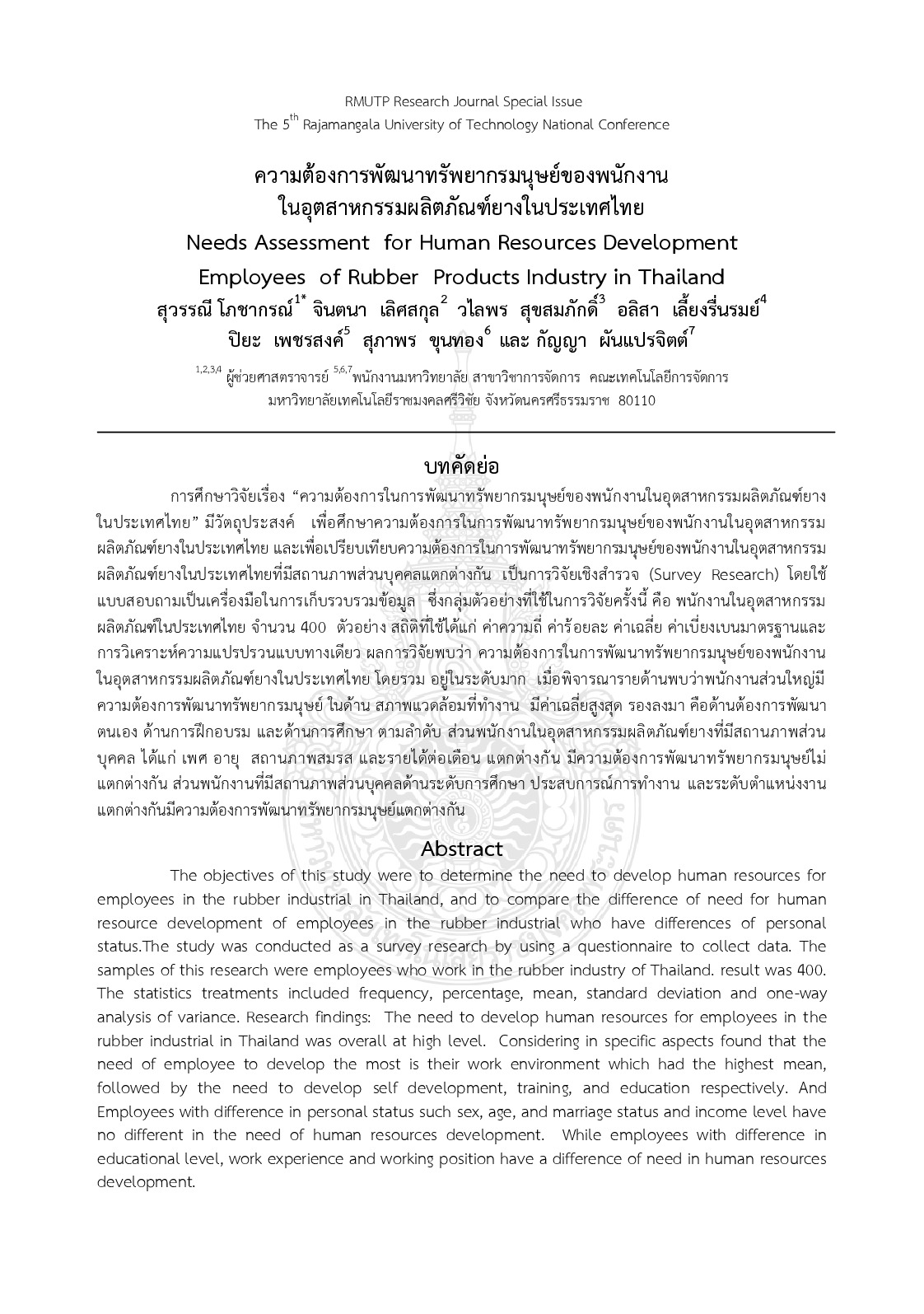
Needs assessment for human resources development employees of rubber products industry in thailand
The objectives of this study were to determine the need to develop human resources for employees in the rubber industrial in Thailand and to compare the difference of need for human resource development of employees in the rubber industrial who have differences of personal status.The study was conducted as a survey research by using a questionnaire to collect data. The samples of this research were employees who work in the rubber industry of Thailand. result was 400. The statistics treatments included frequency percentage mean standard deviation and one-way analysis of variance. Research findings: The need to develop human resources for employees in the rubber industrial in Thailand was overall at high level. Considering in specific aspects found that the need of employee to develop the most is their work environment which had the highest mean followed by the need to develop self development training and education respectively. And Employees with difference in personal status such sex age and marriage status and income level have no different in the need of human resources development. While employees with difference in educational level work experience and working position have a difference of need in human resources development.